Technical Guide
How Buyers Choose the Right Splice for Cost, Reliability, and Harness Throughput
A poorly selected splice can create overheating, branch-sleeve fit problems, and manual rework during production. This guide compares the main types of wire splicing used in wire harness production, explains where each method fits, and shows buyers what to send in an RFQ before approving a splice process.
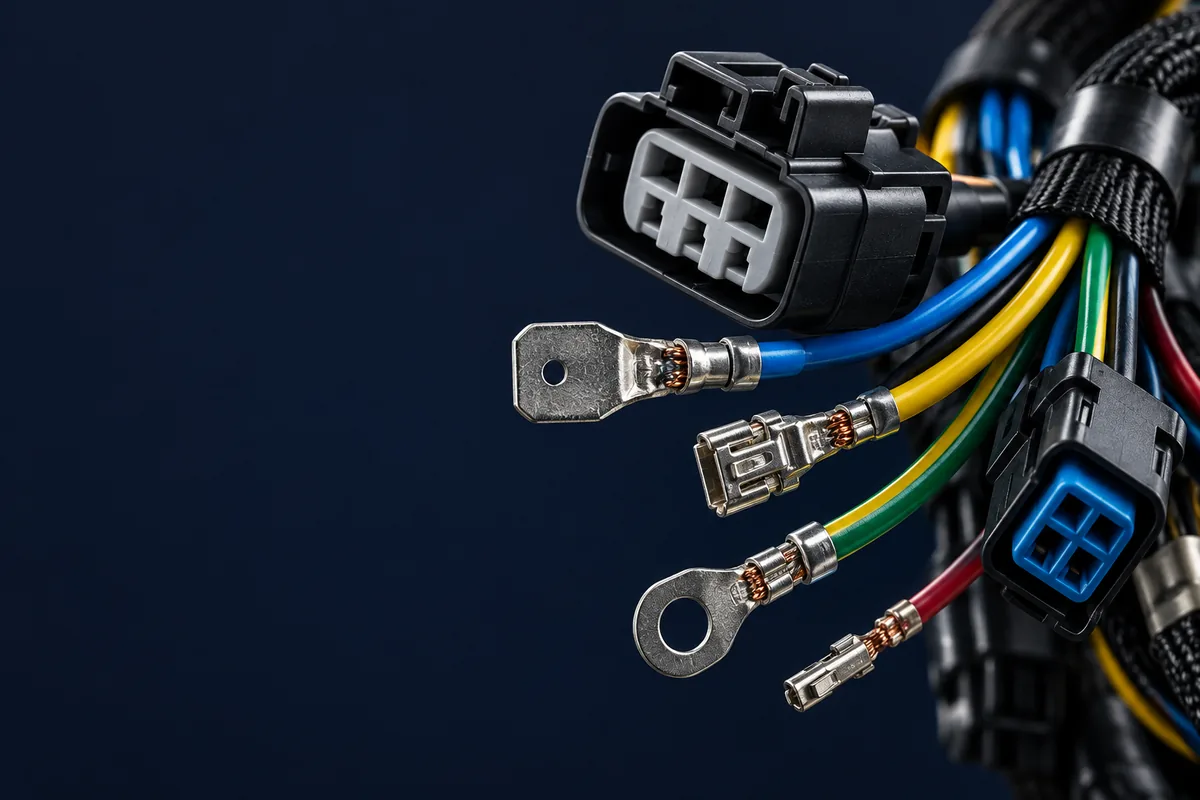
Wire harness production line where inline wire splicing methods are selected and verified before final wrapping and electrical test
A splice is not just a joint between conductors. It changes harness diameter, flex behavior, assembly labor, test scope, and long-term field reliability.
Splicing looks simple on a drawing. Two or more conductors are joined, insulation is restored, and the branch keeps moving. In production, splice choice is where many wire harness programs quietly lose money. The wrong method increases harness diameter, slows assembly, creates operator-sensitive workmanship, and adds test escapes that only appear after vibration, heat, or pull load reaches the field.
Buyers often discover the issue too late. The BOM says "splice" but does not define the process, acceptable splice body size, seal strategy, pull requirement, branch geometry, or class of workmanship. One supplier quotes a low-cost insulated butt splice, another assumes an ultrasonic compact splice, and a third plans a manual solder-and-shrink process. All three bids look comparable until sample approval, when size, reliability, and throughput diverge.
This guide is written for OEM buyers, sourcing teams, quality engineers, and program managers buying custom wire harnesses or cable assemblies. It focuses on the splice methods that matter in real procurement decisions, not hobby wiring. You will see where butt crimps, open-barrel splices, ultrasonic splicing, solder sleeves, lap splices, and IDC methods fit, what standards and tests usually apply, and what information you should send before a supplier locks the manufacturing process.
1. Why the Wrong Splice Creates Real Cost
A splice affects more than electrical continuity. It changes harness packaging, local stiffness, abrasion points, branch breakout shape, repairability, tooling needs, and takt time. When sourcing teams compare only piece price, they miss the downstream costs that show up in pilot builds, PPAP, service loops, and field returns.
The first hidden cost is package size. A standard insulated butt splice may be electrically acceptable, but its body can become the largest point in a branch. That can block sleeve insertion, overmold fit, or routing through clips and grommets. The second hidden cost is process repeatability. A manual solder splice may work in engineering samples, but production variation in strip length, solder wicking, and heat-shrink recovery can create unstable output when volumes scale.
The third hidden cost is inspection and documentation. Once a splice is placed inside a branch wrap, sealed cavity, or molded breakout, visual access drops sharply. That pushes buyers toward controlled methods with validated tooling, clear setup windows, and defined test records. The same logic appears in our wire harness crimping guide, our wire harness quality testing guide, and our prototype cable assembly service page, where manufacturability decisions are locked before volume release.
Industry workmanship standards such as IPC-driven cable and harness criteria exist because splice quality directly affects system reliability. For buyers evaluating whether a splice process is modern enough for an OEM harness, it also helps to understand the production physics behind ultrasonic welding and the limits of conventional soldering in vibration-prone cable assemblies.
A splice that passes continuity can still fail the build if it is too bulky for braid, sleeve, conduit, clip paths, or overmold cavities.
For an illustrative volume comparison, a process that works for 20 prototypes may become a bottleneck at 2,000 units per week if it requires hand soldering or high operator judgment.
High-flex, high-vibration, or moisture-exposed harnesses punish the wrong splice body, wrong insulation recovery, or uncontrolled heat input.
If the drawing only says "splice," suppliers will quote different assumptions and first articles will not be apples-to-apples.
2. The Main Types of Wire Splicing Used in Harness Production
The following splice families provide a useful starting point for evaluating OEM harness programs. The exact terminal part number and insulation system still matter, but these families are enough to organize sourcing decisions and prevent the common mistake of treating every splice as interchangeable.
Butt crimp splices are a familiar option. They are widely available, fast to quote, and suitable for simple inline conductor joins when the body diameter is acceptable. Open-barrel parallel splices are common in automotive harnesses because they join multiple wires in a compact form factor and fit automated or semi-automated crimp processes. Ultrasonic splices compress and fuse stranded copper into a dense, low-profile node without adding a metal splice clip body, which makes them attractive in high-volume harnesses with strict package limits.
Solder sleeves and manual solder splices remain useful in selected industrial, service, or low-volume repair scenarios, but they demand tighter process discipline around heat input, wicking, insulation damage, and post-process sealing. Lap splices and Western-Union-style variants appear more in repair and field rework than in modern OEM volume manufacturing. IDC splices are effective when the design specifically supports insulation displacement, but they should not be treated as a universal replacement for crimped or ultrasonic joints.
If your program includes branch joints, diameter constraints, or high conductor counts, do not evaluate the splice in isolation. Pair it with routing, shielding, tape wrap, and downstream test strategy. Our wire harness design guide and wire harness RFQ checklist explain how those inputs should be frozen before a supplier releases tooling and work instructions.
Table
| Splice Type | Best Fit | Main Advantage | Main Limitation | Typical Buyer Watchout |
|---|---|---|---|---|
| Butt crimp splice | Simple inline wire-to-wire joins | Low cost and fast setup | Bulky body in tight branches | Confirm barrel size, insulation OD range, and post-splice diameter |
| Open-barrel parallel splice | Automotive branch joins and multi-wire joins | Compact and production-friendly | Needs exact tooling and conductor-range matching | Define wire count, strand class, and insulation support method |
| Ultrasonic splice | High-volume compact harnesses | Very low profile and good conductivity | Higher capital cost and process validation burden | Check conductor-material compatibility, cross-section window, and nugget size controls |
| Solder sleeve splice | Sealed low-volume specialty or repair work | Integrated solder and heat-shrink concept | Heat sensitivity and slower throughput | Verify temperature exposure, shrink recovery, and workmanship criteria |
| Manual solder splice | Repair benches and legacy drawings | Flexible for one-off rework | Operator-dependent and poor for scalable output | Ask why a production harness is not using a more controlled crimp or ultrasonic method |
| IDC splice | Specific low-current or signal applications | Fast termination without stripping | Design-specific and not universal | Match conductor type, insulation thickness, and current load exactly |
Note: Physical compactness is often the decision-maker. In dense automotive, robotics, and industrial harnesses, the splice that fits cleanly through branch protection frequently wins over the splice that merely costs a few cents less.
3. How Buyers Match Splice Method to Application
The right splice depends on five variables first: conductor count, package space, current load, mechanical environment, and production volume. Once those are known, the shortlist gets much smaller. Buyers should resist vendor language like "general-purpose splice" and instead compare each option against measurable program constraints.
For example, a low-volume service harness may accept a solder sleeve because field repairability matters more than takt time. A high-volume automotive branch harness with multiple 0.35 mm² to 1.0 mm² wires typically pushes toward open-barrel or ultrasonic splicing because compactness and repeatability dominate. A heavy-gauge battery lead splice will have very different heat generation, pull-force, and tool requirements than a signal-level shield drain wire join.
When cost discussions begin, total installed cost is the right metric. That includes splice component price, tooling amortization, operator training, electrical test coverage, reject rate, branch packaging impact, and service risk. Buyers who only compare the component line item can miss significant costs in medium- and high-volume work.
Table
| Application Condition | Preferred Splice Direction | Why It Usually Wins | What to Validate |
|---|---|---|---|
| Tight branch package under tape or sleeve | Open-barrel or ultrasonic | Lower profile and better branch shape control | Final branch diameter and insulation support |
| Very high annual volume with stable design | Ultrasonic or automated open-barrel | Better repeatability and lower labor per unit | Capital recovery, process capability, and maintenance plan |
| Low-volume prototype or repair | Butt crimp or controlled solder sleeve | Fast implementation with lower setup burden | Operator work instructions and post-splice sealing |
| High vibration equipment | Validated crimp or ultrasonic | Lower risk than uncontrolled hand soldering | Strain relief, flex point placement, and pull test criteria |
| Moisture-exposed harness | Sealed crimp system or validated sleeve solution | Better environmental recovery when specified correctly | Ingress protection method and aging test |
| Signal-only low-current branch | IDC or compact crimp method where design permits | Fast assembly and low package demand | Insulation thickness, contact stability, and continuity under flex |
- Use them when the joint is simple, accessible, and not constrained by branch diameter.
- They are often the fastest path for prototypes, low-volume industrial harnesses, and controlled service builds.
- They become a poor choice when multiple wires converge or when downstream sleeving and routing are tight.
- Use it when copper conductors, compact package goals, and repeated high-volume output justify the capital cost.
- The method is attractive when buyers need a dense splice node with low added mass and stable electrical performance.
- It requires stronger process validation, maintenance discipline, and cross-section control than a generic bench crimp.
- Solder is not automatically wrong, but it is frequently overused in prototype-minded organizations.
- If the harness is intended for repetitive production, vibration, or automotive-style branching, ask why the design is not moving to a more controlled crimped or ultrasonic option.
- If solder remains necessary, define heat-shrink recovery, exposed conductor limits, and acceptance criteria explicitly.
Checklist
Five Inputs Buyers Should Freeze Before Supplier Quote Approval
- Exact wire sizes, strand class, and conductor count entering the splice
- Maximum allowed post-splice diameter after insulation recovery or wrapping
- Environmental exposure: vibration, temperature, moisture, chemicals, and flexing
- Annual volume and peak weekly throughput target
- Required verification: continuity, resistance, pull force, microsection, or visual criteria
4. Process Controls, Failure Modes, and Inspection
Once the splice family is selected, control of the process matters more than the catalog photo. Buyers should ask how the supplier validates strip length, conductor insertion, barrel compression, ultrasonic energy settings, insulation recovery, and post-splice test coverage. A supplier that cannot explain those controls in concrete terms will usually struggle in volume production.
Common splice failures are predictable. Crimped splices fail from wrong conductor range, incomplete insertion, damaged strands, wrong applicator setup, or poor insulation support. Ultrasonic splices fail from unstable energy settings, dirty conductor surfaces, incorrect cross-section stacking, or missing destructive validation during setup changes. Soldered methods fail from excessive wicking, cold joints, insulation shrink-back, voiding, and inconsistent heat application.
Inspection should be matched to the process. Visual inspection alone is not enough for many programs. Buyers may need continuity, low-resistance checks, pull-force sampling, dimensional checks on splice body size, cross-section analysis, or environmental testing for representative samples. The correct combination depends on the harness risk level and end-use environment, but every supplier should at least connect the splice method to a documented verification plan.
Table
| Splice Process | Typical Failure Mode | Production Cause | Useful Verification |
|---|---|---|---|
| Butt crimp | High resistance or pull failure | Wrong barrel range or incomplete wire insertion | Continuity, resistance, pull-force sample, visual barrel check |
| Open-barrel splice | Strand damage or insulation miss-position | Incorrect applicator setup or conductor mismatch | Microscope visual, crimp height where applicable, pull sample |
| Ultrasonic splice | Weak nugget or inconsistent conductivity | Energy drift, stack variation, dirty copper | Resistance trend, destructive validation, nugget dimension review |
| Solder sleeve | Incomplete wetting or insulation damage | Poor heat control or wrong recovery profile | Visual inspection, continuity, sample thermal aging |
| Manual solder | Wicking and flex-point embrittlement | Excess solder or uncontrolled dwell time | Visual inspection, bend review, continuity, sample vibration |
| IDC splice | Intermittent contact | Wrong insulation thickness or conductor mismatch | Continuity under movement, insertion check, dimensional review |
Note: For production harnesses, a splice process should be described as a controlled manufacturing operation, not just as a purchased component.
Checklist
- Documented work instruction with strip length and conductor positioning
- Approved tool or machine setup record
- Defined inspection frequency and sample size
- Electrical test after splice completion
- Escalation plan for any splice outside dimensional or resistance limits
- Change-control rule when wire spec, strand count, or insulation changes
5. RFQ and Incoming Inspection Checklist
Most splice disputes start before production. The buyer assumes the supplier understands the design intent, while the supplier fills in missing details with whatever process looks fastest or cheapest to quote. That is preventable if the RFQ package defines the splice as clearly as any connector or terminal.
At minimum, send the harness drawing or splice table, BOM, wire specifications, expected quantity, environment, and test target. If package space is critical, include the maximum allowed splice diameter or a 3D space claim. If the design is not frozen, say so directly and ask the supplier to quote options with tradeoffs rather than assuming a single process.
Incoming inspection should also be tailored to splice risk. For prototypes, first-article photos and electrical test results may be enough. For repeat production, buyers should request process confirmation, sample splice dimensions, and representative validation evidence before full release. That is especially important when the supplier proposes changing from solder to crimp or from crimp to ultrasonic for cost or throughput reasons.
Checklist
What to Send with the RFQ
- Drawing, splice table, BOM, or a marked sample showing every splice location
- Wire size, strand construction, insulation type, and conductor count per splice
- Expected annual volume, pilot lot quantity, and target lead time
- Environmental conditions: vibration, bend, temperature, moisture, and chemicals
- Compliance target such as IPC workmanship class, automotive customer spec, or internal validation plan
- Maximum allowed splice diameter or branch packaging constraints if space is limited
What to Request Back from the Supplier
- Recommended splice method with a short reason for the choice
- Quoted cost and tooling impact by splice option
- Expected cycle time or throughput effect if the process changes
- Inspection and test proposal including continuity and any destructive validation
- Photos or samples of comparable splice constructions already in production
6. Frequently Asked Questions
Frequently Asked Questions
What is the most common wire splice type in production wire harnesses?
For general production harnesses, crimp-based splices are widely used because they balance cost, speed, and repeatability. In automotive branch harnesses, open-barrel parallel splices are especially common, while high-volume compact harnesses may shift to ultrasonic splicing when package size and cycle time justify the equipment.
Is ultrasonic wire splicing better than crimp splicing?
Not universally. Ultrasonic splicing is often better when you need a compact copper-to-copper joint, low profile, and stable high-volume output. Crimp splicing is often better when the design needs lower setup cost, simpler servicing, or broader material flexibility. Buyers should compare package size, annual volume, and validation burden rather than assuming one method is always superior.
When should buyers avoid manual solder splices in a wire harness?
Buyers should challenge manual solder splices when the harness will see vibration, repeated flexing, or medium- to high-volume production. Solder can still fit repair, industrial maintenance, and low-volume specialty work, but uncontrolled wicking and variable heat input make it a poor default for scalable OEM harness production.
How do I specify a splice correctly in an RFQ?
Send the drawing or splice table, conductor sizes, strand class, insulation type, wire count per splice, target quantity, environment, compliance target, and any maximum allowed splice diameter. If the splice method is not fixed, ask the supplier to return two or three process options with cost, lead-time, and package tradeoffs.
What tests should a supplier run on wire splices?
Define electrical continuity coverage and acceptance criteria in the production test plan. Depending on risk, buyers may also require low-resistance checks, pull-force samples, dimensional checks, destructive validation, thermal aging, or vibration testing. The correct mix depends on the end-use environment and whether the splice is accessible after wrapping or sealing.
Can one splice type be used for every wire gauge and application?
No. The splice must match conductor cross-section, strand construction, insulation thickness, current load, and package space. A method that works for 22 AWG signal wires may be completely wrong for 8 AWG battery leads, and a bulky splice that is acceptable in an open industrial cabinet may fail immediately in a tight automotive branch.
Frequently Asked Questions
What is the most common wire splice type in production wire harnesses?
For general production harnesses, crimp-based splices are widely used because they balance cost, speed, and repeatability. In automotive branch harnesses, open-barrel parallel splices are especially common, while high-volume compact harnesses may shift to ultrasonic splicing when package size and cycle time justify the equipment.
Is ultrasonic wire splicing better than crimp splicing?
Not universally. Ultrasonic splicing is often better when you need a compact copper-to-copper joint, low profile, and stable high-volume output. Crimp splicing is often better when the design needs lower setup cost, simpler servicing, or broader material flexibility. Buyers should compare package size, annual volume, and validation burden rather than assuming one method is always superior.
When should buyers avoid manual solder splices in a wire harness?
Buyers should challenge manual solder splices when the harness will see vibration, repeated flexing, or medium- to high-volume production. Solder can still fit repair, industrial maintenance, and low-volume specialty work, but uncontrolled wicking and variable heat input make it a poor default for scalable OEM harness production.
How do I specify a splice correctly in an RFQ?
Send the drawing or splice table, conductor sizes, strand class, insulation type, wire count per splice, target quantity, environment, compliance target, and any maximum allowed splice diameter. If the splice method is not fixed, ask the supplier to return two or three process options with cost, lead-time, and package tradeoffs.
What tests should a supplier run on wire splices?
Define electrical continuity coverage and acceptance criteria in the production test plan. Depending on risk, buyers may also require low-resistance checks, pull-force samples, dimensional checks, destructive validation, thermal aging, or vibration testing. The correct mix depends on the end-use environment and whether the splice is accessible after wrapping or sealing.
Can one splice type be used for every wire gauge and application?
No. The splice must match conductor cross-section, strand construction, insulation thickness, current load, and package space. A method that works for 22 AWG signal wires may be completely wrong for 8 AWG battery leads, and a bulky splice that is acceptable in an open industrial cabinet may fail immediately in a tight automotive branch.
External Resources
- IPC overview and standards context
- Ultrasonic welding process background
- Soldering process fundamentals
Cta
Title: Need Help Choosing the Right Splice for Your Harness?
Send your drawing, BOM, target quantity, operating environment, target lead time, and compliance goal. We will review the splice locations, flag package or reliability risks, and recommend the best-fit manufacturing method before quote release.
Primarybutton: Request a Splice Review
Secondarybutton: Talk to Engineering
Badges
- Splice method review before pricing
- Package-risk feedback for branch layouts
- Test and documentation recommendations
Rfqtitle: Send This With Your RFQ
Rfqitems
- Drawing, BOM, or sample showing each splice location and wire sizes
- Forecast quantity, pilot lot size, and target lead time
- Environment: vibration, temperature, moisture, and flex conditions
- Compliance target such as IPC class, customer spec, or validation plan
- Any splice diameter, sleeve, or overmold space limits
Deliverablestitle: What You Get Back
Deliverablesitems
- Recommended splice method for each critical joint
- Quoted cost, tooling impact, and realistic lead time
- Suggested test scope and inspection checkpoints
- DFM notes on branch packaging and reliability risks