Technical Guide
When a Mismatched Connector Delays Launch
AC, DC, Circular, and High-Current Options Buyers Should Compare Before Ordering
A build that looked fine on paper can still miss launch when the rack PDU needs IEC 60320 C19, the field harness needs an IP67 circular connector, and the battery branch was quoted with a housing that cannot safely carry the required continuous current. This guide compares the main types of power connectors used in cable assemblies, explains where each family fits, and shows buyers what to send before requesting samples or pricing.
connector families show up most often in sourcing reviews: IEC, NEMA, barrel, circular, board, and high-current battery/distribution
is a common mismatch zone where housing size, temperature rise, and wire gauge start to invalidate catalog assumptions
is usually the minimum sealing target once power leaves a protected enclosure and enters outdoor or washdown duty
is a realistic turnaround for a good supplier to flag rating, keying, and sourcing risks before quoting
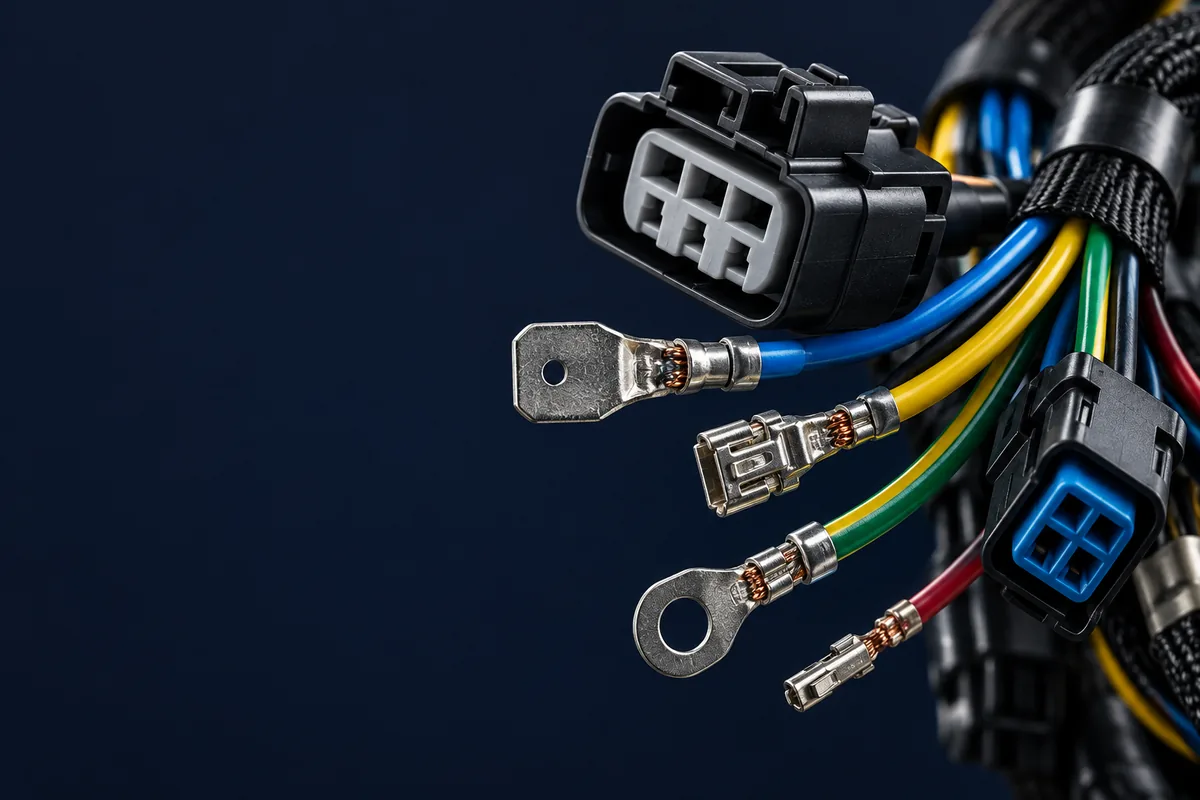
Industrial power cable assembly with heavy-duty power connector interfaces used for current, sealing, and production-fit evaluation
Power connector selection is not only about mating shape. Current rating, conductor size, temperature rise, sealing level, keying, and sourcing continuity determine whether the finished cable assembly passes build, validation, and field service.
Power connector mistakes rarely fail at the first design review. They fail later, when the cable assembly reaches pilot build and the catalog part that looked acceptable cannot carry the real load, does not fit the enclosure cutout, or forces the harness team into a manual assembly process that was never priced. That is how a straightforward procurement line item turns into expedited samples, delayed first-article approval, and avoidable field rework.
Buyers usually see the same pattern: engineering writes a generic note such as "power connector both ends," the RFQ goes out without the exact mating interface or current profile, and suppliers quote different assumptions. One supplier prices an IEC inlet cordset, another assumes an Anderson-style DC power pair, and a third offers a circular connector that is mechanically robust but too expensive for the actual service life. All three quotes look plausible until production tries to build and test the first batch.
This guide is written for B2B buyers, sourcing engineers, and program managers buying custom power cable assemblies for industrial automation, data infrastructure, medical equipment, robotics, energy storage, and transportation programs. It explains the main types of power connectors that matter in procurement, where each family fits, what ratings really drive risk, and what to send next if you want an RFQ back with usable cost, lead-time, and compliance information.
1. Why the Wrong Power Connector Becomes a Cost Problem Fast
The first mistake is treating "power connector" as if it were a single interchangeable category. In real assemblies, the connector type drives conductor size, strip length, crimp tooling, torque or solder process, panel hardware, sealing method, incoming inspection steps, and final electrical test. A mismatched connector can make a cable technically functional in the lab while still failing the installation, service, or compliance expectations that actually matter in production.
The cost impact appears in three places. First, wrong assumptions create quote spread because suppliers are pricing different connector families and different assembly labor. Second, pilot builds slow down when housing cavity sizes, backshell clearance, or wire gauge ranges do not match the released drawing. Third, field replacements become expensive if the connector chosen for convenience cannot survive the mating cycles, vibration, or ingress exposure in the real application. Our power cable assembly guide and wire harness connector selection guide show how these connector decisions cascade into broader cable-system risk.
This is also why good suppliers ask questions that seem detailed before they quote. They need to understand whether the job is mains AC power distribution, low-voltage DC device power, battery interconnect, circular field I/O power, or board-level internal distribution. The answer changes the applicable standards, test plan, and sourcing strategy. References such as the IEC 60320 connector family and the NEMA connector system are useful because they remind teams that plug shape alone does not define electrical suitability.
AC mains connectors, SELV DC connectors, and high-current battery connectors are not interchangeable risk classes. Voltage, current, creepage, and safety expectations differ immediately.
A connector that carries the current may still fail the job if the panel cutout, keying, latching force, or mating clearance is wrong for the enclosure or service workflow.
Screw terminals, solder cups, IDC, press-fit board headers, and stamped crimp contacts create very different labor content and process controls.
Some families are globally stocked and multi-sourced; others carry long lead times, counterfeit risk, or limited regional availability that can destabilize a launch.
Quote
Text: When a buyer sends only "power connector" on the RFQ, we usually need 8 follow-up inputs before the quote is real: AC or DC, voltage, continuous current, inrush profile, wire gauge, mating cycles, ingress target, and the exact mating part or standard family. Missing even 2 of those 8 is enough to move cost and lead time materially.
Author: Hommer Zhao
Role: Founder & General Manager
2. The Main Types of Power Connectors Buyers Should Separate
Most teams do not need an encyclopedia of every connector series on the market. They do need a clean decision tree that separates the connector families most likely to change cost, compliance, and build method. The highest-value split is by power architecture first: AC mains, low-voltage DC device power, circular sealed field power, board-to-wire internal power, and high-current battery or distribution connectors.
For example, rack equipment and laboratory gear often use IEC 60320 inlets and cord connectors because interchangeability and global appliance practice matter. Portable electronics and small devices still use barrel or locking DC connectors where current is modest and simplicity wins. Industrial machines frequently move to circular M-series or similar sealed interfaces because vibration resistance, keyed mating, and ingress protection matter more than low piece price. Battery systems and power-distribution assemblies use purpose-built high-current connector families where contact resistance, temperature rise, finger safety, and polarization have to stay controlled at much higher load.
If your program crosses multiple environments, do not let one familiar connector family dominate the whole design by habit. A data cabinet, field-mounted actuator, and service battery pack can all be on the same BOM while needing different connector logic. For adjacent applications, our battery cable assembly page, M12 cable assembly page, and industrial automation industry page show how environment and service conditions change the right answer.
Table
| Connector Type | Typical Power Range | Common Use Case | Main Strength | Primary Buying Risk |
|---|---|---|---|---|
| IEC 60320 / appliance power | 250 VAC, typically 2.5 A to 20 A depending on pattern | IT equipment, test gear, medical and office devices | Recognizable global standard and easy field replacement | Quoting the wrong inlet/cordset pattern such as C13 vs C19 or ignoring regional plug requirements |
| NEMA / regional mains power | 125 VAC to 250 VAC, current by configuration | North American industrial and commercial equipment | Clear regional geometry and branch-circuit familiarity | Specifying plug shape without cord gauge, jacket rating, or listing requirement |
| Barrel and locking DC | Low-voltage DC, usually sub-10 A to low teens | Adapters, compact devices, embedded products | Low cost and simple integration | Center-pin size mismatch, polarity confusion, or inadequate retention for vibration |
| Circular sealed power connectors | Low-voltage to medium-power device feeds | Sensors, actuators, mobile equipment, washdown machinery | Keying, IP sealing, and reliable mating in harsh environments | Assuming all circular connectors with the same shell size share the same coding or current capacity |
| Board-to-wire power connectors | Internal chassis distribution from a few amps to tens of amps | Power supplies, control boards, industrial electronics | Compact packaging with controlled mating interface | Ignoring board header temperature rise, PCB copper limitations, or insertion-cycle limits |
| High-current battery / distribution connectors | Tens to hundreds of amps | UPS, ESS, EV auxiliary systems, chargers, mobile equipment | Low-resistance contacts, polarization, and safer high-load handling | Underspecifying cable gauge, derating, or touch-safe and finger-proof requirements |
Note: A connector that mates is not necessarily a connector that qualifies. Current rating, temperature rise, creepage, sealing, keying, and approval path still have to match the actual build.
Quote
Text: Around 70% of preventable power-connector issues we see are not exotic engineering failures. They are classification mistakes: AC vs DC confusion, field connector vs indoor equipment connector confusion, or buying a 30 A housing for a branch that spends long duty cycles above 24 A in a warm enclosure.
Author: Hommer Zhao
Role: Founder & General Manager
3. How to Match Connector Type to Ratings, Environment, and Assembly Process
Once the family is chosen, buyers need to lock the parameters that actually decide whether the connector survives production and use. Continuous current is first. Catalog ratings are often measured under defined conductor size, ambient temperature, and duty assumptions. If your enclosure runs hot, your bundle density is high, or your duty cycle is sustained rather than intermittent, the practical current limit can be lower than the headline number. This matters especially on board-level power connectors and compact circular interfaces.
Voltage and safety class come next. SELV DC device power, mains AC input, and battery-distribution work are reviewed differently by quality and compliance teams. If the build needs finger-safe contacts, first-mate-last-break behavior, touch-proof housings, or a listed appliance coupler, say so in the RFQ rather than assuming the connector family automatically delivers it. Our EV high-voltage wire harness guide shows how quickly design rules tighten once voltage and safety exposure increase.
Environment then filters the short list. Indoor equipment can tolerate interfaces that would fail quickly on a factory floor, marine deck, or outdoor cabinet. If the cable sees coolant mist, washdown, UV, vibration, or repetitive mating during service, buyers should ask about sealing geometry, latch retention, plating system, and cycle life. Standards bodies such as the International Electrotechnical Commission and organizations referenced by UL matter here because the connector decision often sits inside a bigger compliance path, not just a mechanical drawing.
Assembly process is the last filter buyers forget. Some connectors are ideal electrically but expensive to build because they require manual tinning, torque verification, or difficult rear-shell assembly. Others are efficient in volume because they use stable stamped-and-formed crimp contacts and mature applicators. When comparing quotes, ask whether the connector is assembled with documented crimp tooling, solder process control, torque instructions, and electrical test coverage. The cheapest connector body can become the highest total cost if it slows production or drives rework.
- Define nominal and maximum voltage, continuous current, inrush or surge behavior, and acceptable temperature rise.
- If duty exceeds 80% of the connector headline rating, ask the supplier to confirm wire gauge, ambient temperature, and derating assumptions.
- Confirm mating part number, shell size, coding/keying, latch style, panel thickness, and rear clearance.
- For service equipment, also state the minimum mating-cycle target and whether blind mating is expected.
- Specify IP target, vibration profile, chemical exposure, flammability expectations, and required approvals such as UL, CE, or customer-specific standards.
- If the connector is part of a regulated device, tell the supplier which approval path the assembly must support.
- State annual volume, prototype quantity, approved brands or alternates, and whether distributor stock or direct OEM sourcing is required.
- Ask for lead-time risk on housings, contacts, seals, backshells, and any special crimp tooling.
Checklist
Questions Buyers Should Resolve Before Approving a Connector Family
- What is the real continuous current at the highest ambient temperature, not just the nominal nameplate current?
- Does the connector need to be touch-safe, finger-safe, keyed, or lockable against accidental disconnect?
- Is the assembly field-serviceable, or should the supplier deliver a pre-terminated and tested harness only?
- Does the application need IP67, IP68, or only indoor contamination resistance?
- Are there approved brands, listed components, or compliance targets that limit acceptable substitutes?
- Will the mating interface be on a panel, on a PCB, or free cable-to-cable?
Quote
Text: The connector rating printed in the catalog is only the starting point. When we review a power-cable RFQ above about 20 A continuous, we immediately cross-check conductor size, enclosure temperature, duty cycle, and termination method. Those four variables explain most temperature-rise surprises before the first sample is built.
Author: Hommer Zhao
Role: Founder & General Manager
4. RFQ and Incoming Inspection Checklist
If you want comparable quotes, provide the connector context in a way that removes guesswork. The most useful package is a drawing or harness print, BOM, mating-part reference, quantity split by prototype and production, target lead time, environment summary, and compliance target. If no drawing exists yet, even a connector photo plus cable gauge, voltage, current, and enclosure notes is better than sending only a marketing description.
Incoming inspection should also reflect the connector type. Appliance and mains-power builds may need marking checks, cord-jacket verification, and polarity review. Circular sealed connectors need cavity, seal, and keying confirmation. High-current battery connectors deserve extra scrutiny on contact retention, torque or crimp quality, housing polarization, and temperature-rise expectations under load. The broader process logic aligns with the same discipline used in our wire harness quality testing guide and custom cable assembly process guide.
For procurement teams, the objective is simple: prevent the supplier from making a hidden assumption that later becomes your production problem. The RFQ should force agreement on connector family, mating part, performance target, and test scope before the PO is placed.
Table
| Checkpoint | What To Verify | Why It Matters | Typical Evidence |
|---|---|---|---|
| Mating interface | Exact part number, coding, gender, and orientation | Prevents mechanically compatible but wrong variants | Drawing, mating-part screenshot, first-article photos |
| Wire and contact match | Approved conductor size and termination range | Avoids overheating, weak crimps, and assembly scrap | BOM, crimp spec, supplier work instruction |
| Current and duty assumptions | Continuous load, peaks, inrush, ambient temperature | Stops catalog ratings from being misapplied | Load profile, electrical spec, derating note |
| Environmental requirement | IP rating, vibration, chemicals, UV, service cycles | Filters out indoor-only connector options early | Application note, test requirement, validation plan |
| Compliance target | UL, CE, RoHS, customer standard, labeling requirements | Aligns component approvals and documentation before build | RFQ notes, approved vendor list, declaration request |
| Supply-chain risk | Brand restriction, alternates, lead time, MOQ, tooling | Protects launch timing and future replenishment | Distributor stock check, sourcing plan, quote clarifications |
Checklist
What To Send With the RFQ
- Drawing, BOM, or a clear sample reference with photos of both mating sides
- Voltage, continuous current, peak current, and expected duty cycle
- Wire gauge, cable jacket requirement, and any bend-radius constraints
- Environment details: indoor, outdoor, washdown, vibration, UV, or chemical exposure
- Target lead time, prototype quantity, and annual production volume
- Compliance target such as UL, CE, RoHS, IPC/WHMA-A-620 process control, or customer-specific approval
What Buyers Should Ask Back From the Supplier
- Confirmed connector family and exact mating-part interpretation
- Recommended conductor size and any rating derating notes
- Electrical test scope: continuity, polarity, hipot, insulation resistance, or load test
- Material availability and realistic component lead time
- First-article photos or sample approval checkpoints before release to volume
5. Frequently Asked Questions
The questions below are the ones procurement and engineering teams ask most often when narrowing power connector options for a real production program.
Frequently Asked Questions
What are the main types of power connectors used in cable assemblies?
In B2B cable-assembly work, the main categories are IEC 60320 appliance connectors, NEMA mains connectors, barrel or locking DC connectors, circular sealed power connectors such as M-series variants, board-to-wire power connectors, and high-current battery/distribution connectors. The correct choice depends on voltage class, current, mating cycles, and environment, not just connector shape.
How do I choose between AC and DC power connector types?
Start with the electrical architecture. AC mains connectors must match regional standards, insulation, and approval needs at 125 VAC, 230 VAC, or higher, while DC connectors are usually selected around voltage drop, polarity control, inrush, and sustained current. Once loads move above roughly 20 A continuous, contact resistance and temperature rise deserve explicit review rather than catalog-only selection.
Are circular power connectors better than IEC or NEMA connectors?
Not universally. Circular connectors are often better for IP67 sealing, vibration resistance, and compact field equipment, while IEC 60320 and NEMA families are usually better where standardized appliance or regional mains interfaces matter. A circular connector can outperform an appliance connector outdoors, but it may add unnecessary cost and mating complexity inside a protected rack.
What current margin should buyers use when selecting a power connector?
There is no single universal margin, but many teams start investigating derating once the normal duty cycle exceeds about 80% of the published connector current rating or when ambient temperature rises above the test assumptions. Good practice is to review wire gauge, contact system, enclosure temperature, and duty profile together instead of applying a one-number rule blindly.
Do I need UL or other approvals for a custom power cable assembly?
If the assembly connects to regulated equipment or enters markets where listing and compliance evidence matter, you should define that before quoting. Depending on the product, buyers may need listed or recognized components, RoHS declarations, marking control, and documented electrical tests such as continuity, polarity, hipot, or insulation resistance. Approval requirements vary by market and end product, so the RFQ should name the target explicitly.
What should I send a supplier to quote the right power connector assembly the first time?
Send the drawing or BOM, quantity split, target lead time, operating environment, compliance target, voltage and current profile, and the exact mating part if you already have one. At minimum, give the supplier the connector family, wire gauge range, and application context. Without those basics, a quote can still be fast, but it will be based on assumptions rather than controlled scope.
Frequently Asked Questions
What are the main types of power connectors used in cable assemblies?
The main categories are IEC 60320 appliance connectors, NEMA mains connectors, barrel or locking DC connectors, circular sealed power connectors, board-to-wire power connectors, and high-current battery or distribution connectors.
How do I choose between AC and DC power connector types?
Choose first by electrical architecture, then by voltage, continuous current, inrush profile, environment, and compliance target. AC mains and DC power connectors carry different approval and safety expectations.
Are circular power connectors better than IEC or NEMA connectors?
Circular connectors are often better for harsh environments and sealed field applications, while IEC 60320 and NEMA families are usually better where standardized appliance or regional mains interfaces matter.
What current margin should buyers use when selecting a power connector?
Many teams review derating closely once normal duty exceeds about 80% of the connector headline rating or when ambient temperature materially exceeds the test conditions.
Do I need UL or other approvals for a custom power cable assembly?
If the assembly enters regulated equipment or a market that expects listing and compliance evidence, the RFQ should explicitly define the needed approvals, declarations, and electrical tests.
What should I send a supplier to quote the right power connector assembly the first time?
Send the drawing, BOM, quantity, environment, target lead time, compliance target, and the exact mating part if available so the supplier can quote controlled scope instead of assumptions.
External Standards and Reference Links
Cta
Title: Need a Power Connector Quote You Can Actually Use?
Send the connector drawing, mating-part reference, BOM, quantity, environment, target lead time, and compliance target. Our team will review the connector family, flag rating or sourcing gaps, and return a manufacturable quote with realistic lead time and recommended test scope.
Primarybutton: Send Power Connector RFQ
Secondarybutton: Talk to Engineering
Badges
- Connector-family check before pricing
- Rating and sourcing risks flagged early
- Prototype-to-production support
Rfqtitle: Send This With Your RFQ
Rfqitems
- Drawing, BOM, mating-part number, or sample photos
- Voltage, continuous current, peak current, and duty cycle
- Quantity forecast, target lead time, and prototype volume
- Environment details such as IP target, vibration, UV, or chemicals
- Compliance target such as UL, CE, RoHS, or customer-specific standard
Deliverablestitle: What You Get Back
Deliverablesitems
- Connector-family confirmation and DFM gap review
- Quoted unit cost, tooling notes, and realistic lead time
- Recommended electrical test scope and approval documentation path