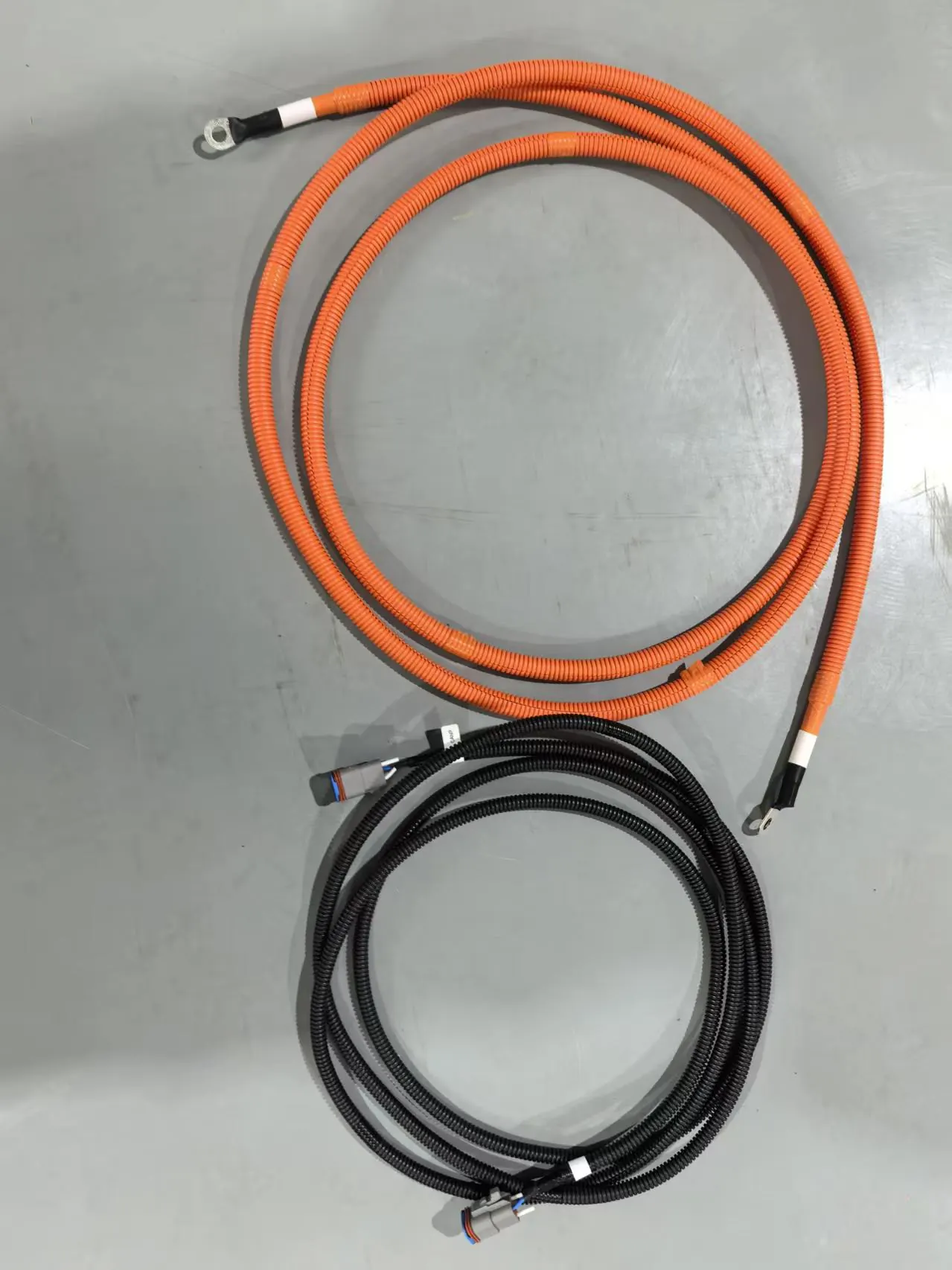
Custom EV ChargingHarnesses & EVSE Cable
EVSE wire harnesses and cable assemblies for Level 2 AC stations and DC fast-charge cabinets — charge-gun leads, liquid-cooled high-power DC cable and ISO 15118 comms wiring. Built to CCS, NACS, CHAdeMO and Type 2, up to 1000V DC and 500A+.
What makes an EV charging harness different
An EV charging harness is not ordinary power cable cut to length. A charge cable gets plugged, bent and dragged hundreds of times a year at the curbside, while carrying high current at 600–1000V DC and feeding back the control and communication signals that govern the charge. That demands a flexible TPU/TPE jacket that is oil-, UV- and abrasion-resistant, fine-stranded copper that survives the bend cycles, and a shielded comms pair built into the same assembly. For the highest-power DC fast chargers, the conductor itself is liquid-cooled high-voltage cable so a 350kW+ station can deliver 500A+ without overheating.
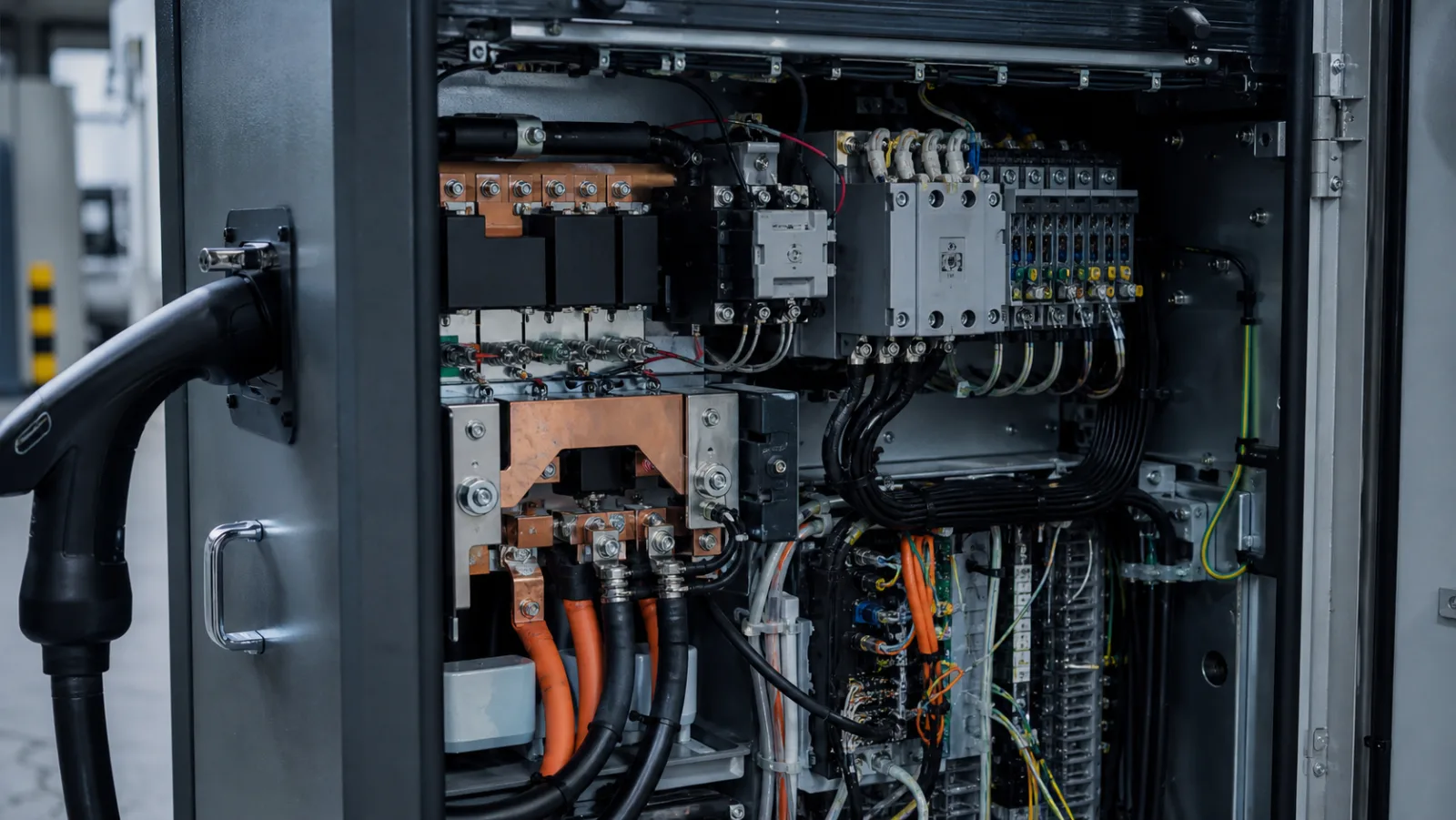
Across an EVSE the wiring changes job at every stage: the contactor, RCD and control board inside a Level 2 AC station; the DC power-module bus, AC mains input and charge-gun lead inside a DC fast-charge cabinet; the PLC-over-CP, CAN and ISO 15118 comms that run the logic; and the grid-side power and metering wiring back to the panel or energy-storage buffer. We build all of these as custom, pre-terminated and tested assemblies to CCS1/CCS2, NACS, CHAdeMO and Type 2, including commercial EV truck harnesses, EV HVAC adapter cables and IP67 waterproof assemblies for outdoor charging hardware.
EV charging applications we wire
Custom EVSE cable assemblies for every stage of an AC or DC charging station
AC Charging Stations (Level 2)
Internal power and control harnesses for Level 2 AC EVSE — wall boxes, pedestals and commercial AC posts. We wire the contactor, RCD/RCM, control board and the captive Type 2 / J1772 charge-cable assembly, with the CP/PP control-pilot signaling built to IEC 61851 and SAE J1772.
DC Fast-Charge Cabinets
High-current cabinet and dispenser harnesses for DC fast chargers and HPC cabinets — power-module DC bus, AC mains input, and the charge-gun lead. Liquid-cooled high-power DC cable carries 500A+ for 350kW+ stations while the conductor stays within temperature.
Communication & Control
Shielded comms and control harnesses for charger logic — PLC over the CP line, CAN between power modules and the controller, and the ISO 15118 high-level communication that enables Plug & Charge and smart-charging.
Cabinet & Grid-Side Power Wiring
AC input, metering and grid-side power wiring connecting the charger to the panel, transformer or energy-storage buffer. High-ampacity power assemblies and lug terminations for the cabinet busbar and breaker landings.
Built EVSE-grade, layer by layer
Conductors
Fine-stranded copper sized for ampacity and flex life — from heavy liquid-cooled DC conductors carrying 500A+ down to the shielded comms pair, each chosen for current, voltage drop and the bend cycles a charge cable sees daily.
Insulation
Dielectric rated for 600–1000V DC service with the spacing and wall thickness a high-power EVSE charge cable demands, plus a shielded twisted pair for the CP/PLC and CAN signaling so power and comms share one assembly without coupling noise.
Jacket
Flexible TPU/TPE charge-cable jacket that is oil-, UV- and abrasion-resistant for outdoor curbside duty, rated -40°C to +90°C, with a liquid-cooled high-power DC option for HPC cabinets that holds conductor temperature at 350kW+.
Connectors
Charge-gun and inlet assemblies built to CCS1, CCS2, NACS, CHAdeMO and Type 2 per IEC 62196 / SAE J1772, terminated, sealed to IP67 and electrically tested in-house — no field crimping on the dispenser.
EVSE-grade technical capabilities
High-power DC and AC construction built to CCS / NACS / IEC 61851, validated for 600–1000V DC, 500A+ liquid-cooled current and IP67 outdoor service.

Why choose our EV charging harness services
EVSE cable assemblies that pass inspection and survive years of daily plug cycles
EVSE-Grade Materials
TPU/TPE oil-, UV- and abrasion-resistant charge-cable jackets and fine-stranded flexible copper engineered for daily plug cycles and curbside abuse — not repurposed general-purpose wire.
Built to CCS / NACS / IEC 61851
Charge-gun assemblies and station harnesses manufactured to the connector and signaling standards your charger must meet — CCS1/CCS2, NACS, CHAdeMO and Type 2 per IEC 62196, with CP/PP control to IEC 61851 and SAE J1772.
High-Power DC Engineering
Liquid-cooled DC cable, 600–1000V dielectric design and 500A+ conductor sizing validated for 350kW+ HPC cabinets, alongside the ISO 15118 / PLC / CAN comms wiring that runs the charger.
100% Electrical Test
Built under our ISO 9001 quality system to IPC/WHMA-A-620 workmanship, with continuity, hi-pot and contact-resistance testing on every assembly before it ships.
EV charging standards we build to
Charge-gun assemblies and station harnesses manufactured to the connector and signaling standards your charger must meet, under our ISO 9001 quality system and IPC/WHMA-A-620 workmanship.
EV charging harness FAQ
Which charging connectors and standards do you build to?
We build charge-gun and inlet assemblies to CCS1, CCS2, NACS, CHAdeMO and Type 2, manufactured to IEC 62196 / SAE J1772 connector requirements with control-pilot (CP/PP) signaling per IEC 61851. For high-level communication we wire to ISO 15118 (PLC over the CP line) so the station supports Plug & Charge and smart-charging. These are standards we build to on your specification — your charger model and target market dictate the connector mix.
Can you supply liquid-cooled high-power DC charge cables?
Yes. For 350kW+ DC fast-charge and HPC cabinets we build liquid-cooled high-power DC charge-cable assemblies that carry 500A+ continuous while keeping the conductor within temperature. The construction uses fine-stranded flexible copper, a 600–1000V dielectric, and an oil/UV/abrasion-resistant TPU/TPE jacket rated -40°C to +90°C.
What voltage and current can your EV charging harnesses handle?
Our DC assemblies are built for systems up to 1000V DC, which covers modern 400V and 800V vehicle architectures and the cabinet DC bus. Air-cooled charge cables handle the AC and lower-current DC range, and liquid-cooled high-power cable extends continuous current past 500A for ultra-fast charging.
How do you wire the communication and control signals?
EVSE comms run over several buses, and we harness all of them: PLC over the control-pilot (CP) line for ISO 15118 high-level communication, CAN between the power modules and the charger controller, and the CP/PP signaling defined by IEC 61851. The comms pair is shielded and routed away from the DC power conductors to control EMI inside the cabinet.
Are these assemblies sealed for outdoor charging stations?
Yes. Charge cables and cabinet entries are sealed to IP67, and the TPU/TPE jacket is oil-, UV- and abrasion-resistant for curbside and outdoor duty across a -40°C to +90°C range. Sealed terminations keep moisture and contamination out of the charge-gun and the cabinet over years of daily plug cycles.
What quality system and workmanship standard do you build to?
Assemblies are manufactured under our ISO 9001 quality system and built to IPC/WHMA-A-620 cable-and-wire-harness workmanship criteria. Where a customer specifies a further standard (for example IEC 61851 for the station or a market-specific connector certification), we manufacture to that requirement — we do not claim certifications we do not hold.
Can you wire both the charge-gun lead and the cabinet internals?
Yes. We build the complete EVSE wiring scope: the captive charge-cable / charge-gun assembly, the DC power-module bus and AC mains input inside the cabinet, the shielded comms and control harnesses, and the grid-side power and metering wiring connecting the charger to the panel, transformer or energy-storage buffer.
What is your MOQ and lead time for EV charging programs?
We support prototypes from small quantities with 7–10 day sample lead times, scaling to production batches once a harness is validated on the real charger. Building a tested charge-cable and cabinet harness early lets you verify fit, thermal behavior and comms before committing to volume.
Ready for your EV charging harness project?
EVSE cable built to CCS / NACS / Type 2, liquid-cooled for high-power DC and 100% electrically tested, with 7–10 day samples. Talk to our EV charging specialists.
Related cable solutions
Custom cable assembly and harness services that pair with EV charging programs.
High-Voltage Cable
Orange-jacketed 400V/800V HV and liquid-cooled DC cable assemblies for chargers.
Explore →Commercial EV Truck Harness
Class 4-7 commercial EV harnesses across HV, LV and BMS scope.
Explore →EV HVAC Adapter Cable
Thermal-management harness adapters for EV battery cooling systems.
Explore →Anderson Power Connector Cable
High-current Anderson-terminated power cable for charging and storage.
Explore →