Commercial EV Β· Class 4-7 Heavy Truck

Commercial EV Truck Wire Harness Custom Manufacturing for Class 4-7 Programs

Wire harnesses engineered for medium- and heavy-duty commercial electric trucks β€” high-voltage traction, low-voltage signal integration, range-extender modules, and chassis harness packages. Built to automotive workmanship standards with IATF 16949 process discipline and ready to scale from pre-series prototype to volume launch.

HV + LV
Full Vehicle Coverage
IATF 16949
Automotive QMS
5-500+
Pilot to Volume
USA Tier-1
Program Experience
Commercial EV Truck Wire Harness assembly line for blasting instrumentation

Commercial EV Harness Capabilities

Engineered for the class 4-7 vehicle envelope β€” bigger currents, longer routing, tougher duty cycle than a passenger EV, and a different supplier discipline than legacy truck wiring

High-Voltage Drive Harness

Orange-jacketed HV harness assemblies for traction inverter, motor, and battery-pack interconnect on 400 V and 800 V architectures. HVIL interlock, shielded conductors, and torque-controlled lug terminations matched to your inverter and pack supplier callouts.

  • 400 V and 800 V class systems
  • HVIL interlock integration
  • Hex-crimp + ring-lug HV terminations

Range-Extender Module Harness

Dedicated harnesses for fuel-cell or genset range-extender modules β€” high-current DC link, CAN-FD diagnostics, thermal management interconnect, and module-to-pack power coupling for class 5-7 platforms targeting longer-range commercial duty cycles.

  • DC link + signal in one harness
  • CAN-FD diagnostics integration
  • Thermal-loop sensor wiring

Low-Voltage Vehicle Harness Package

Full-vehicle 12 V / 24 V harness packages β€” body, lighting, cab, telematics, and ADAS sensor integration. Modular sub-harnesses with documented mate connector lists so vehicle engineering can swap variants between platform configurations without re-tooling.

  • 12 V and 24 V architectures
  • Modular sub-harness design
  • Body + ADAS + cab integration

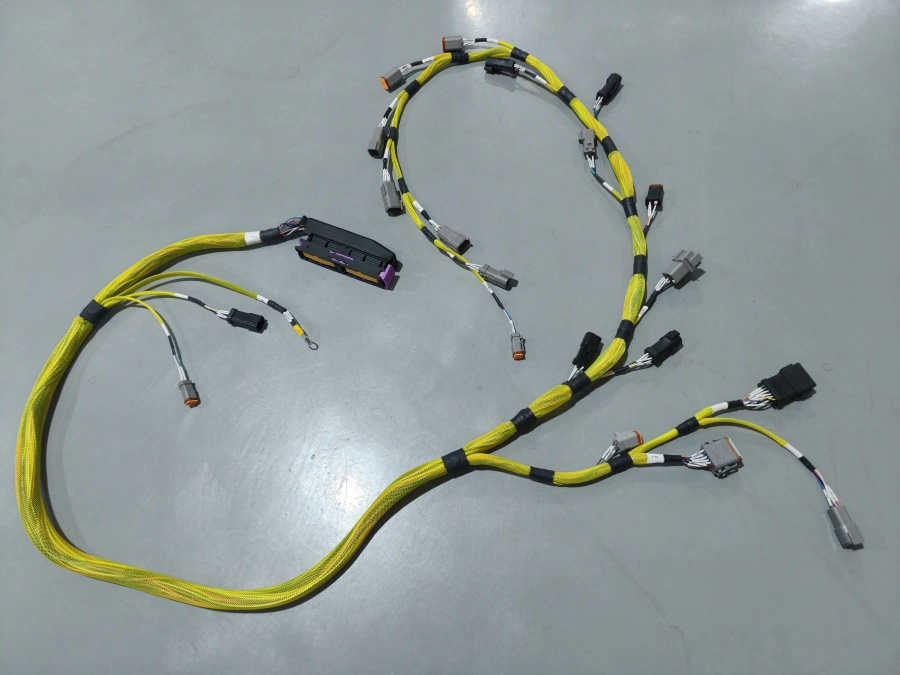
Signal Coil & Inline Sensor Harness

Dedicated harnesses for relay coils, inline liquid sensors, pressure transducers, and telematics fan-out. Tighter EMC discipline than a stock commercial truck harness to keep ADAS and high-voltage paths cleanly decoupled.

  • Relay coil drive wiring
  • Inline liquid sensor harness
  • Shielded twisted-pair signal paths

Battery Pack Interconnect & BMS Wiring

Cell-tap, BMS slave, voltage-sense, and balancing harnesses inside the battery pack. Built to pack-OEM strip and lug specs with serialized lot traceability so a field failure can be back-traced to the assembly batch.

  • Cell-tap and BMS slave wiring
  • Voltage-sense balancing harness
  • Pack-level lot traceability

Prototype-to-Production Scaling

Pre-series pilot builds, engineering-revision turnaround under tight launch timelines, and volume ramp into series production once the platform is frozen. The same operators and the same fixtures move from pilot to volume β€” no supplier hand-off in the middle of the program.

  • 5-unit pilot to 500+ series
  • Engineering-change turnaround
  • Same operators pilot β†’ production

Vehicle Programs & Applications

Class 4-7 platforms where battery weight, route range, and uptime define the program

Last-Mile Delivery EV Trucks

Class 4-5 delivery box trucks for parcel, grocery, and final-mile fleets. Full-vehicle harness packages plus battery pack interconnect for high duty-cycle stop-and-go urban routing.

Class 6-7 Regional Haul EVs

Regional-haul electric trucks with extended battery capacity or range-extender modules. HV drive harness + cell-tap + BMS wiring tuned for the longer route and heavier payload envelope.

Vocational & Refuse EV Platforms

Refuse trucks, utility trucks, and vocational EV platforms with body-mounted power take-off (ePTO) and auxiliary load harnesses on top of the base traction system.

Yard & Terminal Tractors

Class 8 yard-tractor and terminal-tractor EV programs running short-cycle high-utilization duty. Battery and HV harnesses tuned for the rapid-charge / rapid-discharge profile.

Commercial EV Powertrain Suppliers

Tier-1 powertrain integrators supplying inverter, motor, and pack subsystems to multiple commercial EV OEMs. Shared HV harness platforms across OEM customers under common automotive QMS.

Range-Extender & Fuel-Cell EV Platforms

Hybrid range-extender and fuel-cell electric truck programs where a secondary energy source pairs with the battery pack. Dedicated module-to-pack harnesses and DC-link interconnect.

Technical Specifications

Voltage Classes12 V / 24 V LV, 400 V Class A HV, 800 V Class B HV
Current RangeUp to 250 A continuous on HV main, signal-class wiring AWG 22 to AWG 16
Wire ConstructionsUL 1015 / UL 1581 / TXL / GXL / orange-jacket HV, FLR-Y, FLR2X, ISO 6722 automotive
Connector FamiliesDeutsch DT/DTM/DTHD, TE AMPSEAL, Molex MX150, Yazaki, Sumitomo, HVIL-equipped HV connectors
TerminationsCrimp (TE Pro-Crimper / Deutsch HDT-48-00 / Molex CR1000), hex-crimp HV lugs, sealed splice
Sealing & IP RatingIP67 / IP6K9K cab, IP69 underbody, sealed splice and grommet exit
Operating Temperature-40 Β°C to +125 Β°C standard; +150 Β°C engine-bay rated wire on request
Workmanship StandardIPC/WHMA-A-620 Class 2 default; Class 3 available for safety-critical paths
Quality SystemIATF 16949 process discipline, PPAP Level 2-5 on request, AIAG-aligned APQP
Testing100% continuity + hipot for HV harnesses; pull-force sampling; sealed splice integrity test
DocumentationLot traceability, operator-ID logged crimps, engineering-change record per revision
ComplianceIPC/WHMA-A-620, IATF 16949, UL 758, ISO 6722, RoHS, REACH
Why Commercial EV OEMs Choose Us

Class 4-7 EV programs don't behave like passenger EV programs β€” and they don't behave like legacy commercial truck programs either

Pilot-Through-Launch Continuity

The same engineering contact, the same operators, and the same fixtures carry your harness from 5-unit prototype to volume launch. No supplier hand-off in the middle of a program, no re-qualification of fixtures, no operator retraining at scale-up.

HV + LV Under One Roof

We build the orange-jacketed HV traction harness and the LV vehicle harness package on the same floor with shared work instructions. Cross-coupling, EMC fan-out, and HVIL chain are reviewed once across the full vehicle harness set.

Engineering-Change Discipline

Class 4-7 programs run engineering changes constantly during ramp. We track ECN cadence by harness number, lock fixtures to revision level, and ship pilot quantities of new revs while running production of the prior rev.

Pack-Level Lot Traceability

Cell-tap and BMS wiring carries serialized lot traceability through every crimp and splice. A field-return battery pack can be back-traced to the assembly cell, operator, crimp tool, and wire spool that produced the harness inside it.

IATF 16949 Process Discipline

Automotive QMS by design β€” control plan, FMEA, PPAP, APQP β€” applied to the EV harness scope from day one rather than retrofitted at PPAP Level 3 submission.

Drawing-Native Intake

EPLAN, KBL, and structured BOM intake supported. Drawings stay in source format. No redraw, no tolerance loss, no week-long quote cycle while engineering decodes a screenshot.

Real Project Snapshot

An anonymized example from our case bank β€” illustrates how a class 4-7 EV harness program ramps with engineering-change pressure.

Industry
ev-commercial-truck
Region
USA (West Coast OEM)
Year
2025-2026

Scenario: An American class 4-7 commercial EV truck OEM ramping into pre-series production needed a supplier capable of running multiple harness families (HV drive, LV vehicle package, range-extender, signal coil, inline sensor) on parallel timelines with engineering changes landing weekly.

Challenge: Tight launch deadline, frequent ECNs, simultaneous pilot and quality-rework on different revisions, and a $40,000 credit ceiling reached early in the program. Multiple internal departments (purchasing, quality, engineering, logistics) all engaged on the supplier relationship.

What we did: Locked fixtures to harness-number + revision-level, ran pilot quantities of new revs in parallel with production of the prior rev, and routed all communication through a single program-manager channel so engineering changes never lost the through-line.

Result: Established multiple-harness-family recurring supply, supported the program through pre-series ramp, and moved into a sustained repeat-order relationship across the HV, LV, range-extender, and signal harness scopes.

Concrete numbers
  • 6+ harness families in active production
  • Multiple weekly engineering-change cycles supported
  • $40 K credit ceiling reached β†’ upgraded mid-program
  • Pilot to series scaling within 12 months
  • Multi-department (purchasing + QA + engineering + logistics) engagement

From RFQ to Production

A repeatable six-step process used on every Commercial EV Truck Wire Harness program

01

Program & Recorder Review

We review the VOD recorder family, probe length range, target resistance per meter, and field conditions before recommending the right variant family.

02

Variant Specification Lock

For each application β€” standard, long-range, high-temperature, Kevlar-reinforced, or lab precision β€” we confirm conductor stack, dielectric, and reinforcement before sample release.

03

Sample Build & Characterization

Initial sample lots are produced, measured for per-meter resistance, and compared to your recorder calibration. Adjustments locked into the production process window.

04

100% Continuity + Resistance Verification

Every probe cable is end-to-end continuity tested and resistance-checked before lot release. Sample-level per-meter resistance characterization on each production lot.

05

Documentation & Serialization

Lot certificate of compliance documents measured resistance values, manufacturing date, and lot ID. Serialization available for R&D and academic programs.

06

Logistics & Repeat Production

Reels labelled, packaged for transport, and shipped on mining-season schedules. Recurring POs supported with split air + sea logistics where seasonal demand requires.

Building a Class 4-7 EV Truck Program?

Send the harness drawing pack, BOM, or wiring schematic. We will review HV path, LV scope, connector callouts, and IATF expectations and quote prototype + series in parallel.

Frequently Asked Questions