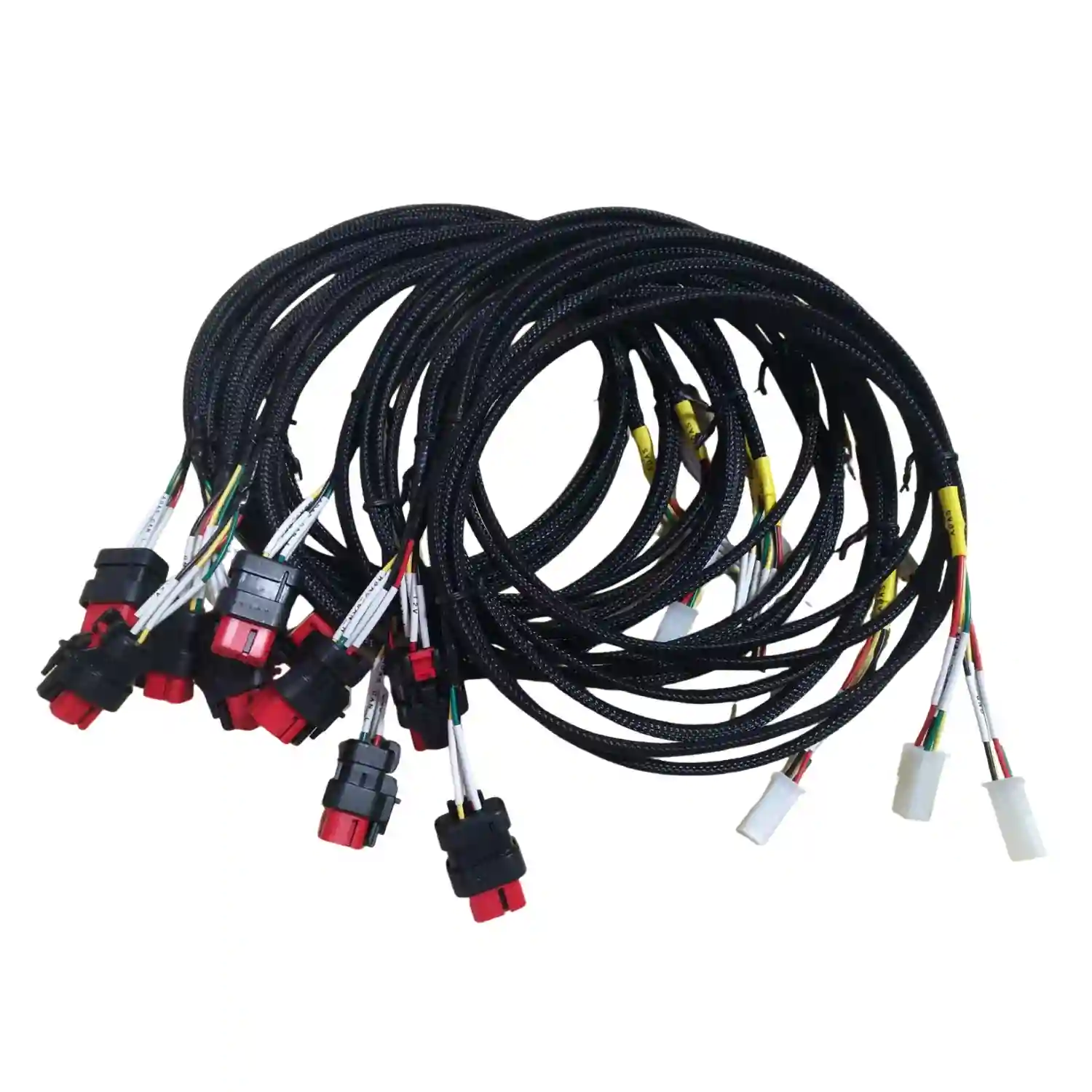
Cable Assembly

Warehouse Robotics Wire Harness Custom Cable Assembly for AMR & Manipulation Robots

Wire harnesses and cable assemblies engineered for warehouse robotics — wrist/elbow camera USB cables, grapple and gripper actuator wiring, pressure-sensor harnesses, and full robot dress packs. Built for high-flex duty cycles, dense wrist routing, and rapid prototype-to-volume scaling under repeat-PO cadence.

Warehouse robotics wire harness cable assembly manufacturing line
Flex-Cycle Cable Stock10M+
Repeat-Order DisciplinePO-Series
Mixed Harness SetsCamera + Sensor
Pilot to Production5 → 500

Application Context

What this warehouse robotics wire harness service covers

Wire harnesses and cable assemblies engineered for warehouse robotics — wrist/elbow camera USB cables, grapple and gripper actuator wiring, pressure-sensor harnesses, and full robot dress packs. Built for high-flex duty cycles, dense wrist routing, and rapid prototype-to-volume scaling under repeat-PO cadence.

Cable assemblies built for the wrist, elbow, gripper, and base of pick-and-place and AMR robots — where every cable lives in a tight dress pack with millions of flex cycles ahead of it

Capabilities

Warehouse Robotics Harness Capabilities

Cable assemblies built for the wrist, elbow, gripper, and base of pick-and-place and AMR robots — where every cable lives in a tight dress pack with millions of flex cycles ahead of it

Wrist Camera USB Cable

USB cable assemblies for wrist-mounted vision cameras on pick-and-place robots. Tight bend-radius, retention-aware connector exit, and signal-integrity discipline for USB 2.0 / USB 3.0 imaging at the wrist.

  • USB 2.0 / 3.0 / Type-C support
  • Wrist-routing bend radius
  • Connector retention for vibration

Elbow Camera & Mid-Arm Vision Cable

USB / GigE Vision cable assemblies routed through the elbow joint and mid-arm of pick-and-place robots. Twisted-pair signal integrity, shield-drain-to-chassis discipline, and high-flex cable stock that survives the duty cycle.

  • USB and GigE Vision options
  • Continuous-flex jacket
  • Shield-drain to chassis ground

Grapple / Gripper Actuator Harness

End-effector and grapple harnesses for pick-and-place and bin-pick robots — solenoid, motor, and pneumatic actuator wiring with the strain-relief and pull-cycle discipline a gripper sees in its first 6 months of duty.

  • Solenoid + motor + pneumatic wiring
  • Strain-relief at end-effector
  • Pull-cycle qualified termination

Pressure Sensor & Force-Feedback Harness

Discrete sensor cables for pressure transducers, force-torque sensors, and grip-force feedback paths. Shielded twisted-pair with low-capacitance signal handling so the controller sees clean analog data through the dress pack.

  • Pressure transducer wiring
  • Force-torque sensor cabling
  • Low-capacitance signal path

Actuator & Drive Cable Assembly

Motor and actuator drive cables for joint actuators, linear stages, and end-effector drives. Hex-crimp HV lugs on heavier drives, fine-pitch crimp on lighter actuators, and dress-pack-ready routing geometry.

  • Joint actuator drive cabling
  • Linear stage motor cable
  • Dress-pack routing geometry

Complete Robot Harness RFQ Sets

We quote full robot harness packages — wrist + elbow + grapple + sensor + actuator + base as a coordinated set — so a robotics OEM doesn't have to chase 5 separate suppliers and reconcile 5 separate APQP cycles.

  • Full robot dress-pack RFQ
  • Coordinated APQP across set
  • Single-supplier traceability

Engineering Challenges

Robotics harness risks we review before quote

01

High-Flex Duty & Bend Radius

Wrist and dress-pack routing sees millions of flex cycles. We review bend radius, service loops, and continuous-flex jacket selection before sampling so the cable survives the duty cycle, not just a bench continuity test.

02

Dress-Pack Routing Density

Camera, sensor, gripper, and actuator branches all share a tight wrist and arm dress pack. Branch length, exit orientation, and fixation are planned so the harness installs cleanly and moves without chafing.

03

Vision Signal Integrity

USB 3.0 and GigE Vision links need twisted-pair discipline, shield-drain to chassis, and impedance control so radar-fast camera data stays clean through a moving joint.

04

Connector Retention & Strain Relief

End-effector and vibration exposure demand retention-aware connector exits and pull-cycle-qualified terminations, so a gripper harness survives its first months of duty.

Technical Capabilities

Technical Specifications

Build-to-print robotics harnesses — wrist and elbow vision, gripper, sensor, and actuator drive cables — reviewed against IPC/WHMA-A-620 workmanship, UL 758 wire rating, and RoHS / REACH compliance.

Cable TypesUSB 2.0 / 3.0 / Type-C, GigE Vision, twisted-pair signal, motor drive, pneumatic control
Flex Cycle RatingStandard 5M-10M+ cycle continuous-flex cable for dress-pack and wrist routing
Wire AWG RangeAWG 30 (signal) through AWG 14 (joint actuator drive)
Connector FamiliesUSB A/B/C, M8 / M12 sensor, JST / Molex / TE signal, Anderson Powerpole drive, custom OEM-spec
TerminationCrimp (Pro-Crimper III / Molex CR1000), molded USB ends, pin-and-socket discrete contacts
ShieldingFoil + braid for GigE / USB 3.0, twisted-pair with drain wire for signal-class
Operating Temperature-20 °C to +80 °C standard (indoor warehouse and fulfillment environments)
Workmanship StandardIPC/WHMA-A-620 Class 2 default; Class 3 for safety-relevant paths
Testing100% continuity, USB/GigE link verification on critical paths, pull-force sampling on connectors
DocumentationLot traceability, operator-ID logged crimps, ECN tracked per harness SKU
Volume Profile5-unit prototype, 50-unit pilot, 500-unit series, 1000+ recurring per harness SKU
ComplianceIPC/WHMA-A-620, UL 758, RoHS, REACH
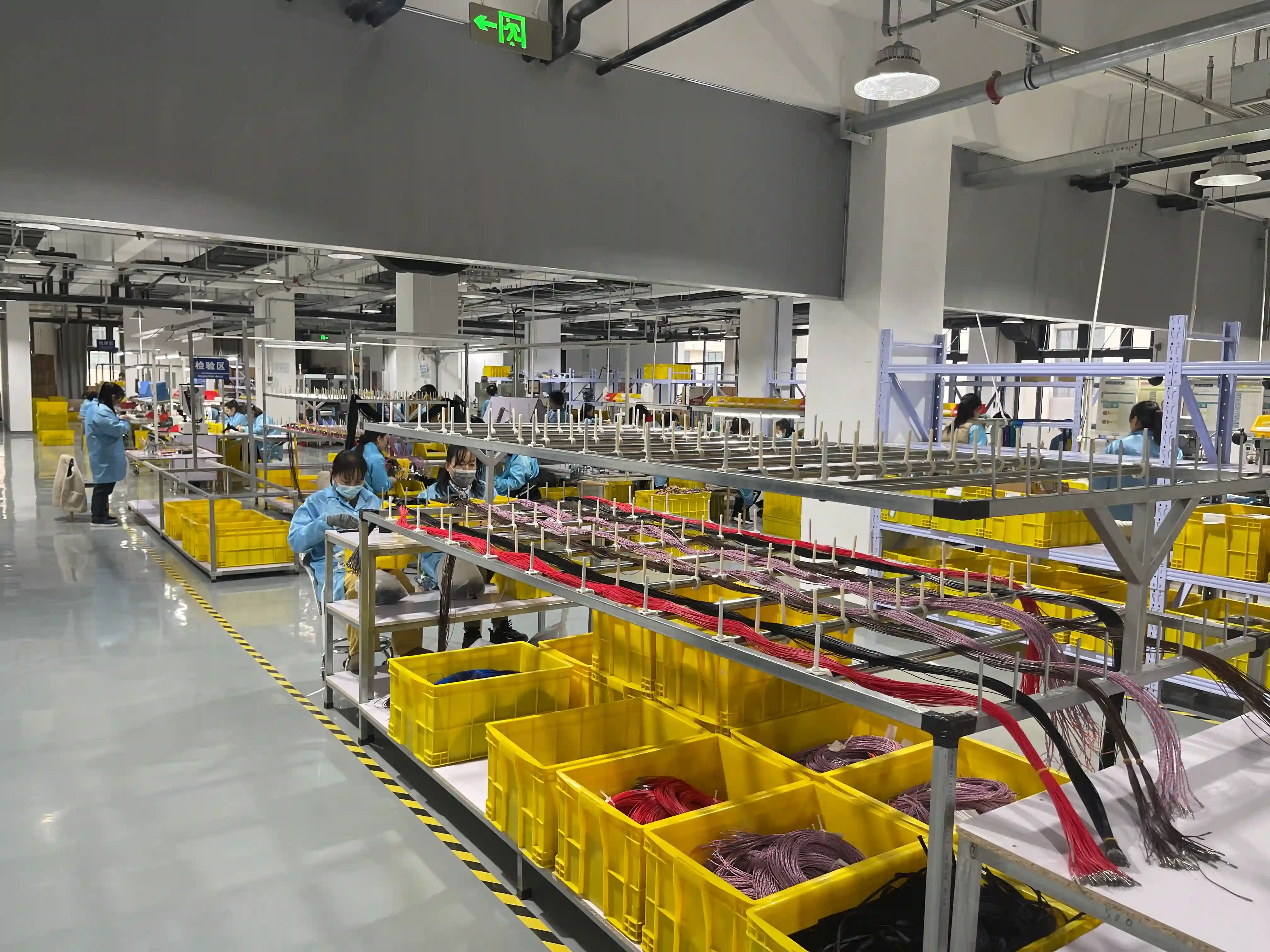
Warehouse robotics wire harness cable assembly

Manufacturing Process

From RFQ to Production

01Drawing / BOM Review
02Component Sourcing
03Cutting & Stripping
04Crimping / Assembly
05In-process Inspection
06Electrical Test
07Final Inspection
08Packaging & Shipment

Quality & Testing

Documented testing and traceability for robotics OEMs

Every robotics harness leaves the factory with a release plan — 100% continuity, USB / GigE link verification on critical paths, and connector pull-force sampling — logged with operator-ID crimps, lot traceability, and ECN tracking per harness SKU under IPC/WHMA-A-620 workmanship.

100% Continuity TestUSB / GigE Link VerificationConnector Pull-Force SamplingOperator-ID Logged CrimpsLot TraceabilityECN Tracking per SKUIPC/WHMA-A-620 WorkmanshipRoHS / REACH ComplianceFinal Inspection

Why WHP

Why Robotics OEMs Choose Us

Robotics programs run on PO-series cadence — every harness ships with the next-PO already in the queue

PO-Series Repeat Cadence

We support a rolling series of repeat purchase orders — the same harness SKU re-ordered every few weeks at varying quantities. Fixtures stay locked, operators stay current, and lead-time stays predictable.

Coordinated Full-Robot Harness RFQ

Robotics OEMs often need wrist + elbow + grapple + sensor + actuator as a coordinated set. We quote the full robot harness package together so APQP, lot traceability, and revision discipline live in one supplier program.

Cost Decomposition Discipline

Mature robotics customers run cost-decomposition reviews — wire stock, connector list, labor, test, packaging. We provide transparent cost breakdowns by line item so engineering and sourcing can target the right reduction without compromising critical specs.

Engineering-Change Velocity

Robotics programs run engineering changes constantly during ramp. We hold pilot capacity to ship a new-rev harness within days while production of the prior rev continues for the existing fleet.

High-Flex Cable Stock In-House

Continuous-flex jacket constructions rated for 5M-10M+ cycles are stocked in-house. No three-week lead-time on a wrist-cable program because the cable family ships from an offshore supplier.

Single-Supplier Sales-Continuity

When the original sales rep on the account leaves, we maintain the program continuity through formal hand-off — engineering contact, work instructions, fixture status, ECN history — so the customer doesn't lose institutional memory.

Robotics harness quality references

IPC/WHMA-A-620 workmanship (Class 2 default, Class 3 for safety-relevant paths), UL 758 wire rating, and RoHS / REACH compliance — documented with lot traceability per harness SKU.

IPC/WHMA-A-620Class 2/3 Workmanship
UL 758Wire Rating
RoHS / REACHCompliance

FAQ

Warehouse Robotics Wire Harness FAQ

What makes a warehouse robotics wire harness different from a standard harness?
Warehouse robots — AMRs, AGVs, and ASRS shuttles — move constantly, so the harness has to survive continuous motion, not just a static install. We build with continuous-flex (high-flex) rated conductors, generous bend radii, service loops, and abrasion-resistant jackets so the cable withstands repeated flexing at the drive wheels, lift axes, and cable carriers rather than fatiguing after a few weeks of duty.
How do you specify continuous-flex cable for moving robots and dress packs?
We select the conductor stranding, jacket material, and minimum bend radius against the actual motion profile — travel distance, bend radius at the carrier, and expected flex cycles. Fine-stranded, continuous-flex rated cable is routed with correct service loops and strain relief so the harness moves with the robot and the dress pack without kinking or work-hardening.
How do you protect encoder and sensor signal integrity on a moving axis?
Encoder, LiDAR, and machine-vision links use twisted pairs with individual and overall shielding, controlled impedance where the protocol requires it, and a defined shield-drain path to chassis ground. Keeping signal pairs separated from motor and power conductors — and terminating shields correctly — keeps position feedback and vision data clean while the axis is in motion.
How do you keep connectors from loosening under constant vibration?
Warehouse robots run over floor joints and ramps all day, so we specify locking or threaded connectors (for example M8 and M12 circular sensor connectors), retention-aware exits, and strain relief at each termination. Crimps are pull-force sampled and back-shells or boots are added where the connector sees repeated shock and vibration.
Can you build battery and charging harnesses for AMR and AGV platforms?
Yes. We build battery interconnect and charge-contact harnesses with correctly sized power conductors for the current draw, appropriate lugs and connectors, and fusing or sense leads where the BMS requires them. Power and charging harnesses are built to the same continuous-flex and vibration standards as the signal harnesses on the same robot.
How do you handle EMI shielding around motor and drive cables?
Motor, servo, and drive cables are shielded and routed to keep switching noise away from sensor and vision pairs. We use foil, braid, or foil-and-braid shielding matched to the frequency content, bond shields to chassis, and separate power from signal branches within the dress pack to hold EMI margins on the sensitive links.
Do you test flex-cycle life on continuous-flex harnesses?
For continuous-flex applications we can run flex-cycle validation on representative samples against the target motion profile, alongside 100% electrical continuity, insulation, and connector pull-force checks. Tell us the bend radius, travel, and cycle target and we will agree the sample plan before production.
What are your minimum order quantities and lead times?
We support prototype and low-volume builds for design validation and pilot fleets, scaling up to recurring production for larger robot deployments. Lead time depends on connector and cable availability; share your BOM, drawings, and forecast and we will confirm MOQ and a lead-time estimate for your program.

OEM Program Entry

Building a Warehouse Robotics Program?

Send the wrist / elbow / gripper drawing pack or the full robot harness BOM. We will review dress-pack routing, flex-cycle expectation, vision-cable signal class, and quote prototype + series in parallel.

We will review

  • 01Design Feasibility
  • 02Component Availability
  • 03Cost Drivers
  • 04Validation Requirements

Related Capabilities

Related Capabilities

Pages adjacent to warehouse robotics wire harness that pair with the same robotics automation programs

Programs & Applications

Robotics Programs & Applications

Where these harnesses ship — warehouse fulfillment, e-commerce robotics, and manipulation-robot OEMs

Warehouse Pick-and-Place Robots

Harnesses for in-aisle pick-and-place robots used in e-commerce fulfillment, grocery DCs, and parcel sortation. Wrist + elbow vision, gripper, and sensor harnesses on every arm.

Bin-Pick & 3D-Vision Robots

Cable assemblies for vision-guided bin-pick robots — multi-camera USB / GigE harnesses, force-torque sensor wiring, and gripper actuator harnesses tuned for the bin-pick duty cycle.

AMR & Mobile Manipulation Platforms

Wire harnesses for autonomous mobile robots (AMRs) and mobile manipulators — base power, LiDAR / camera sensor wiring, and arm-mounted manipulation harness sets on the same platform.

Sortation & Induction Robotics

Harnesses for sortation robots, induction lines, and parcel-handling cells where high-cycle pick-and-place duty defines the dress-pack cable construction.

E-Commerce Fulfillment Automation

Robotics OEMs supplying e-commerce fulfillment automation — Symbotic-class, Locus-class, 6 River Systems-class platforms — with mixed harness families across each robot SKU.

Industrial Manipulation R&D

Research and pre-production robotics programs that need a supplier capable of small-batch prototype iteration plus production scale-up on the same fixtures.

Case Snapshot

Representative project type (illustrative)

Representative project type we handle, shown for illustration. Not a specific named customer.

warehouse-robotics · Global · Recent

Scenario. A warehouse robotics OEM building manipulation robots moves from first quote to a rolling purchase-order cadence, ordering camera cables, grapple cables, sensor harnesses, and actuator cables at varying quantities.

Challenge. A sales-contact transition mid-program, an RFQ scope expanding from a single SKU to a multi-product line, and intensifying customer-side cost decomposition and industrialization engineering.

What we did. We preserve continuity through a clean engineering and account hand-off, support cost decomposition with transparent line-item breakdowns, and run multiple harness families in parallel pilot and production tracks on shared fixtures.

Result. The program moves from single-order quoting to a rolling purchase-order cadence with a multi-SKU portfolio in active production and deepening engineering engagement.

  • Multi-SKU harness portfolio in active production
  • Rolling purchase-order cadence
  • Sales-contact transition preserved
  • Cost-decomposition transparency provided