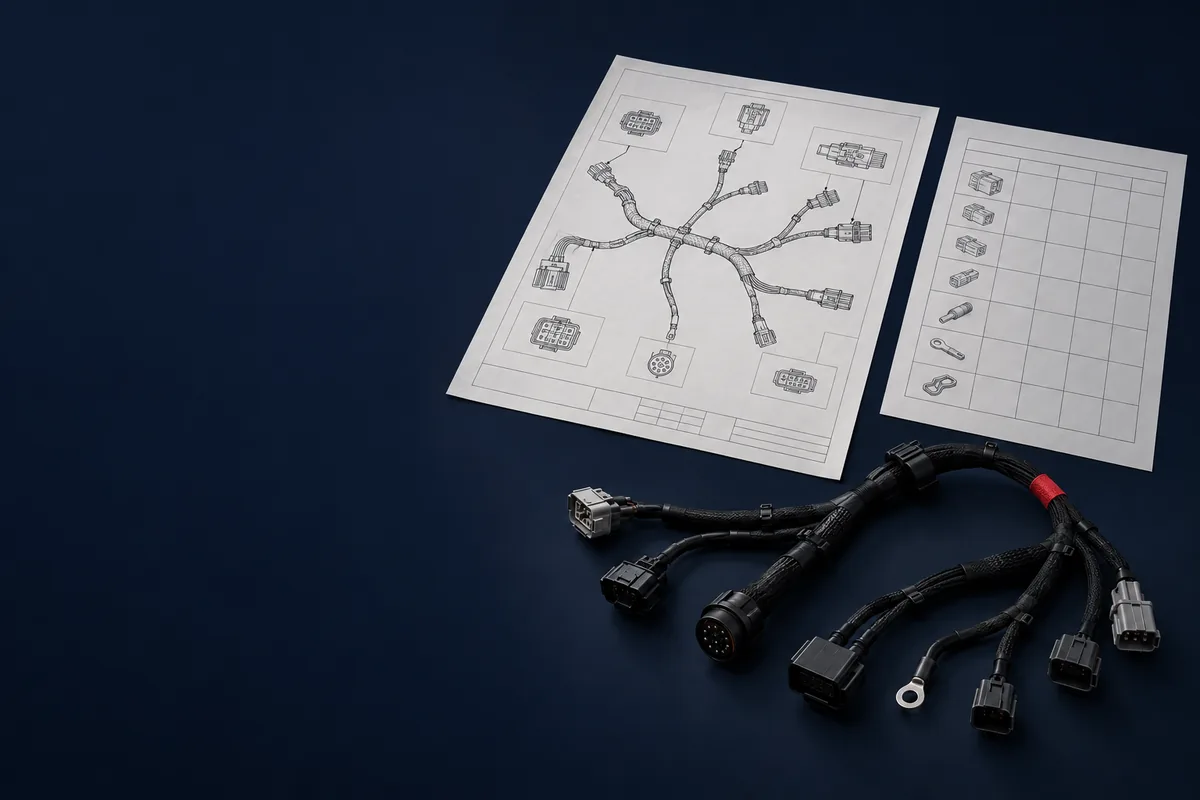
A low-volume wire harness costs more per unit because one-time work and minimum material buys are spread over few pieces, not because the assembly itself is different. The fixed part is the engineering review, the fixture or board, test programming and the first-article build. The material part is that terminals, wire and connectors are bought in reels, spools and bags larger than a small order uses. This guide shows how to put numbers on both, with worked examples that use assumed figures so you can replace them with your own quote.
Updated October 6, 2026. An earlier version listed percentage price premiums by volume tier, a dollar saving from prototyping and a minimum-order commitment, none of which we could source; those have been removed, and the empty sections have been written out.
What Counts as Low Volume?
There is no standard definition. The bands below are a working convention for this guide, not an industry rule, and what matters is which cost dominates in each one.
| Band | Quantity | What dominates the unit price |
|---|---|---|
| Prototype | 1 to about 10 | Engineering and setup; design is still changing |
| Low volume | About 10 to 1,000 | Setup and fixture amortization, plus material minimums |
| Mid volume | About 1,000 to 10,000 | Material price breaks and labor efficiency |
| High volume | Above about 10,000 | Automation, tooling and purchasing terms |
The 10 to 1,000 band is where most procurement teams struggle: too many units for a prototype shop to build economically and too few for a high-volume line to justify its setup. For our own scope on small runs, including 1 to 40 piece batches, see the low-volume wire harness manufacturing service page.
Why Small Orders Cost More per Unit
Three things combine. Each has a different owner, so asking the supplier to separate them in the quote tells you what you can change.
- One-time setup and engineering (NRE). Reviewing the drawing and BOM, building a first article, programming the continuity tester and preparing work instructions cost the same whether you order 10 or 1,000.
- Fixtures and tooling. A layout board or fixture speeds assembly and keeps every unit identical, but it has to be built before the first unit.
- Material minimums. Epec Engineered Technologies, a cable assembly maker, describes the sources of high minimums: crimp terminals come on reels of “several thousand units,” wire is produced on spools (a standard 1,000 ft spool of 10 AWG weighs more than 30 pounds), and raw material for jackets can carry minimums of “several hundred pounds or more.” Setup and changeover scrap on automated equipment add to it (Epec).
The first is a cost spread over quantity, the second is an investment you may reuse, and the third is an inventory exposure that someone has to carry. The three worked examples below put a number on each, using assumed inputs.
Three Worked Examples (Assumed Numbers)
All figures here are assumptions chosen to show the arithmetic. They are not prices, quotes or market data; replace them with the numbers on your own quotation.
Example 1: how one-time cost spreads over quantity
Unit price = variable cost per unit + NRE / quantity. Assume variable cost (materials, labor and test) of $14.00 per unit and one-time NRE of $600.
| Quantity | NRE per unit | Unit price | NRE share of unit price |
|---|---|---|---|
| 10 | $60.00 | $74.00 | 81% |
| 50 | $12.00 | $26.00 | 46% |
| 200 | $3.00 | $17.00 | 18% |
| 1,000 | $0.60 | $14.60 | 4% |
The unit price falls steeply at first and then flattens, because the NRE term is NRE divided by quantity. Going from 10 to 50 units cuts the unit price from $74.00 to $26.00; going from 200 to 1,000 only moves it from $17.00 to $14.60. If NRE is shown as a separate line, you can also reuse it: a repeat order of the same drawing normally does not pay it again, so ask how repeat orders are priced.
Example 2: when a dedicated fixture pays back
Break-even quantity = fixture cost / labor saved per unit. Assume a dedicated assembly board costs $900 and saves $1.50 of labor per unit compared with building on a generic layout.
900 / 1.50 = 600 units. Below that quantity the board costs more than it saves on this one program, so at low volume a generic or reusable board is usually the cheaper route. Count total expected volume, not just the first lot: if you expect to reorder the same harness for 600 units across a year, the board pays back even though no single order is large. Ask whether the fixture is yours, the supplier’s, or shared, and what happens to it if you change suppliers.
Example 3: who pays for the leftover reel
Assume a terminal that sells only on a reel of 5,000 at $0.04 each, so a full reel costs $200. A harness uses 6 of them and you order 50 harnesses.
50 x 6 = 300 terminals are used, worth 300 x $0.04 = $12. The other 4,700 terminals, worth $188, stay on the shelf. The reel is a real cost; the question is who carries it. The options are: the supplier absorbs it and recovers it in the unit price, you are charged for the full reel, you are charged for what you use with the remainder reserved for your repeat orders, or you consign the reel. A quote that does not say which one applies has hidden the exposure inside the price.
Five Things in Your Design That Raise Low-Volume Cost
You control more of the price than it seems. In order of how often they matter:
- Non-stock wire colors, jackets and markings. A color or print that is not stocked can force a full-spool or custom buy for a handful of units.
- Uncommon connectors and terminals. A part with a long lead time or a large packaging minimum sets the schedule and the exposure regardless of quantity.
- Many part numbers for few units. Each part number brings its own minimum; ten different terminals on one small harness means ten leftover bags.
- Overmolding and custom molded parts. These add tooling and changeover waste (Epec lists molding among the process drivers of minimums).
- Test scope. A full test program on a very small lot is mostly programming time; match the scope to the risk, and see the quality testing methods guide for what each test proves.
Levers That Reduce MOQ Exposure
Minimums are driven by material packaging and setup economics, so the levers work on those two things. None of them guarantees a lower price; each changes who carries the risk.
- Standardize components across programs. The same terminal, wire and connector family across several harnesses lets one reel serve all of them.
- Accept in-stock alternates. Name which substitutions are approved so a stocked part can replace a non-stock one without a change request.
- Give a forecast or blanket order. Telling the supplier the likely annual quantity, with scheduled releases, can justify buying a full reel because the rest will be used.
- Buy the reel and draw it down. Paying for the full reel up front, with it reserved for your orders, converts a hidden exposure into a visible one you control.
- Consign scarce parts. If you already hold a special connector, supplying it removes the supplier’s minimum from the quote.
- Combine lots. One order of 100 usually carries less setup per unit than four orders of 25, if your demand allows it.
How to Choose a Low-Volume Supplier
Not every harness maker handles small lots equally. Use these seven checks during manufacturer selection:
- Does the quote separate NRE, fixture, unit price and material exposure?
- Will they state connector, terminal, wire and overmold MOQ before release?
- Is the process manual or semi-automatic with reusable fixtures, rather than built for one automated line?
- Can they work to the acceptance standard on your drawing, such as IPC/WHMA-A-620? Ask which class and see the inspection guide.
- What test records come with each lot, and how are failures handled?
- How are drawing revisions controlled between small lots?
- Will they name a reference or a comparable past job for a similar quantity?
Before signing, send a complete RFQ package; incomplete drawings are the most common reason small-lot quotes come back late or wrong.
Prototype vs Low-Volume Production
| Question | Prototype | Low-volume production |
|---|---|---|
| Is the design frozen? | No; expect changes | Yes; released revision |
| Purpose | Fit, function and design validation | Repeatable units to ship or install |
| Documentation | Drawing and BOM may be provisional | Controlled drawing, BOM, work instruction, test plan |
| Cost focus | Speed and engineering time | Setup spread and material exposure |
Validating the design on a small prototype first usually costs less than discovering a connector clearance or pinout error across a full production lot, because a lot-wide error is paid for on every unit. See the prototyping guide and the prototype service page.
The Small-Batch Process, Step by Step
- RFQ review. The supplier checks the drawing, BOM and quantity and asks about gaps and non-stock items.
- Quote and material plan. NRE, fixture, unit price and MOQ exposure are stated, and any full-reel or custom buy is approved by you.
- Material procurement. The longest-lead part usually sets the schedule; see the lead time guide for a phase-by-phase worked example.
- First article. A first unit is built and inspected against the drawing before the rest of the lot.
- Lot build and test. Wire is cut and terminated, assemblies are routed, labeled and tested.
- Records and shipping. Test records and packing match the lot; see the custom cable assembly process guide for each stage in detail.
The calendar time depends on part availability and test scope, not on quantity alone, so we do not quote a standard number of weeks here. For how the cost lines add up in a quote, read the custom wire harness cost guide.
References
- 1.IPC/WHMA-A-620 — Requirements and Acceptance for Cable and Wire Harness Assemblies. IPC reference
- 2.Epec Engineered Technologies — Cable Assembly Minimum Order Quantity: What Drives High MOQs? blog.epectec.com (checked October 6, 2026)
The unit-price formula, break-even formula and all dollar and quantity figures in the three worked examples are our own arithmetic on assumed inputs, not sourced prices.
Representative project (anonymized)
Anonymized example from our case bank, shared so buyers can see how this scope is actually executed in production.
Industry: robotics | Region: US | Year: 2026
Scenario: A US robotics company scaling from prototype to small-batch production needed aggressive turnaround times across multiple concurrent wire harness programs.
Challenge: The customer repeatedly requested faster turnaround and expedited quotes, with project timelines heavily compressed and frequent checks on production status.
Solution: The manufacturer implemented proactive status updates and prioritized scheduling for the customer's high-mix, low-volume orders to meet the aggressive timelines.
Result: Successfully fulfilled multiple concurrent small-batch orders with expedited lead times, supporting the customer's rapid prototyping and product launch phases.
Concrete numbers: 1 to 40 piece batch sizes, multiple concurrent orders, expedited turnaround requests
Frequently Asked Questions
What counts as low-volume wire harness manufacturing?
There is no standard definition. In this guide it means roughly 10 to 1,000 units, a range where assembly is manual or semi-automatic and the one-time setup is spread over few pieces. Prototypes below about 10 units and runs above about 10,000 behave differently.
Is there a minimum order quantity for low-volume harnesses?
It depends on the supplier and on your bill of materials. Material minimums come from reels of terminals, spools of wire and packaged connectors, so ask for the connector, terminal, wire and overmold minimums to be listed separately in the quote. Our low-volume service page describes how we show MOQ exposure before release.
Why is the per-unit cost higher at low volume?
One-time costs, namely engineering review, fixture, test programming and first article, are divided by fewer units. In the worked example above, with an assumed $600 of NRE and $14.00 of variable cost, the unit price is $74.00 at 10 units, $26.00 at 50 and $14.60 at 1,000. The assembly work per unit is similar; the spread is what changes.
Can I avoid tooling or fixture costs on a small order?
Often, yes. A generic or reusable layout board avoids a dedicated fixture, which only pays back above a break-even quantity (fixture cost divided by labor saved per unit). Count your total expected volume across reorders when deciding, and ask who owns the fixture.
What lead time should I expect for a low-volume order?
It depends on the longest-lead part and the test scope more than on quantity, so a single number would mislead. Confirm connector and wire availability first, and see the lead time guide for how the phases add up.
Can a low-volume design scale to full production later?
Generally yes. The drawing, BOM, work instructions and test plan from a controlled low-volume build carry into production. What changes at higher quantity is the tooling, automation and purchasing terms, not the validated design.
Planning a Small Harness Run?
Send the drawing, BOM, batch quantity, deadline and test requirements. We will return material-risk questions, MOQ exposure and release options so you can compare quotes on the same basis.