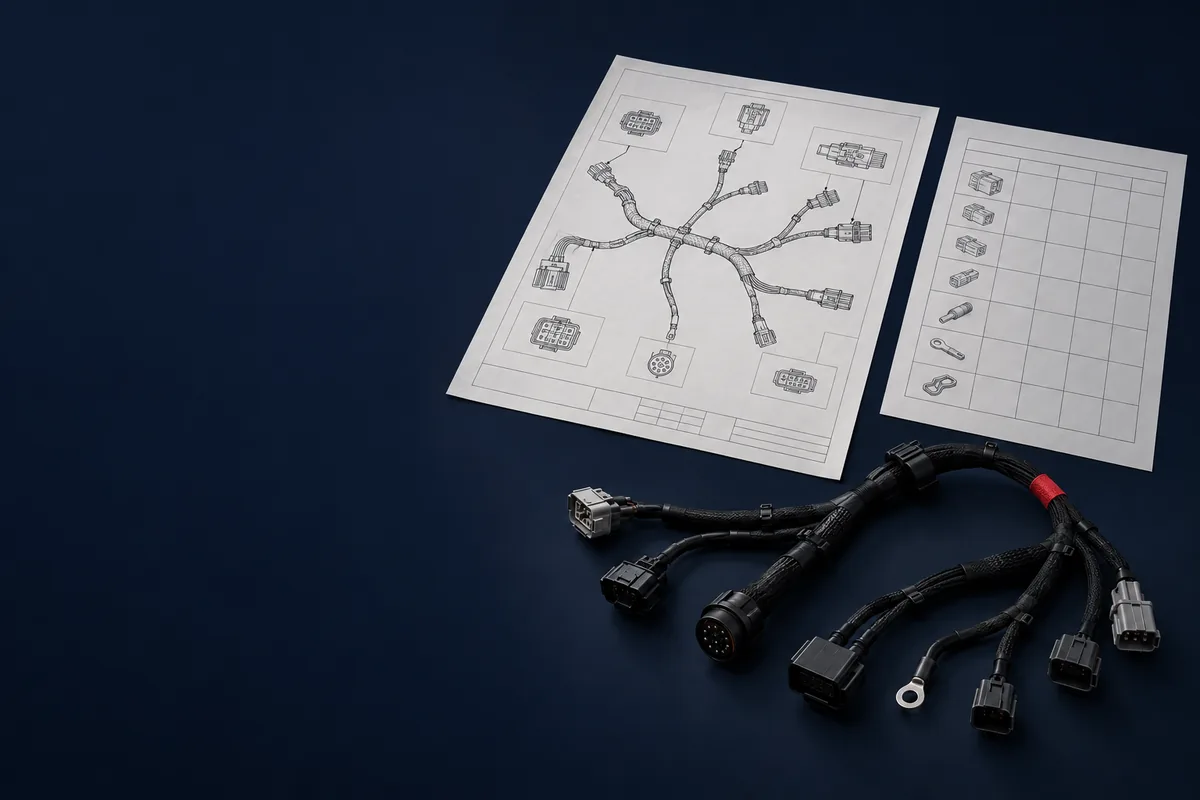
"How long will it take to get my custom cable assembly?" It's the first question many customers ask—and the answer depends on requirements, material availability, capacity, and approval timing.
This guide covers the 8 critical steps that determine project success. Confirm the relevant process scope with our facility. Understanding this process will help you work effectively with your manufacturer and get your product to market faster.
1 Requirements Gathering: The Foundation of Everything
Requirements gaps can cause problems later in the project. Incomplete or unclear requirements lead to misquotes, design revisions, and delays. The more detail you provide upfront, the smoother everything else goes.
Essential Information to Provide
| Category | Required Information | Why It Matters |
|---|---|---|
| Electrical | Voltage, current, signal types, wire gauge | Determines wire/insulation selection |
| Mechanical | Length, routing constraints, bend radius | Affects design and material choices |
| Environmental | Temperature range, chemicals, IP rating | Determines jacketing and sealing |
| Connectors | Part numbers, manufacturer, pinout | Drives tooling and material ordering |
| Volume | Annual quantity, lot sizes, ramp schedule | Affects pricing and process design |
| Compliance | UL, RoHS, industry standards | Material sourcing and documentation |
Documentation Checklist
Ideal Documentation
- Detailed engineering drawing
- Bill of Materials (BOM)
- Connector datasheets
- Wire/cable specifications
- Test requirements
Minimum Viable Start
- Basic sketch with dimensions
- Connector types/preferences
- Number of conductors
- Operating environment
- Sample or existing unit
2 Quotation & Lead Time Estimation
Once we have your requirements, we develop a detailed quotation. This involves reviewing specifications, sourcing materials, estimating labor, and calculating tooling requirements.
What Goes Into a Quote
| Cost Component | Description | Cost Driver |
|---|---|---|
| Materials | Wire, connectors, terminals, sleeving, labels | Component selection and quantity |
| Labor | Cutting, stripping, crimping, assembly, testing | Assembly complexity and labor |
| Tooling/Setup | Crimp applicators, test fixtures, jigs | One-time NRE |
| Quality/Testing | Inspection, testing, documentation | Required inspection and test scope |
| Overhead/Margin | Facility, equipment, management, profit | Supplier quotation |
How Volume Affects Pricing
Higher volumes can lower per-unit costs through:
- Material discounts: Larger wire/connector orders may qualify for better pricing
- Setup amortization: One-time costs spread across more units
- Labor efficiency: Workers get faster with practice
- Automation justification: High volumes justify specialized equipment
⚠️ Quote Validity
Use the validity period stated in the quotation. Material costs (especially copper) fluctuate, and connector lead times can change dramatically. If you delay beyond the quote validity, request an updated quote before placing your order.
3 Design & Engineering Review
Once the order is confirmed, our engineering team creates or reviews the production documentation. This is where we translate your requirements into manufacturable specifications.
Engineering Deliverables
Production Drawing
- • Wire routing diagram
- • Connector pinout
- • Length specifications
- • Labeling requirements
- • Material callouts
Bill of Materials (BOM)
- • Part numbers for all components
- • Quantities per assembly
- • Approved suppliers
- • Alternate parts (if any)
Work Instructions
- • Step-by-step assembly sequence
- • Process parameters
- • Quality checkpoints
- • Visual inspection criteria
Test Specifications
- • Continuity test parameters
- • Hipot voltage/duration
- • Pass/fail criteria
- • Test equipment requirements
During this phase, we may come back with design questions or suggestions. This is normal—our engineers often identify potential issues or cost savings that weren't obvious in the requirements phase.
4 Prototype Development
Before committing to full production, we build prototype units to validate the design. This step catches problems before they become expensive.
What Prototyping Validates
Fit & Form
- • Connector compatibility
- • Length accuracy
- • Routing feasibility
- • Physical interference
Function
- • Electrical continuity
- • Signal integrity
- • Current capacity
- • System integration
Prototype Approval Process
We ship samples to you
Quantity agreed from your testing needs
You test in your application
Fit check, electrical test, environmental testing if needed
Feedback and revision (if needed)
We iterate until the design is approved
Written approval
Your sign-off freezes the design for production
5 Production Preparation
With an approved prototype, we prepare for production. This involves finalizing tooling, ordering materials, and setting up the production line.
Production Prep Activities
| Activity | Typical Duration | Notes |
|---|---|---|
| Material Ordering | Confirm material availability | Connector lead times vary widely |
| Tooling Fabrication | Confirm tooling scope | Crimp applicators, test fixtures |
| Assembly Board Setup | Confirm engineering schedule | Jigs for consistent routing |
| Test Program Development | Confirm engineering schedule | Automated tester programming |
| Operator Training | Confirm training needs | Process familiarization |
| First Article Production | Confirm inspection scope | Final verification before run |
⚠️ Lead Time Reality
The biggest schedule risk is usually material lead times. Popular connectors from major manufacturers (TE, Molex, Amphenol) may have extended lead times during supply chain disruptions. We can often suggest alternatives, but if you require specific part numbers, plan accordingly.
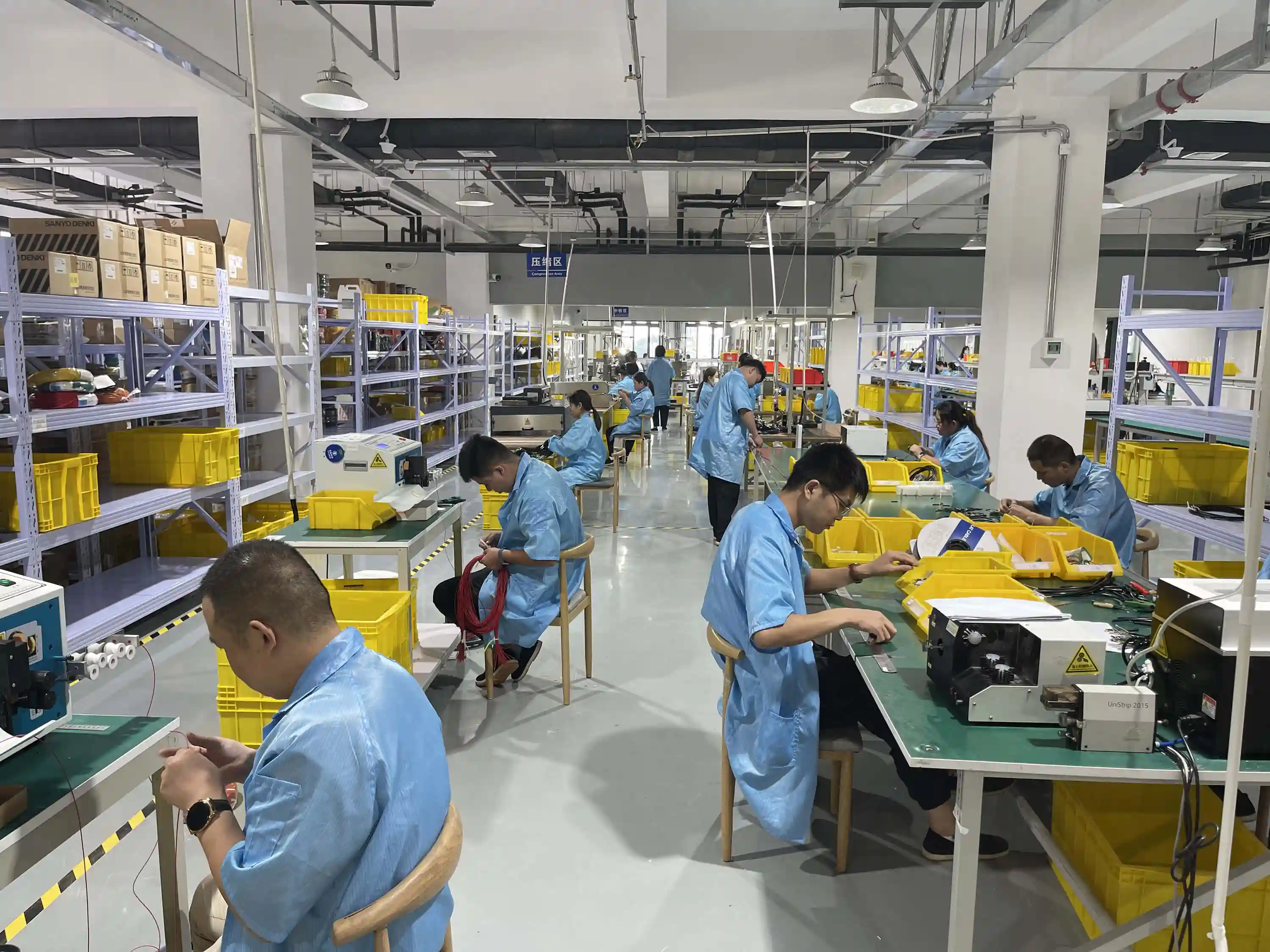
6 Manufacturing: Where It All Comes Together
Manufacturing Operations
Wire Processing
Cutting to length, stripping insulation, twisting (if required). Automated cut-and-strip machines handle high volumes; manual processing for complex cables.
Terminal Crimping
Attaching terminals using calibrated crimp presses. Each terminal type requires specific tooling and settings. Learn about crimp quality verification .
Connector Assembly
Inserting terminals into connector housings. Position, orientation, and retention must be verified for each wire.
Harness Assembly
Routing wires on assembly board, adding sleeving/tape/conduit, installing clips/grommets, branch bundling.
Labeling & Marking
Applying identification labels, wire markers, warning labels, and compliance markings as specified.
7 Testing & Quality Assurance
Agree on the required testing and release records before shipment. The extent of testing depends on your requirements and industry standards. Read our complete guide on wire harness testing methods .
Standard Testing Protocol
| Test | What It Checks | Frequency |
|---|---|---|
| Visual Inspection | Workmanship, damage, labeling | Per approved test plan |
| Continuity | All connections complete and correct | Per approved test plan |
| Hipot (if required) | Insulation integrity | Per approved test plan |
| Dimensional | Length, routing, branch points | First article + sample |
| Pull Test | Crimp/termination strength | First article + sample |
8 Packaging & Delivery
The final step—getting your harnesses to you safely and on time.
Packaging Options
Standard
Individually bagged, boxed in quantity
Best for: General industrial
Custom
Specific packaging to your requirements
Best for: Kitting, line-side delivery
Protective
ESD bags, foam inserts, custom trays
Best for: Sensitive electronics
Shipping Considerations
If sourcing from international manufacturers , shipping method significantly impacts total lead time:
| Method | Transit Time | Cost | Best For |
|---|---|---|---|
| Air Express | Confirm carrier and route | $$$ | Prototypes, urgent orders |
| Air Freight | Confirm carrier and route | $$ | Medium urgency |
| Sea Freight | Confirm port and route | $ | Large orders, planned inventory |
Typical Project Timeline
Confirm each phase of the project schedule against the actual scope and available materials:
| Phase | Simple Design | Complex Design |
|---|---|---|
| Quote | Confirm RFQ review scope | Confirm scope and availability |
| Design Review | Confirm drawing review scope | Confirm materials and capacity |
| Prototype | Confirm materials and capacity | Confirm engineering and materials |
| Production Prep | Confirm materials and capacity | Confirm engineering and materials |
| Production | Confirm materials and capacity | Confirm engineering and materials |
| Shipping (Air) | Confirm scope and availability | Confirm scope and availability |
| Total | Agree on a project schedule | Agree on a project schedule |
Common Mistakes to Avoid
The following issues can cause delays and extra costs:
1. Incomplete Requirements
Providing partial information leads to multiple quote revisions and design iterations. Take time upfront to document everything.
2. Skipping Prototyping
Going straight to production and discovering fit issues. Compare prototype costs with the risk of rework or scrap in production.
3. Unrealistic Lead Time Expectations
Expecting delivery before materials, engineering, and testing are ready. Plan for realistic timelines and communicate urgency early if needed.
4. Changing Requirements Mid-Project
Design changes after approval can require renewed review and validation. Finalize requirements before prototype approval whenever possible.
5. Not Communicating Volume Forecasts
Material planning depends on volume visibility. If you expect growth, share forecasts so we can secure capacity and materials.
Conclusion: Your Roadmap to Success
Custom cable assembly manufacturing isn't complicated, but it does require systematic execution. By understanding and engaging with each step of the process, you can minimize delays, reduce costs, and get exactly the product you need.
If you're ready to start your custom cable assembly project, use our supplier evaluation questions to find the right manufacturing partner . And when you're ready to get started, we're here to help.
Frequently Asked Questions
What are the main steps in the custom cable assembly process?
The typical flow is requirements gathering, design and DFM review, BOM creation and component sourcing, prototyping, testing and validation, production build, quality inspection, and packaging and delivery. Each stage has a sign-off so problems are caught before they scale into a full run.
How long does the full custom cable assembly process take?
Prototype and production timing depend on material availability, complexity, capacity, and approval. Confirm a project-specific schedule, including procurement for specialty connectors.
What information do I need to provide to start?
At minimum a drawing or schematic, a bill of materials, a connector and pinout list, the operating environment, and the required quantity. A complete package up front can reduce clarification cycles that delay quoting and sampling.
Do you provide design or DFM support?
Yes. A design-for-manufacturability review checks connector compatibility, wire routing, strain relief, and testability before tooling, which can reduce rework once production starts.
What testing is performed during the process?
Standard checks include continuity, hipot/dielectric withstand, insulation resistance, crimp pull-force, and where applicable IP or leak testing. The exact suite is set by the application and the customer's acceptance criteria.
Can the same process handle both low and high volume?
Yes. Low-volume builds use manual assembly and reusable fixtures, while high-volume runs add automation and dedicated tooling. The design documentation created early carries through both, with further validation where the production method changes.