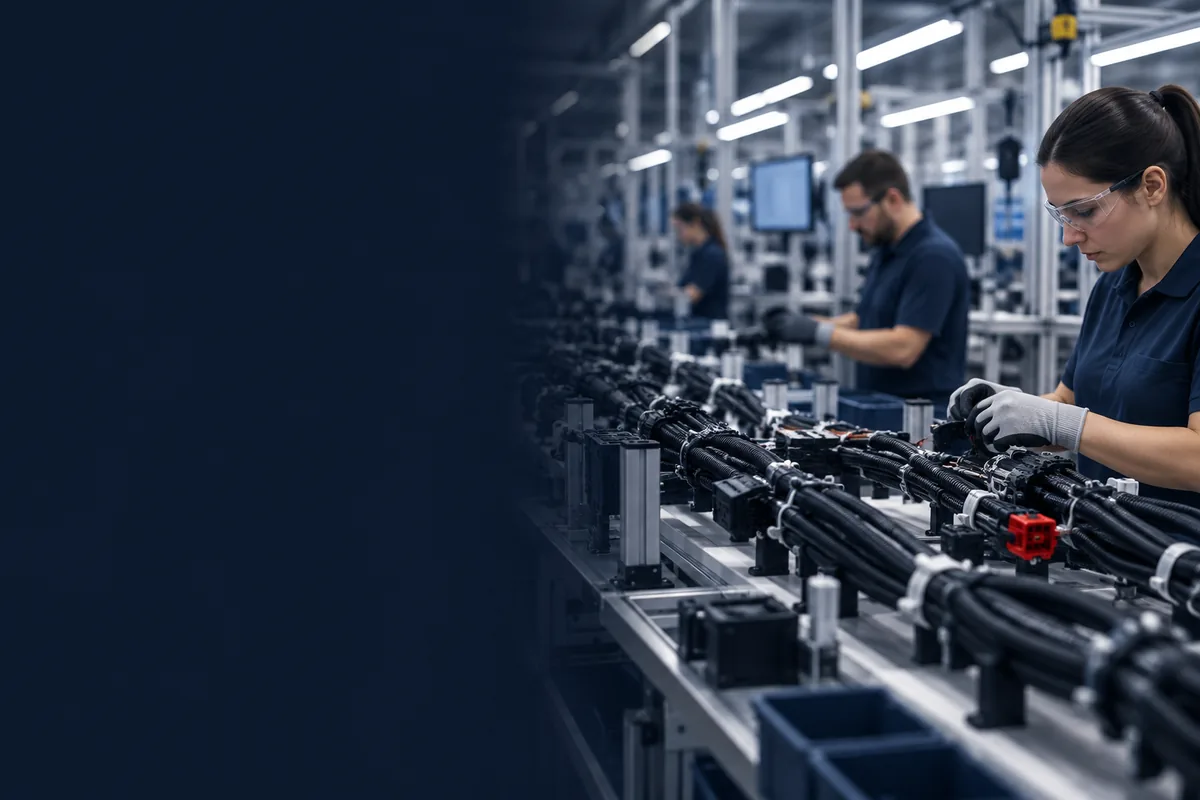
Selecting the wrong wire harness supplier can create delays and rework. This framework helps OEM teams assess manufacturing controls, evidence, capacity, and communication before approving a cable-assembly supplier.
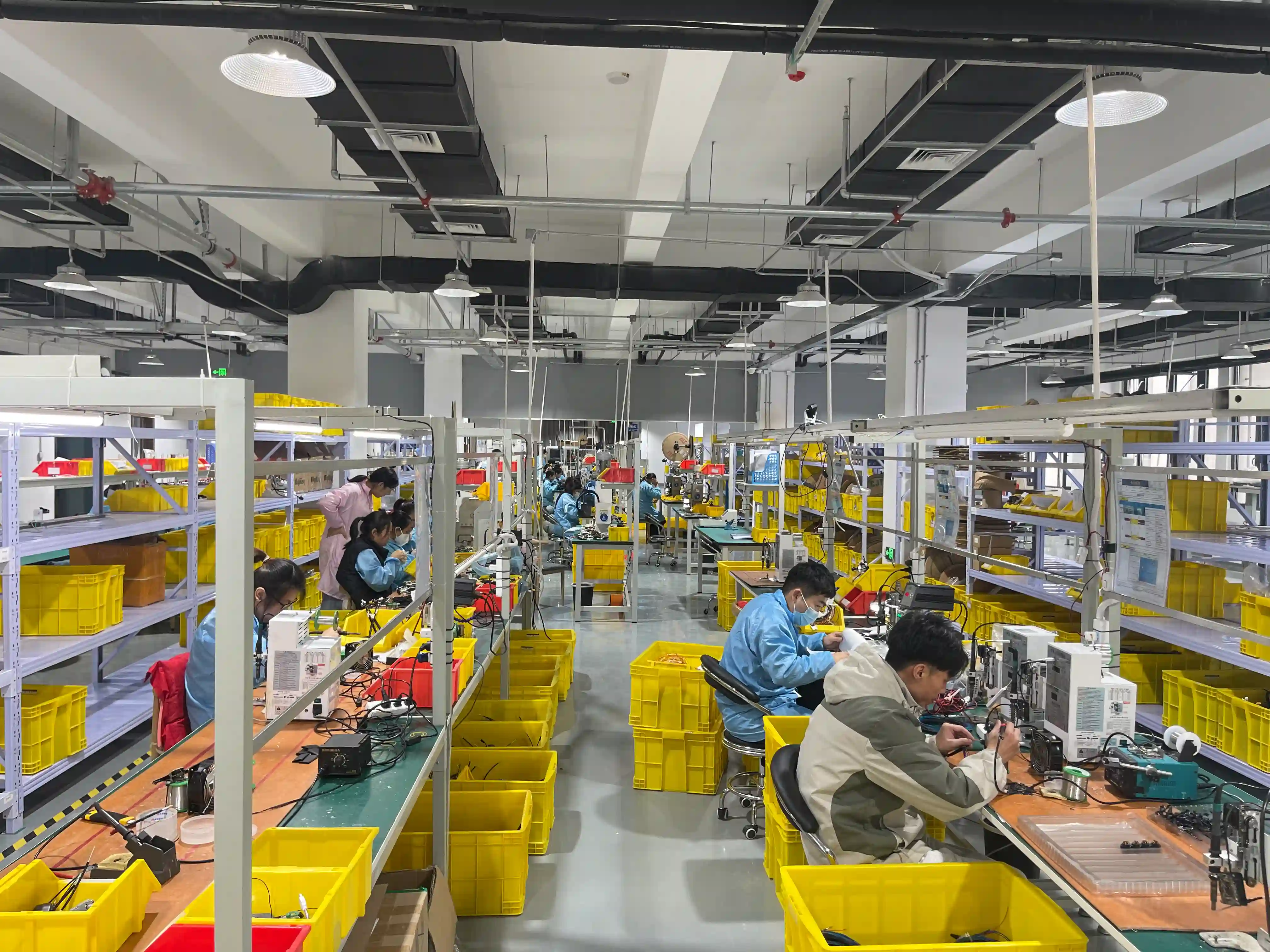
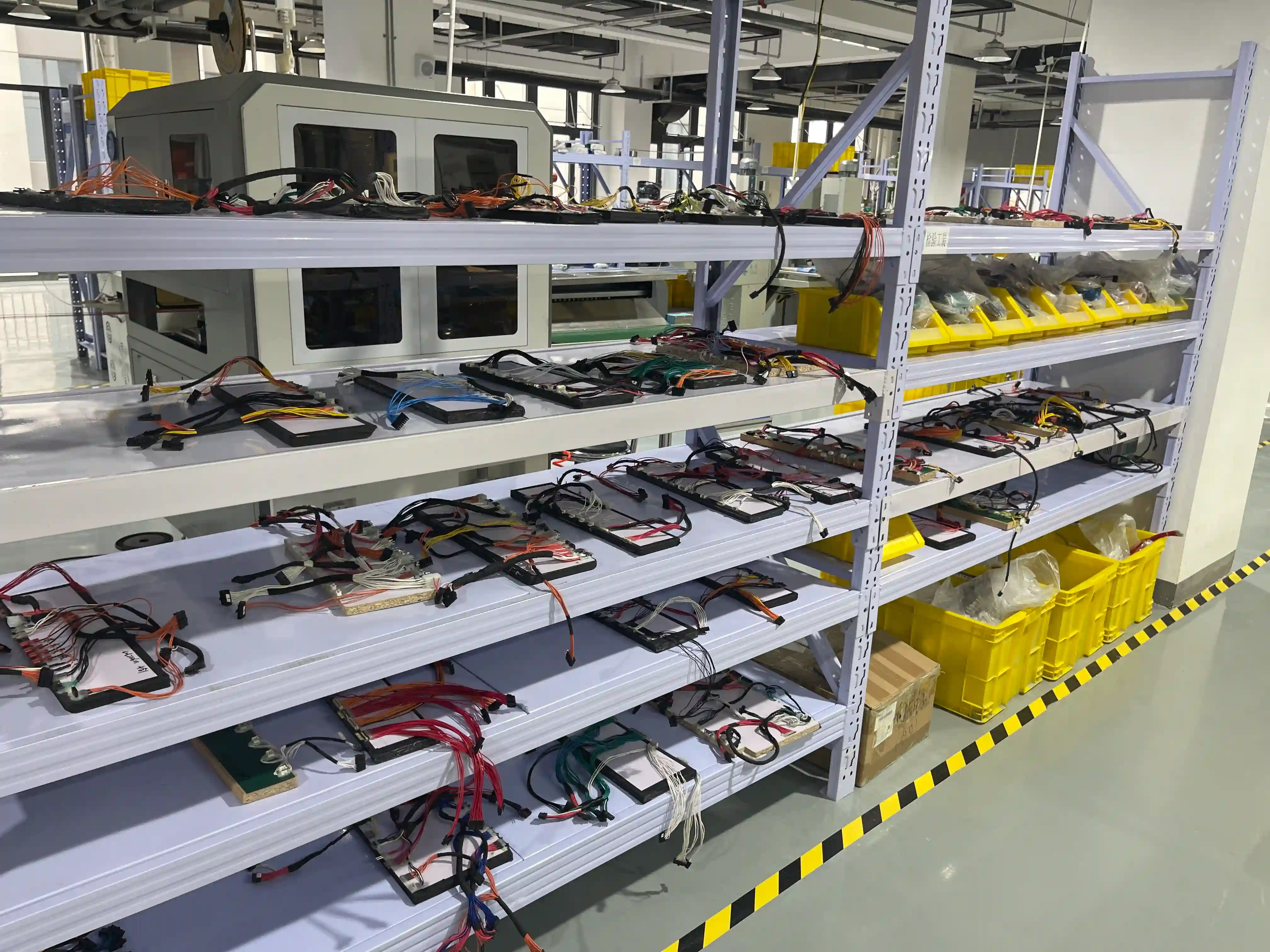
A well-organized wire harness production floor is your first visual indicator of manufacturer quality
Let me be honest with you: choosing a wire harness manufacturer isn't like picking a restaurant on Yelp. There's no "4.8 stars, great ambiance" rating that tells the whole story. A polished website says little about whether a supplier can deliver a consistent crimp, and a modest one can hide a very capable shop.
This guide is for OEM teams evaluating wire harness manufacturers across automotive, medical, robotics, and industrial automation and choosing the right partner. It distills the evaluation into 12 factors that actually matter.
Why Your Choice of Manufacturer Matters More Than Ever
Wire harnesses are the nervous system of any electrical product. A harness failure can interrupt product operation—and in industries like medical devices or automotive, that failure could have serious consequences. Use the relevant IPC workmanship criteria and customer test requirements to assess wiring quality.
Define Your Requirements First
Before you even Google "wire harness manufacturer," you need clarity on what you're actually looking for. Many RFQs are essentially "we need some wires connected." That's like walking into a car dealership and saying "I need something with wheels."
Questions to Answer Before Sourcing:
Technical Specs
- Voltage & current requirements
- Operating temperature range
- Environmental conditions (IP rating needed?)
- Signal types (power, data, analog, digital)
Business Requirements
- Annual volume (prototype vs. production)
- Target unit cost
- Required certifications
- Lead time expectations
Use our Wire Harness RFQ Checklist to make sure you're providing manufacturers with everything they need for an accurate quote. A complete RFQ can reduce clarification cycles and improve quotation accuracy.
Verify Critical Certifications
Certifications aren't just fancy logos for the website. They provide evidence about a defined management-system or product scope, subject to verification. When a manufacturer tells you they're "working toward" a certification, verify whether certification has actually been issued. Here's what each certification actually means for you:
| Certification | What It Means | Applicability to Confirm |
|---|---|---|
| ISO 9001 | Basic quality management system with documented processes | Often requested; verify scope |
| IATF 16949 | Automotive-specific QMS with PPAP, FMEA, SPC requirements | Automotive OEMs |
| ISO 13485 | Medical device quality management with full traceability | Medical devices |
| ISO 9001 | industrial quality with risk management and configuration control | industrial equipment |
| IPC/WHMA-A-620 | Wire harness workmanship standard (Class 1/2/3) | Any quality-critical application |
| UL Certification | Safety testing and compliance for North American markets | Consumer electronics, appliances |
Pro tip: Ask for the certification body's name and verify it on their website. Fake certificates do exist, so verify them. The IPC Validation Services portal provides information on validation services; verify the specific credential with its issuer.
Evaluate Technical Capabilities
Not all wire harness manufacturers are created equal. Some excel at high-mix, low-volume custom work. Others are optimized for repeat volume production. You need to match their capabilities to your actual needs—not their marketing claims.
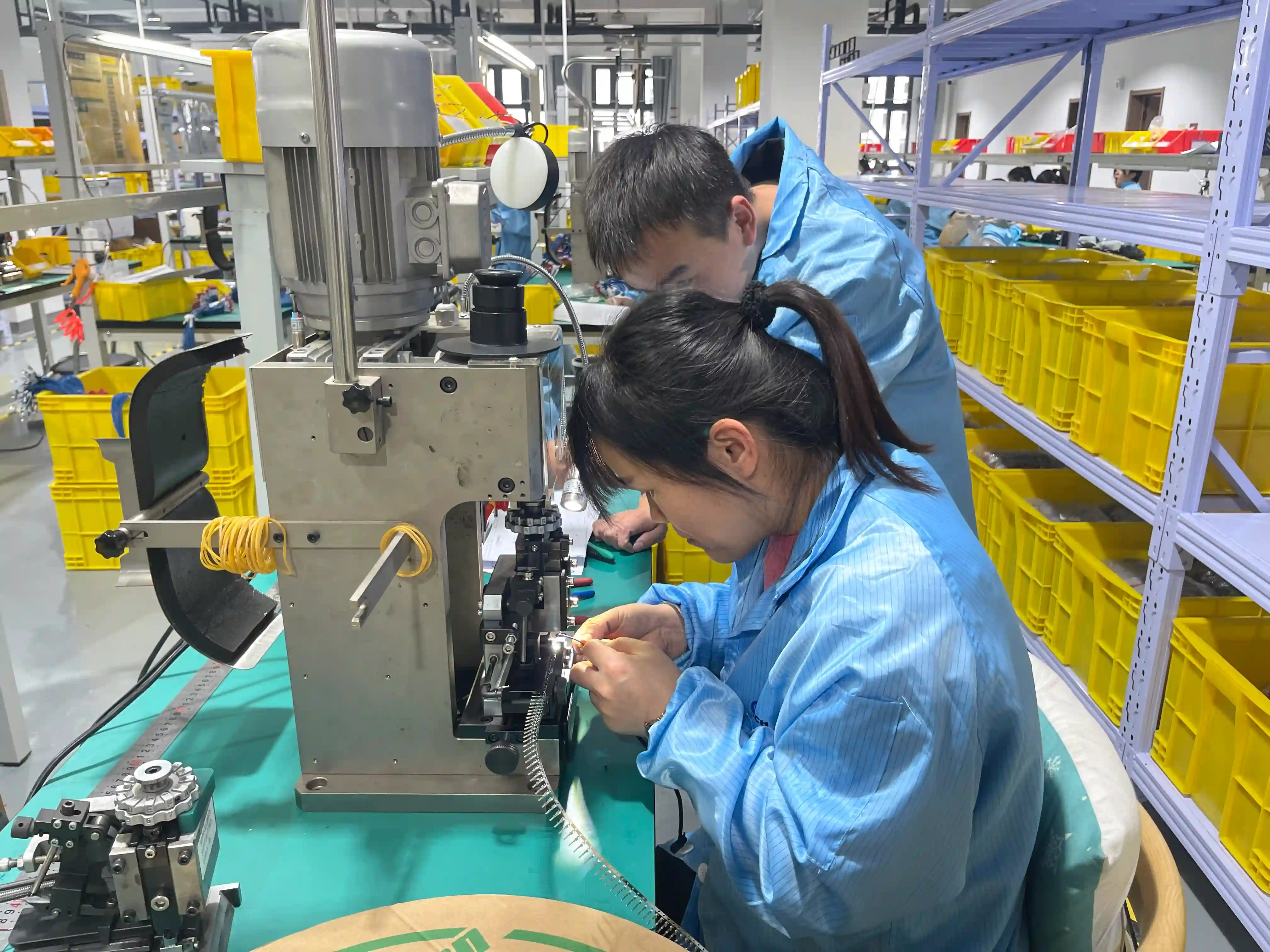
Key Technical Capabilities to Assess:
Equipment & Automation
- • Automated wire cutting & stripping machines
- • Crimp force monitoring systems
- • Ultrasonic welding equipment
- • Laser wire marking capabilities
- • Overmolding and potting equipment
Process Capabilities
- • Wire gauge range (matched to the drawing)
- • Connector types supported
- • Shielding and EMI protection
- • High-voltage capabilities matched to the rated system voltage
- • Ingress protection (for example, IP67/IP68 as specified and tested)
Want to dive deeper? Check out our Capabilities page to see what a well-equipped manufacturer should offer. We also have a Wire Harness Design Guide that covers the technical requirements in detail.
Assess Production Capacity & Scalability
A supplier suited to a small prototype run may need different capacity and scheduling arrangements for recurring production. Confirm how the supplier would support your ramp and competing orders.
| Volume Tier | MOQ to Confirm | Lead Time to Confirm | Best Supplier Type |
|---|---|---|---|
| Prototype | Small sample quantity | Confirm material and sample schedule | Specialized prototype shops |
| Low Volume | Small batches | Confirm batch schedule | Flexible mid-size manufacturers |
| Mid Volume | Recurring batches | Confirm production capacity | Contract manufacturers |
| High Volume | Volume production | Confirm ramp and delivery schedule | Large-scale production facilities |
At our facilities, confirm support for prototype runs, production capacity, and ramp requirements for your program.
Review Quality Control Systems
Quality isn't something you inspect at the end—it's built into every step of the process. During a supplier review, examine the quality lab and inspection records. You can tell a lot about a manufacturer by how seriously they take inspection.
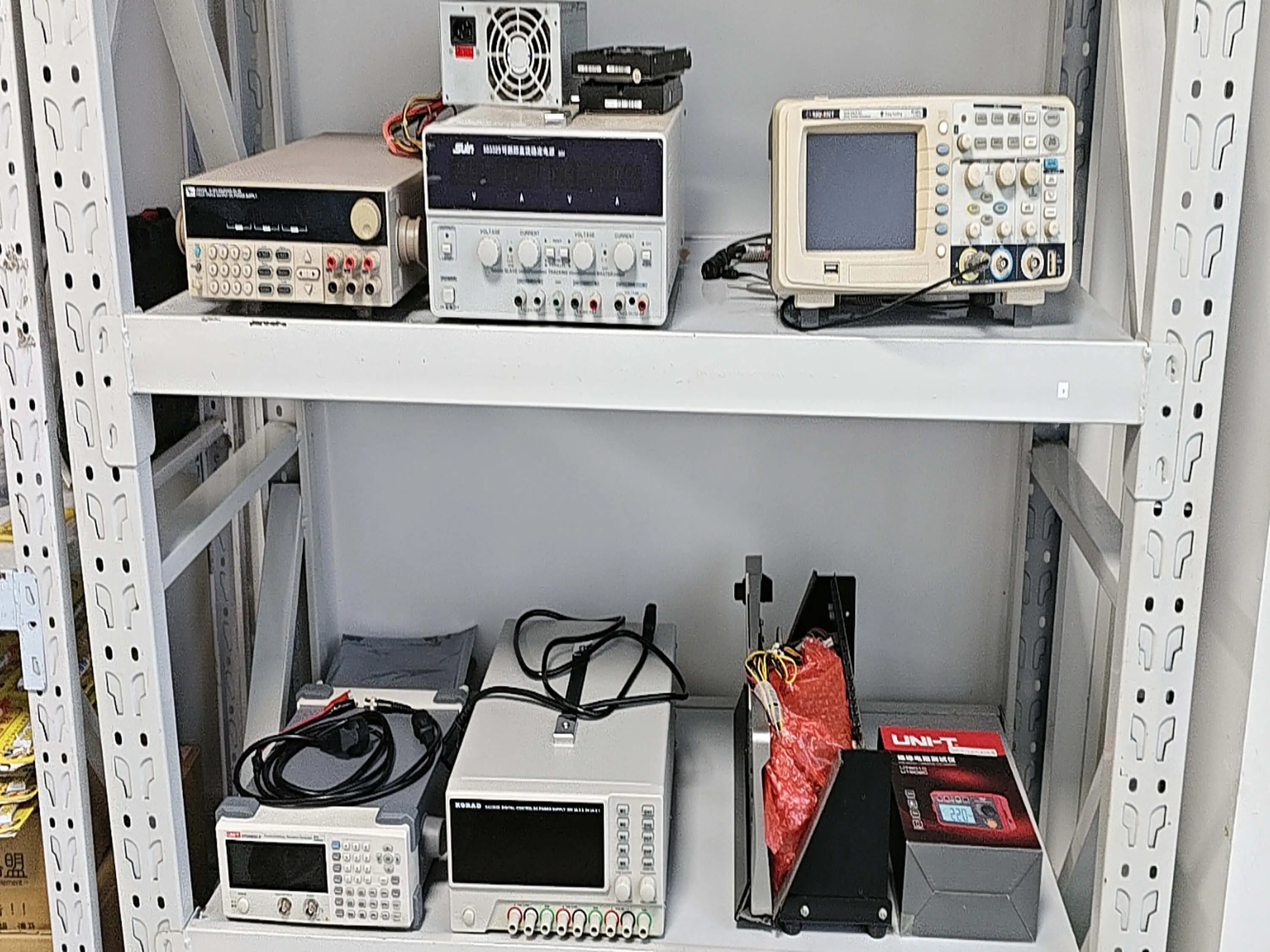
Quality Control Checkpoints:
Incoming Quality Control
Inspection and sampling to the approved control plan; verify material certificates
In-Process Quality Control
Crimp force monitoring, first-article inspection, operator self-checks, SPC data collection
Final Quality Control
Electrical, visual, dimensional, and packing checks to the approved test plan
Engineering & Design Support
Engineering support can help improve a specification before production. A supplier with strong engineering support can identify cost-saving opportunities, catch design issues before production, and suggest better component alternatives you might not know about.
Engineering Services to Look For:
- DFM (Design for Manufacturability) analysis
- 3D modeling and routing simulation
- Component selection assistance
- Value engineering for cost reduction
- Schematic review and optimization
- Compliance consultation (UL, CE, etc.)
Confirm the scope and terms of a DFM review; resolving design issues early can reduce later rework. Learn more about our custom cable assembly process.
Testing Capabilities
Testing is where theory meets reality. A manufacturer might have beautiful crimps and neat lacing, but if they can't verify electrical performance, you're rolling the dice with every shipment. Here's what proper testing looks like:
| Test Type | Purpose | When Required |
|---|---|---|
| Continuity Testing | Verify all connections are complete, no opens or shorts | As required by the approved control plan |
| Hi-Pot Testing | Verify insulation integrity under high voltage stress | Safety-critical applications |
| Pull Force Testing | Verify crimp and termination strength | Per IPC/WHMA-A-620 |
| Resistance Testing | Measure circuit resistance for power applications | High-current circuits |
| Environmental Testing | Thermal cycling, humidity, vibration simulation | Automotive, industrial, outdoor |
Review the available testing lab capabilities for your assembly, and agree on the shipment test records before production.
Industry-Specific Experience
A manufacturer experienced in automotive harnesses doesn't automatically know how to build medical device cables—and vice versa. Each industry has its own standards, materials, documentation requirements, and gotchas that only experience teaches.
Automotive
IATF 16949, PPAP documentation, strict change control, temperature range defined by the application
Medical
ISO 13485, FDA compliance, biocompatible materials, lot traceability
Robotics
High-flex cables, continuous motion rated, EMI shielding, compact designs
Industrial
Harsh environments, oil/chemical resistance, industrial protocols (Profinet, EtherCAT)
Ask for case studies or references in your specific industry. Better yet, ask to speak with a current customer who has similar requirements. Reference availability may depend on customer confidentiality; request other verifiable evidence if needed.
Supply Chain Stability
Supply interruptions illustrate a sourcing risk: your manufacturer is only as good as their component supply. A factory with beautiful equipment is useless if they can't get the connectors you need.
Confirm stock availability and the authorized sourcing route for each specified component. Our Molex cable assemblies page shows our depth in that connector family alone.
Location & Logistics
"Should I source from China, Mexico, or keep it domestic?" This is a common sourcing question. The honest answer: it depends on your priorities. Here's how different regions typically compare:
| Factor | China | Mexico | USA/Europe |
|---|---|---|---|
| Labor Cost | $$$ | $$ | $ |
| Lead Time (to USA) | Confirm route and carrier | Confirm route and carrier | Confirm route and carrier |
| MOQ Flexibility | High | Medium | Medium |
| Communication | Timezone gap | Same timezone | Native English |
| IP Protection | Requires due diligence | Good | Strong |
Communication & Responsiveness
Unclear answers from a supplier can undermine the working relationship. Pay attention to communication quality during the quoting process—it's a preview of what working together will be like.
Green Flags
- • Meets an agreed response-time expectation
- • Asks clarifying questions about your needs
- • Provides detailed, itemized quotes
- • Proactively suggests improvements
- • Has dedicated project manager assigned
Red Flags
- • Days to get a response
- • Generic, copy-paste responses
- • Can't explain their own quote
- • Different person every time you call
- • Avoids technical questions
Confirm the communication language, available support hours, and escalation contact. Visit our contact page or check our About page to meet the team you'll be working with.
Request Samples & Conduct Site Visits
Before committing to production, consider a pilot program and compare samples from shortlisted candidates side-by-side. Look beyond just "does it work" to examine workmanship details that indicate long-term reliability.
Sample Evaluation Checklist:
- Crimp quality (cross-section if possible)
- Wire stripping (no nicks or cut strands)
- Label quality and accuracy
- Overall neatness and consistency
- Connector seating and locking
- Heat shrink application
- Documentation accuracy
- Packaging protection
If possible, visit the factory in person. Photos can be deceiving, and there's no substitute for walking the production floor. Pay attention to housekeeping, worker training, and how they respond to your questions. We welcome factory tours—check out our facilities page for a virtual preview.
Manufacturer Comparison Checklist
Use this scoring matrix to objectively compare your shortlisted manufacturers. Rate each factor 1-5 and calculate the weighted score based on your priorities.
| Evaluation Factor | Weight | Supplier A | Supplier B | Supplier C |
|---|---|---|---|---|
| Certifications | 15% | __/5 | __/5 | __/5 |
| Technical Capabilities | 15% | __/5 | __/5 | __/5 |
| Quality Systems | 20% | __/5 | __/5 | __/5 |
| Industry Experience | 15% | __/5 | __/5 | __/5 |
| Pricing | 15% | __/5 | __/5 | __/5 |
| Communication | 10% | __/5 | __/5 | __/5 |
| Sample Quality | 10% | __/5 | __/5 | __/5 |
| TOTAL WEIGHTED SCORE | 100% | __/5 | __/5 | __/5 |
Red Flags to Watch For
Some patterns reliably signal trouble. Here are warning signs that should make you think twice:
Price Too Good to Be True
If a quote is substantially lower, check whether materials, test scope, tooling, and delivery terms are comparable.
Won't Provide References
Request references or other verifiable evidence of relevant work.
No Quality Data Available
Can't show you PPM rates, first-pass yield, or corrective actions? Run.
Pushy Sales Tactics
"Special discount expires today!" warrants checking the offer’s terms and timing.
Factory Photos Don't Match
Reverse image search their factory photos. You'd be surprised.
Can't Explain Their Process
If the salesperson cannot explain the build process, request a discussion with engineering and verify where production occurs.
Final Thoughts
Choosing a wire harness manufacturer is one of the most important supply chain decisions you'll make. A suitable partner can help identify design issues, discuss cost options, and plan for changing production needs.
A poorly matched partner can create cost, schedule, and customer-service problems.
Take your time. Do your homework. And remember: unit price alone does not establish total cost.
A Personal Note from Hommer
A clear released design helps the transition from RFQ to production. If you're evaluating manufacturers, send the drawing, BOM, volumes, and test requirements so we can give a candid fit assessment.
Feel free to reach out directly at our contact page. No pressure, no sales pitch—just a conversation.
Related Articles You Might Find Useful
Wire Harness RFQ Checklist: 15 Details Manufacturers Need
Make sure your quote requests have everything needed for accurate pricing.
Cable Assembly vs Wire Harness: Complete Guide
Understand the differences to specify the right solution for your project.
Wire Harness Design Guide: 10 Critical Steps
Engineering best practices for designing manufacturable harnesses.
Cable Selection Guide for Warehouse Robots
Industry-specific guidance for robotics and automation applications.
External Resources & References
- IPC/WHMA-A-620 Standard — Official workmanship standard for cable and wire harness assemblies
- SAE J1128 — Low-voltage primary cable standard for automotive applications
- UL Wire & Cable Certification — Safety certification requirements and database
- WHMA (Wiring Harness Manufacturers Association) — Industry association with resources and standards
Frequently Asked Questions
What should I look for when choosing a wire harness manufacturer?
Evaluate certifications, capability range, in-house testing, traceability, and communication quality. A strong partner can show documented processes, relevant industry approvals, and a track record in your specific application rather than just a low price.
Which certifications matter most for a harness manufacturer?
IPC/WHMA-A-620 is the workmanship baseline, ISO 9001 covers the quality system, and industry-specific approvals matter for regulated work — IATF 16949 for automotive, ISO 13485 for medical, and UL recognition for safety-critical wiring.
Should I choose a domestic or overseas manufacturer?
It is a trade-off. Overseas suppliers often offer lower cost and broad capacity, while domestic suppliers can provide shorter lead times, easier communication, and simpler IP control. Many buyers blend both to balance cost against speed and risk.
How can I assess quality before placing an order?
Request a facility audit or virtual tour, evaluate samples, ask for a First Article Inspection report and test data, and check references in your industry. These steps reveal real capability far better than a capabilities brochure.
What are red flags when evaluating a manufacturer?
Be cautious of vague answers about testing, no lot traceability, reluctance to share certifications or test reports, and unrealistically short quotes. These warrant closer review of the supplier’s process and evidence.
How important is MOQ and volume flexibility?
Very, if your needs change over time. A manufacturer that handles both prototypes and production lets you scale without re-qualifying a new supplier, which saves significant time and engineering effort as your program grows.