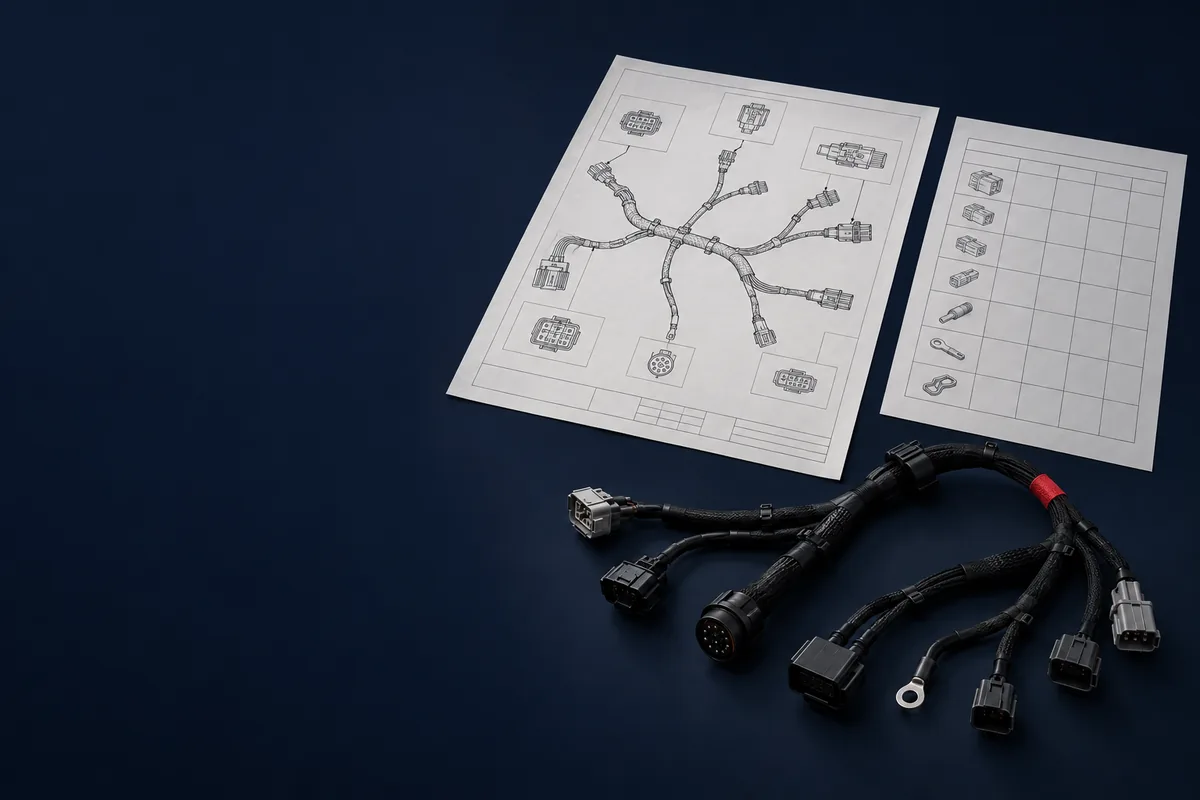
First article inspection is where many wire harness programs quietly lose time and money. The sample arrives, continuity passes, the connector mates, and everyone wants to move forward. Two weeks later the same harness is back on the table because the branch breakout is 18 mm off, the pull-force record is missing, the label revision does not match the released drawing, or the supplier cannot prove which terminal lot went into the approved sample. At that point pilot timing slips, premium freight appears, and the sourcing team is explaining why a “good sample” still was not approval-ready.
This guide is for OEM buyers, NPI teams, supplier-quality engineers, and procurement managers who need a first article process that actually protects launch timing. It explains what first article inspection should cover on a wire harness, which defects matter most, what to request from the supplier before review, and how to turn FAI from a reactive argument into a controlled gate. If you are planning a sample build now, pair this guide with our wire harness RFQ checklist, wire harness prototyping guide, and wire harness testing service page.
Public references such as first article inspection, IPC standards, ISO 9001 quality systems, and PPAP explain the framework. What buyers still need is the practical checklist for a real cable assembly or wire harness approval.
1. Why first article inspection becomes expensive so fast
Wire harness FAI is expensive when teams use it only to verify fit and forget that the approved sample becomes the reference for production. A harness can look acceptable on the bench and still create launch risk if the approved state is not fully documented. The cost problem is not usually one bad crimp. It is the chain reaction that starts when sample hardware, work instructions, test records, and drawing revision stop matching each other.
For B2B buyers, the operational pain is immediate. Purchasing wants approval so material can be released. Manufacturing wants the sample frozen so fixtures and board layouts do not change again. Quality wants traceability, pull-force evidence, insulation resistance data, and clear acceptance criteria tied to the released revision. If any of those pieces are missing, first article review turns into repeated email loops and sample rebuilds instead of a launch gate.
2. What a wire harness FAI should actually cover
A useful wire harness FAI covers five control layers: released design, physical build, workmanship, electrical and mechanical test evidence, and traceability. Buyers should review those layers as one package, not as separate documents that can disagree silently. If your supplier sends a sample photo, a continuity printout, and a promise that everything else is “per drawing,” you do not yet have first article control.
At minimum, the buyer should confirm the sample part number, drawing revision, BOM revision, connector orientation, branch dimensions, wire type, color or marking logic, terminal and seal part numbers, protective materials, label content, packaging method, and the actual acceptance standard used for workmanship. For many industrial and automotive programs that workmanship reference is IPC/WHMA-A-620. For regulated sectors, FAI should also align with the broader quality framework already defined in the RFQ or quality agreement.
Comparison table: what buyers should verify before approving the sample
| FAI Check Area | What To Verify | Common Failure | Why It Delays Launch | Buyer Action |
|---|---|---|---|---|
| Revision control | Drawing, BOM, sample label, and report all match the released revision | Sample built to old connector or branch revision | Every downstream report has to be rebuilt | Lock revision on the FAI cover sheet before review starts |
| Dimensional layout | Overall length, breakout points, branch lengths, clip positions, and orientation | Harness fits on bench but not in product envelope | Fixture, routing, and install sequence change late | Require measured results against drawing tolerances |
| Workmanship | Crimp appearance, seal seating, insertion depth, dress, taping, and marking | Acceptable function with poor repeatability | Volume production cannot hold the same quality level | Reference IPC/WHMA-A-620 class explicitly |
| Electrical test | Continuity, shorts, insulation resistance, hipot, and any special functional checks | Only continuity was tested | Field failure risk is pushed into pilot or SOP | Define the exact test plan in the RFQ or FAI request |
| Mechanical robustness | Pull-force, retention, strain relief, and connector lock engagement | Terminal stays connected electrically but fails under handling | Rework and warranty risk increase after shipping | Request measured values, not “pass” only |
| Traceability | Wire, terminals, seals, housings, labels, sleeves, and outsourced subparts linked to lots | Approved sample cannot be traced to production materials | PPAP, audit, and containment decisions get blocked | Review lot records during FAI, not after the PO release |
3. The buyer checklist before the FAI meeting starts
The fastest way to clean up first article inspection is to control the input package before the sample arrives. Buyers should never start FAI with open questions about which drawing is current, whether alternates are approved, or which environmental test level applies. If those answers are not clear before the meeting, the FAI becomes an engineering workshop instead of an approval gate.
Use this pre-review checklist before you schedule the sample meeting:
- Released drawing and BOM with revision dates visible
- Approved alternates or deviations listed in writing
- Quantity stage identified: prototype, pilot, FAI, PPAP sample, or production release
- Target environment: indoor, under-hood, washdown, medical, vibration, flex, UV, or chemical exposure
- Test scope defined: continuity, hipot, insulation resistance, pull-force, fit-check, or application-specific validation
- Workmanship reference defined, such as IPC/WHMA-A-620 Class 2 or Class 3
- Packaging and labeling requirements defined if the sample will move directly into customer review
- Required deliverables listed: dimensional report, test report, material certs, FAI form, photos, or traceability sheet
- Supplier contact named for quality decisions during the review call
- Acceptance decision path defined: approve, approve with conditions, or reject and rebuild
If your supplier is also preparing production-intent validation, align the FAI package with your wire harness PPAP process, IATF 16949 quality requirements, and any prototype cable assembly milestones already agreed.
4. What separates a real FAI from a cosmetic sample review
Some buyers still review first articles like showroom samples. They check whether the harness “looks right,” whether the mating connector clicks, and whether the resistance tester prints “pass.” That is not enough. A real FAI should confirm that the sample was built with the same controlled logic the supplier will use in production: released materials, defined work instructions, verified crimp settings, measurable branch dimensions, and repeatable electrical test criteria.
On wire harnesses, workmanship matters because cosmetic-looking defects often predict later escapes. A partially seated seal may still pass continuity. A nicked conductor may still survive the bench test. A tape wrap started at the wrong branch angle may still fit the fixture. Those issues become launch problems when the assembly moves into vibration, operator handling, or higher production volume. That is why the first article must include both visible workmanship review and recorded test evidence.
The minimum evidence package usually includes dimensional inspection, continuity results, insulation resistance or hipot where required, pull-force or retention evidence for critical terminations, photos of key features, and a parts-lot record. For high-risk programs, buyers should also request cross-sections, crimp-height data, sealing checks, mating-force observations, and traceability for outsourced subassemblies such as overmolded exits or labeled branch kits.
5. When to approve, conditionally approve, or reject
Buyers need a decision rule before the sample review ends. Without one, teams approve weak samples under schedule pressure and then try to recover with side emails. The better approach is to classify findings by launch risk. Cosmetic issues that do not affect fit, function, traceability, or repeatability may be conditionally approved with a documented correction. Revision mismatch, missing critical test evidence, uncontrolled alternate materials, or dimensional nonconformance on critical branches should trigger rejection and rebuild.
A conditional approval should still be narrow. It means the harness is acceptable for the defined sample purpose while specific corrections are closed before the next stage. It does not mean “good enough, we will figure it out later.” If the supplier cannot describe how the corrected build will be controlled in the work instruction, test file, or material record, the issue is not closed.
Five findings that usually justify rejection
- Sample part number, label, or report tied to the wrong drawing or BOM revision
- Critical branch dimensions or connector orientation outside released tolerance
- Missing electrical or mechanical test evidence required by the program
- Unapproved substitute wire, terminal, seal, tape, or protective material
- No traceability path for the approved sample materials or process settings
6. What to send suppliers so the next sample goes faster
Many FAI delays start much earlier than inspection day. They start with incomplete source data. If you want the next wire harness sample to move faster, send a controlled package instead of scattered revisions. The supplier should receive the latest drawing, BOM, quantity split, operating environment, test scope, compliance target, packaging rules, and target lead time in one package. That is the difference between engineering review and guesswork.
For practical B2B sourcing, the strongest next-step package includes the released drawing or approved sample reference, BOM with manufacturer part numbers where controlled, annual and pilot quantity, installation environment, target lead time, compliance target, and the exact FAI or PPAP deliverables required. That lets the supplier quote the true scope, plan the right fixtures and test files, and return a realistic schedule.
If your program needs help on test setup, route validation, or production readiness after FAI, review our manufacturing capabilities, custom cable assembly services, and contact page before releasing the next sample loop.
Frequently Asked Questions
What is the difference between a prototype sample and a wire harness first article?
A prototype proves a design idea can be built and tested. A first article proves the released revision, material set, workmanship standard, and inspection method are controlled well enough to become the production reference. In practice, a first article should include documented dimensional and test evidence, not just a working sample.
Should wire harness FAI always include pull-force data?
For critical crimps, high-reliability applications, or programs tied to IPC/WHMA-A-620, automotive quality requirements, or customer-specific controls, buyers should expect pull-force or equivalent mechanical evidence. A simple “visual pass” is rarely enough when termination reliability matters.
Can continuity testing alone approve a first article?
No. Continuity only proves that the intended circuits connect at the moment of test. It does not prove branch dimensions, connector orientation, crimp quality, seal seating, insulation integrity, retention force, or traceability control. Buyers should treat continuity as one line item in the FAI package, not the whole decision.
When should a buyer reject instead of conditionally approve?
Reject when the finding affects revision control, fit, function, required test scope, approved materials, or traceability. Conditionally approve only when the issue is minor, documented, low risk, and clearly correctable before the next build stage without changing the approved technical baseline.
How many first article samples should buyers request?
The answer depends on harness complexity, branch count, connector risk, and whether the sample also supports PPAP or customer qualification. For many OEM programs, one documented master sample plus additional samples for destructive or application testing is more useful than a single untouched “golden” piece.
What should I send with my next FAI or production-ready RFQ?
Send the drawing, BOM, target quantity, environment, target lead time, compliance target, and the exact FAI deliverables you need. Also include any special test, labeling, packaging, or customer-specific requirements so the supplier can quote and plan the correct approval scope from the start.
Need a launch-ready wire harness FAI package?
Send your drawing, BOM, quantity by build stage, installation environment, target lead time, and compliance target through our contact page. If you already have a sample, include the current FAI report, photos, and any open nonconformances. We will return a DFM and inspection-gap review, a realistic sample or rebuild plan, the recommended test and documentation scope, and a quotation aligned to the approval stage you actually need.
- Send next: drawing or existing sample reference, BOM, quantity, environment, target lead time, compliance target
- You receive back: DFM review, inspection-gap list, recommended test scope, quote, and realistic timing
- Best fit for: OEM buyers, supplier-quality teams, NPI programs, pilot and SOP release planning