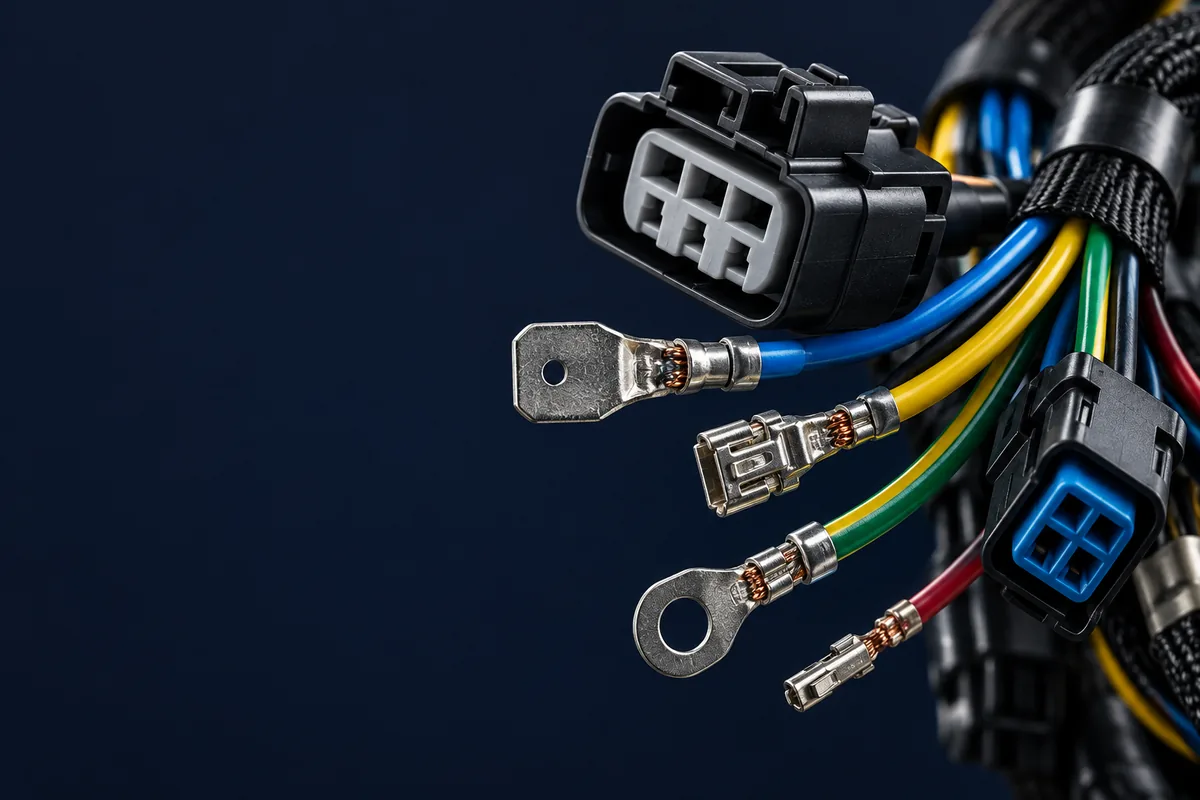
"JST connector" is not one part — it is a family of wire-to-board and wire-to-wire connector series from the Japan Solderless Terminal company, and the series you pick decides pitch, current, and wire range. The two most-asked-about are the JST-XH (2.5 mm pitch) and the JST-PH (2.0 mm pitch). They look similar and are not intermateable: XH carries more current on a larger pitch, PH is smaller and denser. Choosing between them — and specifying the rest of the connector so a harness is buildable — is what this guide covers.
TL;DR
- "JST" is a manufacturer, not a single connector — always specify the series (XH, PH, SH, ZH, GH, VH).
- JST-XH = 2.5 mm pitch, rated up to about 3 A per contact; JST-PH = 2.0 mm pitch, up to about 2 A.
- XH and PH are not intermateable — a 2.5 mm housing will not correctly mate a 2.0 mm header.
- Specify series and pitch, contact/terminal part number, wire gauge and rating, polarity/keying, and lead length together.
- Release on crimp-height and pull-force records to IPC/WHMA-A-620, not on the housing "clicking in".
What "JST connector" actually means
JST publishes dozens of connector series, and calling for "a JST connector" without the series is like calling for "a bolt" without the thread. Each series fixes a contact pitch (the center-to-center spacing between pins), a current rating, and a wire-gauge range, and the series are generally not cross-compatible. The first job on any RFQ is therefore to name the series, because everything downstream — the mating header, the crimp terminal, the applicator tooling — follows from it. The connector-family logic behind this choice sits alongside our wire harness connector selection guide.
The JST series you will actually specify
Most wire-harness work lands on a handful of series. The figures below are JST's published nominal ratings and should always be confirmed against the specific series datasheet and any temperature derating for your application:
- JST-SH — 1.0 mm pitch. Very compact, roughly 1 A per contact. Common on small PCBs and space-constrained wire-to-board links.
- JST-GH — 1.25 mm pitch. Compact with an optional lock, around 1 A. Used where SH is too fragile but board space is still tight.
- JST-ZH — 1.5 mm pitch. Around 1 A, a step up in robustness from SH/GH.
- JST-PH — 2.0 mm pitch. Up to about 2 A per contact; one of the most common signal and low-power connectors in consumer and industrial electronics.
- JST-XH — 2.5 mm pitch. Up to about 3 A per contact; the workhorse for power and battery leads, and the de-facto standard for LiPo balance connectors.
- JST-VH — 3.96 mm pitch. Up to about 10 A per contact; used where the harness carries real power.
JST-XH vs JST-PH — the real comparison
These two get confused because they are both crimp-terminal, disconnectable wire-to-board series in overlapping applications. The differences that matter:
- Pitch. XH is 2.5 mm; PH is 2.0 mm. That spacing difference alone means a 3-pin XH housing is physically wider than a 3-pin PH, and the two do not mate — a 2.5 mm housing will not seat correctly on a 2.0 mm header.
- Current. XH is rated higher (about 3 A per contact) than PH (about 2 A), because the larger pitch and contact accept a heavier wire and dissipate more heat. For a power or battery lead, XH is usually the right call.
- Wire gauge. XH commonly accepts around 22–28 AWG and PH around 24–30 AWG — but the crimp range is set by the specific terminal, so it must be read from the terminal datasheet, not assumed from the series.
- Density. PH's 2.0 mm pitch packs more circuits into the same width, which is why it dominates signal and low-power connections where board real estate matters more than current.
The short rule: reach for XH when the lead carries power or you want a rugged, forgiving crimp; reach for PH when you need density and the current is low. Neither is "better" — they solve different problems, and a design often uses both. If a program needs a JST contact removed or reworked, the how to depin a connector guide covers the depinning process, and the Molex connector rework guide shows the same discipline on a comparable series.
How to specify a JST harness for an RFQ
A JST connector is under-specified more often than a bulky industrial one, precisely because it looks simple. Five things must be defined together for a production-ready quote:
- Series and pitch. Name the series (XH, PH, ...) and confirm pin count; the pitch follows from the series but stating it removes ambiguity.
- Contact / terminal part number. The exact crimp terminal and its plating, and whether it is customer-approved or open to an equivalent — the terminal, not the housing, sets the crimp range.
- Wire gauge, color, and rating. AWG, insulation type and temperature class per UL 758; if the gauge is open, give current, distance, and temperature so it can be sized against the series rating.
- Polarity, keying, and lock. Housing orientation, keyed features, and whether a positive lock is required so the connector cannot back out under vibration.
- Lead length, tolerance, and marking. Length with an acceptable tolerance, plus any label or wire-marking rule.
For the current-and-gauge side of this, the 4-pin connector types guide and electrical terminal connectors guide cover how contact choice drives what a connector can carry.
Crimp and release — what "done" looks like on a JST harness
The reliability of a JST assembly is in the crimp, not the click. JST terminals need the correct applicator or hand tool for the series and gauge — an out-of-range tool produces a crimp that reads fine on continuity and fails on a pull. A production JST harness passes the same gates as any terminated lead: crimp height within the terminal's specification, a pull-force result that meets the applicable class, 100% continuity, and a visual inspection to IPC/WHMA-A-620 workmanship criteria. The crimp discipline behind that is in the wire harness crimping guide. If you need JST harnesses built and released to that standard, our JST cable assembly service covers series selection, terminal sourcing, crimp control, and release evidence.
JST connector FAQs
Are JST-XH and JST-PH interchangeable? No. XH is 2.5 mm pitch and PH is 2.0 mm; the housings do not mate with each other's headers. Choose one per connection and keep it consistent across mating halves.
Which JST connector is used for LiPo balance leads? JST-XH is the de-facto standard for LiPo balance connectors, because its 2.5 mm pitch and ~3 A rating suit battery leads. Confirm pin count matches the cell count plus one.
How much current can a JST connector carry? It depends on the series and the terminal: roughly 1 A for SH/GH/ZH, about 2 A for PH, about 3 A for XH, and up to about 10 A for VH per JST's nominal ratings — always confirmed against the datasheet and derated for temperature and adjacent-contact loading.
What is the most common mistake specifying a JST connector? Calling for "a JST connector" without the series, or picking the housing without the matching crimp terminal and its wire range. The series and terminal define the connection; the housing alone does not.