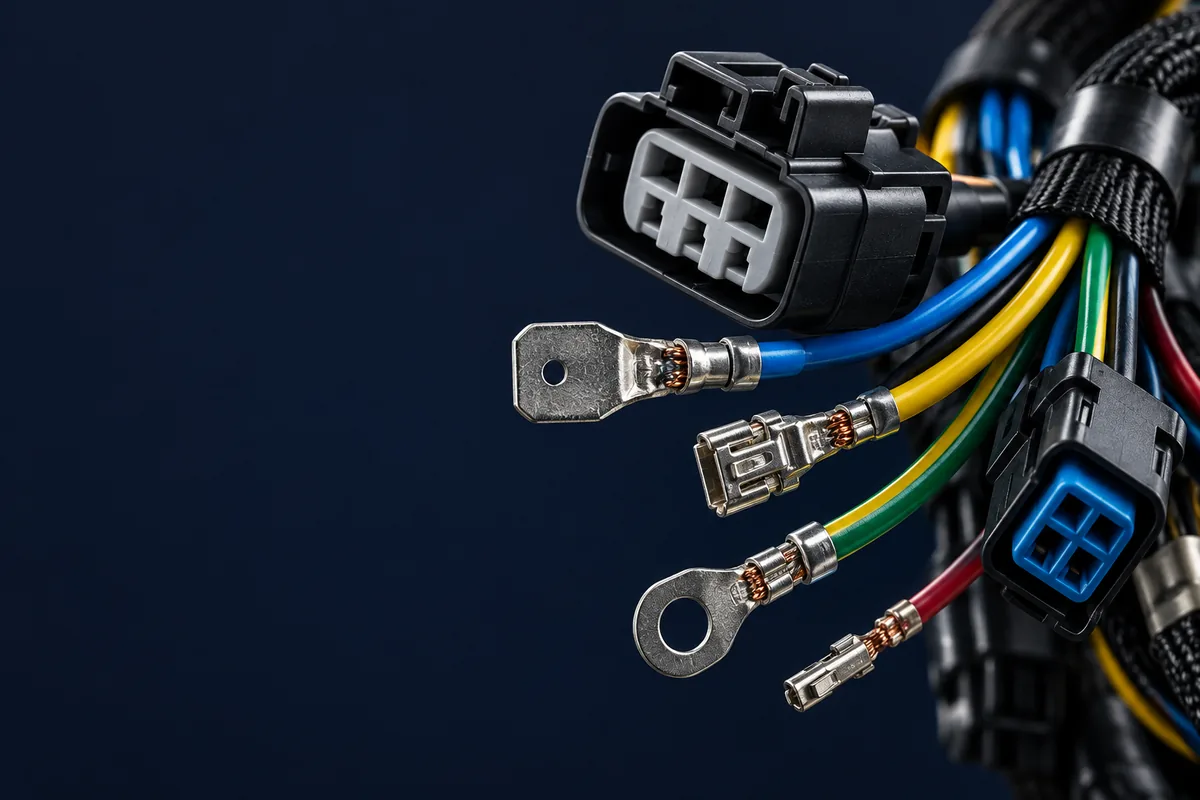
A wire harness quotation may need a terminal-by-terminal review before purchasing approval. A cost breakdown and component datasheets help make the selected materials visible. Ring terminal decisions affect installation: stud size, tongue width, barrel range, plating, and pull-force evidence should be defined before sampling.
TL;DR
- A ring terminal is a crimped circular lug that stays captured under a screw, stud, or ground post.
- Specify wire size, stud hole, tongue width, barrel style, plating, insulation, and crimp tooling together.
- Use IPC/WHMA-A-620, UL-758, and pull-force records as release evidence, not visual inspection alone.
- For vibration, heat, or battery current, validate torque, strain relief, plating compatibility, and 100% continuity.
Background: why ring terminals deserve a separate sourcing check
Ring terminals are easy to underestimate because they look simpler than sealed connector systems. A buyer sees a circular tongue, a crimp barrel, and a color-coded sleeve. A production engineer sees at least 10 linked decisions: conductor size, strand class, insulation outside diameter, barrel geometry, stud hole, tongue width, material thickness, plating, tool setup, and inspection plan.
A ring terminal is a crimp terminal with a closed circular mating end that mounts over a screw, bolt, or threaded stud. A ring terminal connector is the same termination used as part of a wire harness or cable assembly connection point. A ground lug is a ring terminal or similar lug used to bond a conductor to chassis, engine block, bus bar, or earth reference. These definitions matter because a procurement note that says "ring terminal, red" is not enough for production release.
This guide is written for engineers and sourcing teams at the quoting, prototype, or pilot-build stage. The objective is practical: choose a ring terminal that fits the wire and mating hardware, can be crimped repeatably, passes inspection, and does not force avoidable substitutions during ramp. For broader terminal families, compare this article with our electrical terminal connectors guide. For process control after terminal selection, use the wire harness crimping guide and crimp pull test guide.
Ring terminal selection table for wire harness RFQs
Ring terminal selection starts with the conductor and the mounting point. Current rating depends on copper cross-section, contact area, temperature rise, installation torque, and the heat path around the joint. Mechanical reliability depends on the barrel fill, conductor brush, insulation support, tongue stiffness, strain relief, and whether the harness branch can pull sideways on the stud.
| Decision item | What to specify | Factory check before release | Common failure if missed |
|---|---|---|---|
| Wire size | AWG or mm2, conductor material, strand class | Barrel fill and crimp-height setup by wire family | Loose strands, over-crimping, low pull force |
| Stud hole | M3, M4, M5, M6, 1/4 in, or exact drawing size | Fit check on real hardware or gauge pin | Terminal rocks on stud or cannot seat under washer |
| Tongue geometry | Width, length, bend angle, material thickness | Clearance check inside enclosure or on bus bar | Terminal contacts neighboring hardware or twists during torque |
| Barrel style | Insulated, non-insulated, open barrel, closed barrel, heat-shrink sealed | Applicator, die, strip length, conductor brush photo | Hidden crimp defects or poor insulation support |
| Plating | Tin, nickel, silver, or gold, matched to mating surface | Material certificate or supplier datasheet review | Galvanic corrosion, fretting, or rising contact resistance |
| Environment | Temperature, vibration, oil, salt spray, splash, service access | Heat shrink, boot, strain relief, and routing review | Cracked insulation, green corrosion, broken strands near barrel |
| Inspection evidence | IPC/WHMA-A-620 class, pull-force plan, continuity, first-article photos | FAI pack and OQC checklist before shipment | Good-looking terminals with no objective release record |
Standards and evidence that should appear in the quote pack
Ring terminals should be released against a workmanship standard and a product requirement, not a supplier promise. Many OEM harness drawings cite IPC/WHMA-A-620 for cable and wire harness acceptance criteria. Wire and appliance wiring material references often connect to UL programs, including UL-758 style information when the conductor insulation must be traceable. Automotive buyers may also require IATF 16949 process discipline for change control, lot traceability, and corrective action.
For engineers who need a public refresher on connector terminology before reviewing terminal drawings, Electronics Notes connector basics is a useful neutral reference. Use it for vocabulary only; final ring terminal release still depends on the buyer drawing, terminal datasheet, tooling record, and harness inspection criteria.
The practical release package for a ring-terminal harness should include the terminal part number, approved alternate list, wire specification, tool or applicator reference, crimp setup record, pull-force result by wire size, continuity test record, and first-article photos for high-risk terminations. For power cables, ground straps, engine-starting harnesses, or battery-bank interconnects, add torque environment and strain-relief review. Our battery cable assembly and engine-starting harness pages show where ring terminals often become high-current release items instead of minor accessories.
Illustrative prototype review
In a hypothetical automation harness review, separate high-current branches, control leads, and panel ground points. Evaluate terminal tongue and barrel geometry for the power branches, panel clearance for control leads, and plating and washer compatibility at ground points.
This review can help avoid selecting a terminal solely by sleeve color and can make proposed alternates visible before sampling. Compare datasheets, tooling, and installation requirements to support the buyer's approval decision.
Review drawings, BOMs, terminal options, mating hardware, and inspection risks before ordering tooling or bulk material. Catalog availability alone does not establish production suitability: confirm applicator availability, barrel inspection access, stud-hole tolerance, and approved alternates.
Crimping, pull force, and visual inspection controls
Crimping turns a ring terminal into a controlled electrical joint. A correct crimp compresses conductor strands into the barrel without cutting strands, folding the conductor brush back, cracking the barrel, or crushing the insulation support. The best visual inspection still needs measurement or test evidence because a polished sleeve can hide poor conductor compression.
For production, the setup operator should verify terminal reel, wire size, strip length, crimp height or approved tool setting, bellmouth, conductor brush, insulation support, and terminal orientation before release. Pull-force testing should be recorded by wire size and terminal family. Continuity testing should be 100% for finished harnesses unless the buyer has explicitly defined a lower-risk sampling plan. For sealed or heat-shrink ring terminals, the heat process should show full recovery and adhesive flow without jacket burn, split tubing, or exposed strands.
Ring terminal defects often appear near the transition from barrel to wire. Side loading from poor routing breaks strands over time, especially on engine, pump, compressor, and mobile equipment harnesses. If the terminal branch exits at a sharp angle, add a boot, adhesive heat shrink, clip, or bend-relief feature. For assemblies that need branch protection beyond the lug itself, our strain relief cable assembly service and wire cutting and crimping service cover the production controls around strip length, termination setup, and handling.
Ring terminal vs fork terminal vs battery lug
A ring terminal can remain mechanically captured on a stud if clamp force loosens, but that does not ensure a safe electrical connection. A fork terminal is faster to install because the screw does not need full removal, but the open end is less tolerant of vibration, incorrect screw size, or poor clamp force. A battery lug is a heavier high-current terminal, often used with larger cable sizes, thicker tongues, and stronger strain-relief requirements.
| Termination | Best use | Not ideal for | RFQ detail to lock |
|---|---|---|---|
| Insulated ring terminal | Low-to-medium current panel wiring and serviceable grounds | Very tight spaces where sleeve inspection is blocked | Sleeve material, wire range, stud size, temperature rating |
| Non-insulated ring terminal | Compact harnesses with separate heat shrink or boots | Touch-risk locations without downstream insulation | Barrel length, crimp die, post-crimp insulation method |
| Heat-shrink ring terminal | Splash, humidity, outdoor, marine, and field-service wiring | Areas with heat-sensitive jacket materials unless process is controlled | Shrink ratio, adhesive flow, recovery temperature, seal length |
| Fork terminal | Low-vibration control panels where service speed matters | Chassis grounds, mobile equipment, or high-vibration mounts | Fork width, screw size, locking washer, clamp geometry |
| Battery lug | Large-gauge power, UPS, starter, inverter, and battery interconnects | Small signal circuits where tongue mass creates routing stress | Cable size, tongue thickness, hole size, plating, bend relief |
RFQ checklist for ring terminal harnesses
A ring terminal RFQ should remove guesswork before price comparison. Send the harness drawing, wire list, terminal schedule, mating hardware, target quantity, environment, and required evidence. Photos of the stud, screw, washer stack, bus bar, panel, or engine block are useful when the drawing does not capture real clearance. For replacement harnesses, send one used sample if corrosion, twisting, or broken strands are part of the field problem.
- Wire gauge or mm2, conductor material, strand count, insulation outside diameter, and jacket rating.
- Ring terminal part number, approved manufacturer, approved alternates, material, plating, and insulation style.
- Stud or screw size, washer stack, mounting material, expected torque, and clearance around the tongue.
- Operating environment: temperature range, vibration, moisture, salt, oil, service frequency, and enclosure type.
- Required standards: IPC/WHMA-A-620 class, UL-758 wire style evidence, IATF 16949 change control, or buyer-specific criteria.
- Inspection evidence: first-article photos, crimp height, pull-force result, continuity test, hi-pot test if required.
- Packaging requirement to prevent bent tongues, mixed terminal lots, and sleeve damage during shipment.
When information is missing, do not let the supplier fill gaps silently. Ask for assumptions in the quote. If the supplier proposes an alternate ring terminal, require a comparison of wire range, barrel dimensions, plating, tongue geometry, applicator, strip length, and test result. The best substitution is one the buyer can approve before production, not one discovered during incoming inspection.
When a ring terminal is not the right choice
A ring terminal is the wrong choice when the connection must blind-mate, seal through a connector housing, disconnect repeatedly without tools, or pass through a compact panel opening that cannot fit the tongue. In those cases, a sealed connector, quick-disconnect, ferrule, terminal block, or overmolded interface may reduce assembly risk. Ring terminals are strong at bolted electrical interfaces, not every wire-to-device problem.
Ring terminals also need careful use on fine signal wires. A heavy tongue can transfer vibration into a 24 AWG or 26 AWG conductor if the branch is unsupported. For those circuits, add strain relief near the terminal, reduce unsupported length, or move the interface into a connector housing designed for small contacts. The right answer is the one that controls both the electrical path and the mechanical load path.
External resources
- IPC background and IPC/WHMA-A-620 context
- UL safety organization background for wire and component traceability
- IATF 16949 quality management context for automotive suppliers
- Electronics Notes connector basics for terminology review
Frequently Asked Questions
How do I choose the correct ring terminal size for a wire harness?
Choose the ring terminal by matching at least 6 inputs: wire gauge, insulation outside diameter, stud hole, tongue width, barrel style, and required plating. For production harnesses, add IPC/WHMA-A-620 acceptance class and pull-force evidence by wire size before sample approval.
What is the difference between a ring terminal and a battery lug?
A ring terminal can cover small signal, control, and ground wires, while a battery lug is a heavier high-current ring-style terminal for larger cable sizes and power connections. Battery lugs usually need thicker tongues, stronger crimp tooling, bend relief, and 100% continuity testing because current and heat risk are higher.
I need 500 harnesses with M6 ground rings; what should I send for quoting?
Send the harness drawing, wire list, M6 mating hardware details, wire gauge, insulation outside diameter, annual forecast, and required inspection records. For 500 pieces, ask for first-article photos, crimp setup records, pull-force results, and 100% continuity reports before approving production.
Should I use tin-plated or nickel-plated ring terminals?
Tin-plated copper ring terminals fit many general harness applications, while nickel plating is more common where heat, corrosion, or mating material compatibility requires it. The decision should reference the operating temperature, mating surface, and the terminal specification and buyer material requirements on the drawing.
Can a fork terminal replace a ring terminal in a control panel?
A fork terminal can replace a ring terminal only when vibration is low, clamp force is controlled, and the buyer accepts the open-ended service interface. For safety grounds, mobile equipment, or battery leads, a closed ring terminal is usually safer because it remains captured under the screw or stud.
How do suppliers verify ring terminal crimp quality?
A release plan can verify ring terminal crimps with strip-length checks, conductor brush inspection, crimp height or tool-setting control, pull-force testing by wire size, visual inspection, and 100% continuity on finished harnesses. Higher-risk programs may require IPC/WHMA-A-620 class criteria, lot traceability, and first-article photos.
What causes ring terminals to fail after installation?
Possible causes include wrong stud hole size, weak crimp compression, poor plating match, side-loaded routing, missing strain relief, and uncontrolled installation torque. A good RFQ should define the terminal, wire, mating hardware, environment, and inspection plan before the first production lot.
Need ring terminals reviewed before a harness quote?
Send your drawing, wire list, stud hardware, target quantity, and inspection requirement. Our team will check terminal fit, crimp tooling, pull-force evidence, alternate risk, and production packaging before quoting.