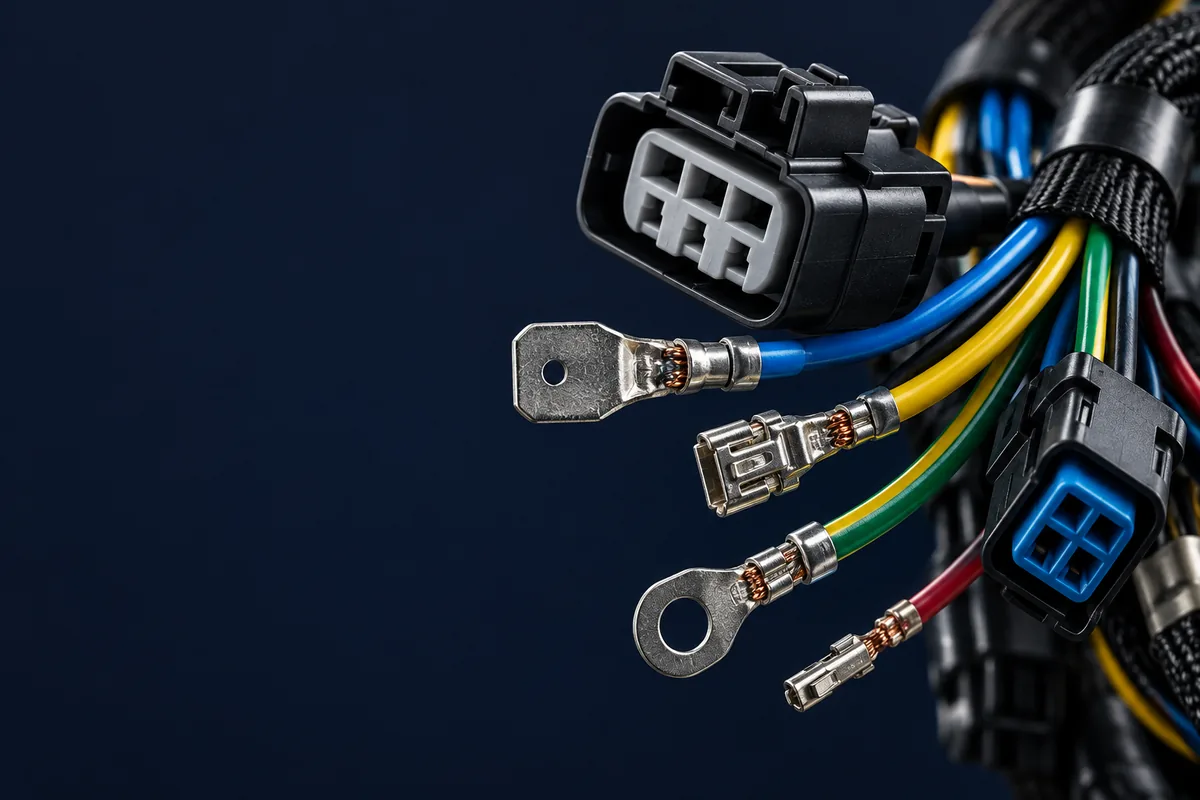
A pigtail connector is a connector housing pre-terminated with a short length of wire — the "pigtail" — that is spliced or terminated into the rest of a system, instead of the wire being crimped into the connector at final assembly. A pigtail wire harness is a harness built around one or more of these pre-terminated leads. The value is simple: the hard part — the crimp, the seal, the connector qualification — is done and tested at the factory, and the installer only has to make a straightforward splice.
TL;DR
- A pigtail connector = a connector housing with a short pre-terminated wire lead, spliced in downstream.
- Use pigtails to move the critical crimp and seal into a controlled factory process, away from field assembly.
- Specify connector part number, wire gauge and color, lead length, seal/strain relief, and the splice method together.
- Release on IPC/WHMA-A-620 workmanship, crimp-height and pull-force records — not on the connector "clicking in".
What a pigtail connector is — and how it differs from a full harness
The distinction is where the termination happens. In a fully assembled harness, every wire is cut, stripped, crimped, and loaded into its connector before shipment. A pigtail delivers the connector already terminated to a short lead, and the connection to the rest of the circuit is completed later by a splice — a butt splice, a soldered and heat-shrunk joint, or a terminal into a downstream block.
That changes who does the risky work. Connector qualification under USCAR-2, a correct crimp height, a sealed backshell, and a pull-tested joint are the parts most likely to fail if done at an installer's bench. A pigtail moves them into a factory process with crimp-force monitoring and inspection, and leaves the installer a splice that is far harder to get wrong.
When a pigtail is the right choice
- Field service and repair. A replacement pigtail lets a technician restore a failed connector with a splice instead of a full re-terminate and re-seal.
- Sealed or specialty connectors. Where a connector needs a specific crimp tool, seal, and backshell (Deutsch, sealed Molex, circular), a factory-terminated pigtail protects the seal integrity.
- Mixed-supplier assemblies. When the connector side is qualified but the downstream wiring varies by build, a pigtail fixes the qualified end and leaves the variable end open.
- Retrofit and adapter leads. A pigtail adapts a new connector to an existing loom without rebuilding the whole harness.
How to specify a pigtail for a production-ready RFQ
A pigtail is under-specified more often than a full harness, because it looks like "just a connector with a wire". Five things must be defined together:
- Connector part number and terminals. The housing, the exact terminal and seal, and whether terminals are customer-approved or open to an equivalent.
- Wire gauge, color, and rating. AWG, insulation type and temperature class per UL 758; if the gauge is open, provide current, distance, and temperature and it can be sized.
- Lead length and tolerance. Too short forces a splice in a bad location; too long adds cost and clutter. Give the length and an acceptable tolerance.
- Seal, strain relief, and marking. Backshell, boot, heat-shrink, and any label or wire-marking rule.
- Downstream termination. How the pigtail joins the system — butt splice, soldered joint, ferrule, or ring terminal — so the far end is not left ambiguous.
The connector-family decisions behind this sit alongside our wire harness connector selection guide, and if a program needs a connector removed or reworked, the how to depin a connector guide covers the depinning process. For the crimp discipline behind a reliable pigtail, see the wire harness crimping guide.
What "done" looks like on a pigtail
A pigtail passes the same gates as any terminated lead: crimp height within the terminal's specification, a pull-force result that meets the applicable class, 100% continuity, and a visual inspection to IPC/WHMA-A-620 workmanship criteria. Where the connector is sealed, the seal seating and backshell are inspected too. The connector "clicking in" is not evidence — the crimp and pull records are. If you need production-ready pigtails built and tested to that standard, our pigtail connector cable assembly service covers connector sourcing, crimp control, and release evidence.
Pigtail connector FAQs
Is a pigtail connector the same as a wire harness? No. A pigtail is a connector pre-terminated to a short lead that is spliced into a system; a wire harness is the full routed assembly. A pigtail harness is a harness built around one or more pigtail leads.
Why use a pigtail instead of terminating the connector in place? To move the crimp, seal, and connector qualification into a controlled factory process and leave the installer a simple splice — reducing field-assembly failures on sealed or specialty connectors.
What is the most common mistake specifying a pigtail? Leaving the lead length, seal, and downstream splice method undefined. A connector part number alone does not make a pigtail production-ready.
Can you build custom pigtails with sealed connectors? Yes — with the connector, terminal, seal, wire, and length defined, sealed pigtails (Deutsch, sealed Molex, circular) are built with crimp-force control and pull-force evidence.