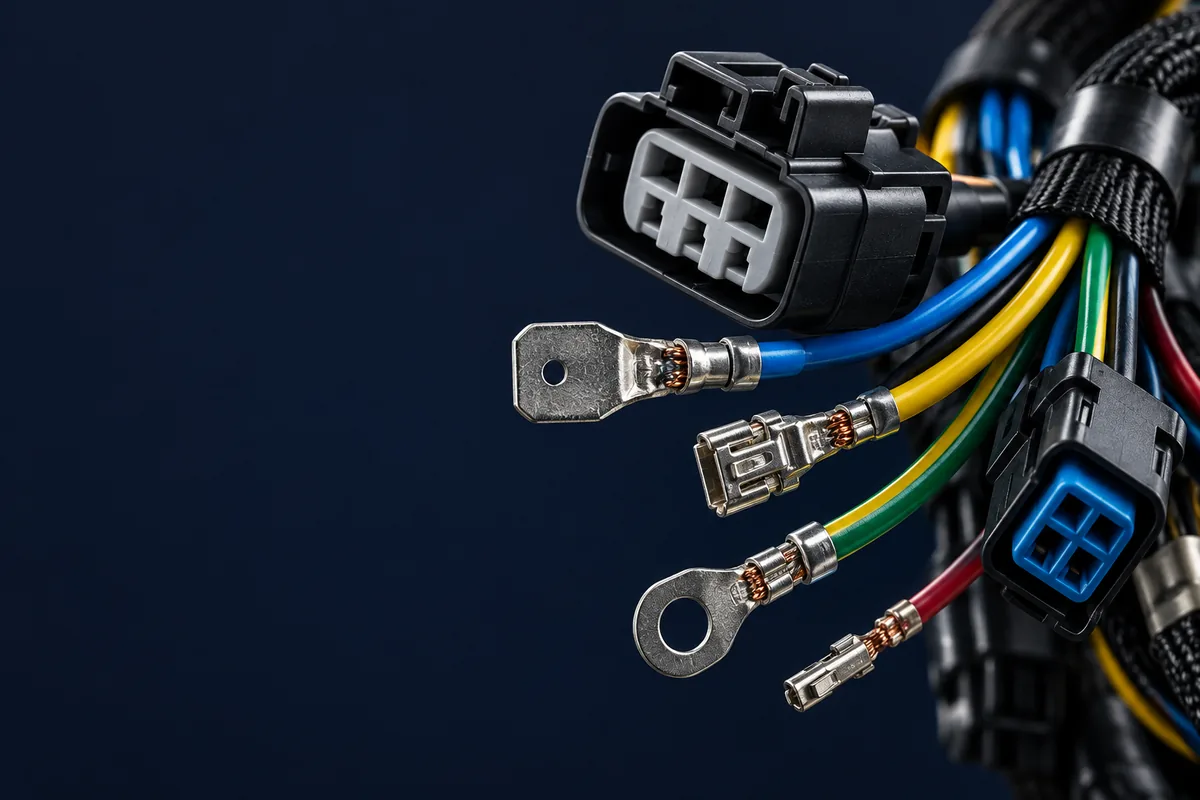
A North American power-equipment engineering team asked us to quote a highly customized harness after its regional branch relationship moved up to headquarters review. The challenge was not a simple catalog plug: the project required a custom pass-through wire harness with custom molds and custom connectors. The case-bank concrete numbers were: 10-core pass-through wire harness, Custom mold development required, Custom connector design. That case is a useful starting point for this 4 pin connector guide because it shows the real sourcing question: when is a 4-pin connector enough, and when does the harness architecture need more circuits, sealing, tooling, or a custom interface?
A 4 pin connector is an electrical connector with four separate contact positions used to carry power, ground, signals, data pairs, or control lines through a wire harness or cable assembly. For OEM buyers, the right 4-pin choice depends on current, voltage, sealing, coding, mating direction, terminal family, cable exit, and production test scope. The safest RFQ names the connector series, pinout, gender, wire size, environment, and inspection standard instead of asking only for a "4 pin cable."
TL;DR
- Pick 4 pin connector types by circuit function first: sensor, power, data, lighting, or sealed field wiring.
- For industrial automation, M8 and M12 4-pin connectors solve different space, current, and sealing needs.
- For automotive and heavy equipment, sealed Deutsch-style 4-pin housings usually matter more than compact size.
- Require IPC/WHMA-A-620 workmanship evidence, UL-758 wire traceability, and 100% continuity for production lots.
- If four circuits cannot cover power, ground, shield, diagnostics, and safety lines, do not force a 4-pin architecture.
This guide is written for hardware engineers, sourcing managers, NPI buyers, and quality teams who already have a drawing, prototype, or mating device and need to release a manufacturable 4-pin cable assembly. The article takes the role of a senior factory engineer with manufacturing experience supporting wire harness and cable assembly builds for industrial, automotive, medical, and power-equipment programs. The objective is practical: help you decide which 4 pin connector type belongs in your RFQ, what data the supplier needs, and what acceptance evidence should come back before pilot production.
1. What a 4 Pin Connector Is and What It Is Not
A 4 pin connector is a four-contact interface, not a complete specification. Four positions can describe a tiny JST wire-to-board plug, an M8 sensor connector, an M12 D-coded Ethernet connector, a sealed Deutsch DT04 housing, an LED pigtail, or a circular industrial-style cable end. Those parts do not share the same current rating, terminal system, sealing path, tooling, or inspection method.
A pinout is the electrical assignment of each contact position in the connector. It should show which cavity carries DC positive, ground, signal, shield drain, CAN high, CAN low, or other functions. A connector gender is the mating-side description of whether the connector uses male pins or female sockets; it should be defined from the mating interface, not from the cable exit. A keyed connector is a connector with a mechanical shape, coding, latch, or shell feature that prevents incorrect mating with a similar-looking part.
Standards language helps buyers avoid loose interpretations. IPC/WHMA-A-620 is commonly used for cable and wire harness workmanship criteria, and public background on IPC standards explains why workmanship classes need to be named rather than assumed. UL-758 covers appliance wiring material style evidence, while the UL safety organization reference is a stable public source for the certification context. Industrial circular connectors often sit inside IEC 61076 families, with broader context available through the International Electrotechnical Commission. Automotive programs may also require IATF 16949-style traceability and change control, described at a high level in the IATF 16949 reference.
A four-position connector only answers the cavity count. Before we quote, we still need current per circuit, wire gauge, seal requirement, mating side, terminal series, and test class. Four pins can be a clean solution or a hidden shortage of circuits.
2. Main 4 Pin Connector Types Buyers Should Compare
The table below compares the 4-pin connector families that appear most often in custom wire harness and cable assembly sourcing. Final approval still depends on the exact manufacturer series, material, plating, terminal, cable OD, and equipment interface.
| 4 Pin Connector Type | Typical Application | Strength | Buyer Risk If Under-Specified | RFQ Detail to Lock |
|---|---|---|---|---|
| M8 4-pin circular | Compact sensors, actuators, IO-Link devices | Small body, good for dense machines | Wrong coding, rear seal, or cable OD | A/B coding, gender, pinout, cable jacket, IP target |
| M12 4-pin circular | Industrial sensors, Ethernet, power drops | Stronger shell and mature field wiring ecosystem | Mixing A-coded sensor use with D-coded Ethernet use | Coding, protocol, shield, pinout, panel or cable mount |
| Deutsch DT 4-pin sealed | Vehicles, heavy equipment, outdoor machinery | Robust latch and environmental sealing | Wrong wedge lock, seal size, or terminal gauge range | Housing, wedge, terminal, seal, wire gauge, cavity plugs |
| JST / Molex 4-pin wire-to-board | Battery packs, displays, controls, compact modules | Low profile and device-side mating compatibility | Using the wrong pitch or latch style for vibration | Exact series, pitch, mating header, terminal part number |
| 4-pin pigtail connector | LED lighting, sensors, repair leads, field replacement | Pre-terminated factory crimping reduces field work | Lead length, wire color, and open-end finish left undefined | Lead length, wire gauge, color code, end treatment, test scope |
| 4-pin bulkhead / panel connector | Cabinet walls, enclosures, instruments, marine panels | Controlled pass-through between inside and outside wiring | Panel thickness, thread, gasket, and rear clearance omitted | Panel cutout, thickness range, gasket, nut, grounding path |
| 4-pin high-current power connector | DC motors, power modules, battery accessories | Separates multiple power or control paths in one interface | Contact current and temperature rise not validated | Continuous current, peak current, conductor size, voltage drop |
For sensor and actuator programs, compare this guide with our M8 sensor cable assembly and M12 cable assembly pages. If the project is broader than one connector, our wire harness connector selection guide and connector sourcing cable assembly page give a wider sourcing framework.
3. M8, M12, and Sealed 4-Pin Connectors: How to Choose
Start with the circuit job. A 4-pin A-coded M8 connector often fits compact sensor wiring where the machine needs DC power plus one or two signal lines. A 4-pin M12 A-coded connector is larger and easier to handle in many industrial environments. A 4-pin M12 D-coded connector is a different decision because it is normally tied to industrial Ethernet rather than generic sensor wiring. A 4-pin sealed Deutsch-style connector shifts the review toward vibration, splash, dust, oil exposure, and serviceability in vehicles or outdoor equipment.
Then check the cable exit. Many 4-pin failures begin behind the mating face: the cable OD is outside the rear-seal range, the jacket is too soft for clamp retention, the bend path side-loads the connector, or the overmold does not support the real routing path. This is where a connector drawing and cable datasheet must be reviewed together. A connector that passes bench continuity can still fail after installation if the rear strain relief is not matched to the harness route.
Finally, compare stock availability with approved-alternate control. A buying team may want one 4-pin connector family across multiple machines, but the same family may not support every current, sealing, and cable-size requirement. Approved alternates can help during allocation, but they must be documented before the PO. For programs with multiple brands and substitutions, use the same discipline described in our multi-brand connector sourcing guide.
For a 4-pin M12 assembly, I separate A-coded sensor work from D-coded Ethernet before looking at price. The shell size looks the same to procurement, but the cable construction, shield plan, and final test are different jobs.
4. When Four Pins Are Not Enough
The opening case-bank example is the caution here. The team needed a 10-core pass-through wire harness, Custom mold development required, Custom connector design. For that program, forcing the design into a 4-pin off-the-shelf connector would have removed circuits the system needed and pushed the risk into adapters, splices, or undocumented field wiring. A 4-pin connector is attractive when it simplifies assembly, but it should not hide missing functional requirements.
Four pins may be enough when the device needs positive, negative, signal, and signal return; or when a sensor uses power, ground, and two data or switching lines. Four pins may be too few when the system also needs shield drain, diagnostics, redundant safety loops, separate actuator power, CAN high and CAN low plus power and ground, or future service pins. If the wiring architecture is still changing, treat the connector count as a design decision, not a purchasing shortcut.
Buyers should also think about validation. If a four-contact connector carries both power and sensitive signal, the assembly may need separation rules, shield termination, insulation resistance, hipot, or functional testing. If the connector is part of an automotive or heavy-equipment harness, require production controls that align with IPC/WHMA-A-620 workmanship, UL-758 wire evidence, and IATF 16949-style traceability. For validation planning, our wire harness testing service and IPC-A-620 inspection guide explain what evidence buyers should request.
5. RFQ Checklist for 4 Pin Cable Assemblies
A strong RFQ prevents the supplier from guessing. Send the drawing, mating device, target connector family, pinout, wire list, cable length, environment, quantity, and inspection requirement. If you only know the mating side, send photos with dimensions and a sample if available. If the connector is mounted through a panel, include panel thickness, cutout, gasket, nut, and rear clearance. If the connector is overmolded, include the cable bend path and any branding, color, or strain-relief requirement.
For first article approval, ask for objective records: connector and terminal part numbers, wire style evidence, crimp setup record, continuity report, visual inspection photos, and any sealing or pull-test data. On our production floor, a new 4-pin sealed connector family normally gets first-article photos of terminal seating, seal compression, wire color order, and latch engagement before batch release. For a 500-piece pilot lot, we would expect 100% continuity and polarity test, with pull-force or retention checks sampled by terminal family when the drawing calls them out.
- Connector family: M8, M12, Deutsch, JST, Molex, bulkhead, pigtail, or custom
- Contact count and pinout: cavity numbers, signal names, voltage, current, and polarity
- Gender and orientation: male or female contact, straight or right-angle, keyed or coded
- Wire details: AWG or mm2, strand count, insulation OD, jacket material, UL style if required
- Environment: temperature, vibration, oil, moisture, dust, UV, washdown, or indoor cabinet use
- Validation: IPC/WHMA-A-620 class target, UL-758 traceability, continuity, hipot, pull, seal, or functional test
- Commercial inputs: prototype quantity, pilot quantity, annual volume, target lead time, and approved alternates
For production release, a 4-pin harness should not leave the factory with continuity alone if the connector is sealed or vibration exposed. We want pinout, latch, seal, crimp, and strain-relief evidence tied to the same lot.
Frequently Asked Questions
What are the most common 4 pin connector types?
The most common 4 pin connector types in custom harness work are M8 sensor connectors, M12 industrial connectors, sealed Deutsch DT connectors, JST or Molex wire-to-board connectors, 4-pin pigtails, and bulkhead panel connectors. Buyers should define the exact series, pinout, gender, wire gauge, environment, and inspection standard before quoting.
Is a 4 pin M12 connector always the same as a 4 pin sensor connector?
No. A 4-pin M12 can be A-coded for sensor or actuator I/O, D-coded for 100 Mbit/s industrial Ethernet, or another coded variant depending on the manufacturer series. The connector shell size does not define the electrical role. State the coding, protocol, shield requirement, and IEC 61076 family expectation in the RFQ.
When should I use a sealed Deutsch-style 4 pin connector?
Use a sealed Deutsch-style 4 pin connector when the harness sees vibration, splash, dust, oil, or outdoor service, such as heavy equipment, vehicles, and marine-adjacent machinery. Specify the housing, wedge lock, terminal, wire seal, cavity plug, AWG range, and IPC/WHMA-A-620 inspection level before approving production.
Can one 4 pin connector carry both power and signal?
Yes, but the design must control current, voltage drop, insulation, spacing, noise, and test coverage. A common layout may use power, ground, signal, and signal return. If the signal is sensitive or the load current is high, add shielding, separation, or a different connector rather than relying on four contacts alone.
What information should I send to quote a 4 pin cable assembly?
Send the drawing, mating connector or device, pinout, wire gauge, cable length, gender, orientation, environment, quantity, and inspection requirement. For sealed or panel-mounted connectors, add IP target, cable OD, panel thickness, gasket details, and rear-clearance constraints. For production lots, request 100% continuity and polarity test records.
How do suppliers test 4 pin wire harnesses?
Suppliers usually test 4 pin harnesses with continuity, polarity, visual terminal seating, latch inspection, and label checks. Depending on risk, the plan may add insulation resistance, hipot, pull-force sampling, seal inspection, IP validation, or functional testing. The acceptance plan should reference IPC/WHMA-A-620 and any UL-758 wire traceability requirement.
When is a custom connector better than a 4 pin catalog connector?
A custom connector is better when the program needs more than four circuits, a special pass-through, a molded geometry, controlled panel fit, mixed power and signal separation, or an interface that must prevent field mismatch. The case-bank project used a 10-core pass-through wire harness with custom mold development and custom connector design.
Need help choosing a 4 pin connector for a harness build?
Send your drawing, mating connector, pinout, quantity, environment, target lead time, and test requirement through our contact page. Our team will review the connector family, wire fit, sealing path, crimp process, and inspection evidence before quoting your custom cable assembly.
- Send next: drawing, BOM, connector photo, pinout, wire list, and annual volume
- You get back: manufacturability review, connector-risk notes, quote, lead time, and test plan assumptions
- Useful for: sensor cables, 4-pin power leads, sealed vehicle harnesses, panel connectors, and custom pigtails