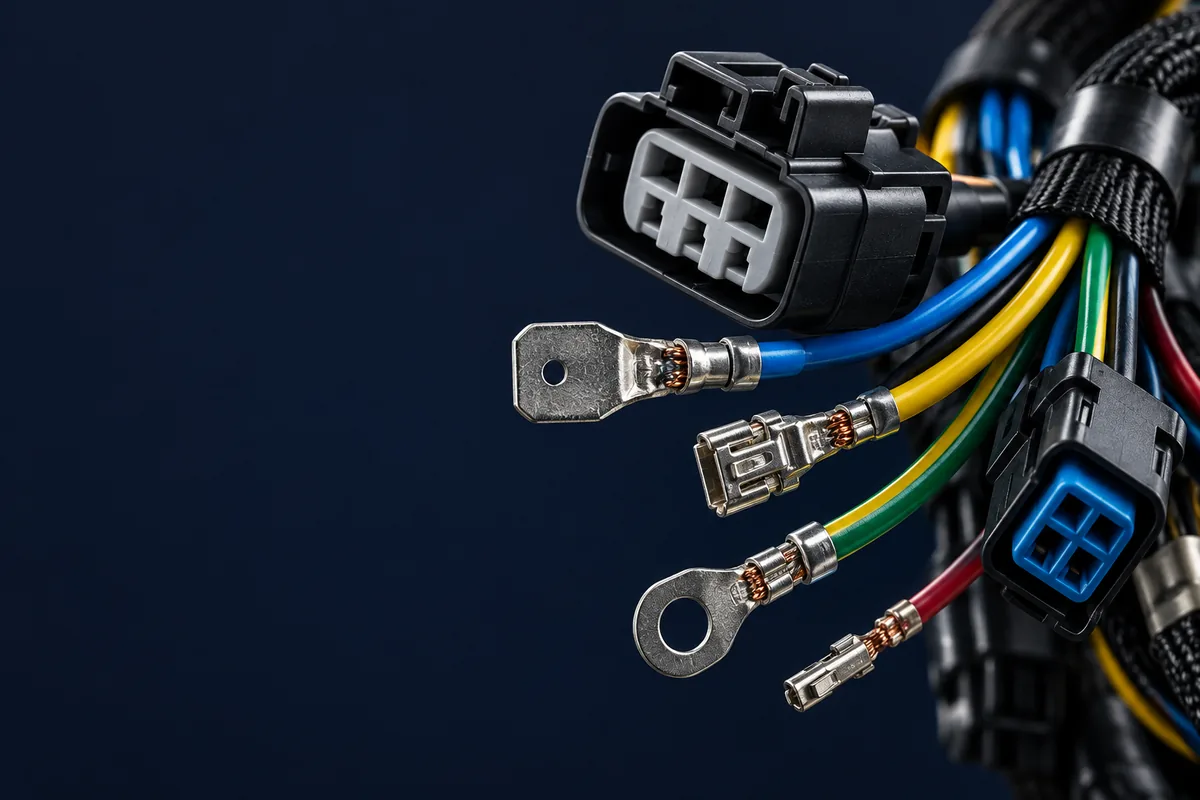
The wrong connector is one way to turn a reliable wire harness into a field failure. This guide compares 5 major connector families—Molex, TE Connectivity, Deutsch, Amphenol, and JST—across current rating, IP sealing, temperature range, and cost. Use the decision matrix to match the right connector to your application using documented requirements.
1. Why Connector Selection Makes or Breaks Your Harness
Connector selection affects harness reliability. Incorrect current ratings, inadequate sealing, or incompatible materials can lead to field failures; verify each interface against its operating environment.
The connector market is fragmented across hundreds of manufacturers and thousands of part numbers. For engineers designing custom cable assemblies, this abundance creates a paradox of choice. Selecting the wrong connector doesn't just cause electrical failures—it creates cascading problems: mismatched terminals require rework, wrong pin counts delay prototyping, and underspecified sealing leads to warranty claims.
This guide cuts through the noise. We compare the 5 connector families used in a range of wire harness applications, provide clear decision criteria, and give you a practical matrix to match connectors to your specific use case.
2. The 6 Critical Selection Criteria
Before comparing specific connector brands, you need to define your requirements across six dimensions. Missing one of these can lead to redesigns, field failures, or cost overruns. For a deeper dive into how these criteria fit into your overall harness design process, see our wire harness design guide.
| # | Criterion | Key Question | Typical Spec Range |
|---|---|---|---|
| 1 | Current Rating | Max current per contact with application-specific derating? | Per circuit and contact datasheet |
| 2 | Voltage Rating | System voltage + transient spikes? | Per system and insulation requirements |
| 3 | Environmental Sealing | Exposure to water, dust, chemicals? | IP20 – IP69K |
| 4 | Temperature Range | Min/max operating temperature? | Per selected connector datasheet |
| 5 | Vibration & Shock | Vibration severity and locking needed? | Friction fit to positive lock |
| 6 | Mating Cycles | How many connect/disconnect cycles? | Per connector qualification data |
Current Derating
Select current ratings using the manufacturer's derating data, wire size, populated contacts, ambient temperature, and load profile. Confirm allowable temperature rise in the assembled system; no single percentage margin covers every installation.
3. 5 Major Connector Families Compared
The following manufacturers offer widely used wire harness connector families. Each has specific strengths, and experienced harness designers routinely mix brands within a single assembly—using the right connector family for each interface point.
3.1 Molex — Compact Power Connectors
Molex offers compact power connector families with different pitches and current capabilities. Its Fit Family overview lists Mini-Fit at 4.20mm, Micro-Fit at 3.00mm, and Ultra-Fit at 3.50mm with up to 14.0A for the stated Ultra-Fit configuration. Verify derating and the exact contact/wire combination. (Source: Molex Fit Family)
Strengths
- • Compact power connector options
- • Excellent crimping tooling ecosystem
- • Widely stocked, fast procurement
- • Wire gauge range depends on terminal selection
Limitations
- • Sealing depends on the selected series
- • Temperature rating depends on materials and series
- • Verify vibration qualification for the installation
- • Confirm the latch and retention design
3.2 TE Connectivity — The Automotive & Industrial Workhorse
TE Connectivity (formerly Tyco/AMP) offers automotive and industrial connector families. Their MATE-N-LOK power connectors, AMPSEAL environmentally sealed series, and HVP 800 high-voltage EV connectors cover a broad range of applications. If you're building automotive wire harnesses, check the exact series against the OEM requirements.
Strengths
- • Broad product portfolio
- • Sealing rating depends on the exact AMPSEAL configuration
- • Temperature rating depends on the selected series
- • Verify the supplying site's quality-system scope
Limitations
- • Higher cost vs Molex/JST equivalents
- • Longer lead times for specialized series
- • Complex part numbering system
- • Proprietary tooling requirements
3.3 Deutsch (TE) — The Harsh Environment Specialist
The Deutsch brand is part of TE Connectivity. DT connectors are used in harsh environments with a wedge-lock retention system. Confirm temperature, sealing, and vibration ratings for the exact assembly.
Strengths
- • Environmental sealing depends on configuration
- • Exceptional vibration resistance
- • DT operating temperature: -55°C to +125°C; confirm the selected configuration (TE DT data)
- • Field-repairable with contact removal tools
Limitations
- • Compare current pricing with unsealed alternatives
- • Larger physical footprint
- • DT housings include up to 12 positions (TE DT data)
- • Purchase traceable parts from authorized sources
3.4 Amphenol — Industrial Grade
Amphenol offers broad circular connector families and the AT Series of environmentally sealed rectangular connectors. The AT Series competes directly with Deutsch DT while offering multiple pin counts and compact options. For programs where the approved connector kit must be sourced and tested with the harness, our Amphenol cable assembly service covers BOM review, MOQ planning, sample lead time, and release evidence. For industrial wire harnesses, customer-specified circular connectors may be the qualified option.
Strengths
- • Customer-specified circular families available
- • Temperature rating depends on the selected series
- • EMI/RFI shielding capabilities
- • AT Series: cost-effective sealed alternative
Limitations
- • Specialized circular series can be expensive
- • Confirm current lead times for specialized parts
- • Specialized assembly tooling required
- • Overkill for standard industrial applications
3.5 JST — The Cost-Effective Signal Connector
JST offers compact signal connectors, including XH, PH, and SH families, for internal equipment and industrial automation wiring. XH has a 2.5mm pitch; check current rating, wire compatibility, and retention for the exact part. (Source: JST XH specification)
Strengths
- • Economical signal-connector options
- • Compact pitch options; check the selected series
- • Excellent for high-density signal wiring
- • Wide availability from Asian suppliers
Limitations
- • Current ratings depend on the contact and wire
- • Check sealing for the selected series
- • Limited vibration resistance
- • Verify qualification before outdoor or vehicle use
Master Comparison Table
| Feature | Molex | TE Connectivity | Deutsch | Amphenol | JST |
|---|---|---|---|---|---|
| Best For | Power delivery | Automotive/Industrial | Harsh environments | industrial | Signal/Low-cost |
| Current Range | Per selected series and configuration | Per selected series and configuration | Per selected series and configuration | Per selected series and configuration | Per selected series and configuration |
| IP Rating | Verify exact assembly rating | Verify exact assembly rating | Verify exact assembly rating | Verify exact assembly rating | Verify exact assembly rating |
| Temp Range | Per selected series and configuration | Per selected series and configuration | Per selected series and configuration | Per selected series and configuration | Per selected series and configuration |
| Vibration | Low | Medium–High | High | Very High | Low |
| Cost/Contact | Current supplier quotation | Current supplier quotation | Current supplier quotation | Current supplier quotation | Current supplier quotation |
Automotive Wire Harness Connectors
Automotive wire harness connectors are their own category, because the vehicle environment is unforgiving and the service life is long. A connector under the hood or on the chassis sees application-specific temperature swings, constant vibration, road salt, moisture, and fluids, and it has to keep working for the specified service life and environmental cycles. That is why automotive connectors are designed and validated to performance standards such as USCAR-2 and, for many German OEM programs, LV214, with quality-system requirements defined by the customer. Choosing an “automotive-grade” housing is the starting point, not a marketing label. For the vehicle side of our work, see automotive wire harnesses.
The systems actually used
Most modern automotive harnesses are built from a handful of sealed connector systems rather than generic parts. TE Connectivity's AMPSEAL, MCON, and MQS families, Molex's MX150 and MX64, and Aptiv's (formerly Delphi) Metri-Pack and GT series cover cabin, body, and powertrain applications, while Deutsch DT connectors carry over into off-highway and commercial vehicles. Sealing is chosen by zone: engine-bay, underbody, and exterior circuits may require sealed systems qualified for the exposure, while a dry cabin circuit can use an unsealed system to save cost — the decision covered in the next section.
Error-proofing built into the connector
Automotive connectors carry error-proofing that other markets often skip, because a harness is installed by hand on a moving line. Colour coding and mechanical keying stop a connector being mated to the wrong counterpart; a Connector Position Assurance (CPA) feature is designed to indicate full connector locking; and a Terminal Position Assurance (TPA) feature helps verify terminal seating and retention. Specifying CPA and TPA where the connector series offers them helps detect assembly errors — a partially mated connector and a backed-out terminal.
EV high-voltage connectors
Electric-vehicle harnesses add a high-voltage class with its own rules: touch-proof (finger-safe) interfaces, a High-Voltage Interlock Loop (HVIL) that signals the system to de-energise before a connector is opened, larger creepage and clearance distances, and the industry's orange identification. Series such as TE's HVP and Aptiv's high-voltage connectors are built for this. High-voltage connector selection is a safety decision, not a convenience one, and should be made with the OEM's electrical and safety requirements in hand.
The terminal has to match the wire
An automotive connector selection mistake is treating the housing as the whole decision. The terminal inside it has to match the wire gauge and the current — a terminal crimped onto a wire it was not designed for is a hot joint waiting to happen, whatever the housing is rated for. For an industrial connector program, review the connector specification against the actual wire-gauge requirement. For automotive designs: confirm the terminal, the wire gauge, and the crimp specification together, not just the connector part number.
Connector Gender and Polarity: How to Avoid Mating Errors
The comparison above picks the connector family; getting the connector to mate correctly — and only one way — comes down to gender and keying features to specify: its gender and its polarization. Confused gender or missing keying is a possible reason a harness will not mate on the line, or mates the wrong way and damages a circuit. Neither is a rating you compare on a datasheet; both are things you have to state explicitly on the drawing.
What connector gender means
For conventional pin-and-socket designs, gender identifies which half carries pins or sockets:
- Male (plug / pin) carries the pins or tabs; female (receptacle / socket) carries the spring sockets that receive them. Conventional pin-and-socket pairs require complementary contacts; genderless designs are an exception.
- Housing gender and contact gender can differ. A housing described as a “plug” can still hold female contacts, and a “receptacle” housing can hold male pins. Because of that, gender is specified twice — for the housing and for the contacts inside it — and both have to be called out.
- The energised side is usually socketed. By convention the side that is live when the pair is unmated is given female (recessed socket) contacts, so no exposed pin is left energised where it can be touched or shorted. Confirm touch protection for the exact interface and electrical safety requirements; gender alone does not establish protection.
- Hermaphroditic (genderless) connectors exist too: certain rectangular power and data families use a single interface that mates to an identical part, removing the gender decision entirely. Useful where either end could be either side of a link.
Polarization and keying: one orientation only
Opposite genders let two connectors mate; polarization is what stops them mating the wrong way:
- Polarization features — an asymmetric housing shape, guide ribs, a keyway, or an offset pin — let the connector seat in only one rotation, so it cannot be plugged in reversed or turned 180°.
- Keying variants — many series offer several keyed (and often colour-coded) versions of the same connector, such as Key A / B / C. Using different keys for connectors of the same size on one assembly means two look-alike connectors cannot be cross-mated to each other’s branch. The drawing has to say which key goes where.
- Cavity and pin-1 indexing — numbered cavities and a pin-1 marker fix which conductor lands in which cavity, so even a symmetric-looking connector can be wired and inspected against a defined cavity map.
The failure modes — and how the drawing prevents them
Mating problems can involve the following issues: a same-gender pair that physically cannot mate; the correct gender but the wrong keying variant, letting a connector cross-mate to the wrong harness branch; the right connector inserted reversed, which can involve absent, damaged, or defeated polarization; or the right housing fitted with the wrong contact gender inside. These risks can be reduced by stating, for each mating side, the gender of both the housing and the contacts, the exact keying / polarization variant, the colour code where the series offers one, and the cavity and pin-1 assignment. Where the series also offers the position-assurance features covered in the automotive error-proofing section above (CPA and TPA), add them so a half-mated connector or a backed-out terminal is caught before the assembly ships. Pin the gender, key, and cavity map down in the specification and verify mating on representative assemblies from each supplier.
Circular Connectors: Choosing a Family
The families compared above are mostly rectangular housings. When a harness leaves the cabinet — to a sensor, a motor, a drive or a machine module — the interface is usually a circular connector: a round shell with a threaded, bayonet or push-pull coupling that gives a repeatable, sealable, vibration-resistant mate. “Circular” is not one product; it is a set of size families that each suit a different job, and the drawing has to name the family, not just the shape.
The circular families you will actually specify
| Family | Typical use | Coupling | What to confirm on the drawing |
|---|---|---|---|
| M8 | Compact sensors, actuators, IO-Link devices | Small threaded ring (snap-in variants exist) | Pin count, coding, gender, cable OD — see M8 sensor cable assembly |
| M12 | Industrial sensors, fieldbus, industrial Ethernet | Threaded coupling nut | Coding (A, B, D, X and others), pin count, shielding, gender — see the M12 coding guide and M12 cable assembly |
| M23 | Servo motors, drives, power-plus-signal hybrid interfaces | Threaded coupling ring | Power and signal contact layout, shield termination, cable OD — see M23 connector cable assembly |
| Push-pull circular | Instrumentation and medical equipment where quick, one-hand mating matters | Latching push-pull, no threads | Series and keying, shell type, cable clamp — see medical connector manufacturers |
| Sealed circular families (e.g. Amphenol and TE/Deutsch ranges) | Vehicle, off-highway and machine harnesses in wet or vibrating environments | Series-specific (threaded, bayonet or latching) | Exact series and shell size, contact size, seal set — see Amphenol cable assembly and the Deutsch connector guide |
Sizes and pin counts inside each family vary by manufacturer and series, so treat the table as a way to pick a family and then read the datasheet for the exact part. The same pin count can mean very different connectors: our 4-pin connector guide shows how one count spans M8, M12 and sealed automotive parts.
How to choose between them
- Start with what the connector carries. Low-current signal and sensor supply points to M8 or M12; motor power with feedback signals points to a hybrid interface such as M23; Ethernet needs an M12 coding that supports the data rate and a shielded, correctly terminated cable.
- Match the coupling to how it is mated. Threaded rings hold vibration and seal well but need tightening to the right torque; push-pull is faster but relies on the latch design. A coupling that is easy to leave half-mated is a field-failure risk.
- Read the IP rating as a mated-state rating. A circular connector’s ingress protection generally applies when it is fully mated and tightened; an unmated or loosely coupled connector is not protected, so specify caps for unmated ports where they matter.
- Treat shielding as part of the connector. For Ethernet, encoder or fieldbus lines, the shield must terminate 360° to the shell through the connector and clamp, as required by the system design; poor termination can degrade shielding.
- Check the cable against the back end. The cable outer diameter has to fit the seal and strain relief of the specific series; a cable that is too thin or too thick defeats the seal. Our strain relief guide covers the clamp side.
- Decide molded or field-wireable. Overmolded cable assemblies are sealed and consistent; field-wireable connectors allow on-site termination but depend on installer technique.
On the drawing, name the exact series and part number, the coding and gender, the cable, the shield termination method and the IP requirement for the mated state. “M12, 4-pin” alone leaves a coding and gender decision open — the same trap covered in the M12 coding guide.
4. Sealed vs Unsealed: When to Spend More
The sealed-vs-unsealed decision is an important cost driver in connector selection. Sealed connectors can cost more per mated pair, but using unsealed connectors in wet environments leads to corrosion failures that cost far more to diagnose and repair. Understanding where to draw the line saves money without compromising reliability. This decision directly impacts your total wire harness cost.
| IP Rating | Protection Level | Typical Applications | Example Connectors |
|---|---|---|---|
| IP20 | Access protection; no water-ingress rating (check IEC 60529) | Indoor panels, enclosures | Verify rating for exact part and mounting |
| IP54 | Dust + splash resistant | Indoor wet areas, HVAC | Select a documented splash-resistant configuration |
| IP67 | Dust-tight; temporary immersion test, commonly 1m for 30 min (Phoenix Contact) | Outdoor, automotive underhood | Deutsch DT, Amphenol AT |
| IP68 | Immersion under the manufacturer-specified conditions | Marine, underground | Verify the exact sealed series and test conditions |
| IP69K | High-pressure washdown | Food processing, agriculture | Verify the exact washdown-rated configuration |
Rule of Thumb
Assess rain, condensation, immersion, and washdown separately. Select a sealed configuration where needed, and compare its quotation with the program-specific service and failure costs.
5. Application Matching: Decision Matrix
Use this matrix to shortlist connector families, then verify the exact part number against current, voltage, environmental, and customer requirements. These examples do not establish qualification for a complete assembly.
| Application | Power (per circuit load) | Signal (per circuit requirements) | External/Harsh | Key Requirement |
|---|---|---|---|---|
| Automotive Interior | TE MATE-N-LOK | TE MQS | — | Customer quality-system requirements |
| Automotive Underhood | TE AMPSEAL | TE AMPSEAL | Deutsch DT | Specified ingress and temperature performance |
| EV High Voltage | TE HVP 800 | TE AMPSEAL | TE HVP 800 | HVIL and rated system voltage |
| Industrial Control | Molex Mini-Fit | JST XH | Deutsch DT | Cost + reliability |
| Robotics | Molex Ultra-Fit | JST PH | Amphenol AT | Vibration, flex life |
| Medical Device | TE Micro-Mate | JST SH | Amphenol Medical | Biocompatibility |
| Agriculture/Mining | Deutsch HD | Deutsch DT | Deutsch HD | Specified washdown and shock performance |
| industrial | Customer-qualified circular connector | Customer-qualified circular connector | Customer-qualified circular connector | Circular, EMI-controlled |
6. 5 Costly Connector Selection Mistakes
1 Sizing to Nominal Current, Not Peak + Margin
A motor can draw more current during startup than during steady operation. Select the connector using the complete load profile, manufacturer derating guidance, and allowable contact temperature rise; do not apply a universal peak-current multiplier.
2 Ignoring Pitch Compatibility Between Brands
Connectors with similar pitch or appearance may have incompatible tolerances, contact geometry, or retention features. Verify an approved mating pair rather than assuming interchangeability.
3 Using Unsealed Connectors in Condensation Zones
Even "indoor" applications experience condensation when temperature cycles across the dew point. Control panels in unheated warehouses, refrigeration equipment, and outdoor signage need an ingress-protection assessment matched to the actual exposure. For more on preventing moisture-related failures, see our failure analysis guide.
4 Buying Counterfeit Connectors to Save Cost
Untraceable connectors can have uncertain materials and qualification history. Purchase through authorized sources and verify the exact part number and supporting documentation.
5 Specifying Connector Without Matching Wire Gauge
Every connector terminal is designed for a specific wire gauge range. Crimping a 22 AWG wire into a terminal rated for 16–18 AWG can produce an unqualified termination with poor retention. Always verify the terminal's wire gauge range matches your actual conductor size. See our materials guide for wire gauge selection.
7. Connector Specification Checklist for RFQs
When submitting a wire harness RFQ, including complete connector specifications helps reduce delays and requotes. Use this checklist alongside our complete RFQ checklist to ensure your manufacturer has everything needed to quote accurately.
Electrical Requirements
- ✓ Max current per contact (peak + continuous)
- ✓ System voltage (AC/DC) including transients
- ✓ Number of contacts/positions needed
- ✓ Contact plating (tin, gold, silver)
- ✓ Shielding/EMI requirements (if any)
Environmental Requirements
- ✓ IP rating (IP20/54/67/68/69K)
- ✓ Operating temperature range
- ✓ Vibration severity (random/sinusoidal, G-level)
- ✓ Chemical exposure (oils, coolants, solvents)
- ✓ UV exposure (outdoor applications)
Mechanical Requirements
- ✓ Wire gauge range (AWG or mm²)
- ✓ Mating/unmating cycles expected
- ✓ Panel mount vs inline vs PCB mount
- ✓ Locking mechanism preference
- ✓ Strain relief / backshell requirements
Commercial Requirements
- ✓ Approved manufacturer/brand (or equivalent)
- ✓ Specific part numbers (if pre-selected)
- ✓ Annual volume (affects pricing tiers)
- ✓ Lead time tolerance
- ✓ Compliance standards (UL, CE, RoHS)
Frequently Asked Questions
What are the most common connector types used in wire harnesses?
Common types include wire-to-wire connectors (Molex Mini-Fit, TE MATE-N-LOK), wire-to-board connectors (JST XH, Molex KK), sealed connectors for harsh environments (Deutsch DT, Amphenol AT), and high-power connectors for EV and industrial applications. Selection depends on current requirements, environmental exposure, and mating cycles needed.
Which circular connector family should I use: M8, M12 or M23?
Pick by what the connector carries. M8 suits compact sensors and actuators, M12 suits industrial sensors, fieldbus and Ethernet (with the correct coding), and M23 suits servo motors and hybrid power-plus-signal interfaces. Then confirm the exact series, coding, gender, cable outer diameter and shield termination against the manufacturer’s datasheet.
How do I choose between Molex, TE Connectivity, and JST connectors?
Choose Molex Mini-Fit or Micro-Fit for high-current power delivery in compact form factors (rating depends on the exact series and wire configuration). Choose TE Connectivity for automotive and industrial applications requiring environmental sealing and high mating cycles. Choose JST for cost-effective signal-level connections in consumer electronics and internal wiring.
What IP rating do I need for outdoor wire harness connectors?
Select ingress protection from the actual rain, dust, immersion, and washdown exposure. IP67 addresses temporary immersion; jet and high-temperature washdown requirements need their own test ratings. Confirm the rating of the complete mated assembly.
Can I use different connector brands interchangeably?
Do not assume cross-brand interchangeability. Some families offer specified intermateable parts, while others do not. Require manufacturer documentation and qualification for the exact mating pair; multiple brands may still serve separate interfaces in one harness.
What is the most important factor in connector selection?
Match the contact rating to the complete load profile and environmental conditions using the manufacturer's derating data. Verify temperature rise and retention in the assembled system.
How do sealed vs unsealed connectors differ in cost?
Sealed connector pricing depends on the series, contact count, seals, tooling, and purchase quantity. Compare current quotations for complete mating pairs and include assembly and validation costs.
Related Articles
Wire Harness Design Guide: 10 Critical Steps
Complete guide covering wire gauges, connectors, routing, DFM, and insulation for reliable designs.
Top 10 Wiring Harness Materials
Selection guide covering conductors, insulation types, connector housings, terminals, and shielding.
Wire Harness Failure Analysis: 7 Common Causes
Learn 7 common failure modes and prevention strategies to address recurring defects.
Need Help Selecting Connectors for Your Wire Harness?
Our engineering team reviews customer-specified connectors for build-to-print automotive, industrial and medical wire harness programs. Send a released drawing and BOM for manufacturability and availability review.