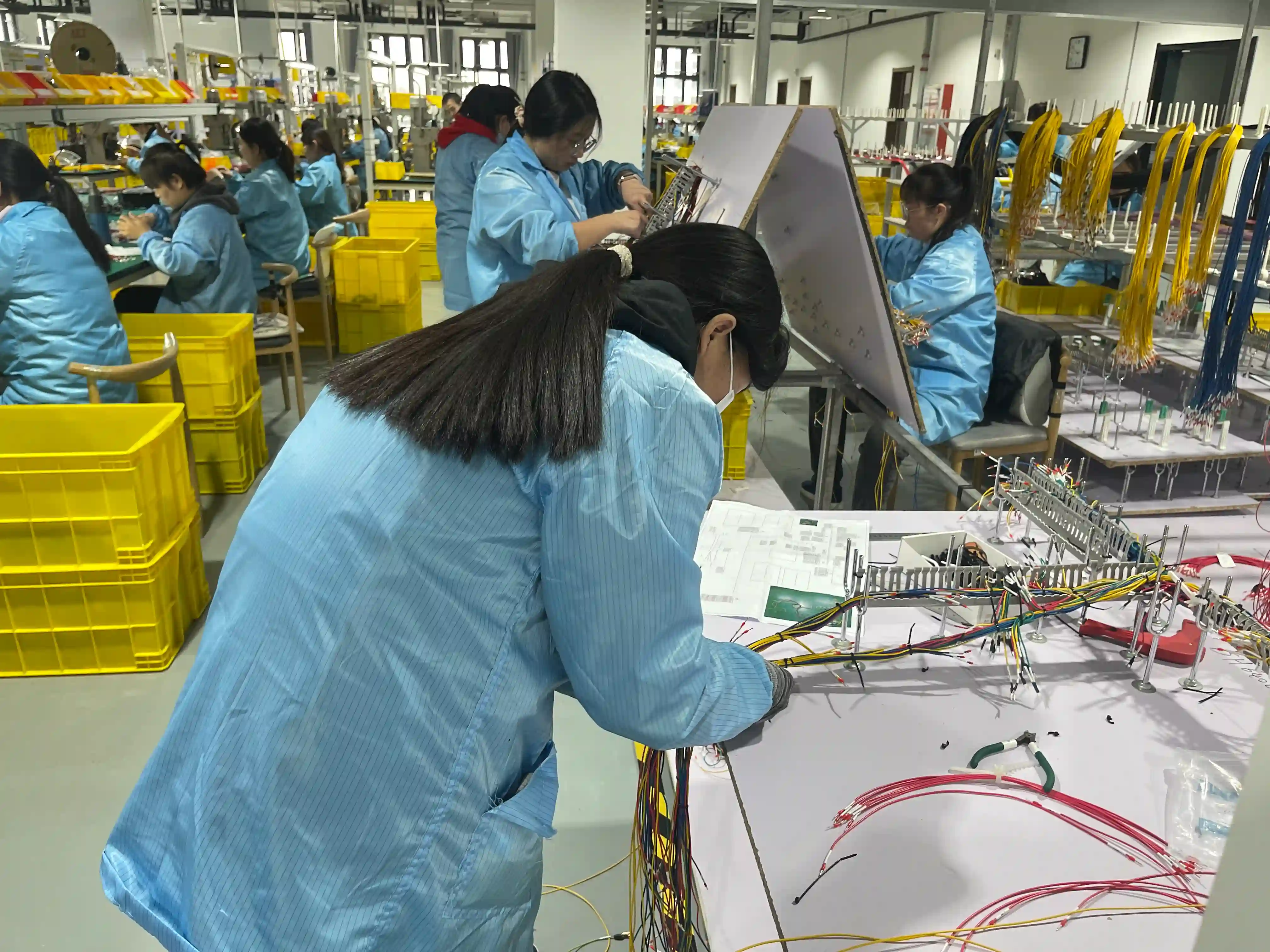
Real Project Snapshot — Wire Harness Prototyping Guide
Anonymized example from our case bank, shared so buyers can see how this scope is actually executed in production.
Industry: marine | Region: US | Year: 2025-Q3 → 2026-Q1
Scenario: A US marine OEM sought a new supplier for custom wire harnesses and audio systems, initiating a rigorous multi-month evaluation process involving multiple business units.
Challenge: The customer issued 6 separate RFQs over two months and engaged in a 64-email deep-dive technical thread, demanding strict weekly delivery, tariff mitigation, and cost competitiveness compared to incumbent suppliers.
Solution: Maintained rapid response times (1-2 days), proactively proposed a buffer stock strategy (advance ordering) to meet weekly delivery needs and mitigate tariff risks, and transparently presented alternative material options with cost benefits.
Result: Successfully navigated the extensive qualification process, secured the tooling order, and transitioned into the prototyping phase for mass production.
Concrete numbers: 6 separate RFQs, 64-email technical thread, 1-2 day response time, weekly delivery requirement
You have a wire harness design on paper. You need physical samples to validate fit, function, and manufacturability before committing to production tooling. The prototyping stage is where good designs prove themselves—and where bad designs reveal problems that would cost 10x more to fix in production.
Yet most guides on this topic stay at 30,000 feet. They tell you prototyping is important (you already know that) but not how to do it efficiently. This guide is different. It covers the practical details: what documents to prepare, how long each stage actually takes, what mistakes to avoid, and how to pass quality testing on the first attempt.
Why Prototyping Matters (And Why 73% of First Prototypes Need Revision)
Skipping the prototype stage is the most expensive shortcut in wire harness manufacturing. Industry data shows that catching a design error during prototyping costs roughly $100–$500. Catching the same error during production? $5,000–$50,000 in scrapped materials, rework, and delays.
Three Types of Wire Harness Prototypes
Proof of Concept
Quick and rough. Validates the basic electrical design and connector choices. Often hand-built with off-the-shelf components.
Functional Prototype
Production-intent materials and connectors. Validates fit in the actual enclosure/vehicle. Used for environmental and electrical testing.
Pre-Production / First Article
Built on production tooling and fixtures. Undergoes formal First Article Inspection (FAI). The final gate before mass production begins.
Hommer's Take
"I've reviewed over 2,000 prototype requests in my career. The single biggest predictor of success isn't the complexity of the design—it's the quality of the documentation the customer provides. Engineers who bring clear schematics, a complete BOM, and defined test criteria get usable prototypes in 2–3 weeks. Those who send a napkin sketch and say 'figure it out' end up with 3–4 revision cycles and 8+ weeks of delays."
The Prototype Readiness Checklist: 12 Items to Prepare
Before approaching any manufacturer, make sure you have these 12 items ready. Missing even 2–3 of them typically adds 1–2 weeks to your timeline as the manufacturer sends clarification requests back and forth.
Common Documentation Gaps
The top 3 missing items we see: (1) mating connector part numbers, (2) wire color assignments, and (3) specific test criteria. These seem minor but each one triggers a back-and-forth cycle that delays your project by 3–5 business days.
The 6-Stage Prototype Process (With Realistic Timelines)
Every wire harness prototype follows this sequence. The timelines vary based on complexity, which we define by circuit count:
| Complexity | Circuits | Connectors | Total Timeline |
|---|---|---|---|
| Simple | 1–25 wires | 2–5 | 2–3 weeks |
| Medium | 25–100 wires | 5–15 | 3–5 weeks |
| Complex | 100+ wires | 15+ | 5–8 weeks |
DFM: 8 Costly Mistakes to Catch Before Production
Design for Manufacturability (DFM) review during prototyping prevents expensive surprises. Based on data from our production floor, these are the top 8 mistakes we catch during prototype review. Related reading: our wire harness design guide .
| # | Mistake | Impact | Prevention |
|---|
The #1 Field Failure
Research from industrial machinery applications shows that 63% of wire harness failures occur where cables rub against sharp edges or vibrate unpredictably. A single unsecured 16mm power cable vibrating at 120Hz can saw through its own insulation in under 400 hours of operation. Prototype testing should include vibration exposure whenever the end application involves moving machinery.
One of the most common questions from engineers starting a new project is: should I build the prototype in-house or send it to a contract manufacturer ? The answer depends on complexity, quantity, and your internal capabilities.
| Factor | DIY / In-House | Outsourced |
|---|
Hommer's Take
"I always recommend outsourcing if you plan to eventually manufacture at scale. When you build a DIY prototype and hand it to a factory, they often say 'this can't be made this way at volume.' Then you start over. If you prototype with the same manufacturer who will do production, every design decision is validated for manufacturability from day one. The upfront cost is higher, but the total cost to production is lower."
Testing is where prototypes prove their worth. The question is whether to test manually or invest in automated testing. The answer comes down to circuit count and production intent.
- • Speed: ~17 minutes per connection point
- • Accuracy: ~95% defect detection
- • Equipment: Multimeter, megohmmeter
- • Best for: 1-25 circuits, one-off prototypes
- • Cost: Low equipment, high labor
- • Speed: ~1 second per connection point
- • Accuracy: 99.9999%+ defect detection
- • Equipment: Automated test fixture ($2K-$20K)
- • Best for: 25+ circuits, pre-production articles
- • Cost: High equipment, near-zero labor per unit
The Crossover Point
For a 100-wire harness, manual testing takes approximately 28 hours per unit. Automated testing with a custom fixture completes in under 2 minutes. If you plan to build more than 5 units, the automated fixture pays for itself. Assembly Magazine data confirms that automated testers can generate configuration files in 5 seconds, compared to 5 hours for manual setup.
First Article Inspection (FAI): How to Pass the First Time
FAI is the formal process of verifying that the first production-intent unit meets all design specifications. Many engineers dread FAI, but with proper preparation, passing on the first attempt is achievable.
The FAI Documentation Package
Top 5 FAI Failures (and How to Prevent Them)
Hommer's Take
"The companies that pass FAI on the first try all do one thing differently: they share the FAI checklist with us before we build the prototype. When we know exactly what will be measured and how, we set up our processes to hit those targets from the start. No surprises."
From Prototype to Production: Scaling Without Starting Over
A successful prototype is exciting, but the transition to production introduces new challenges. Here is what typically changes between prototype and production. For more on the full custom cable assembly process , see our dedicated guide.
| Aspect | Prototype | Production |
|---|
Plan for 2–3 prototype iterations before freezing the design for production. Budget accordingly—each iteration typically costs 60–80% of the initial prototype since tooling and fixtures can often be reused.