Procurement Guide
Levels, 18 Elements & RFQ Checklist for Automotive Programs
A launch-ready wire harness misses PPAP approval because the supplier used the wrong terminal revision, left crimp pull-force studies out of the submission, and cannot trace cavity seals back to lot codes. SOP slips, premium freight starts, and the OEM line starts calling every hour. This guide explains wire harness PPAP levels, the 18 elements buyers should care about, what changes cost and timing, and what to send suppliers before the first submission.
potential PPAP elements, selected by customer requirement
common submission level when the customer specifies it
gap-closure timing depends on the missing evidence
launch exposure from misaligned documents and samples
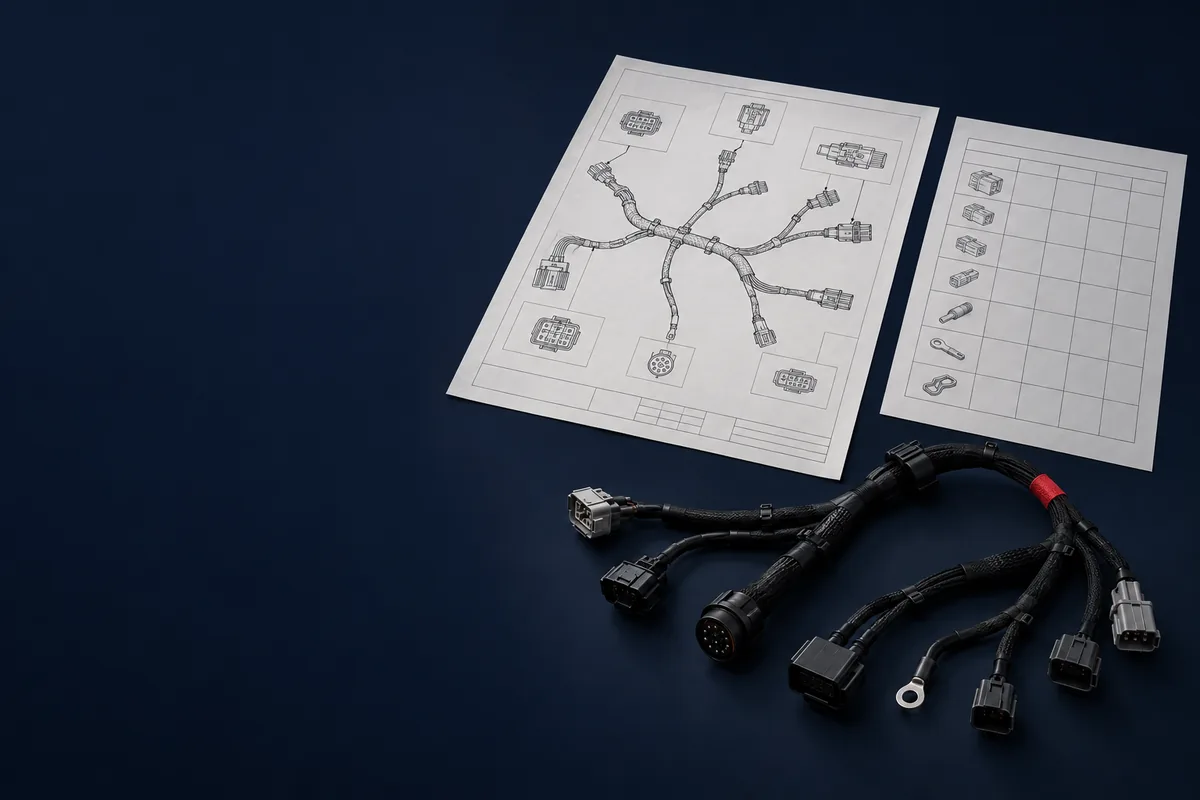
Automotive wire harness production line preparing documented samples and traceability records for PPAP submission
A wire harness PPAP package is not only paperwork. It proves that the sample, process, tooling, test method, and revision-controlled materials all match the released program scope.
A wire harness can pass continuity, hipot, and fit-check in the lab and still fail PPAP. That is the expensive part of automotive sourcing: the product may function, but the launch package still collapses because the process is not frozen, the material traceability trail breaks at a supplier change, or the dimensional report does not match the latest drawing revision.
For OEMs and Tier 1 buyers, PPAP is the gate between “sample looks good” and “this supplier can ship production parts without blowing up launch timing.” On a wire harness program, that gate touches crimp validation, terminal and seal traceability, connector revision control, control plans, PFMEA, packaging, labeling, and any customer-specific test record tied to the final assembly drawing.
This guide is written for B2B buyers, supplier quality engineers, and program managers who need an approval package that moves a harness program to SOP without repeated submission loops. It covers the PPAP level decision, the 18 elements that matter most for cable assemblies, the cost and timing traps that drive rework, and the exact RFQ package a supplier needs before first submission.
1. Why Wire Harness PPAP Fails
Most rejected wire harness submissions fail for operational reasons, not because buyers forgot the PPAP acronym list. The common pattern is simple: drawing revision A released, sample built to revision A, but the PFMEA, control plan, pull-force report, and packaging label example were created against older assumptions. When that mismatch surfaces at customer review, the supplier is effectively being asked to prove a different product than the one sitting in the sample box.
Wire harnesses add failure points that molded or machined parts do not have. One harness can combine multiple connector families, cavity seals, backshell hardware, labels, sleeves, tape, overmolds, and outsourced subcomponents. If even one of those items lacks approved part-number control or lot traceability, the submission may be held even when electrical performance is fine.
The sample, PSW, dimensional report, and control documents reference different drawing or BOM revisions.
Crimp height windows, pull-force studies, continuity method, or seal verification are mentioned but not backed by records.
Wire, terminals, seals, labels, and overmold materials cannot be tied to approved lots and released suppliers.
The supplier prepared a generic PPAP package but missed OEM packaging labels, IMDS data, or special appearance and fit checks.
2. PPAP Levels and the 18 Elements
PPAP levels define how much evidence the customer wants to review, not how much work the supplier should do internally. In automotive wire harness programs, Level 3 is the normal baseline: warrant, supporting data, and production samples submitted to the customer. Level 2 is occasionally accepted for lower-risk changes or carryover programs. Level 4 is customer-defined and usually appears when an OEM wants only selected evidence. Level 5 means the supplier retains a full package on site for customer review.
The 18 PPAP elements are broader than many buyers need to see line by line. For harness assemblies, the highest-value elements usually include design record, engineering change documents, DFMEA if supplier-owned design applies, PFMEA, process flow, control plan, MSA, capability data where relevant, dimensional results, material and performance test results, qualified laboratory documentation when required, sample parts, master sample, checking aids, customer-specific requirements, and the Part Submission Warrant (PSW).
Table
| Level / Element Group | What Buyers Should Confirm | Wire Harness Example |
|---|---|---|
| PPAP Level 2 | PSW + limited supporting data by agreement | Carryover harness with minor label update |
| PPAP Level 3 | PSW + full supporting evidence + samples | New automotive harness for SOP launch |
| PPAP Level 4 | Customer-defined subset | Engineering deviation or controlled trial build |
| PPAP Level 5 | Full package retained on site | Audit-heavy program or supplier surveillance |
| Core process evidence | PFMEA, process flow, control plan, MSA | Crimp, insertion, taping, overmold, electrical test controls |
| Product evidence | Dimensional, material, performance results | Connector cavity check, pull force, continuity, seal retention, packaging test |
Note: Buyers do not need every PPAP element at the same review depth. They do need the submission level, customer-specific requirements, and evidence scope agreed before the supplier starts building samples.
Checklist
The PPAP Elements Buyers Check Most Often on Harness Programs
- Released drawing, BOM, and approved deviation list
- Process flow, PFMEA, and control plan aligned to the actual assembly route
- Crimp validation records, pull-force data, and test method references
- Dimensional and fit results on branches, breakouts, labels, clips, and connector orientation
- Material and performance results for wire, terminals, seals, tape, sleeving, overmold, and final assembly
- PSW signed to the correct part number, revision, submission level, and reason for submission
3. What Changes Timing, Cost, and Approval Risk
A wire harness PPAP timeline changes fastest when the program includes new tooling, customer-specific test fixtures, multiple outsourced subcomponents, or design volatility. Programs with custom terminals, molded strain reliefs, inline electronics, unusual branch geometry, or special packaging validation often stall because sample hardware is ready before the documentation package is mature.
Cost also moves in layers. The visible cost is sample build, dimensional reporting, and test time. The hidden cost sits in engineering rework, premium freight for corrected samples, expedited terminal orders, repeated customer review meetings, and plant disruption when SOP material still lacks an approved PSW. Buyers should budget PPAP as a launch-control activity, not a paperwork add-on.
- Existing process, approved terminals, unchanged test method.
- Fastest path if label, packaging, or branch marker change is tightly scoped.
- Adds fit verification, part-number traceability, and possible crimp revalidation.
- Customer review often expands from Level 2 expectation to Level 3 reality.
- PFMEA, control plan, gage studies, packaging validation, and sample timing all move together.
- Any drawing revision change near sample build can reset the package.
Table
| Driver | Cost Effect | Lead-Time Effect |
|---|---|---|
| Custom terminals / seals / overmolds | Higher validation and sample scrap cost | Longer tool and sample loop |
| Customer-specific tests or packaging | More fixture, labor, and reporting effort | Longer approval window |
| Supplier-owned subcomponents | More traceability and qualification work | More coordination across vendors |
| Late engineering changes | Repeated report and sample rebuilds | Can reset submission timing entirely |
4. What Buyers Should Send Before Submission
Suppliers cannot build a clean PPAP package from a partial RFQ. If the buyer wants an approval-ready wire harness launch, the supplier needs the released drawing, BOM, quantity, target SOP date, test scope, packaging rules, and the exact compliance framework before first-article scheduling. Missing one of those items usually pushes the debate downstream into a rejected submission.
The most efficient approach is to treat the PPAP package as part of the sourcing package. Put the submission level, required elements, sample quantity, test expectations, and any customer-specific portals or forms in writing before the quote closes. That lets the supplier price engineering time correctly instead of hiding PPAP labor inside unit cost or changing terms later.
Checklist
Minimum Buyer Package Before PPAP Planning
- Released drawing, BOM, and connector / terminal / seal part numbers
- Quantity by stage: prototype, DV, PV, PPAP samples, and production release
- Target SOP date, target lead time, and customer submission level
- Environment, durability, electrical test scope, and packaging requirements
- Compliance target such as IATF 16949, OEM customer-specific requirements, IMDS, RoHS, or REACH
- Known open issues, approved deviations, and ownership of any supplier design responsibility
Note: If the buyer wants the supplier to return a complete launch package, say so explicitly in the RFQ. “Quote samples” and “quote PPAP-ready submission with PSW, control plan, PFMEA, validation records, and packaging evidence” are different scopes.
5. Supplier Review Checklist Before SOP
Before signing off a wire harness supplier for SOP, buyers should review the package like an operations checklist, not a document count exercise. A thick PPAP folder can still hide serious launch risk if the sample label, terminal lot, crimp settings, or branch orientation do not match the approved package.
The quickest way to reduce surprises is to force one final cross-check between the released part, the sample in hand, the PSW, and the evidence set. If the supplier cannot walk through that traceability chain in a single review call, the program is not actually PPAP-ready.
6. Frequently Asked Questions
Frequently Asked Questions
What PPAP level is most common for automotive wire harnesses?
Level 3 is the most common default for new wire harness launches because the customer typically wants the PSW, full supporting evidence, and production samples. Lower levels can be accepted for limited changes, but buyers should confirm the level before sample build starts.
Does every wire harness program require all 18 PPAP elements?
Not every customer reviews all 18 elements with the same intensity, but the supplier still needs a disciplined package behind the submission. For wire harnesses, buyers usually care most about the released design record, process flow, PFMEA, control plan, dimensional and performance results, customer-specific requirements, and the PSW.
What usually delays wire harness PPAP approval the most?
The biggest delays come from revision mismatch, missing traceability for terminals or seals, control documents that do not reflect the real build process, and customer-specific packaging or test requirements discovered after samples are already built.
What should I send a supplier if I want a PPAP-ready quote?
Send the released drawing, BOM, quantity by build stage, target SOP date, environment, target lead time, compliance target, submission level, test requirements, packaging rules, and any customer-specific forms or portals. That lets the supplier quote the approval scope instead of only the sample hardware.
Frequently Asked Questions
What PPAP level is most common for automotive wire harnesses?
Level 3 is the most common default for new automotive wire harness launches because customers usually require the PSW, full supporting evidence, and production samples.
What usually delays wire harness PPAP approval the most?
Revision mismatch, missing traceability for terminals or seals, control documents that do not match the real build process, and late customer-specific requirements are the most common delay drivers.
What should I send a supplier if I want a PPAP-ready quote?
Send the released drawing, BOM, quantity by build stage, SOP target, environment, lead-time target, compliance target, submission level, test requirements, and packaging rules so the supplier can quote the full approval scope.
Related Resources
- IATF 16949 automotive quality requirements overview
- Wire harness crimping guide for pull-force and process validation
- Automotive vs industrial wire harness requirements
- PPAP (Production Part Approval Process) overview — Wikipedia
- AIAG (Automotive Industry Action Group) standards and publications
Cta
Title: Need a PPAP-Ready Wire Harness Quote?
Send your drawing, BOM, annual and launch quantity, application environment, target lead time, compliance target, and required PPAP level. We will return a manufacturability review, PPAP scope recommendation, sample-and-submission timeline, and the test and documentation package needed before SOP.
Primarybutton: Request a PPAP Quote
Secondarybutton: Contact Engineering
Badges
- PPAP scope locked before sample build
- Automotive launch review
- Traceability and test planning support
Rfqtitle: Send This With Your RFQ
Rfqitems
- Released drawing and BOM, or the latest approved sample reference
- Prototype, PPAP sample, and production quantity with target SOP date
- Environment, target lead time, and compliance target such as IATF 16949 or OEM-specific rules
- Required submission level, test scope, packaging standard, and any customer-specific forms
Deliverablestitle: What You Get Back
Deliverablesitems
- DFM and revision-gap review before formal submission planning
- Quoted tooling, sample, and PPAP scope with realistic lead time
- Recommended validation, traceability, and document package for approval