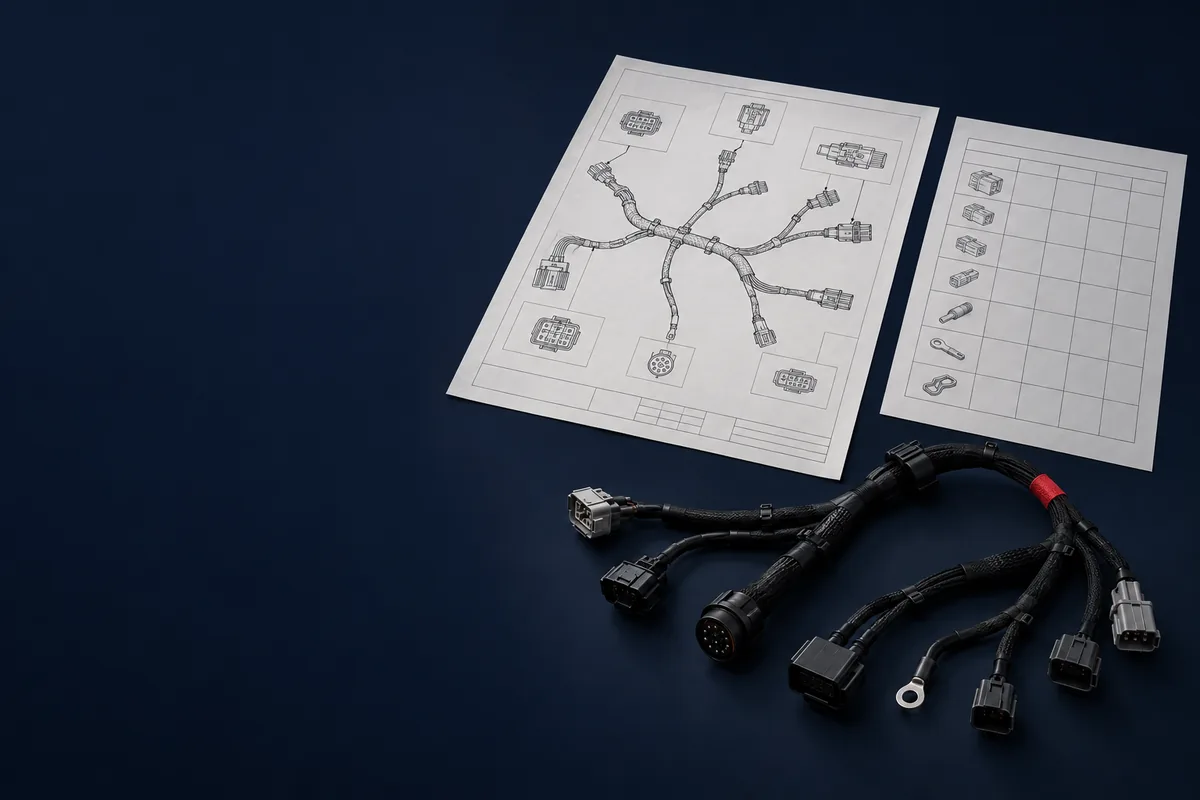
A European heavy-duty truck program came to us in 2025-Q4 with a long-lifecycle harness RFQ that looked commercially attractive but technically unstable. The program required a wire harness with grommets, and the case-bank record gives the production frame exactly: Concrete numbers: ['SOP 2029', 'EOP 2035', '6-year production lifecycle', '1 re-issued RFQ due to drawing errors']. The first RFQ had drawing quality issues, so the customer cancelled the quote, corrected the technical package, and re-issued the RFQ under a tighter timeline.
That is the cost problem this guide addresses. A drawing error before source selection does not only delay a quotation. It changes terminal counts, grommet tooling assumptions, labor routing, test fixture design, packaging, and whether the supplier can support the same baseline from start of production to end of production. For a buyer planning SOP in 2029 and EOP in 2035, weak revision control can turn a six-year supply program into repeated requotes and avoidable engineering-change disputes.
This article is written for OEM sourcing managers, supplier quality engineers, project buyers, and harness design teams who need a quote-ready data package before releasing a wire harness RFQ. It connects drawing revision control with wire harness RFQ discipline, first article inspection, wire harness PPAP planning, prototype cable assembly, and automotive wire harness sourcing.
TL;DR
- Freeze drawing, BOM, and test revisions before asking suppliers for cost or lead time.
- For long-lifecycle programs, quote SOP, EOP, annual volume, and change-control rules together.
- Grommets, clips, seals, terminals, and test fixtures need revision-specific approval evidence.
- Use IPC-A-620, IATF 16949, and UL-758 language to prevent vague quality requirements.
- Ask suppliers for a revision-risk log before accepting the lowest unit price.
Key Definitions Buyers Should Align First
A wire harness drawing revision is a controlled engineering version that defines geometry, branch lengths, connector positions, labels, materials, tolerances, and test requirements for a harness build.
SOP is start of production, the planned point when prototype or pilot builds move into controlled repeat manufacturing. EOP is end of production, the planned stop point for regular supply, service stock, or program support.
Engineering change management is the process that evaluates, approves, records, and releases drawing, BOM, tooling, test, and supplier-process changes after a baseline has been frozen.
IPC-A-620 is the cable and wire harness workmanship acceptance standard maintained by IPC/WHMA; public background on IPC is available through IPC. UL-758 covers appliance wiring material requirements under UL's recognized component framework; public background on UL is available through UL.
Why Drawing Revision Control Changes the Quote
A wire harness quote is a manufacturing plan converted into cost. When the drawing revision is unstable, the supplier cannot price the plan cleanly. A branch length change may alter wire usage, loom length, tape time, and packaging. A grommet datum change may require a different insertion method or fixture stop. A connector change may affect terminal applicators, crimp pull testing, and incoming material lead time. A label-position change may create an installation or service requirement that is invisible in the BOM.
In the heavy-duty truck case, the buyer did the right thing after finding drawing quality issues: they cancelled the first quote and re-issued the RFQ with corrected specifications. That protected the long-term program, but it compressed the quoting window. If the supplier had priced the first package as if it were final, both parties would have compared cost against the wrong design baseline.
For a six-year harness program, the drawing revision is not admin metadata. It is the commercial boundary for tooling cost, labor standard time, test coverage, and who pays when the design moves.
The practical buyer lesson is simple: do not request a final price from suppliers until the RFQ package names the exact drawing revision, BOM revision, connector revision, wire list revision, test specification revision, and approved deviation list. If those items are still moving, request a budgetary estimate and label it clearly. That avoids treating a supplier's early number as a binding production quote.
What a Quote-Ready Revision Package Includes
A quote-ready package gives the supplier enough evidence to price material, labor, tooling, quality, logistics, and risk. For automotive and heavy-equipment harnesses, it should include more than a 2D drawing. Send the released drawing, 3D route or installation envelope where available, BOM, wire list, connector drawings, terminal and seal specifications, grommet drawings, clip and bracket requirements, label artwork, test plan, packaging instruction, annual volume, target SOP, target EOP, and ramp profile.
Every file should carry a revision identifier and release date. Put the revision in the filename and in the RFQ summary table. If the drawing says Rev C but the BOM says Rev B, ask engineering to resolve the mismatch before releasing the supplier pack. If the supplier has to discover the mismatch, the quote clock starts with clarification instead of costing.
Buyers should also define the quality language early. IPC-A-620 should be cited for workmanship acceptance where applicable. IATF 16949 expectations should be stated when the program requires automotive process discipline, traceability, customer-specific requirements, change approval, corrective action, or PPAP-style evidence. If UL recognized appliance wiring material is part of the design, state UL-758, wire style, voltage, temperature, and flame rating instead of writing "UL wire" as a loose note. ISO 9001 background is available through ISO 9000, but ISO 9001 alone does not replace harness-specific revision and workmanship controls.
Comparison: Uncontrolled vs Controlled Revision RFQ
| RFQ Area | Uncontrolled Revision Package | Controlled Revision Package | Cost or Lead-Time Impact |
|---|---|---|---|
| Drawing and BOM | Drawing Rev C, BOM Rev B, unclear release owner | Single revision matrix with file names, dates, and owner | Avoids 1-3 clarification loops before pricing |
| Grommet and seal design | Shape shown, material and tolerance missing | Material, hardness, cavity fit, IP target, and inspection method defined | Prevents late tooling or mold-cost additions |
| Connector and terminal set | Connector family named, terminals and seals omitted | Full manufacturer part numbers and approved alternates listed | Reduces shortage and wrong-crimp risk |
| Workmanship standard | "Build to good quality" or generic inspection note | IPC-A-620 class, visual acceptance, and pull-test rules stated | Removes disagreement over defects at first article |
| Automotive documentation | PPAP mentioned after quote release | IATF 16949-style traceability and PPAP level identified in RFQ | Prevents underquoted documentation labor |
| Lifecycle assumptions | Annual volume only | SOP, EOP, ramp, service stock, and engineering-change process included | Improves pricing for long-term material and tooling commitments |
This comparison is also a supplier-screening tool. A capable supplier should not only return a number. They should identify where the revision package is weak, where cost can move, and which assumptions are locked into the quote. For a long-lifecycle vehicle harness, that risk log may be more valuable than a price that is 3 percent lower.
Where Drawing Errors Create Hidden Cost
The largest cost shift often comes from labor and tooling, not the visible copper or connector price. A changed branch breakout can affect assembly board layout. A grommet change can require different insertion force control, lubricant approval, or dimensional inspection. A connector orientation change can require operator retraining and new poka-yoke checks. A label or sleeve change can affect printing setup and traceability flow. A test-specification change can require a fixture update and new test-program validation.
For quoting, split cost into five buckets: material, direct labor, tooling and fixtures, quality documentation, and logistics. Then ask which buckets are revision-sensitive. On a harness with grommets, material may be stable while tooling and inspection are not. On an automotive harness with multiple sealed connectors, terminal and seal revisions may drive lead time. On an industrial control harness, label and test requirements may drive labor more than parts.
When a buyer sends a corrected drawing after a quote, I recheck the labor route first: cutting, stripping, crimping, insertion, grommet fit, board layout, labels, and 100 percent electrical test. The BOM rarely tells the full cost story.
Lead time also changes with revision quality. A supplier may quote 2-4 weeks for prototype harnesses when materials and drawings are clean, then lose the first week to technical clarification if the package has gaps. For production sourcing, buyers should ask for three dates: quote-ready confirmation date, material-ready date, and first-article ship date. These dates expose whether the delay is engineering, procurement, or manufacturing.
Supplier Review Checklist Before You Accept the Quote
Before choosing a supplier, ask them to return a revision-control review with the quote. This does not need to be a long report. It should be specific enough to show that the supplier actually read the drawing package and costed the manufacturing route.
- Confirm the exact drawing, BOM, wire list, connector list, and test specification revisions used for pricing.
- List every supplier assumption that affects unit price, tooling price, MOQ, or lead time.
- Identify missing grommet, seal, clip, label, connector, terminal, and wire-style details.
- State whether IPC-A-620 class, UL-758 wire style, and IATF 16949 or PPAP expectations are included in the quote.
- Separate NRE, tooling, test fixture, sample, pilot, and production unit prices.
- Identify the longest-lead material and any alternates that need written customer approval.
- Confirm how engineering changes after quote approval will be costed and documented.
- Ask whether the supplier can support the planned lifecycle from SOP to EOP, not only the first prototype batch.
This checklist turns quote comparison into risk comparison. Two suppliers may both quote the same drawing, but only one may have included the grommet inspection fixture, crimp pull-test records, and automotive traceability expected later. If the buyer compares only unit price, the missing scope appears later as an engineering change, quality dispute, or schedule slip.
How to Handle a Re-Issued RFQ Without Losing Control
When drawing errors force a re-issued RFQ, treat the event as a controlled reset. Send a revision delta table, not just a new attachment set. The table should show what changed, why it changed, which files are obsolete, which supplier assumptions are cancelled, and whether previous pricing can be reused. This prevents suppliers from combining old and new information by mistake.
For the heavy-duty truck case, the corrected technical data package allowed the BOM and manufacturing process to be re-evaluated against the long-term production timeline. That is the right outcome. The buyer did not hide the correction or pressure suppliers to keep the first quote active. They re-issued the RFQ, and the supplier rebuilt the cost model against the corrected baseline.
Buyers can make this faster by using a simple revision-delta format:
- Changed: branch length, grommet geometry, connector position, label, wire gauge, terminal, seal, clip, test method, or packaging rule.
- Reason: design correction, installation clearance, supplier feedback, compliance update, cost-down, or customer requirement.
- Commercial effect: no price effect, unit-price effect, tooling effect, lead-time effect, or documentation effect.
- Approval needed: engineering, supplier quality, purchasing, customer, or regulatory/compliance owner.
A re-issued RFQ is not a failure if the new package is cleaner. The failure is asking suppliers to price Rev C while hidden assumptions from Rev B remain alive in email.
Controls for SOP 2029 to EOP 2035 Programs
A program with SOP 2029 and EOP 2035 needs lifecycle thinking at the first quote. The supplier must price the starting configuration and understand how changes will be handled for six years. For automotive and heavy-duty truck harnesses, this includes engineering changes, material obsolescence, connector availability, tooling maintenance, service stock, annual cost reviews, tariff exposure, and requalification triggers.
Ask for a change-control clause before nomination. It should say how drawing changes are submitted, who reviews cost and timing, how old inventory is handled, how samples are approved, whether PPAP resubmission is needed, and how the supplier prevents mixed-revision shipments. For safety, automotive, and controlled industrial programs, mixed revision is a serious traceability risk because two harnesses with the same customer part number may not install, test, or perform the same way.
Use revision-specific labels and packaging where practical. The harness label, carton label, certificate of conformance, and shipment paperwork should identify the customer part number and revision. If the drawing changes but the customer part number does not, the revision record becomes the buyer's first line of industrial during receiving inspection, installation troubleshooting, and warranty analysis.
Next Step: Send a Revision-Controlled RFQ Package
If you are preparing a long-lifecycle wire harness RFQ, send us the drawing, BOM, quantity, annual forecast, SOP date, EOP target, operating environment, grommet and connector details, target lead time, compliance target, and required test evidence. We will return a quote-readiness review, revision-risk log, manufacturability comments, material and tooling assumptions, realistic lead time, and a production quote. You can start through our contact page, review our manufacturing capabilities, or send a prototype package through the prototype cable assembly service.
Author and Evidence Basis
This guide was prepared by Hommer Zhao, using anonymized supplier-side RFQ experience from wire harness programs and the current WellPCB wire harness production content base. The site positions WellPCB as an IATF 16949 and ISO 9001 certified wire harness and cable assembly manufacturer with 10+ years of manufacturing experience; buyers can review the public capability and certification context on the capabilities page and factory overview.
The production scenario in the opening comes from the project case bank, not a fabricated testimonial or named customer story. The specific lifecycle numbers are preserved from that anonymized source, while standards references such as IPC-A-620, UL-758, IATF 16949, and ISO 9001 are used as decision criteria buyers can include in RFQ and supplier-quality reviews.
FAQ
What drawing revision information should be included in a wire harness RFQ?
Include the drawing revision, BOM revision, wire list revision, connector list revision, test specification revision, release date, and owner for each file. For automotive programs, add IPC-A-620 class and any IATF 16949 or PPAP documentation expectation before asking for a final quote.
How does a re-issued RFQ affect wire harness cost?
A re-issued RFQ can change material, labor, tooling, test fixture, and documentation cost. In the 2025-Q4 truck case, the package had 1 re-issued RFQ due to drawing errors, so the supplier had to re-evaluate the BOM and manufacturing process before pricing the long-term program.
Why do grommets make drawing revision control more sensitive?
Grommets affect installation fit, sealing, tooling, insertion process, and inspection. A small drawing change can alter material, cavity fit, IP target, fixture design, or labor time, so the RFQ should define grommet material, hardness, geometry, tolerance, and test method.
What standards should buyers cite for harness revision-controlled programs?
Use IPC-A-620 for cable and wire harness workmanship, UL-758 when appliance wiring material recognition applies, and IATF 16949-style controls for automotive traceability, change approval, corrective action, and defect prevention. State the required class, evidence, and document level in the RFQ.
How early should suppliers review drawings before SOP?
For a long-lifecycle program, suppliers should review the drawing package during RFQ and again before first article. In a program with SOP 2029 and EOP 2035, early review protects the full 6-year production lifecycle, not just the first sample lot.
What should I ask the supplier to return with the quote?
Ask for confirmed revision numbers, a risk log, missing-data questions, material-ready date, first-article lead time, NRE and tooling split, quality-documentation scope, and a list of assumptions that affect price. The answer should reference the same drawing and BOM revisions you sent.
Send Your RFQ Package for Review
Send the drawing, BOM, quantity, annual forecast, operating environment, connector and grommet details, target lead time, SOP and EOP targets, compliance target, and required test evidence through our contact page. We will return a quote-readiness review, revision-risk log, manufacturability comments, material and tooling assumptions, realistic lead time, and a production quote tied to the revision set you sent.