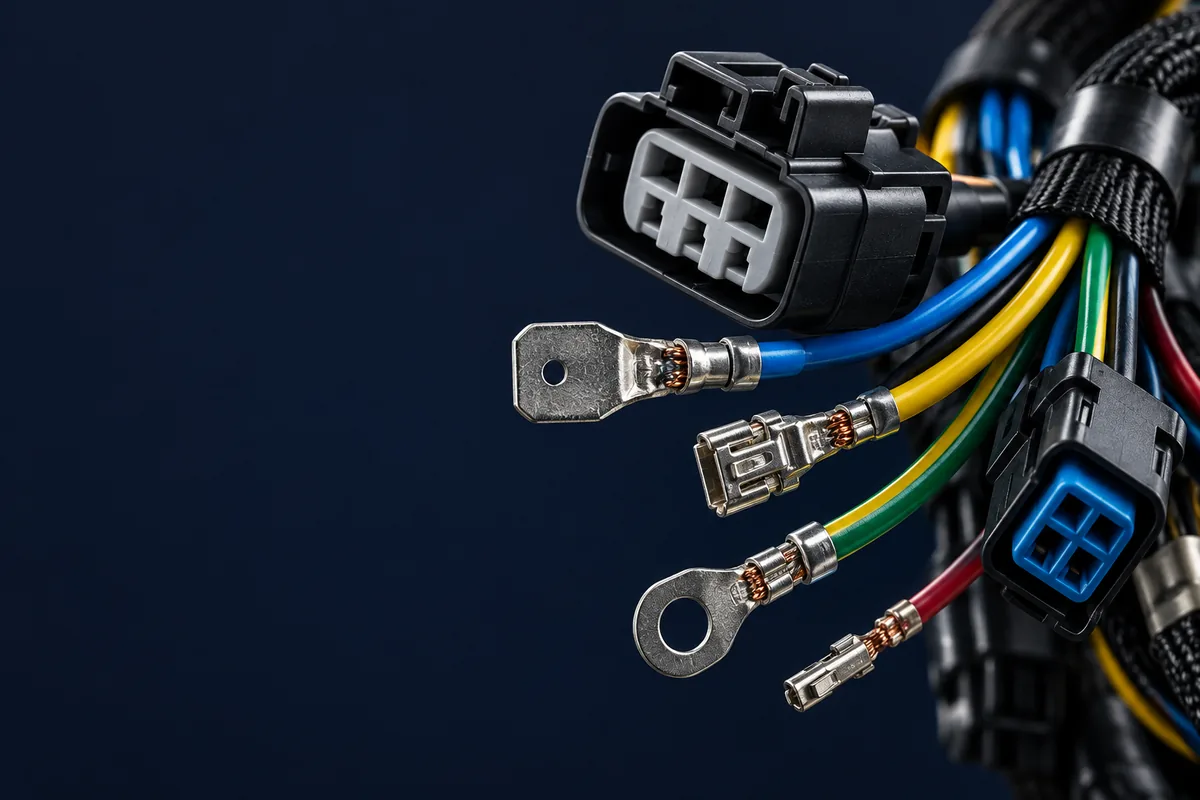
Picture a "simple" wire harness request: 200 units, nothing special, "just like the automotive harnesses we've seen." Then someone asks where it's going. A CNC machine. Suddenly "just like automotive" becomes a very different conversation.
Automotive and industrial wire harnesses might look similar, but they're engineered for completely different environments and requirements. Getting this wrong means either over-engineering (wasting money) or under-engineering (product failures). Discuss application requirements with the team at our facility; this guide shows where these differences matter—and where they don't.
Quick Comparison: Automotive vs Industrial at a Glance
| Factor |
Automotive
|
Industrial
|
|---|---|---|
| Typical Temperature Range | Routing-specific; use OEM qualification range | Application-specific; use equipment requirements |
| Primary Certification | Customer-required automotive QMS scope | Customer-required QMS and product approvals |
| Vibration Requirements | Extreme (road, engine) | Moderate to high (machine specific) |
| Chemical Exposure | Oil, fuel, coolant, road salt | Varies by application |
| Production Volume | Often high-volume repeat production | Often lower-volume, mixed production |
| Connector Types | Sealed, automotive-specific | Industrial, open frame |
| Lifespan Expectation | Per vehicle program design-life requirement | Per equipment design-life requirement |
| Cost Sensitivity | Extreme (pennies matter) | Moderate (reliability > cost) |
| Design Changes | Customer-controlled change approval | More flexible |
Environmental Requirements: Where It Gets Real
The environment where your harness operates determines almost everything about its design. Here's where automotive and industrial part ways:
Automotive Environment
Temperature
- • Under hood: assess sustained routing temperature
- • Near exhaust: assess local heat exposure
- • Winter cold: assess the operating minimum
- • Thermal cycling: daily temperature swings
Chemical Exposure
- • Engine oil and transmission fluid
- • Brake fluid (attacks many plastics)
- • Coolant/antifreeze
- • Road salt and de-icing chemicals
- • Gasoline and diesel fuel
Mechanical Stress
- • Continuous vibration (engine, road)
- • Shock loads (potholes, impacts)
- • Routing through tight spaces
- • Door/hinge flex zones
Additional Challenges
- • Water immersion (puddles, car wash)
- • UV exposure (exterior applications)
- • EMI/RFI interference
- • Stone impact
Industrial Environment
Temperature (Varies by Application)
- • Office/factory floor: assess local ambient conditions
- • Food processing: assess cold, heat, and washdown
- • Steel/glass: assess localized high-temperature exposure
- • Refrigeration: assess the operating minimum
Chemical Exposure (Application Specific)
- • Cutting fluids and lubricants
- • Cleaning chemicals
- • Food-safe requirements
- • Process chemicals
Mechanical Stress
- • Machine vibration (varies widely)
- • Cable carrier/drag chain motion
- • Robot arm flexing
- • Repeated bending cycles
Additional Challenges
- • EMI from motors and drives
- • Metal chips and debris
- • Water/coolant spray
- • Longer cable runs
Certification Requirements: Night and Day
This is where automotive and industrial diverge most dramatically. Understanding the certification requirements for each industry is crucial for selecting the right supplier.
| Requirement | Automotive | Industrial |
|---|---|---|
| Quality System | Verify customer-required IATF 16949 scope | Verify customer-required QMS scope |
| Process Approval | Customer-defined PPAP submission level | First article typically |
| Change Control | Per customer change-control requirements | Per customer and internal change-control requirements |
| Safety Certification | OEM-specific supplier quality requirements | Applicable product safety and conformity requirements |
| Workmanship Standard | Customer-specified IPC/WHMA-A-620 class | Customer-specified IPC/WHMA-A-620 class |
| Audit Frequency | Per customer and certification program | Per customer and certification program |
PPAP Explained
Production Part Approval Process (PPAP) is an automotive industry standard requiring suppliers to demonstrate that their manufacturing process can consistently produce parts meeting all requirements. Its documentation may include design records, sample parts, and process capability studies. For wire harnesses, this typically means extensive documentation, dimensional studies, and initial sample submissions before customer-authorized production release.
Material Specifications: Different Worlds
The materials used in automotive vs industrial harnesses reflect their different operating environments and cost constraints.
Wire Insulation Materials
| Material | Temp Range | Automotive | Industrial | Notes |
|---|---|---|---|---|
| PVC | Grade-specific; check wire datasheet | Rarely | Common | Often economical; temperature rating is grade-specific |
| XLPE | Grade-specific; check wire datasheet | Standard | Common | Good chemical resistance |
| TPE | Grade-specific; check wire datasheet | Growing | Sometimes | Recyclable, flexible |
| Silicone | Grade-specific; check wire datasheet | High temp areas | Furnace/high heat | Expensive, very flexible |
| PTFE (Teflon) | Grade-specific; check wire datasheet | Extreme apps | Chemical/high temp | Chemical and thermal capability depends on grade |
Wire Types Comparison
Automotive Wire Standards
- SAE J1128: Low-voltage primary wire
- SAE J1127: Battery cable
- ISO 6722: Road vehicles wire
- GXL/SXL/TXL: Automotive wire constructions; confirm wall and temperature requirements
- Conductor and plating per wire specification
Industrial Wire Standards
- UL 1007/1015: General purpose hook-up wire
- UL 2464: Multi-conductor cable
- MTW: Machine tool wire
- TFFN: Fixture wire
- Options for solid or stranded
Connector Types: Specialized vs Versatile
Connectors are where automotive and industrial requirements diverge significantly. Automotive connectors prioritize sealing and cost at volume; industrial connectors prioritize versatility and field serviceability.
| Feature | Automotive Connectors | Industrial Connectors |
|---|---|---|
| Sealing | Sealing selected for the routing environment | Open frame common, sealed optional |
| Common Brands | TE, Aptiv (Delphi), Yazaki, Sumitomo | Molex, Phoenix Contact, Weidmuller, Harting |
| Termination | Crimped terminals (automated) | Crimp, screw, spring, IDC |
| Field Serviceability | Replace entire harness | Individual wire replacement often possible |
| Pin Count | Position count depends on interface requirements | Usually smaller, multiple connectors |
| Cost Model | Low unit cost, high tooling | Moderate unit cost, low tooling |
Testing Requirements: How Much is Enough?
Testing requirements differ significantly between industries. Learn more about specific wire harness testing methods .
| Test Type | Automotive | Industrial | Notes |
|---|---|---|---|
| Continuity | Per approved test plan | Per approved test plan | Define coverage and acceptance criteria |
| Hipot | Often | When specified | Depends on voltage levels |
| Pull Force | Sample + in-process | Sample typically | Per applicable terminal and workmanship requirements |
| Environmental | Per OEM qualification plan | Per equipment qualification plan | Thermal, humidity, vibration |
| Cross-Section | Per approved control plan | Per approved control plan | Crimp quality verification |
| Salt Spray | Often | Rare | Corrosion resistance |
| Flex/Bend Cycle | For door harnesses | For robot/cable track | Application dependent |
Documentation & Traceability: Paper vs Digital
Documentation requirements are vastly different between industries:
Automotive Documentation
- • PPAP package at the customer-required submission level
- • Control plans
- • PFMEA (Process Failure Mode Analysis)
- • Cpk/Ppk capability studies
- • Material certifications with lot traceability
- • Dimensional reports
- • Run-at-rate documentation
- • Retain samples for years
Industrial Documentation
- • First article inspection report
- • Test reports (continuity, hipot)
- • Certificate of conformance
- • Material certs (when specified)
- • Basic lot traceability
- • As-built documentation
- • Work instructions
- • Calibration records
Cost Impact
Automotive documentation requirements can add cost to a harness program, especially for the initial PPAP. Production volume affects how programs recover these costs. Industrial programs with simpler documentation can be cost-effective at much lower volumes.
Cost Comparison: Where Does the Money Go?
Understanding cost drivers helps you optimize your harness program. Here's where automotive and industrial differ:
| Cost Factor | Automotive Impact | Industrial Impact |
|---|---|---|
| Material Cost | Optimized through volume contracts | Higher per-unit due to lower volumes |
| Tooling | High upfront, amortized over volume | Low to moderate |
| Quality/Documentation | Program-specific quality and documentation costs | Program-specific quality and documentation costs |
| Labor Content | Highly automated where possible | More manual labor accepted |
| Engineering/NRE | High, spread over high volumes | Moderate, visible in unit cost |
| MOQ Economics | Evaluate tooling recovery using the actual forecast | Evaluate tooling and setup costs against quantity |
Choosing the Right Manufacturing Partner
Not every manufacturer is suited for every application. Here's how to match your needs to the right partner:
For Automotive Projects
- ✓ Verify IATF 16949 certification (check the scope!)
- ✓ Confirm experience with your OEM's specific requirements
- ✓ Ask about PPAP capabilities and timeline
- ✓ Verify appropriate production capacity
- ✓ Check customer-specific requirement compliance
For Industrial Projects
- ✓ Verify customer-required quality-system certification
- ✓ Experience in your specific application area
- ✓ Flexibility for design iterations
- ✓ Reasonable minimum order quantities
- ✓ In-house testing capabilities (continuity, hipot)
Use our supplier evaluation questions and manufacturer selection guide to thoroughly evaluate potential partners.
Conclusion: Right-Size Your Requirements
The fundamental difference between automotive and industrial wire harnesses isn't just technical—it's economic. Automotive requirements evolved to serve high-volume, safety-critical, harsh-environment applications where pennies per unit matter but you can amortize significant upfront costs. Industrial requirements evolved to serve lower-volume, more varied applications where flexibility and per-unit economics matter more than ultimate optimization.
The mistake is applying automotive requirements to industrial applications (over-engineering and overspending) or industrial approaches to automotive applications (under-engineering and risking quality issues). Match your requirements to your actual application, and you can balance of quality, reliability, and cost.
At WellPCB, we serve both automotive and industrial customers. We understand the different requirements and can help you determine the right approach for your specific application.
Frequently Asked Questions
What is the main difference between automotive and industrial wire harnesses?
Automotive harnesses often face road exposure, vibration, and thermal cycling, with requirements set by the vehicle program. Industrial harnesses serve a broad range of panel and machine environments. Select materials, sealing, tests, and quality-system requirements for the actual application.
Can an automotive wire harness be used in industrial equipment?
Sometimes, but not as a drop-in. Automotive harnesses have circuit-specific voltage, current, and connector ratings, so for industrial use you must verify voltage, current, insulation rating, and the relevant UL/IEC approvals before substituting.
Which standards apply to automotive versus industrial harnesses?
Automotive programs may specify IATF 16949 quality-system requirements plus USCAR, ISO 16750, or OEM qualification requirements. Industrial programs may specify UL/CSA component requirements and IEC or other equipment standards. Confirm the applicable scope for the program.
Why are automotive harness connectors sealed?
Engine-bay and underbody harnesses face moisture, road spray, salt, and pressure-washing, so automotive connectors need sealing selected for the specified exposure. Industrial harnesses inside a control cabinet often use unsealed connectors because the environment is far less aggressive.
Is the wire different between automotive and industrial harnesses?
Yes. Automotive harnesses commonly use thin-wall TXL/GXL cross-linked wire to save weight and space, while industrial harnesses often use MTW, THHN, or appliance wire chosen for panel routing, higher current, or specific flame ratings.
Which type of harness costs more to manufacture?
It depends on volume and complexity rather than category. Automotive harnesses benefit from very high volumes that lower unit cost, while industrial harnesses are often lower-volume, higher-mix builds where engineering and material variety drive the price.