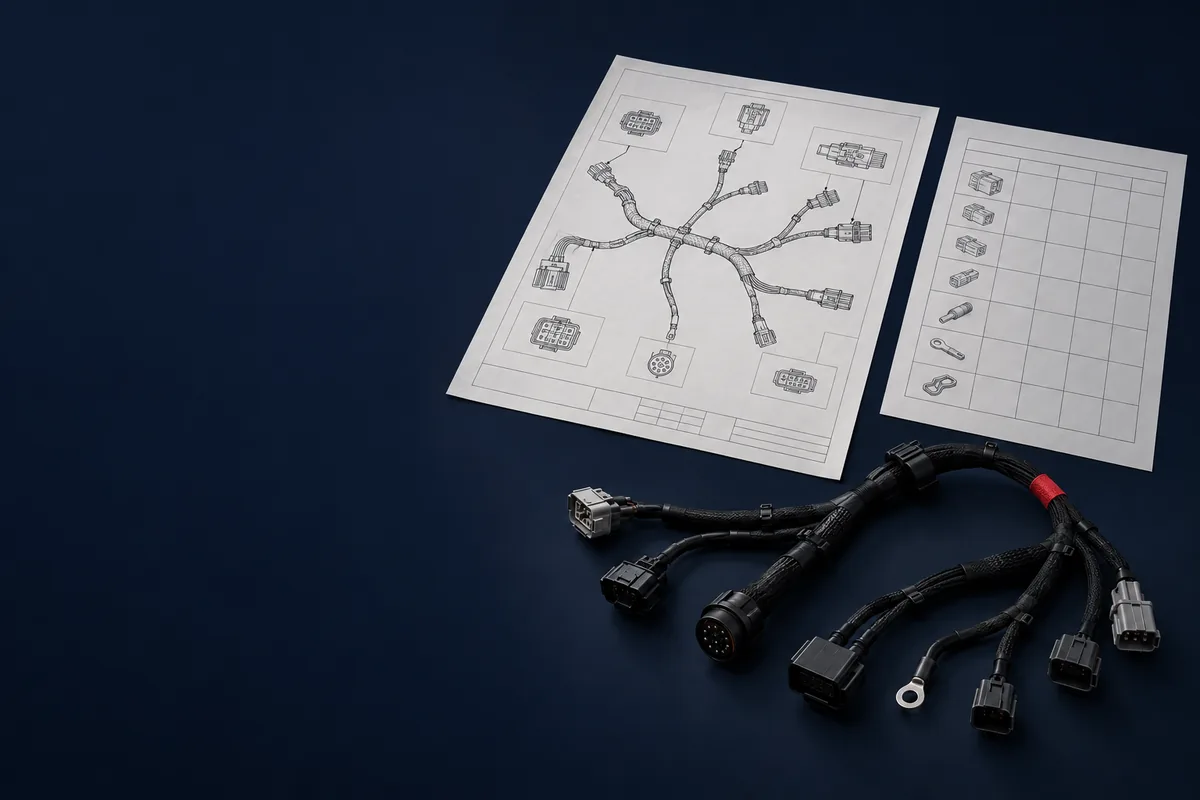
An automotive wire harness supplier says it is IATF 16949 certified, the quote looks competitive, and the launch team relaxes for a moment. Then the first sample arrives with no crimp-height study, no clean lot traceability for seals and terminals, and no clear reaction plan for out-of-spec electrical test results. The certificate was real, but the operational control behind the build was weak. That is the gap buyers need to manage before SOP, not after a line stop.
This guide is for OEM buyers, supplier-quality engineers, APQP teams, and commodity managers sourcing automotive and high-reliability wire harnesses. It explains what IATF 16949 actually changes inside a harness supplier, which records matter during sourcing and audit, and how to connect the standard to real launch controls such as PPAP, first article inspection, component sourcing, and our wire harness testing service.
Public references such as the IATF global oversight site, ISO 9001 quality management principles, PPAP, and AIAG explain the framework. What buyers still need is the sourcing-level checklist for a real wire harness program where crimp settings, connector revisions, traceability, and launch timing all move together.
1. Why certification alone does not protect your launch
IATF 16949 is useful because it pushes a supplier toward disciplined automotive process control. It asks for more than a general quality promise. Buyers should expect controlled documents, nonconformance handling, traceability logic, internal audits, corrective action, supplier management, and evidence that the production process can repeat the approved build. On a wire harness line, that touches cutting, stripping, crimping, seal insertion, cavity loading, taping, testing, packaging, and label control.
The mistake is to treat the certificate itself as proof that every quoted harness program is ready. A certificate does not tell you whether the quoted connector family is still on the released BOM, whether the crimp applicator is validated for your wire range, whether the sample used the same terminal lot that production will use, or whether the supplier has a realistic containment plan if a 100% continuity test starts failing on second shift. Those questions still have to be asked, documented, and reviewed program by program.
2. What buyers should verify before approving the supplier
The fastest way to use IATF 16949 correctly is to stop asking, "Are you certified?" and start asking, "Show me how the certified system controls this harness." A strong supplier should be able to walk from the released drawing to the work instruction, the crimp validation record, the test plan, the lot record, and the reaction plan without improvising. If that chain breaks, the quality system is not helping your launch enough.
For harness buyers, the most valuable evidence usually sits at the process level rather than in a generic quality manual. You want to see how the system works where defects actually occur: wrong cavity loading, strand damage, seal mismatch, revision drift, missing labels, poor branch geometry, and uncontrolled substitutes.
| Control area | What to ask for | Why it matters | Typical risk if missing | Buyer takeaway |
|---|---|---|---|---|
| Revision control | Released drawing, BOM, ECN history, and sample label match | Prevents building to an old connector or branch layout | PPAP and FAI loops restart | Check revision on every sample and report |
| Crimp process control | Crimp height window, pull-force record, applicator ID, and setup approval | Crimps are still the highest field-failure driver | Intermittent opens, heat, weak retention | Ask for measurable crimp evidence, not visual claims |
| Material traceability | Wire, terminal, seal, housing, sleeve, and label lot linkage | Supports containment and automotive recall discipline | No clean root-cause boundary | Lot traceability should survive to shipment level |
| Test control | Continuity, shorts, insulation resistance, hipot, and tester file revision | Confirms the released electrical scope is really checked | Good-looking samples escape with hidden faults | Verify test scope and reaction plan together |
| Change management | Approved alternate process, deviation flow, and customer notification rule | Wire harness launches fail when substitutes enter quietly | Unplanned revalidation and customer escalation | No-substitute parts should be explicit in the RFQ |
| Layered audit and CAPA | Internal audit findings, corrective actions, and closure evidence | Shows whether process drift is found before shipment | Repeat defects across shifts or lines | Look for speed and depth of corrective action |
3. How IATF 16949 connects to APQP, PPAP, and supplier audit work
Buyers get the most value from IATF 16949 when they treat it as the operating system behind launch controls, not as a standalone badge. During APQP, it should shape process flow, PFMEA, control plan discipline, gauge strategy, and escalation rules. During PPAP, it should support traceable evidence that the approved sample, production process, and released documents all match. During supplier audits, it should show whether the plant can repeat those controls across shifts, part families, and volume ramps.
On wire harness programs, that means the standard should appear in everyday decisions: how crimp tools are released, how first-off checks are signed, how operator training is recorded, how defect samples are segregated, how tester files are revision-controlled, and how customer-specific requirements are pushed into the line before pilot build. A supplier that speaks fluently about the standard but cannot show those controls on the floor is not giving buyers enough confidence.
- Use APQP to lock the process flow, PFMEA, and control plan before sample timing gets tight.
- Use PPAP to prove the approved harness and approved process belong to the same revision set.
- Use FAI to verify physical build, workmanship, and test evidence before volume approval.
- Use supplier audits to confirm reaction plans, layered process audits, and corrective actions still work after launch pressure starts.
- Use automotive application requirements and customer-specific rules to define what must never change without approval.
4. Red flags buyers should take seriously
The warning signs are usually operational, not ceremonial. A supplier may show a valid certificate and still struggle when you ask for the latest crimp validation on a 0.35 mm2 signal wire, the lot record for cavity seals used on the pilot build, or the reason a substitute tape entered the line without formal approval. Buyers should pay close attention when answers shift from records to explanations.
Another red flag is when the quality team sounds disciplined but the commercial package stays vague. If the quotation does not define test scope, approved alternates, packaging standard, compliance target, and launch quantities, the supplier may still be quoting risk into your program instead of controlling it. In automotive sourcing, ambiguity always gets more expensive later.
- Samples pass electrically, but the supplier cannot show matching crimp-height or pull-force records.
- Terminal, seal, or connector substitutes appear under the phrase "equivalent material" without customer approval.
- Tester files, labels, and work instructions do not show clear revision control.
- Traceability stops at incoming material instead of reaching the shipped harness lot.
- Corrective actions describe training only, with no process change, verification, or containment proof.
5. What to send next if you want a useful supplier answer
If you want the supplier to respond with more than a generic certificate and a unit price, send a package that defines the real approval burden. Include the released drawing, BOM, annual and launch quantity, environment, target lead time, compliance target, required test scope, and any customer-specific requirements. If the harness is for an automotive launch, say whether PPAP level, IMDS, packaging labels, or special traceability rules already apply.
A serious supplier should return a manufacturability view, a process-control view, and a documentation view. That means not only unit pricing, but also which crimp validations are needed, what test evidence will be provided, where customer approval is required for alternates, and how the launch schedule changes if the design or sourcing assumptions move. That is where IATF 16949 becomes commercially useful to a buyer.
Representative project (anonymized)
Anonymized example from our case bank, shared so buyers can see how this scope is actually executed in production.
Industry: agricultural-machinery | Region: Turkey | Year: 2025-Q3
Scenario: A strategic purchasing director from a diversified heavy machinery group was evaluating suppliers for a new agricultural tractor harness program.
Challenge: The OEM had high quality standards due to the harsh operating environments of agricultural machinery and required suppliers with robust quality management systems to ensure reliability.
Solution: Proactively shared ISO 9001 and IATF 16949 certifications along with factory photos during the initial inquiry phase to demonstrate manufacturing capability and quality assurance for automotive-grade and heavy-equipment applications.
Result: Accelerated the supplier qualification process; the customer proceeded to share technical drawings for the annual harness program based on the validated quality credentials.
Concrete numbers: ISO 9001 certified, IATF 16949 certified, ~500 units annual quantity per model
Frequently Asked Questions
Does IATF 16949 certification guarantee a wire harness supplier is safe to approve?
No. Certification is a strong signal, but buyers still need program-specific evidence for revision control, crimp validation, traceability, test scope, and change management. The certificate supports the system; it does not replace launch review.
What should buyers ask for first on an automotive wire harness audit?
Start with the released drawing and BOM, then ask the supplier to show the linked work instruction, crimp setup record, test file revision, and lot traceability for one actual sample or shipped lot. That path shows whether the system works where it matters.
How is IATF 16949 different from ISO 9001 for wire harness sourcing?
ISO 9001 provides general quality-management structure. IATF 16949 adds automotive-specific discipline around risk, traceability, customer-specific requirements, defect prevention, and launch control. For automotive harnesses, that extra rigor matters.
Should a non-automotive buyer still care about IATF-style controls?
Yes. Even when the program is industrial rather than automotive, buyers benefit from strong control over revision, crimp validation, test evidence, traceability, and corrective action. Many of the most useful habits are cross-industry.
Which documents most often expose a weak harness quality system?
Crimp-height and pull-force records, tester file revisions, traceability sheets, deviation approvals, and corrective-action closure records reveal weakness quickly because they show whether the process is actually being controlled shift by shift.
What should I send with my inquiry if I need an approval-ready quote?
Send your drawing, BOM, quantity, environment, target lead time, compliance target, and the approval scope you expect, including PPAP level, test requirements, labeling, and any no-substitution parts. That lets the supplier quote the true launch burden instead of only the hardware.
Need an automotive wire harness supplier review before release?
Send your drawing, BOM, quantity, environment, target lead time, and compliance target through our contact page. If you already have a sample or audit package, include the latest test report, traceability sheet, and any open quality concerns. We will return a manufacturability review, a process-control gap list, the recommended test and documentation scope, and a quote aligned to the approval stage you actually need.
- Send next: drawing, BOM, quantity, environment, target lead time, compliance target
- You receive back: DFM review, quality-system gap list, recommended test scope, and realistic quote timing
- Best fit for: OEM buyers, APQP teams, supplier-quality engineers, pilot launch and SOP planning