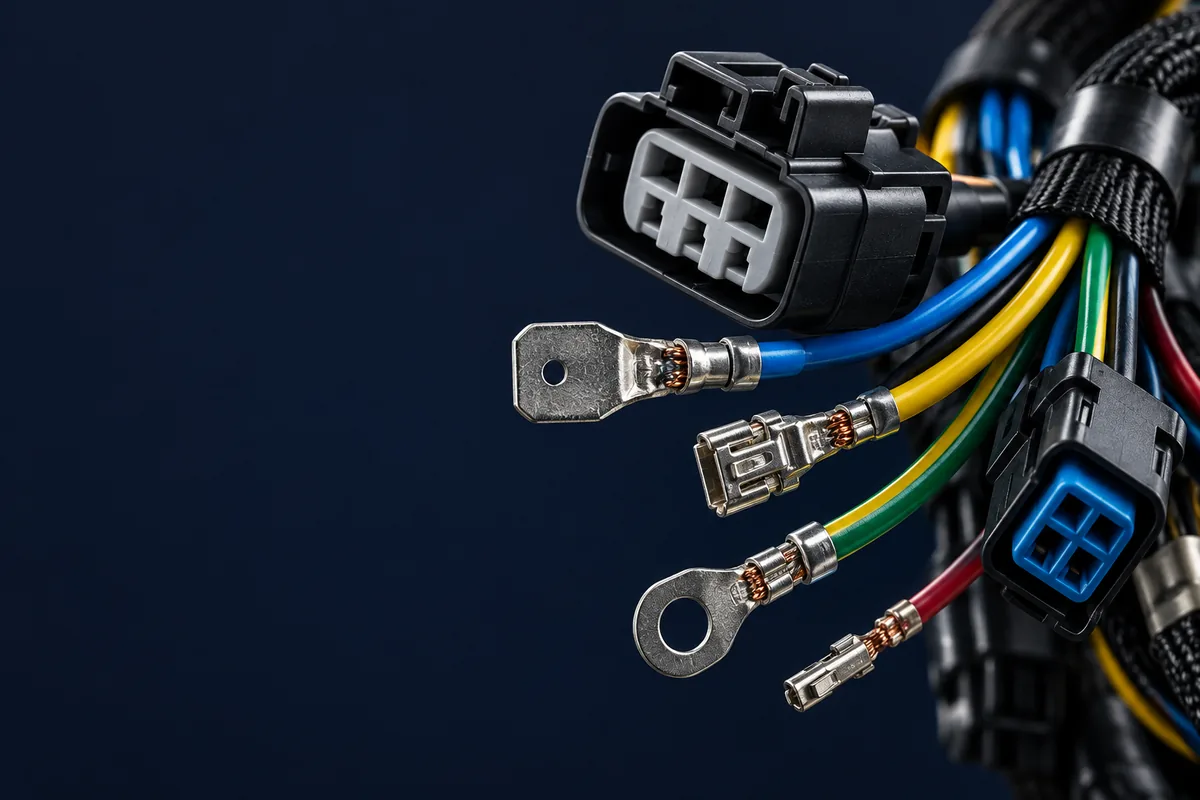
Fine-gauge micro-coaxial assemblies require a reproducible impedance test method. Before pilot release, align the drawing, reference plane, fixture, adapters, calibration records, limit line, sampling plan, and report template so factory and customer measurements can be compared directly.
RF cable assembly testing is a production control process that verifies whether a finished coaxial, micro-coaxial, or shielded RF jumper still meets the signal-path requirement after cutting, stripping, termination, soldering, crimping, strain relief, labeling, and packaging. For engineers and sourcing teams already past concept selection, the goal is not to buy every possible RF test. The goal is to specify the smallest evidence package that proves the assembly will work in the real equipment.
TL;DR
- Use VSWR or return loss to verify mismatch on RF paths, not only continuity.
- Use insertion loss when cable length, frequency, or connector count can consume link margin.
- Define frequency range, fixture, calibration, and acceptance limits before sample release.
- Apply IPC-A-620 workmanship checks with UL-758 wire and insulation traceability where relevant.
- After a severe complaint, require aligned supplier and customer test methods before replacement release.
Background for Engineers and Buyers
This guide is written for RF-adjacent hardware engineers, quality engineers, NPI buyers, and sourcing managers buying coaxial cable assemblies, SMA jumpers, FAKRA leads, BNC test cables, micro-coax camera links, or low-loss antenna feeds. The reader is usually between RFQ and pilot release: the connector family is known, the cable length is estimated, and the next decision is what test evidence must appear on the supplier report.
The objective is practical: prevent a finished RF assembly from passing a basic continuity check while failing the customer's RF bench because VSWR, return loss, insertion loss, or impedance method was never defined.
Voltage standing wave ratio is a mismatch measurement that expresses how much reflected energy exists on a transmission line. Return loss is a mismatch measurement in dB that expresses reflected signal energy relative to the incident signal. Insertion loss is a through-path measurement in dB that shows how much signal is lost from input to output. These three definitions matter because a buyer can ask for the wrong report and still receive beautiful-looking data that does not answer the product risk.
Public references on voltage standing wave ratio, return loss, and insertion loss explain the RF terms. For workmanship and traceability, cite IPC-A-620 for cable and wire harness acceptance evidence and UL-758 when the wire style, insulation system, or appliance wiring material record must be controlled.
What Each RF Cable Test Proves
Continuity testing is the baseline for every assembly because it catches opens, shorts, swapped contacts, shield-to-center faults, and wiring errors. It should normally be 100% final inspection. It does not prove RF performance. A 50 ohm SMA cable can pass continuity and still show a poor launch at the connector because the dielectric was nicked, the center contact was overheated, or the ferrule does not match the braid and jacket stack.
VSWR testing is useful when the customer, radio module, antenna, or instrument team already expresses the limit as a ratio, such as 1.30:1 or 1.50:1 across a defined band. Return loss is often cleaner for engineering reports because dB values show small changes more clearly. As a rough relationship, a 1.50:1 VSWR equals about 14 dB return loss, while a 1.22:1 VSWR equals about 20 dB return loss. Source: Keysight return-loss/VSWR table. The exact acceptance limit must come from the customer-owned design or equipment interface.
Insertion-loss testing becomes the primary gate when total cable path loss threatens link margin. A 150mm internal RF jumper may need only first-article insertion-loss evidence, while a 5m low-loss antenna cable may need lot-level or 100% testing depending on frequency, connector count, and field-service cost. When cable loss reaches 3 dB, about half the signal power has been lost before receiver margin, adapters, temperature, and aging are counted. Source: Anritsu Common RF Terms.
TDR impedance testing is often stronger for short micro-coax and high-speed miniature cables because it can show where the discontinuity occurs: connector launch, shield fold, bend zone, cable body, or fixture. For these assemblies, continuity alone is insufficient; the impedance specification and test method must use the same reference conditions.
RF Cable Assembly Test Method Comparison
The table below separates production tests by what they prove. Use it to write RFQ language and first-article requirements instead of asking vaguely for "RF test report."
| Test Method | What It Proves | Typical Acceptance Language | Best Production Stage | Risk If Missing |
|---|---|---|---|---|
| Continuity and shorts | Correct conductor and shield path | 100% pass/fail by pin map and drawing revision | Every lot, every unit | Open, short, swapped contact, or shield fault reaches incoming QC |
| VSWR | RF mismatch as a standing-wave ratio | Example: VSWR <= 1.50:1 from 700 MHz to 2.7 GHz | First article, pilot, or 100% for critical RF paths | Reflected power, antenna mismatch, unstable radio performance |
| Return loss | RF mismatch expressed in dB | Example: return loss >= 14 dB across operating band | Engineering approval and production trend review | Small connector-launch defects hidden by pass/fail continuity |
| Insertion loss | Total signal attenuation through cable and connectors | Example: insertion loss <= 1.2 dB at 2.4 GHz for finished length | Long cable, high frequency, low-margin systems | Link budget consumed by cable before equipment is installed |
| TDR impedance | Impedance profile and discontinuity location | Target impedance, tolerance, fixture ID, and report window | Micro-coax, short jumpers, controlled-impedance disputes | False rejects or false passes caused by fixture and method mismatch |
| Shield continuity and resistance | Shield bond path or drain connection | Defined shield continuity or resistance limit by assembly type | EMI-sensitive and shielded cable builds | Noise pickup, EMC debug delay, intermittent ground reference |
How to Set VSWR, Return-Loss, and Insertion-Loss Limits
Start with the system port impedance. Most RF transmit, antenna, instrumentation, GNSS, cellular, Wi-Fi, FAKRA, SMA, TNC, and N-Type paths are 50 ohm. Many video, CCTV, SDI, CATV, and broadcast paths are 75 ohm. If the buyer has not locked the equipment impedance, the supplier cannot set a meaningful VSWR or return-loss limit. Our 50 ohm vs 75 ohm coaxial cable guide covers that decision in more detail.
Next, set the operating frequency range. A cable that behaves well at 100 MHz may fail at 2.4 GHz, 5.8 GHz, or another specified RF band. The report should state the start frequency, stop frequency, sweep points or resolution where practical, fixture and adapter stack, calibration date, cable length, and drawing revision. "Pass RF test" is too weak for a controlled production record.
Then choose limits that fit the application instead of copying a catalog maximum. For internal RF jumpers, set the VSWR or return-loss limit from the equipment interface and available mismatch budget. For insertion loss, the limit should be calculated from cable datasheet loss at frequency, finished length, connector loss, and the system link budget. The coaxial cable datasheet guide shows how to read attenuation and bend-radius values before they become production defects.
For short micro-coax and dense connector systems, define whether the acceptance is a single number, a full trace, a limit line, or a controlled report template. If the customer lab uses one launch fixture and the factory uses another, compare a customer-approved set of retained samples before pilot release. On a 100mm assembly, adapter and launch variation can create a false pattern that looks like a cable defect.
Factory Release Package After a Failed RF Lot
After a high-impedance or RF mismatch complaint, do not sort parts until both teams agree on the test method. First freeze the drawing revision, BOM, cable reel, connector lot, fixture, calibration records, operator station, strip dimensions, and inspection reports. Then test retained samples using the supplier method and the customer method. That comparison shows whether the root cause is material, termination, fixture, report definition, or customer-side interpretation.
When methods differ, supplier and customer engineering teams should compare retained samples under both setups, agree on the impedance definition, update the specification and report template, and validate new samples before release. The lesson for RF cable buyers is direct: production should not be released under vague test wording.
A strong release package should include approved drawing, BOM, cable and connector lot traceability, first-article inspection, continuity report, VSWR or return-loss report, insertion-loss report when required, TDR trace or impedance result when required, microscope photos for miniature terminations, packaging photos, and a deviation log. IPC-A-620 evidence should cover workmanship defects such as conductor damage, insulation nicks, poor strip length, damaged shield, weak strain relief, incomplete seating, and label errors. UL-758 evidence should cover the wire or cable style, insulation rating, and traceability where the design calls for appliance wiring material.
RFQ Language That Prevents Test Ambiguity
A controlled RFQ should name the cable family, connector family, impedance, frequency range, finished length, bend radius, environmental exposure, required standards, and test report format. For SMA cable assemblies, include SMA gender, bulkhead or inline style, cable OD range, and whether the assembly must be phase matched. For micro-coaxial cable assemblies, include connector series, cable gauge, datum for length measurement, allowed handling near the exit, and whether TDR evidence is required.
Use this wording pattern when the design team has not issued a final test specification: "Supplier to quote continuity test for 100% of units and RF test evidence for first article. RF test proposal must state VSWR or return-loss method, frequency range, fixture, calibration approach, and proposed limit. Buyer approval required before pilot production." That gives the supplier room to advise while keeping the buyer in control of release criteria.
If the program is lower risk, state that too. Not every short internal jumper needs 100% VNA testing. A good production plan may use 100% continuity, first-article VSWR/return loss, lot sampling for insertion loss, and 100% visual inspection under IPC-A-620 criteria. For high-value field equipment, medical devices, radio modules, or difficult service locations, the added test time may cost less than one field failure.
Buyer Decision Rules
- Require 100% continuity for every RF cable assembly unless a customer-approved process says otherwise.
- Require VSWR or return loss when the assembly connects to antennas, transmitters, receivers, RF modules, or calibrated instruments.
- Require insertion loss when cable length, frequency, adapter count, or low signal margin can consume the link budget.
- Require TDR or impedance evidence for micro-coax, high-speed miniature cables, or any program with tightly controlled impedance requirements.
- Require IPC-A-620 visual workmanship evidence when cable handling, strip length, shield damage, soldering, or strain relief can affect RF stability.
- Require UL-758 traceability when the wire or cable style and insulation rating are part of compliance or customer approval.
These rules are meant to keep engineering and purchasing aligned. A supplier can quote a lower unit cost by removing RF testing, but that cost comparison is incomplete if the buyer later pays for failed incoming QC, resampling, blocked production, or field debug. When RF performance is tied to system function, test evidence is part of the assembly, not an optional document.
Frequently Asked Questions
What is the difference between VSWR and return loss for RF cable assemblies?
VSWR expresses mismatch as a ratio, while return loss expresses reflected energy in dB. They describe the same reflection problem in different formats. A 1.50:1 VSWR is about 14 dB return loss; specify the required limit across a defined frequency band. Source: Keysight return-loss/VSWR table.
Is continuity testing enough for an RF cable assembly?
No. Continuity confirms a conductor and shield path, but it does not prove RF behavior. An assembly can pass 100% continuity and still fail VSWR, return loss, insertion loss, or TDR impedance. Use continuity for every unit, then add RF tests when the signal path requires controlled impedance.
When should I require per-unit VSWR or return-loss testing?
Require per-unit VSWR or return-loss testing when the cable supports antennas, transmitters, receivers, calibrated instruments, or any product with high field-service cost. For lower-risk jumpers, first-article testing plus lot sampling may be acceptable if the frequency band, limit, fixture, and rejection rule are approved.
What should an RF cable test report include?
A useful report should include drawing revision, cable part number, connector part numbers, lot ID, finished length, frequency range, fixture ID, instrument model, calibration date, measured VSWR or return loss, insertion loss if required, inspector, date, and pass/fail limit. IPC-A-620 workmanship evidence should stay tied to the same lot.
Does IPC-A-620 define VSWR or return-loss limits?
No. IPC-A-620 supports workmanship acceptance for cable and wire harness assemblies, including defects that can damage RF performance. VSWR, return-loss, insertion-loss, and impedance limits must come from the RF design, equipment port, customer specification, or approved supplier test plan. UL-758 may support wire and insulation traceability.
How do I prevent supplier and customer RF test mismatch?
Define the fixture, calibration approach, frequency range, report format, and acceptance window before samples ship. For short cables, compare a customer-approved set of retained samples across both labs. If the readings disagree, resolve adapter and launch differences before approving a pilot lot.
Next Step
RF cable assembly testing should be specified before the first sample, not negotiated after a failed lot. Send your drawing, cable family, connector series, impedance, frequency range, quantity, and target test evidence through our contact page. We can review whether VSWR, return loss, insertion loss, TDR, or a simpler continuity-plus-first-article plan fits the risk of your program.