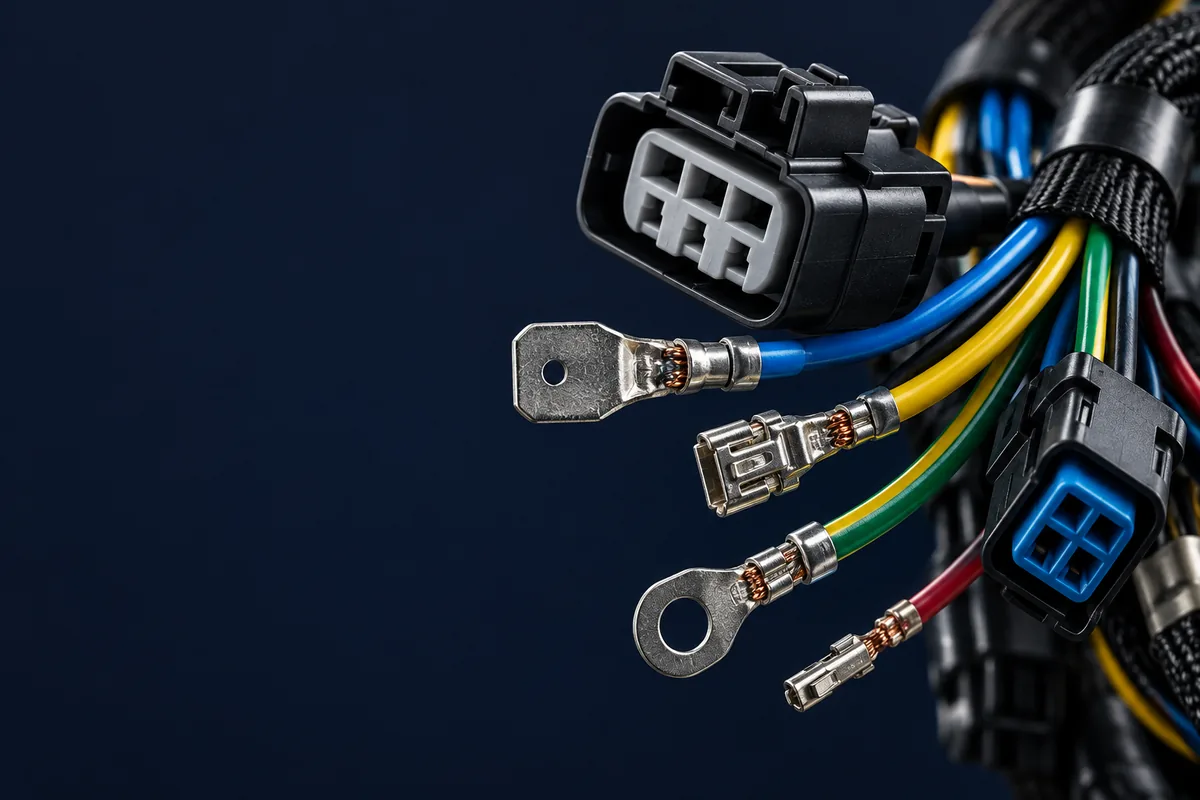
On fine-gauge micro-coax builds, impedance can be a critical electrical parameter. Small differences in crimp geometry, dielectric handling, connector termination, or test-method definition can move measured impedance outside spec. A practical way to keep a beta-to-production program on track is to lock the impedance target, agree the test method and report format with the customer's engineering team up front, and verify against it with first-article approval before volume release.
A micro-coaxial cable assembly is a compact high-frequency cable harness that uses very small coaxial conductors, controlled shielding, and precision connectors to move signals between cameras, sensors, displays, and measurement modules. For sourcing engineers already past concept design, the real question is not whether the cable can be built. The question is whether the supplier, buyer, and end customer are measuring impedance, continuity, shielding, and connector mating the same way before the first pilot build leaves the line.
TL;DR
- Lock the impedance target, tolerance, fixture, and reporting format before sample release.
- Continuity testing cannot catch high-impedance micro-coax failures in a 100mm assembly.
- Use IPC-A-620 workmanship checks with UL-758 wire traceability for buyer evidence.
- Compare supplier and customer test methods before blaming material or operators.
- High-defect beta lots need containment, retest rules, and replacement-unit release gates.
Why Micro-Coax Impedance Failures Escape
Characteristic impedance is the effective opposition a transmission line presents to a fast signal as it travels along the cable. In a micro-coax build, the value depends on conductor geometry, dielectric material, shield construction, connector transition, termination method, and fixture contact repeatability. A cable can pass continuity at low voltage and still fail the signal path because the impedance profile changes at the connector, shield fold, solder cup, or crimped contact.
Continuity testing is a go/no-go electrical check that confirms a conductor path exists and that no gross open or short is present. It is useful at final inspection, but it does not prove controlled impedance, return loss, insertion loss, crosstalk, or shield termination quality. Supplier and customer teams should align the specification definition and testing method rather than relying on continuity alone.
Time-domain reflectometry, or TDR, is a cable test method that sends a fast edge through the assembly and reads impedance changes from reflected energy. TDR is often the right tool for micro-coax and high-speed miniature cable assemblies, but only when the launch fixture, calibration method, edge rate, connector adapter, sampling point, and acceptance window are defined. A 100mm micro-coax is short enough that fixture error can look like cable error.
Use IPC-A-620 as the workmanship reference for cable and wire harness acceptance, including conductor damage, termination condition, insulation support, labels, and final assembly appearance. Use UL-758 language when the wire style, insulation system, voltage rating, or traceability evidence matters. For high-speed behavior, the public characteristic impedance reference helps non-RF stakeholders understand why a cable can fail without an open circuit.
Background for Engineers and Buyers
This guide is written for hardware engineers, quality engineers, and sourcing managers buying micro-coax cable assemblies for camera modules, thermal imaging units, industrial measurement heads, embedded displays, handheld instruments, and compact robotics sensors. At the RFQ stage, the buyer usually has a connector series, cable length, rough pin map, and target sample date. At the pilot stage, the buyer needs tighter evidence: impedance method, mating interface, bend control, operator inspection points, and a release report that the customer's lab will accept.
The objective is practical: prevent repeat impedance-related failures by forcing the drawing, test method, and acceptance evidence to agree before volume production.
The key result should be a release package that names the cable family, connector family, wire gauge, cable length, impedance target, allowed tolerance, fixture type, sample size, retest rule, workmanship standard, and buyer approval gate. If any one of those fields is blank, the supplier is quoting a risk instead of a controlled cable assembly.
What to Lock Before the First Sample
Start with the electrical definition. State whether the assembly is single-ended coax, twinax, paired micro-coax, LVDS-style differential cable, or a mixed harness with power and signal conductors. Then define the target impedance and tolerance at the assembly level. Do not assume the raw cable's catalog impedance automatically survives the connector transition and termination process.
Next, lock the mechanical definition. Specify the connector family, cable length, pin map, and conductor gauge. Those details matter because a short miniature assembly has little physical room to absorb strip-length variation, shield handling error, connector seating variation, or bend damage near the exit. If the drawing only says "100mm cable" without a datum, tolerance, and measurement path, the factory and customer's inspection teams may measure different parts of the same assembly.
Finally, lock the report format. A useful report should show serial number or lot ID, measured impedance result, fixture ID, instrument model, calibration date, test date, inspector, drawing revision, and pass/fail criteria. For replacement production after a failure, add a column for retest status and a note that separates fixture-related retest from true cable nonconformance.
Micro-Coax Test Method Comparison
The table below separates tests that prove basic assembly from tests that prove high-speed behavior. A buyer should not pay for every test on every program, but the RFQ should state which evidence is required at first article, pilot build, and mass production.
| Test Method | What It Proves | Typical Trigger | Risk If Missing | Buyer Evidence to Request |
|---|---|---|---|---|
| Continuity and shorts | Correct conductor path and no gross short | 100% final inspection | Open, swapped, or shorted pin reaches incoming QC | Pin map report tied to drawing revision |
| TDR impedance | Impedance profile through cable and connector transition | High-speed signal, camera, display, RF, or measurement cable | Signal reflection, image noise, link instability, false high-impedance rejects | Trace or numeric result with fixture ID and tolerance |
| Insertion loss | Signal attenuation across frequency | Longer coax, high data rate, RF, or tight signal margin | Marginal link passes bench check but fails in equipment | Frequency range, limit line, measured curve |
| Shield continuity | Shield path from end to end or to defined ground point | EMI-sensitive sensors, thermal imaging, industrial measurement | Noise pickup, unstable reading, failed EMC debug | Shield resistance or continuity result by lot |
| Connector mating inspection | Latch, contact seating, shell alignment, and cable exit condition | Miniature board-to-cable or high-density connectors | Intermittent contact, damaged receptacle, field return | Microscope photos and first-article inspection sheet |
| Flex or bend check | Assembly survives defined handling near connector exits | Portable instruments, serviceable modules, robotic heads | Shield fracture or conductor fatigue after installation | Bend radius, cycle count, post-test electrical result |
How to Write the RFQ So Testing Is Not Ambiguous
A controlled RFQ should treat the test method as a purchased deliverable. Include the connector part numbers, cable part number, AWG, length datum, length tolerance, pinout, shield termination rule, bend radius, jacket or film handling limits, impedance target, test fixture expectation, sample quantity, and production quantity. Missing agreement on these details can lead to disputed acceptance results.
For miniature coax, define whether the supplier may use equivalent cable, equivalent connector, equivalent fixture, or equivalent test equipment. If alternates are allowed, require written approval before material purchase. If alternates are blocked, say so directly in the RFQ. A near-match connector can mate physically but change the launch geometry enough to affect impedance readings.
Internal links help keep the RFQ complete. Use our micro-coaxial cable assembly service page when the program needs miniature coax capability, the coaxial cable assembly page for broader RF cable context, and the coaxial cable datasheet guide when engineering and purchasing need the same language for impedance, shielding, capacitance, and jacket details.
Containment After a High-Impedance Failure
When a pilot lot fails for high impedance, stop production before sorting. Sorting without an agreed method only creates two piles of uncertain parts. First, freeze the drawing revision, test fixture, instrument setup, suspect lot, cable reel, connector lot, operator station, and inspection records. Then test a small retained sample with both the factory method and customer method so the team can see whether the gap is material, process, or measurement.
For an impedance complaint, supplier and customer engineering teams should review the specification and test method together. Agree on any corrections, validate new samples, and document the evidence required before replacement units are released.
Treat impedance yield as a planned release gate, not an afterthought. Whenever a micro-coax program is impedance-sensitive, the next build deserves stronger gates than a routine reorder: require first-article approval, controlled sample retest, a signed report format, and a buyer decision on whether the order must be 100% impedance-tested or sampled once process stability is demonstrated.
Standards and Evidence Package
IPC-A-620 should be cited for workmanship acceptance because micro-coax assemblies still fail from ordinary manufacturing defects: conductor damage, insulation nicks, poor strain relief, damaged shield, incomplete seating, label errors, and handling damage. UL-758 should be cited when the wire style, insulation rating, or appliance wiring material evidence matters. If the product also has automotive traceability requirements, an IATF 16949-style control plan can be used for lot traceability, corrective action, and release discipline even when the supplier is not the design owner.
The release packet for a micro-coax cable assembly should include the approved drawing, BOM, connector and cable lot traceability, first-article inspection, continuity report, impedance report, microscope photos of connector terminations where practical, packaging photos, and a deviation log if anything changed. For beta production, add a buyer signoff before moving from sample to pilot and another signoff before mass production.
Frequently Asked Questions
What impedance tolerance should I specify for a micro-coax cable assembly?
Start with the connector and cable manufacturer's application data, then define the tolerance at assembly level. For a 100mm AWG#40 micro-coax, fixture repeatability can dominate the result, so state the fixture, calibration method, and acceptance window before production. IPC-A-620 supports workmanship evidence, but the impedance number must come from the electrical design requirement.
Can continuity testing replace impedance testing?
No. Continuity confirms an electrical path, while impedance testing checks signal behavior along the transmission path. Use 100% continuity for final assembly and TDR or an approved high-speed method for controlled-impedance requirements.
What records should a supplier provide after a high-impedance complaint?
Ask for drawing revision, cable lot, connector lot, fixture ID, instrument model, calibration date, TDR or impedance results, continuity results, first-article inspection, photos, and a retest rule. When a corrected report format is part of an impedance recovery, it should provide evidence that matches the customer’s engineering review.
Does IPC-A-620 cover micro-coax cable assemblies?
IPC-A-620 covers workmanship expectations for cable and wire harness assemblies, including many inspection conditions relevant to micro-coax terminations, insulation, shielding, labels, and final assembly quality. It does not replace the electrical design requirement for impedance, insertion loss, or fixture-specific test limits.
When should a buyer require 100% impedance testing?
Require 100% impedance testing during recovery from a severe complaint, for first pilot lots with tight signal margins, or when the customer has already found lab correlation risk. After stable production is proven, some programs move to sampling, but the sampling rule should state lot size, sample count, fixture, and rejection trigger.
How do I prevent fixture mismatch between supplier and customer labs?
Share the fixture concept before sample build, define calibration artifacts, name adapter part numbers, and compare a customer-approved set of retained samples across both labs before approving a pilot run. On short assemblies around 100mm, a fixture mismatch can create a false high-impedance pattern even when the cable build is consistent.
Next Step
Micro-coax impedance control is a specification discipline before it is a production test. Lock the electrical target, the fixture method, the report format, and the recovery rule before approving pilot quantity. That is how a buyer avoids turning a miniature cable assembly into a costly full-lot replacement problem.
Need a micro-coax cable assembly quote with impedance evidence? Send your drawing, connector series, target impedance, cable length, sample quantity, and test requirement to our engineering team.