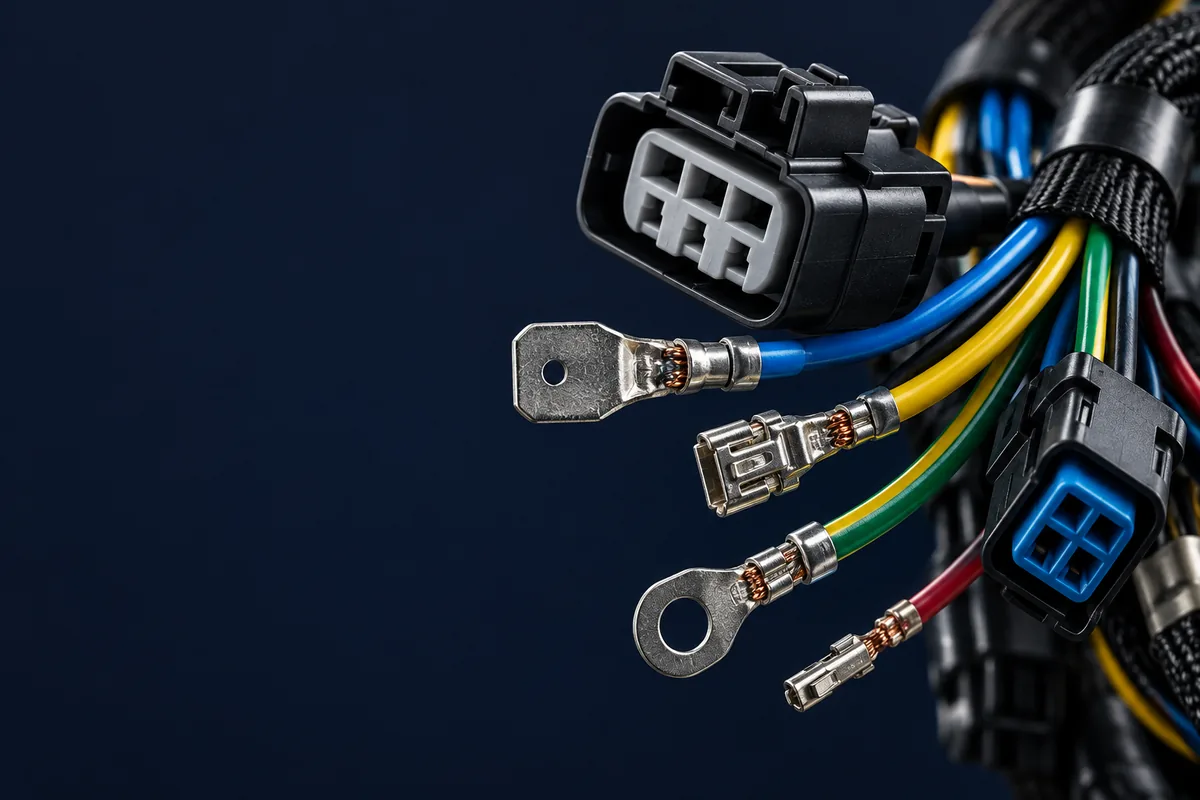
Choosing between semi-rigid, semi-flexible, and flexible coaxial cable is one of the highest-leverage decisions in an RF cable assembly program. On fine-gauge micro-coax builds — for example AWG#40 CABLINE-VS 1:1 assemblies — impedance stability, controlled termination, and repeatable impedance verification are what keep signal integrity predictable from prototype through production.
Semi-rigid, semi-flexible, and flexible coaxial cable choices decide more than routing convenience. They change bend handling, connector termination, impedance stability, RF loss, inspection evidence, and field repair strategy. For most OEM RF cable assemblies, the best choice is the one that protects the RF path while still fitting the enclosure and production process.
TL;DR
- Choose semi-rigid coax when shape stability and low RF variation outrank service flexibility.
- Choose semi-flexible coax when routing needs one-time forming without full solid-tube stiffness.
- Choose flexible coax when installation, vibration, service loops, or moving equipment control the risk.
- Define bend rule, connector process, VSWR, insertion loss, and workmanship evidence before sampling.
- Use IPC-A-620, UL-758, IEC 61196, and IEC 61169 references where the program requires traceability.
Background for Engineers and Sourcing Teams
This guide is written for RF engineers, mechanical engineers, NPI buyers, and sourcing managers who already know they need a custom coaxial cable assembly but have not locked the cable construction. The buying stage is usually RFQ, design transfer, first article, or a corrective action after a marginal RF test result.
The role behind this article is senior factory engineering with experience since 2017 reviewing coaxial cable drawings, SMA and BNC terminations, micro-coax builds, shield preparation, overmold exits, strain-relief choices, and supplier recovery files. The objective is narrow: help you decide when semi-rigid, semi-flexible, or flexible coaxial cable is the correct production choice instead of treating all 50 ohm or 75 ohm cables as interchangeable.
Semi-rigid coaxial cable is a coax cable that uses a solid metallic outer conductor, often copper or aluminum, to hold geometry after forming. Semi-flexible coaxial cable is a coax cable that keeps better bendability than semi-rigid while using a more stable outer shield than ordinary braided flexible coax. Flexible coaxial cable is a coax cable that uses stranded conductors, braid, foil, or layered shields so the assembly can route, service, and absorb motion more easily.
The physics behind all three constructions starts with coaxial cable geometry and transmission line behavior: impedance depends on the relationship between center conductor, dielectric, and outer conductor. Factory workmanship then decides whether that controlled geometry survives stripping, forming, connector attachment, testing, packaging, and installation.
Construction Differences That Change RF Assembly Risk
The outer conductor is the first practical difference. Semi-rigid coax normally uses a continuous metal tube. That tube gives strong shielding, stable geometry, and predictable RF behavior after correct forming, but it does not forgive repeated bending. Once formed, it should be treated like a shaped part. If the routing is wrong, re-forming can work-harden the tube, create tiny cracks, or shift the connector launch.
Semi-flexible coax is often chosen when buyers want part of the semi-rigid RF stability but need easier routing during assembly. The exact construction depends on the manufacturer, so do not approve it by name alone. Ask whether the outer conductor is corrugated, tin-plated braid, bonded braid, foil-plus-braid, or another structure. That construction decides bend radius, strip process, ferrule choice, phase stability, and whether the cable can tolerate a field service bend.
Flexible coax is the broadest family. RG-174, RG-316, RG-58, LMR-type, micro-coax, FAKRA coax, and many antenna pigtails all sit inside this practical category, though their performance ranges differ sharply. Flexible coax helps when the assembly must pass through a hinge, enclosure wall, service loop, vibration zone, robot arm, marine console, or installer-routed path. The tradeoff is higher sensitivity to braid handling, shield coverage, jacket compression, and bend abuse.
For standards language, many buyers cite IPC-A-620 for cable and harness workmanship evidence, UL-758 when wire or insulation traceability is part of the approval package, IEC 61196 when qualified coaxial cable construction is specified, and IEC 61169 when RF connector interface discipline needs a public standards reference.
Side-by-Side Comparison: Bend, Loss, Termination & Cost
Use the table below as a first-pass decision tool before RFQ. The final decision still needs cable datasheets, connector datasheets, bend drawings, test limits, and production evidence.
| Decision Factor | Semi-Rigid Coax | Semi-Flexible Coax | Flexible Coax | Buyer Check Before Approval |
|---|---|---|---|---|
| Outer conductor | Solid metallic tube | More stable shield than normal braid; construction varies | Braid, foil, layered shield, or miniature shield structure | Ask for cable cross-section, shield type, OD, and approved connector list |
| Bend behavior | Best for fixed shapes after controlled forming | Good for limited forming and easier installation | Best for service loops, vibration, and repeated handling | Define static bend radius, dynamic bend need, and no-bend zones near connectors |
| RF stability | Strong when formed correctly and not reworked repeatedly | Middle ground; better than many flexible options when construction is controlled | Depends heavily on shield, dielectric, length, frequency, and handling | Require VSWR or return-loss limit across the actual operating band |
| Assembly process | Needs forming fixture, tube cutting, deburring, and careful connector launch | Needs matched strip dimensions and shield preparation control | Needs braid control, ferrule match, strain relief, and bend protection | Review first-article photos, strip dimensions, pull or retention checks, and RF report |
| Field service | Poor choice for repeated removal or rough service routing | Acceptable when service bends are limited and documented | Best choice where installers handle the cable in the field | State whether the assembly is factory-fixed, installer-routed, or service-replaced |
| Typical applications | Test fixtures, RF modules, fixed RF paths, compact instrument cavities | Internal RF links needing controlled routing with moderate formability | Antenna leads, FAKRA cables, BNC assemblies, portable test cables, marine RF paths | Match cable type to installation profile, not only impedance and connector type |
When to Choose Semi-Rigid Coax
Choose semi-rigid coax when the RF path needs stable geometry, strong shielding, short routing, and a fixed shape that the factory can form repeatedly. It is a strong fit for internal RF modules, instrumentation cavities, compact antenna structures, fixed microwave links, and test fixtures where the assembly is installed once and protected from service abuse.
The main production risk is not the cable concept. It is uncontrolled forming. A semi-rigid cable should have bend centerline, bend radius, straight length, connector clocking, and final envelope controlled by drawing or forming fixture. If the operator bends by eye, a 2mm route error near the connector can become an RF launch problem or an installation interference problem. For production, the supplier should keep a forming fixture, first-article photos, and measured envelope checks with the same revision as the RF report.
When a buyer asks for semi-rigid coax, we normally check four items before quoting: connector compatibility with the tube size, minimum bend radius, finished shape tolerance, and whether the customer expects rework or field adjustment. Semi-rigid is the wrong choice if the installer must "make it fit" during final assembly. It becomes a fragile metal part at that point, not a forgiving cable.
When to Choose Semi-Flexible Coax
Choose semi-flexible coax when the design needs better RF consistency than a general flexible coax but cannot accept the handling limits of a solid-tube construction. It can be useful for short internal links, equipment cavities with moderate routing changes, and RF assemblies where the mechanical team needs a little installation forgiveness.
The term "semi-flexible" must be unpacked in the RFQ. It is not enough to write "semi-flex coax" and expect all suppliers to quote the same construction. Ask for the cable part number, outer conductor description, bend radius, attenuation table, shielding method, compatible connectors, strip dimensions, and frequency rating. Then tie those values to the drawing and test report.
Semi-flexible coax can reduce the rework burden compared with semi-rigid cable, but it still needs handling limits. If operators bend sharply at the connector exit, flatten the dielectric, or rotate the cable to force clocking alignment, the assembly can lose the RF advantage that justified the cable choice. A no-bend zone of 10mm to 25mm from the connector shoulder is a practical drawing note for many small RF assemblies, but the exact value should come from the connector and cable construction.
For programs with cost pressure, semi-flexible coax also supports alternate review. A supplier may propose it when semi-rigid forming is driving scrap, or when a flexible coax is failing return loss after installation. The approval package should compare not only unit cost, but also insertion loss, VSWR or return loss, bend risk, connector yield, and inspection time. Our RF cable assembly testing guide explains how to write those RF acceptance limits before the first sample ships.
When to Choose Flexible Coax
Choose flexible coax when installation and field use create real movement, service loops, vibration, or uncertain routing. Flexible coax is the right default for many SMA cable assemblies, BNC jumpers, FAKRA antenna leads, marine electronics cables, portable instruments, and internal connections that need strain relief rather than fixed metal forming.
Flexible does not mean careless. The cable still has a minimum bend radius, attenuation curve, shield construction, jacket material, operating temperature, and connector compatibility window. A low-cost flexible coax can fail because the braid coverage is weak, the ferrule does not match the jacket OD, the dielectric is nicked during stripping, or the bend at the enclosure wall violates the datasheet. The problem may appear as high VSWR, high insertion loss, shield leakage, intermittent continuity, or field noise.
For miniature and micro-coaxial cable assemblies, flexible handling becomes even more sensitive. The 100mm AWG#40 CABLINE-VS case shows why the acceptance method must be defined before volume release. At that size, the cable may look visually acceptable while the measurement window, fixture launch, or termination variation creates a high-impedance dispute. Flexible coax needs documented handling rules, not just a continuity pass.
Test Evidence and Standards to Request
Every RF cable assembly should receive 100% continuity testing unless the approved process says otherwise. Continuity catches opens, shorts, shield-to-center faults, and wiring errors. It does not prove impedance, mismatch, or loss. For RF paths, request VSWR or return-loss testing when mismatch can affect radios, antennas, instruments, or calibrated equipment. Request insertion-loss testing when cable length, frequency, connector count, or signal margin can consume the link budget.
IPC-A-620 supports workmanship review for cable and wire harness assemblies, including visible defects that can damage RF behavior: nicked insulation, damaged shields, exposed conductors, poor strain relief, incomplete seating, weak crimping, and label mistakes. UL-758 supports appliance wiring material traceability where wire style, insulation, or rated construction must be controlled. IEC 61196 is often referenced when qualified coaxial cable construction is part of a industrial, or high-reliability RF requirement. IEC 61169 is relevant when the buyer needs RF connector interface discipline for families such as SMA, BNC, TNC, or N-Type.
A useful report should name the cable part number, connector part numbers, drawing revision, finished length, frequency range, fixture or adapter stack, instrument model, calibration date, limit line, measured VSWR or return loss, insertion loss if required, visual inspection result, and inspector date. If the program uses TDR or impedance-profile evidence, keep the measurement window explicit; public NIST material on coaxial transmission-line testing shows why cable signatures depend on test setup, propagation, and reference conditions. If the assembly is shaped, add a formed-dimension check against the mechanical drawing.
RFQ Decision Framework
Start by describing the installation. Is the cable factory-installed and never touched, factory-installed but serviceable, installer-routed in the field, or moving during product use? A fixed internal path may justify semi-rigid. A controlled internal path with some route tolerance may fit semi-flexible. A field-handled or moving path usually needs flexible coax plus strain relief.
Next, define the RF requirement. State the impedance, frequency band, maximum insertion loss, VSWR or return-loss target, cable length tolerance, connector family, and whether the assembly needs 50 ohm, 75 ohm, or another controlled impedance. If the design team has not finalized limits, ask the supplier to propose a test plan and mark it "buyer approval required before pilot production." That prevents a quote from silently removing RF evidence.
Then define the mechanical release package. For semi-rigid coax, include bend centerline, bend radius, clocking, and formed envelope. For semi-flexible coax, include allowed forming zone and no-bend zone near connectors. For flexible coax, include minimum bend radius, dynamic or static use, strain relief, service loop length, and any overmold or heat shrink requirement. The coaxial cable datasheet guide shows which datasheet lines should be checked before that RFQ goes out.
Last, compare total program risk. Semi-rigid coax may cost more in forming setup but reduce RF variation in a fixed path. Semi-flexible coax may reduce handling risk where full semi-rigid is too strict. Flexible coax may have a lower assembly barrier, but the wrong braid, jacket, or bend rule can create field failures. A valid sourcing decision compares RF margin, assembly yield, inspection time, and service risk, not only cable price per meter.
Buyer Checklist Before Sample Approval
- Confirm cable construction: semi-rigid tube, semi-flexible shield structure, or flexible braid/foil construction.
- Confirm impedance family: 50 ohm, 75 ohm, 93 ohm, or customer-specific target.
- Confirm operating frequency range and acceptance limit for VSWR, return loss, or insertion loss.
- Confirm bend radius, no-bend zone, formed shape tolerance, and whether the cable sees dynamic motion.
- Confirm connector part numbers, compatible cable OD, strip dimensions, ferrule or solder process, and retention checks.
- Confirm IPC-A-620 workmanship evidence, UL-758 traceability where applicable, and IEC 61196 or IEC 61169 references when required.
- Confirm the first-article package includes photos, test report, drawing revision, BOM, cable lot, connector lot, and packaging method.
Frequently Asked Questions
What is the main difference between semi-rigid and flexible coaxial cable?
Semi-rigid coax normally uses a solid outer conductor that holds a fixed shape after forming, while flexible coax uses braid, foil, or layered shielding to support routing and service movement. For a 100mm to 300mm internal RF path, semi-rigid may stabilize geometry, but flexible coax is safer when installers or vibration can move the cable.
Is semi-flexible coax the same as semi-rigid coax?
No. Semi-flexible coax is a middle option that bends more easily than solid-tube semi-rigid coax, but it still needs construction-specific handling rules. Ask for the exact cable part number, bend radius, shield structure, and connector strip dimensions. IPC-A-620 workmanship checks should be tied to the same first-article report.
I need a 50 ohm SMA cable inside a compact enclosure; which coax type should I choose?
If the route is fixed and controlled by a drawing, semi-rigid coax can work well for a compact 50 ohm SMA path. If the enclosure path may shift during NPI, semi-flexible or flexible coax is often safer until the mechanical route freezes. Request VSWR or return-loss evidence across your actual frequency band.
Can flexible coax pass RF testing as well as semi-rigid coax?
Yes, if the cable construction, connector match, bend radius, and termination process fit the frequency and loss budget. Flexible coax is not automatically lower quality. The risk is variation from handling, braid preparation, and routing. Use insertion loss and return loss limits rather than judging by cable family name alone.
Which standards should I put in an RF coaxial cable assembly RFQ?
Use IPC-A-620 for cable assembly workmanship evidence, UL-758 when wire or insulation traceability matters, IEC 61196 when the cable construction must follow qualified coaxial requirements, and IEC 61169 when RF connector interfaces need standards discipline. The RFQ should still define numeric limits such as VSWR <= 1.50:1 or return loss >= 14 dB.
How do I prevent bend damage near coaxial connectors?
Add a no-bend zone on the drawing, commonly 10mm to 25mm from the connector shoulder for small assemblies unless the connector datasheet says otherwise. Then specify minimum bend radius, strain relief, and final inspection photos. For semi-rigid coax, require a forming fixture or measured bend envelope before pilot release.
What should I send a supplier before asking for a quote?
Send the cable type preference, target impedance, connector part numbers, finished length, operating frequency, bend path, quantity split, environment, and required test report. If you are unsure whether semi-rigid, semi-flexible, or flexible coax is best, send the enclosure route and ask for a comparison quote with RF test assumptions.
Next Step
Send your drawing, cable path, connector series, frequency band, target quantity, and preferred coax construction through our contact page. We can review whether semi-rigid, semi-flexible, or flexible coaxial cable fits the RF requirement, then return a manufacturable quote with bend notes, connector checks, and test evidence recommendations.