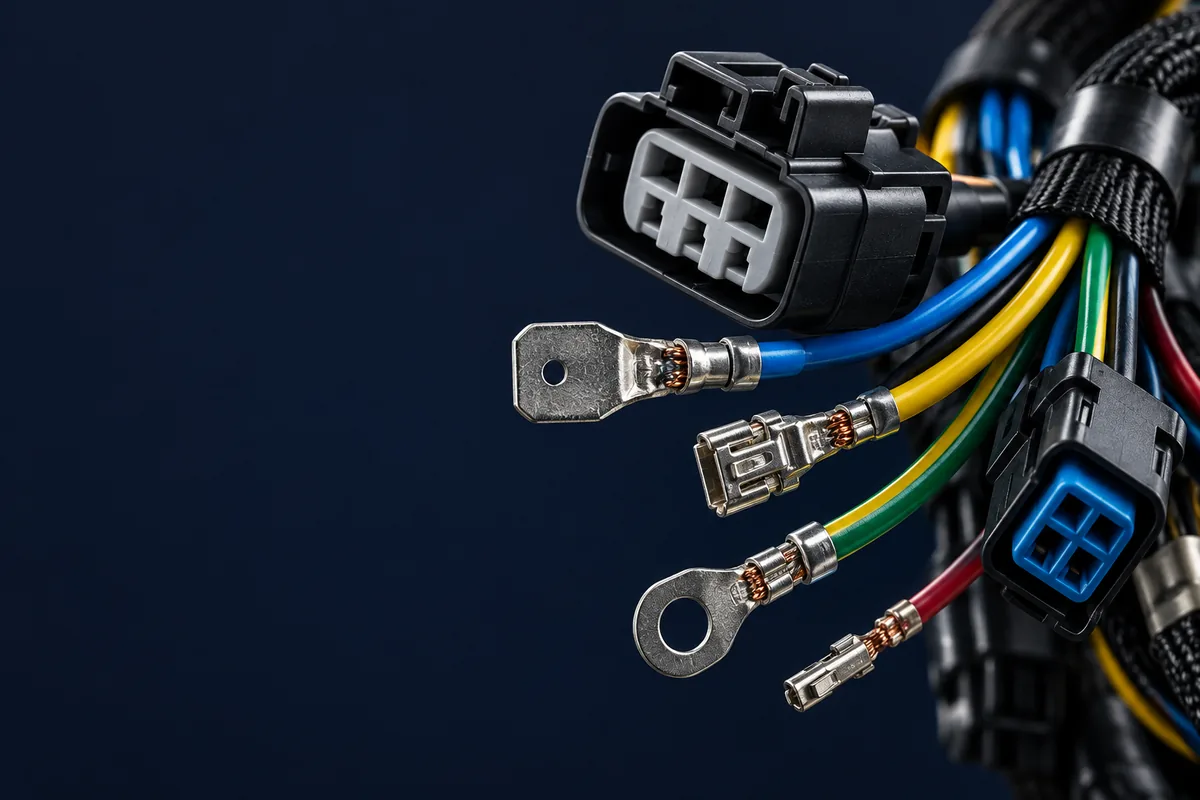
During a custom wiring harness project for the mining sector, an Australian client expanded the RFQ from a standard harness into a specialized braided cable assembly: 3 Core (Yellow, Red, Blue), 18 AWG GXL, Black braid with 2 blue stripes, 50m or 100m rolls, plus laser-etched markings and injection-molded connectors. The challenge was not only making the cable look correct. The real work was freezing the conductor, braid, marking, and molded-exit details early enough that sourcing and production could repeat the same build across future releases.
A custom braided cable assembly is a cable set that combines defined conductors, a protective or decorative braid, termination hardware, identification marks, and optional molded connector exits into one controlled assembly. For OEM engineers and sourcing teams already moving from design validation into supplier quoting, the goal is to avoid a vague "braided cable" description and replace it with a buildable specification that a factory can quote, sample, inspect, and repeat.
TL;DR
- Define conductor colors, AWG, braid pattern, roll length, marking method, and connector exit before RFQ pricing.
- Braid can protect, identify, shield, or bundle the cable; each function changes material and inspection rules.
- Use IPC-A-620 workmanship and UL-758 wire evidence as the baseline for production release.
- Request first-article photos, pull checks, marking samples, and continuity records before volume approval.
- For custom braid colors or stripes, confirm MOQ and lead time before promising a launch date.
Why Custom Braided Cables Need Early Control
Custom braided cable looks like a sleeve choice, but it often becomes a supply-chain and process-control item. A standard black PET sleeve can be bought quickly. A black braid with two blue stripes, a defined hand feel, a fixed coverage target, and a roll-pack requirement may need custom yarn sourcing, machine setup, color approval, and sample retention. If the RFQ waits until after the electrical design is frozen, the braid becomes the schedule risk instead of the wires or connectors.
A braided sleeve is a woven protective layer placed over one cable, several conductors, or a completed harness branch. It can add abrasion resistance, improve handling, organize loose wires, create a brand or service color code, or support EMI strategy when metallic braid is used. It is not automatically a shield. If the buyer needs electrical shielding, the drawing must define conductive material, coverage, termination path, and shield-continuity testing.
A cable identification system is the combination of color, stripe, label, heat-shrink mark, laser mark, tag, and packaging label that lets installers recognize the assembly without opening the drawing. In the mining case, the braid pattern and laser-etched markings were both identification controls. Treating only one of them as "cosmetic" would have created avoidable receiving and installation risk.
A molded connector exit is an injection-molded strain-relief or sealing body formed around the cable-to-connector transition. It controls bend radius, pull load, water path, appearance, and service handling. If the cable also has braid, the supplier must decide whether the braid stops before the mold, enters under the mold, is captured mechanically, or is trimmed and sealed separately. That decision belongs in the sample plan, not on the production floor.
When a buyer asks for a custom braid, I ask what job the braid must do: abrasion, identification, EMI, or bundling. The same 18 AWG cable can need four different braid constructions depending on that answer.
— Hommer Zhao
For workmanship and documentation, anchor the release in recognized standards. IPC-A-620 is the practical reference for cable and wire harness workmanship expectations, while UL-758 style evidence helps buyers verify appliance wiring material ratings when the cable construction uses UL-recognized wire. For supplier change control and traceability in automotive-style programs, IATF 16949 provides a useful quality-management model even when the finished cable is for mining, industrial automation, or energy equipment.
Specification Table for a Quotable Braided Cable RFQ
The strongest RFQs separate electrical construction from braid construction and marking construction. If those items are blended into one drawing note, suppliers will quote different assumptions. The table below is the minimum structure we use before committing sample timing or production pricing.
| RFQ Field | What to Specify | Why It Matters | Supplier Evidence |
|---|---|---|---|
| Core construction | Example: 3 Core (Yellow, Red, Blue), 18 AWG GXL | Locks conductor size, insulation type, color, and strip process | Wire datasheet, UL style or material declaration, cut sample |
| Braid pattern | Example: Black braid with 2 blue stripes | Controls visual ID, sourcing MOQ, machine setup, and inspection sample | Physical braid sample, color approval photo, lot traceability |
| Roll or unit format | 50m or 100m rolls, or finished piece length with tolerance | Changes packaging, handling, test method, and freight assumptions | Packout photo, length record, reel or carton label |
| Marking method | Laser-etched text, heat-shrink label, printed sleeve, or tag | Determines durability under abrasion, fluids, and field cleaning | Marking sample, rub test plan, artwork approval |
| Connector exit | Injected molded connector, boot, backshell, or heat-shrink transition | Controls bend relief, sealing, braid termination, and tooling cost | First-article photos, pull check, mold or fixture revision |
| Electrical test | Continuity, polarity, resistance limit, hipot if required | Prevents a visually correct braided cable from hiding wiring errors | 100% test report or approved sampling record |
Choose the Braid by Function, Not Appearance
Protective braid is usually selected for abrasion, snag resistance, and cable handling. PET expandable braid is common for industrial harnesses because it is flexible, available in many colors, and easy to install over branch bundles. Nylon braid improves toughness in some environments. Fiberglass or high-temperature sleeves belong near heat, but they change handling and cut-edge control. Stainless braid may be used for mechanical protection, but it is heavier, harder to terminate, and not needed for most signal harnesses.
Identification braid is selected because the installation crew must recognize a cable quickly. The mining case used color and stripe pattern as a recognition feature. That seems simple until the supplier discovers that the exact stripe count requires a special braid setup. Buyers should approve a physical sample and keep the sample as the receiving standard. A PDF color swatch is not enough when production will be judged by a field technician under poor lighting.
Shielding braid is different. It must be electrically continuous and terminated intentionally. A metallic braid floating under an overmold may look robust while doing little for EMC. If the assembly carries sensor, encoder, VFD, or communication signals, review the broader shield strategy with our EMI shielding guide and the service details on our shielded cable assembly page. Define whether the shield bonds to a shell, drain wire, ring terminal, EMC gland, or chassis point.
Bundling braid is used to organize conductors and protect appearance rather than solve a harsh mechanical or electrical problem. For this use, the supplier should focus on finished bundle OD, sleeve expansion range, cut-end fray control, and whether the braid passes under labels, clips, grommets, or molded exits. If the braid changes bundle diameter by even 1-2 mm, it may affect clip fit, gland compression, or enclosure pass-through design.
A braid stripe is a production control, not a decoration, when the installer depends on it. We keep the approved braid sample with the job traveler so incoming material is checked against the real release part.
— Hommer Zhao
Connector and Molded-Exit Decisions
Many braided cable problems appear at the transition point. The braid is flexible, the connector is rigid, and the molded or heat-shrink exit must distribute load between them. If the braid ends too close to the connector, the cable can kink at the first bend. If the braid enters too far under a molded exit without compatible sealing, it can create a capillary path for moisture. If the braid is metallic, the termination must avoid loose whiskers that can short nearby contacts.
For injection-molded exits, send the supplier a 3D model or at least a dimensioned sketch showing connector body, cable OD, braid OD, required bend direction, logo or text, and clearance envelope. For lower volumes, a heat-shrink or booted transition may be more economical than custom mold tooling. For production programs, tooling can reduce variation and labor once the design is frozen. If your assembly is moving toward an overmolded release, compare the trade-offs in our overmolded cable assembly guide before approving the sample path.
Connector selection also changes the braid answer. A circular connector with a backshell may capture braid cleanly. A small plastic inline connector may need the braid trimmed back with adhesive heat shrink. A sealed connector may need cavity plugs, wire seals, or a molded boot before the braid can be treated as external protection. The RFQ should state the connector series and mating half instead of asking the supplier to infer the exit method from photos.
Quality Plan for Braided Cable Production
A first article should prove more than continuity. For a custom braided cable, we normally expect at least five evidence types before production release: conductor and insulation verification, braid sample approval, marking approval, termination inspection, and electrical test result. If the cable will be supplied in 50m or 100m rolls, length measurement and packaging become part of quality, not warehouse administration.
For crimped terminals, keep the crimp evidence tied to the exact wire construction. 18 AWG GXL does not behave exactly like every other 18 AWG wire because insulation thickness, conductor stranding, and jacket stiffness change strip and crimp setup. The production record should identify the applicator or tooling method, strip length, visual acceptance criteria, pull-check rule where required, and electrical test plan. Our crimp pull test guide explains how to keep that evidence useful instead of treating it as a generic certificate.
For laser-etched markings, approve text content, font height, orientation, repeat spacing, and contrast on the actual jacket or sleeve. A mark that looks clean on a flat sample may become hard to read after braiding, bending, or molding. If the cable will see abrasive dust, oil, washdown, or handling by gloved technicians, run a small rub or wipe check during sample approval. The test does not need to be complicated; it needs to match the field abuse the cable will actually see.
The buyer's drawing should say where the braid starts and stops. If that detail is left to the operator, every batch can be electrically correct and still look different at installation.
— Hommer Zhao
When Custom Braiding Is Worth the Cost
Custom braid is worth the cost when it prevents installation mistakes, protects the cable in a high-abrasion route, supports a service color system, or replaces several manual identification steps. It is weak value when the braid is selected only because it looks premium but the cable sits inside a protected enclosure. The decision should compare installed cost, not just cable price. A striped braid that adds material cost can still reduce total cost if it eliminates field misrouting or inspection confusion.
MOQ is the commercial trap. A custom color or stripe may require a minimum yarn buy or braiding setup that is much larger than the first production release. Buyers should ask whether the supplier can support prototype pieces with stocked braid, then shift to custom braid at pilot or production volume. If the stripe pattern is mandatory from the first sample, include the expected annual quantity and release cadence so the supplier can quote material honestly.
Lead time should also separate standard components from custom items. Standard wire, common braid, and catalog connectors may move quickly. Custom braid, molded connector exits, special labels, and test fixtures can dominate the schedule. For NPI programs, use a two-lane plan: release electrical samples quickly with approved temporary identification, then release the custom braid and molded exit after visual and mechanical approval. That approach keeps engineering testing moving while the custom materials are being finalized.
RFQ Checklist for Buyers
- Send the conductor list, wire type, AWG, insulation material, and required color sequence.
- Define the braid material, base color, stripe colors, stripe count, finished OD target, and sample approval rule.
- State finished length, tolerance, roll length, packaging method, and label content.
- Provide connector manufacturer part numbers, mating halves, pinout, backshell or boot details, and any no-substitution rule.
- Mark whether the braid is protective, identification-only, EMI-related, or part of strain relief.
- Define marking method, text, repeat spacing, orientation, and durability expectation.
- Request first-article photos showing braid ends, connector exits, labels, crimp areas, and final packout.
- Ask for continuity, polarity, pull-check, insulation-resistance, or hipot records according to application risk.
If your team is still organizing the full sourcing package, start with our wire harness RFQ checklist and our custom braided cable assembly service page. Those two pages help turn the braid, marking, connector, and test details into a quote-ready package.
Frequently Asked Questions
What information do suppliers need to quote a custom braided cable assembly?
Send conductor count, AWG, insulation type, colors, finished length, braid material, braid color or stripe pattern, connector part numbers, marking method, annual volume, and test requirements. For the mining case, the useful RFQ data included 3 Core (Yellow, Red, Blue), 18 AWG GXL, Black braid with 2 blue stripes, and 50m or 100m rolls.
Is braided sleeve the same as cable shielding?
No. PET or nylon braided sleeve mainly provides abrasion protection, bundling, and identification. Shielding requires conductive braid, foil, drain wire, or another controlled ground path. If EMI performance matters, define shield coverage, termination method, and continuity testing instead of assuming a visible braid meets the electrical requirement.
Which standards should apply to custom braided cable assemblies?
Use IPC-A-620 workmanship expectations for cable and harness assembly quality, UL-758 evidence when appliance wiring material ratings apply, and ISO 9001 or IATF 16949-style traceability for controlled production. The exact standard set depends on whether the assembly is industrial, mining, automotive, medical, or energy equipment.
How do I prevent custom braid color or stripe mismatches?
Approve a physical braid sample, not only a digital color reference. Keep that sample with the supplier traveler and receiving inspection record. For stripe patterns such as Black braid with 2 blue stripes, define stripe count, approximate stripe width, acceptable shade range, and whether substitutions require buyer approval.
When should I choose an injection-molded connector exit?
Choose an injection-molded exit when the cable needs repeatable strain relief, a sealed transition, stable bend control, or a production appearance across hundreds or thousands of units. For low-volume samples, heat shrink or boots may be more economical until the connector, braid stop point, and cable OD are frozen.
Should braided cable assemblies receive 100% electrical testing?
For multi-core OEM cable assemblies, 100% continuity and polarity testing is usually justified because a visually correct braid can hide swapped conductors. Add resistance, insulation-resistance, hipot, or shield-continuity checks when the drawing, voltage class, safety risk, or EMI requirement calls for more than basic continuity.
Bottom Line for Sourcing Teams
A custom braided cable assembly is successful when the braid, wire, connector, marking, and test plan are released as one controlled product. The mining case worked because the buyer's specific requirements could be translated into measurable production inputs: 3 Core (Yellow, Red, Blue), 18 AWG GXL, Black braid with 2 blue stripes, 50m or 100m rolls, laser-etched markings, and injection-molded connectors. That level of detail is what lets a supplier quote honestly and build repeatably.
Need help turning a custom braid concept into a production-ready cable assembly? Share your drawing, conductor list, braid target, connector part numbers, quantity, and test requirements through our contact page. We will review the manufacturability risks and return a quote path with sample, tooling, and inspection assumptions clearly separated.