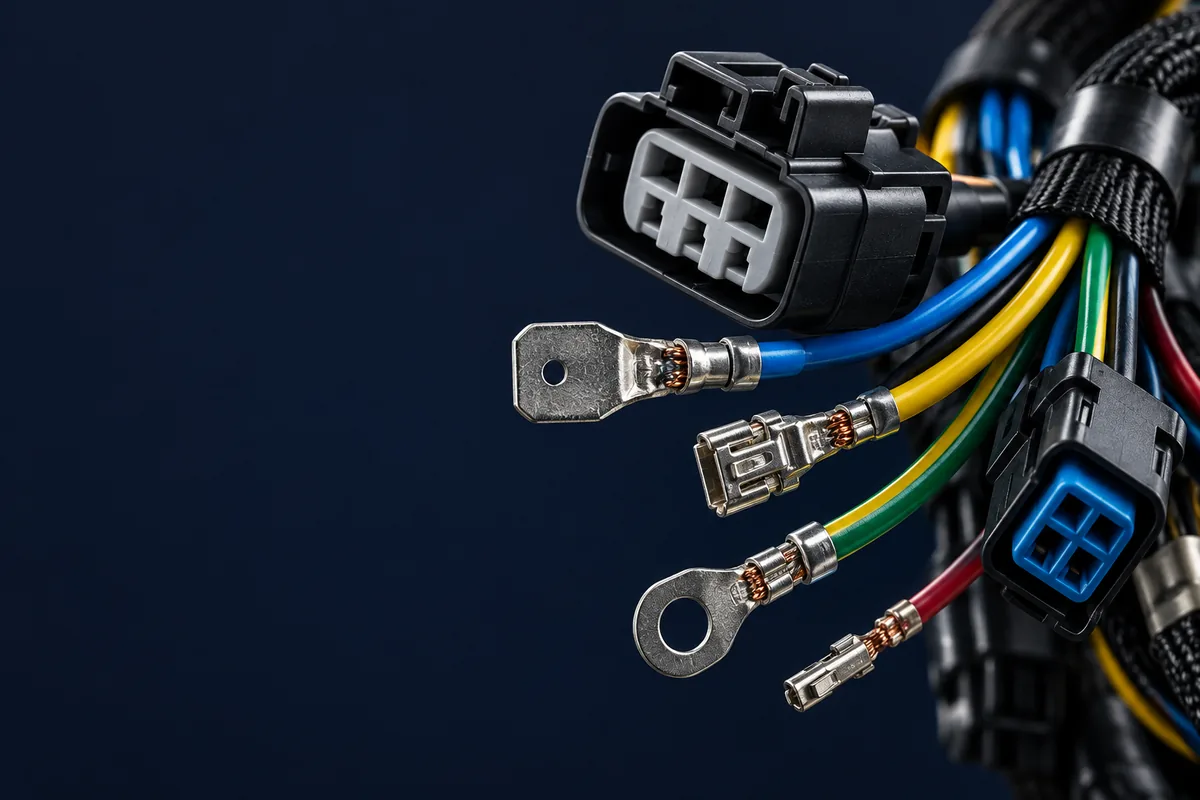
In 2025-Q4, a Canadian specialty equipment OEM needed a new Kevlar-reinforced probe cable but rejected the first quote as too high. The sourcing question was whether a supplier could protect the Kevlar reinforcement layer, support a 10-box prototype order, and still prepare for a 100-box bulk order plan without relaxing tensile or inspection controls.
A Kevlar-reinforced cable assembly is a custom cable build that uses aramid fiber strength members to carry pull load separately from the copper conductors, shield, insulation, and connector terminations. For engineers and buyers in the design-finalization stage, the practical decision is not whether Kevlar sounds rugged. It is where the strength member terminates, how the strain relief transfers load, and what evidence proves the cable can be repeated after the prototype.
TL;DR
- Kevlar should carry pull load; copper conductors should not become the tensile member.
- Define pull force, bend radius, jacket OD, and termination method before prototype pricing.
- Use IPC-A-620 workmanship checks and UL-758 wire evidence in the release package.
- Separate prototype discount decisions from approved material substitution and bulk-order controls.
- Ask for tensile, continuity, polarity, and visual records tied to lot and drawing revision.
Why Kevlar Reinforcement Changes the Design
Kevlar reinforcement is an aramid strength-member system placed inside or alongside a cable construction to absorb tensile force before that force reaches crimp barrels, solder cups, shield terminations, or conductor strands. The material choice only helps when the mechanical load path is designed deliberately. If the fiber bundle is trimmed short, left floating, or trapped under a soft boot with no anchor, the cable still fails at the connector.
A tensile load path is the physical route that pull force follows from the cable jacket into the connector, overmold, clamp, backshell, braid trap, or fixture. In a reinforced probe cable, that load path should pass through the Kevlar reinforcement layer and strain-relief hardware, not through 26 AWG, 28 AWG, or smaller conductors. This is the difference between a cable that survives installation pulls and one that passes continuity on day one but opens after repeated handling.
Strain relief is a mechanical feature that spreads bending and pulling loads over a longer cable length so one rigid transition does not concentrate stress. It can be an overmold, boot, clamp, braid sleeve, backshell, adhesive-lined sleeve, or fixture-controlled bend support. For Kevlar designs, strain relief must also secure the aramid member; a boot that only grips the jacket can leave the internal fibers inactive.
For reinforced probe cables, I want to see the load path before I look at the cosmetic jacket. If the Kevlar is not anchored, a 100-box bulk order just repeats the same hidden weak point 100 times.
- Hommer Zhao
Use recognized standards as references, but turn them into measurable controls. IPC-A-620 supports workmanship acceptance for cable and wire harness assemblies, including conductor damage, crimp quality, insulation condition, splices, and final assembly appearance. UL-758 wire-style evidence helps verify insulation system, temperature rating, material traceability, and construction. For repeat production governance, IATF 16949 style change control gives buyers a useful framework for approving material substitutions, process changes, and corrective actions.
Where the Kevlar Should Terminate
The first sourcing question should be physical: where does the Kevlar reinforcement layer end, and what locks it in place? Common answers include a crimp sleeve over the fiber bundle, a clamp under a metal backshell, a molded anchor inside an overmold, a knot or loop captured by a fixture, or a braid-style termination that distributes load around the cable axis. Each option changes tooling, inspection access, repairability, and prototype cost.
Do not bury the termination method inside a drawing note that only says "reinforced cable." Ask the supplier to show a section sketch or process photo for the approved construction. The sketch should identify cable OD, jacket material, fiber placement, shield layer if used, conductor bundle, connector family, boot or overmold geometry, and the length over which pull load transfers from the jacket into the anchor.
For probe cables, field failures often come from mixed loading: the user pulls the cable during installation, then bends it near the instrument body during service. A design that survives a single straight pull can still fail if the first rigid point sits 3-5 mm behind the connector exit. Keep the hard transition away from the bend zone, then verify the minimum bend radius in the packed and installed condition.
Reinforcement and Strain Relief Options
The table below compares common ways to reinforce custom cable assemblies. The right answer depends on pull load, bend life, connector space, assembly volume, and whether the buyer needs a low-cost prototype before a bulk release.
| Option | Best Fit | Control Point | Prototype Risk | Release Evidence |
|---|---|---|---|---|
| Kevlar strength member under jacket | Probe cables, pull-through cables, compact industrial leads | Fiber anchor, jacket grip, connector exit geometry | Fiber may be present but mechanically inactive | Tensile test, section photo, continuity after pull |
| Kevlar braid or sleeve | Abrasion-prone routing and moderate pull protection | Braid coverage, end capture, sleeve movement | Loose braid can shift under handling | Visual coverage check, pull test, abrasion review |
| Overmolded strain relief | Stable geometry, repeat production, sealed connector exits | Mold compound, bond, cavity pressure, fiber capture | Tooling cost before geometry is proven | First article, dimensional report, post-mold electrical test |
| Mechanical clamp or backshell | Serviceable industrial connectors and larger cable OD | Clamp torque, contact with jacket, fiber foldback | Clamp can crush jacket or shield if OD is wrong | Torque record, pull test, inspection photo |
| Adhesive heat shrink support | Low-volume assemblies and transition smoothing | Sleeve overlap, recovered ID, adhesive witness | Looks strong while carrying little tensile load | Post-shrink visual check, bend review, continuity test |
| Flexible boot without fiber anchor | Cosmetic bend support only, low pull load applications | Boot durometer, exit length, jacket compatibility | May be mistaken for tensile reinforcement | Bend inspection and clear drawing limitation |
Buyers should be cautious when a supplier proposes a cheaper construction that changes both the cable and the strain-relief method. A lower-cost jacket can alter OD, flexibility, adhesive bond, bend radius, and clamp force. If the supplier changes the strength member supplier, the overmold compound, or the connector boot geometry, treat it as an engineering change with new evidence rather than a purchasing substitution.
Prototype-to-Bulk Cost Control Without Weakening the Cable
The Canadian case was commercial on the surface: the initial quote was too high for a prototype, but the buyer also had a 100-box bulk order plan. The engineering risk was that cost pressure could push the supplier to remove the expensive part of the design - the reinforcement layer or the termination control - while leaving the drawing description unchanged.
A better approach is to divide the quote into transparent buckets. Material cost should list special cable, Kevlar reinforcement, connector, terminals, shield or braid, jacket, boot, overmold compound, labels, and packaging. Process cost should list cutting, strip, crimp, solder if used, fiber anchoring, overmolding or booting, visual inspection, tensile testing, electrical testing, and documentation. Tooling or NRE should be separated from unit price so the buyer can see what changes when volume increases.
For the 10-box prototype order, the supplier may approve a one-time commercial discount or use available equivalent raw material after buyer approval. That discount should not become hidden technical permission to substitute the strength member or skip inspection. For the 100-box bulk order plan, the supplier should freeze approved material families, define alternate approval rules, and quote the recurring cost with the same test plan.
A prototype discount is acceptable. A silent material change is not. If a supplier changes the aramid yarn, jacket OD, connector boot, or pull-test frequency to hit price, the buyer needs to approve that before production.
- Hommer Zhao
Use internal links and service pages to align scope before sending the RFQ. If the issue is mechanical load, compare the drawing against our wire harness strain relief guide. If the connector exit needs molded protection, review our overmolded cable assembly guide. For early-stage samples, our prototype cable assembly page explains the evidence package buyers should request before volume release.
What to Put in the RFQ
An RFQ for a Kevlar-reinforced cable assembly should not rely on a single photo or a short note. Send a drawing, existing sample if available, connector part numbers, cable OD target, conductor count, wire gauge, shield requirement, jacket material, installed bend radius, expected pull load, handling environment, sample quantity, annual forecast, target unit price, and test records required with shipment.
The drawing should state the tensile test condition. If the requirement is a production screening load, define the load and duration. If it is a destructive qualification test, define sample size, pull direction, grip points, failure criteria, and whether the assembly must still pass continuity after the load. For crimped terminations, pair the tensile requirement with crimp evidence so the cable does not pass a whole-assembly pull test while hiding marginal conductor capture.
Ask for the following before approving a bulk order:
- First-article photos showing the Kevlar anchor or strain-relief construction before it is hidden.
- Continuity and polarity records for 100% of shipped assemblies.
- Tensile test data linked to drawing revision and sample quantity.
- Material traceability for cable, connector, boot, heat shrink, and any overmold compound.
- Written approval for any alternate raw material supplier or connector family.
- Packaging method that prevents the cable from being kinked at the reinforced transition.
For high-flex or instrument use, packaging is part of the quality plan. A reinforced cable can be damaged before installation if it is coiled below the minimum bend radius or tied tightly against the connector exit. Specify coil diameter, bagging, connector cap, carton orientation, and whether each cable should ship individually or grouped by kit.
Inspection and Test Plan
The inspection plan should prove both electrical function and mechanical load transfer. Minimum checks usually include visual inspection, continuity, polarity, conductor resistance where relevant, insulation resistance or hipot when required, and dimensional confirmation of cable length and connector orientation. Mechanical checks should include tensile evidence, bend-zone inspection, and confirmation that the reinforced section did not slip under load.
IPC-A-620 language helps inspectors classify workmanship defects such as damaged insulation, poor crimps, conductor strand damage, exposed conductor, incomplete seating, and poor final assembly support. UL-758 evidence helps the buyer confirm that the wire or cable construction matches the insulation rating, material description, and traceability expectation quoted in the BOM. These references do not replace the drawing. They make the drawing enforceable.
If the cable includes a shield, keep shield termination separate from Kevlar anchoring. A braid or foil shield controls EMI behavior; it should not be the primary tensile member unless the design explicitly uses a braid clamp rated for load transfer. Shield drain wires, foil foldback, and braid trimming also need visual checks before boots, sleeves, or overmolds hide them.
The strongest reinforced cable we can build still needs ordinary discipline: cable cut length, strip length, crimp height, continuity, pull evidence, and lot traceability. Kevlar does not excuse weak process control.
- Hommer Zhao
Supplier Decision Criteria
Choose the supplier that can explain the cable construction, not only quote the lowest unit price. A useful supplier response should identify the reinforcement method, show how the fiber is anchored, list the approved material stack, describe the inspection sequence, and separate prototype pricing from bulk pricing. If they cannot describe how the load moves from cable to connector, they are quoting a cosmetic reinforced cable.
For repeat production, IATF 16949 style change control is valuable even outside automotive programs. The purchase order should state that no changes to cable construction, Kevlar supplier, connector family, overmold compound, boot, heat-shrink type, test fixture, or inspection frequency are allowed without buyer approval. If cost reduction is needed later, the supplier can propose alternatives with side-by-side evidence rather than changing the build silently.
The best commercial compromise is often not the cheapest first prototype. It is a prototype that proves the load path and gives the buyer enough evidence to release volume. In the Canadian case, protecting the path from a 10-box prototype order to a 100-box bulk order plan mattered more than shaving a few cents by removing the feature that made the cable worth specifying.
Frequently Asked Questions
What is a Kevlar-reinforced cable assembly?
A Kevlar-reinforced cable assembly is a custom cable that uses an aramid strength member to carry pull load separately from conductors, shields, and connector contacts. Buyers should define the reinforcement layer, anchor method, pull-test condition, bend radius, IPC-A-620 workmanship expectation, and UL-758 wire evidence before approving prototypes.
How much prototype volume is enough before a bulk order?
For a new reinforced cable, a 10-box prototype order can be enough if it includes first-article photos, tensile evidence, 100% continuity and polarity records, and material traceability. Before a 100-box bulk order plan, freeze the approved cable construction, connector family, strain-relief method, packaging, and inspection frequency.
Does Kevlar reinforcement replace strain relief?
No. Kevlar reinforcement carries tensile load only when it is anchored into the strain-relief system. A boot, clamp, backshell, overmold, or sleeve still has to transfer force away from the conductor terminations. If the fiber ends before the connector exit, the cable may look reinforced but fail like an ordinary cable.
Which standards should be cited for reinforced cable assemblies?
Use IPC-A-620 for cable and wire harness workmanship acceptance and UL-758 for wire-style or insulation traceability evidence. If repeat production uses controlled substitutions, add IATF 16949 style change approval language. The RFQ should still include measurable pull load, bend radius, cable OD, and test-record requirements.
Can a supplier reduce cost without changing performance?
Yes, but the cost reduction must be visible. A supplier can negotiate raw material, separate tooling from unit price, quote prototype and bulk levels differently, or use buyer-approved equivalents. They should not change the Kevlar reinforcement layer, jacket OD, connector boot, overmold compound, or test frequency without written approval.
What records should ship with reinforced cable samples?
Ask for first-article photos, cable and connector material traceability, tensile test data, 100% continuity and polarity results, dimensional checks, and packaging photos. Each record should reference drawing revision, lot number, sample quantity, operator or workcell, and inspection date so repeat production can be audited later.
Next Step
A Kevlar-reinforced cable should be quoted as a controlled mechanical design, not just a stronger material line in the BOM. Send the drawing, sample photo, target pull load, bend radius, connector callouts, prototype quantity, 100-box forecast if available, and required test records so the supplier can protect the load path before pricing production.
Need an engineering review for a reinforced cable assembly? Send your drawing and prototype target to our cable assembly team.