Technical Guide
How Buyers Choose the Right Material, Shrink Ratio, and Sealing Method
A heat shrink callout that looks minor on the BOM can still create assembly scrap, field leaks, or bulky branches that no longer fit the enclosure. This guide explains how buyers and engineers should specify heat shrink tubing for wire harnesses and cable assemblies, from material selection and shrink ratios to adhesive-lined sealing, strain relief, and workmanship inspection.
is the shrink-ratio range most harness programs compare when matching tubing to connectors, splices, and branch transitions
covers the typical continuous temperature window from standard polyolefin up to higher-performance fluoropolymer options
main jobs drive selection: insulation, environmental sealing, and strain-relief management
is a realistic target for DFM feedback when the supplier receives the wire OD, connector geometry, and intended environment together
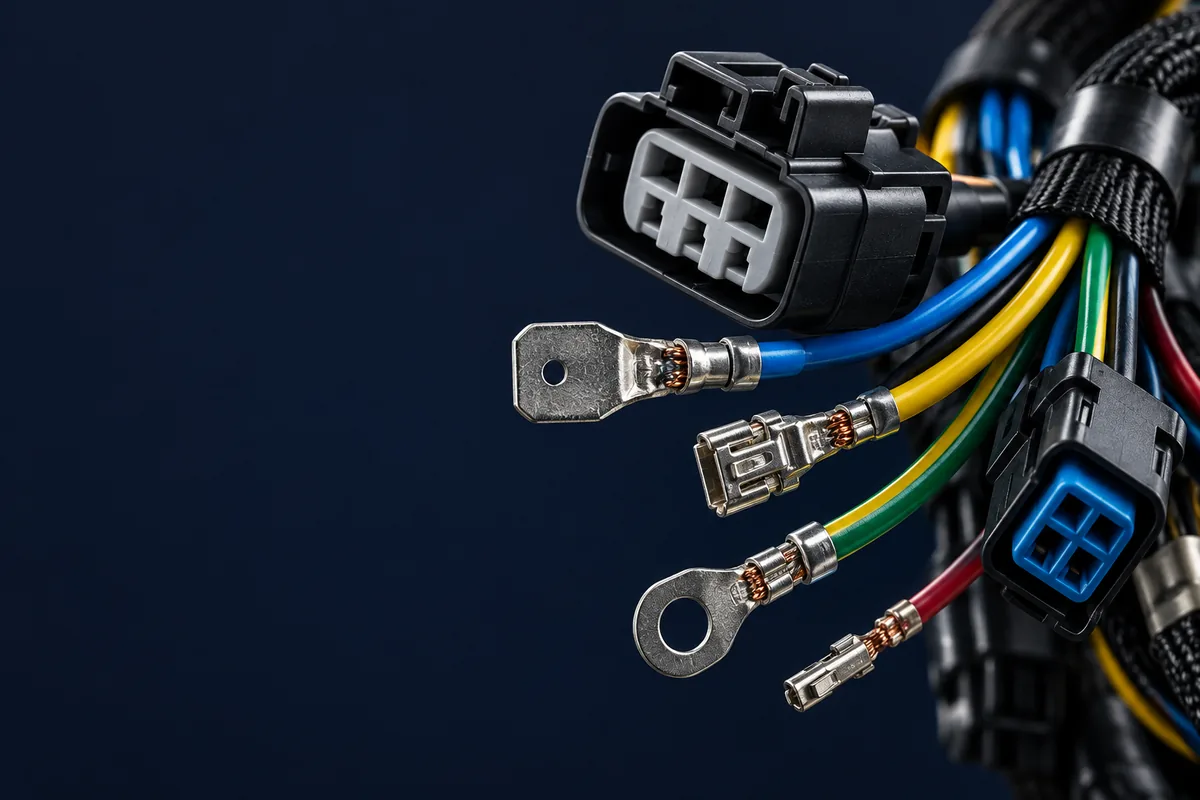
Wire harness assembly line with protective heat shrink tubing applied at branch transitions and connector exits
Heat shrink tubing looks simple, but its fit, material, and recovery behavior directly affect sealing, serviceability, and branch durability.
Heat shrink tubing is one of the easiest items on a drawing to underestimate. Many teams list a color, a lay-flat diameter, and perhaps the words "dual wall" or "adhesive lined," then assume the harness supplier will fill in the rest. That shortcut works until the tubing does not recover tightly enough over the branch, traps adhesive voids near the connector exit, cracks after thermal exposure, or becomes so thick after recovery that the branch no longer routes through its clip, gland, or enclosure opening.
In real production, heat shrink tubing sits at the intersection of design, manufacturing, and field reliability. It can provide basic insulation, help identify circuits, add abrasion protection, support splice encapsulation, create a cleaner transition into conduit or braided sleeve, or act as part of a sealing strategy for a waterproof cable assembly. But each of those jobs asks for a different material set and a different recovery profile. A tubing choice that works well for a bench splice in an indoor control cabinet may be wrong for a medical cable, an automotive branch, or a marine harness that sees salt spray and repeated service handling.
This guide is written for OEM buyers, NPI teams, and engineering teams who need a practical way to specify heat shrink tubing without overbuying or creating hidden quality risk. It connects to our wire harness waterproofing guide, the retention principles in our strain relief guide, and the process controls in our wire splicing guide. If your team is also comparing service-level options, our waterproof cable assembly service page shows how heat shrink fits into a broader sealing package rather than acting as a standalone fix for every environment.
1. Why Heat Shrink Tubing Matters in Wire Harness Design
The most common mistake is to treat heat shrink tubing as cosmetic. In reality, it often carries mechanical and environmental responsibility. A recovered sleeve may need to keep a splice bundle compact, prevent edge abrasion where a branch leaves corrugated conduit, reduce stress concentration behind a connector, or help seal a transition alongside grommets, potting, or overmolding. If the tubing is under-sized, it may split or leave adhesive-starved areas. If it is over-sized, it may recover loosely and trap air pockets. If the wrong polymer is chosen, the sleeve may harden, crack, or cold-flow under the actual temperature and chemical exposure.
Good tubing selection starts by defining the real function. Is the tubing only identifying and insulating one conductor? Is it recovering over a crimped splice that needs strain management? Is it being used as part of a moisture barrier at the branch exit? Is the assembly static, or does the tubing sit at a flex point that cycles every shift? Those questions matter more than catalog marketing language. Standards and authority references such as heat-shrink tubing fundamentals and IPC workmanship guidance are useful starting points, but the field environment should still drive the final callout.
Buyers also need to remember that tubing selection affects throughput. Adhesive-lined tubing adds process time because heating has to be controlled closely enough to create flow without scorching the jacket beneath it. Thick-wall or high-ratio tubing may need more dwell time, more fixture access, or different application sequencing than a simple marker sleeve. On a low-volume prototype build that may be acceptable. On a program producing thousands of harnesses per month, the tubing specification can change labor content, rework rate, and inspection workload.
Used over single conductors, splices, ferrules, or breakout points where the main goal is dielectric protection and basic identification.
Typically requires adhesive-lined or dual-wall tubing and must be validated against water, dust, chemical, and cleaning exposure rather than assumed from appearance.
Helps manage strain, transition stiffness, sleeve retention, and abrasion where a branch exits a connector, conduit, boot, or enclosure.
Recovery time, rework difficulty, branch bulk, and post-recovery dimensions all affect assembly efficiency and field maintainability.
2. Material and Shrink-Ratio Selection
For most wire harness programs, cross-linked polyolefin is the baseline because it balances cost, flexibility, insulation, and processability. It is suitable for many industrial and commercial harnesses, especially when the main requirement is insulation or light bundling. But not every application should stay there. Fluoropolymer tubing can be a better fit where higher temperature, chemical resistance, or thinner recovered walls are needed. Elastomeric and specialty formulations are used when flexibility at low temperature or harsher environments matter more than unit price. Adhesive-lined dual-wall tubing is often chosen where the tubing must recover and bond around irregular geometry to improve sealing and strain transfer.
Shrink ratio should be chosen from the largest installed diameter down to the smallest diameter the tubing must recover over while still gripping correctly. In practical terms, 2:1 is common for simple, controlled geometries. 3:1 is often the safer middle ground when a branch must pass over a connector shoulder or splice lump and still recover onto a smaller cable section. 4:1 or higher is useful when geometry varies sharply, but it also increases wall thickness, recovery energy, and the risk of excess bulk after installation. High ratio is not automatically better; it is only better when the geometry actually needs it.
The comparison table below is a useful starting point for RFQ reviews and design approval.
Table
| Tubing Type | Typical Strength | Typical Limitation | Common Harness Use | Buyer Note |
|---|---|---|---|---|
| Single-wall polyolefin 2:1 | Low cost, easy processing, good general insulation | Limited sealing and moderate geometry tolerance | Wire marking, conductor insulation, light breakout control | Best when the recovered geometry is predictable |
| Single-wall polyolefin 3:1 | More recovery range across mixed diameters | More bulk after recovery than 2:1 | Connector exits, moderate branch transitions, service repairs | Useful when one sleeve must pass over a splice or housing feature |
| Dual-wall adhesive-lined 3:1 | Improved moisture sealing and strain transfer | Needs tighter heat control and longer process time | Outdoor harnesses, splice sealing, waterproof branch exits | Validate adhesive flow and post-recovery dimensions |
| Dual-wall adhesive-lined 4:1 | Covers sharp diameter changes and irregular geometry | Can become overly thick and stiff after recovery | Large branch transitions, field repair kits, retrofit sealing | Use only when the connector-to-cable step really demands it |
| Fluoropolymer tubing | High temperature and strong chemical resistance | Higher material cost and less forgiving processing | industrial, medical, chemical-exposed assemblies | Specify only when the environment justifies the upgrade |
| Elastomeric or specialty flexible tubing | Better flexibility and fatigue tolerance in dynamic areas | Less common availability and more careful qualification needed | Robotics, moving joints, low-temperature dynamic branches | Review flex life and compression recovery, not just shrink ratio |
Note: If the tubing must both pass over a large connector feature and recover onto a small cable OD, calculate the recovered wall and final branch diameter before releasing the drawing. That is where many enclosure-fit problems begin.
3. Where Heat Shrink Fits in a Harness
Heat shrink tubing works best when its role is clearly defined at the branch level. Over a crimp or ultrasonic splice, it can stabilize the bundle and help protect the exposed area from abrasion or incidental moisture. At a connector exit, it can smooth the transition from housing to cable, but it should not be expected to replace a properly designed boot or overmold in a severe environment. Along a straight run, it may be enough to identify circuits or hold labels in place. In a waterproof harness, it may sit underneath or alongside other sealing features rather than act as the only barrier.
This is also the point where many teams confuse heat shrink with strain relief. Tubing can contribute to strain management, but by itself it does not create a complete strain-relief system. Real strain relief depends on load path, bend radius, jacket grip, branch support, and how close the support point sits to the connector or splice. That is why buyers should cross-check tubing decisions against our strain relief design guide instead of assuming a thicker sleeve automatically solves pull and flex problems.
For sealed assemblies, adhesive-lined tubing must be matched to the cable jacket, the expected fluid exposure, and the surrounding components. A visually smooth recovery does not prove a seal. If the application targets washdown or splash resistance, the supplier should verify the entire transition using the same logic discussed in our IP-rating and sealing guide and, where appropriate, references such as the IP code framework. Adhesive-lined tubing can be an effective layer, but it is still part of a system rather than a universal substitute for molded sealing.
For dynamic branches, stiffness matters as much as sealing. Excess adhesive, overly thick wall buildup, or a sleeve that ends too close to a moving pivot can shift the bend point and accelerate conductor fatigue. In those cases, a more flexible tubing material, a longer taper, or a different branch-support strategy may outperform simply adding another layer.
- Use when you need insulation coverage, bundle management, or moderate environmental protection around a localized connection.
- For larger splice packs, confirm the final recovered profile still fits inside sleeve, conduit, or harness clip features.
- Use as a transition aid or secondary protection layer behind the connector where the housing geometry and cable OD are controlled.
- Do not assume tubing alone delivers the same retention and sealing performance as a dedicated boot or overmold.
- Use with caution at repeated flex points. The wrong wall thickness can move the bend line and shorten harness life.
- Where motion is continuous, validate bend-cycle performance after recovery rather than approving from bench feel alone.
4. Inspection Rules and Common Failure Modes
Inspection should focus on function, not only appearance. A good heat shrink result usually shows full recovery, stable position, no scorching, no splits, and a controlled edge transition that does not leave sharp steps or exposed adhesive strings. For adhesive-lined tubing, inspectors should also look for even adhesive flow rather than large voids or heavy squeeze-out that signals overheating. If the tubing is used over a splice or branch transition, the inspector should confirm that the recovered sleeve still supports the required bend and routing geometry.
The most common defects are predictable. Underheating leaves loose recovery and weak sealing. Overheating can char the sleeve, damage the substrate jacket, or cook the adhesive so aggressively that it pools instead of sealing evenly. Wrong-size tubing may bridge over the geometry and leave unbonded cavities. Poor process sequencing can trap labels, braid ends, or branch tape edges under the sleeve, which later creates stress points or wicking paths. Workmanship criteria should also remain aligned with broader harness inspection rules such as our IPC/WHMA-A-620 inspection guide and compliance expectations like RoHS for material declarations.
When a program is sensitive to ingress, flex fatigue, or high temperature, final inspection should not stop at visual review. Add the test that matches the failure mode. That may be pull testing of the branch, thermal cycling, post-exposure continuity, dimensional inspection after recovery, or environmental verification on the full assembly. The purpose is not to create bureaucracy. It is to prove the tubing callout is doing the job it was assigned to do.
Checklist
What Inspectors Should Confirm
- Tubing fully recovered with no splits, scorch marks, or exposed damaged substrate
- Correct overlap length across the splice, connector exit, or branch transition
- Adhesive flow is continuous but not excessive when dual-wall tubing is specified
- Recovered assembly still fits clips, glands, conduits, and enclosure entry points
- No trapped sharp edges, braid whiskers, tape folds, or label corners under the sleeve
- Any sealing or flex requirement is backed by the appropriate validation test, not by visual approval alone
5. RFQ and Specification Checklist
The best way to prevent tubing-related rework is to specify the job, the geometry, and the environment together. A supplier cannot reliably choose between 2:1 polyolefin and 3:1 adhesive-lined tubing if the drawing omits the largest pass-over diameter, the recovered target diameter, the temperature range, and whether the branch is static or dynamic. The fewer assumptions the supplier has to make, the more accurate the quote and the shorter the DFM loop.
A strong RFQ package should include the tubing material or acceptable options, shrink ratio, recovered coverage length, color, print or marking requirement if any, target environment, and the validation expected after installation. If the sleeve is there for sealing, say what kind of sealing. If it is there for strain support, show the routing and support points. If it sits over a splice, send the splice method and final bundle diameter. Those details are what separate a manufacturable tubing callout from a catalog placeholder.
Buyers should also ask the supplier what they will confirm before production. The answer should include DFM review of geometry, final recovered diameter, process method, inspection points, and any recommended changes if the sleeve creates excess bulk or inconsistent sealing. That is the stage where a good supplier prevents avoidable scrap instead of learning from field returns.
Checklist
- Largest pass-over diameter and smallest final recovery diameter for the tubing location
- Material family and shrink ratio required or acceptable alternatives with approval path
- Static versus dynamic application, plus bend radius and support details near the sleeve
- Exposure profile: temperature, fluids, cleaning agents, UV, abrasion, and ingress target
- Coverage length, color, print requirements, and any maximum finished OD constraint
- Validation method expected after recovery: visual, dimensional, pull, thermal, ingress, or electrical
6. Frequently Asked Questions
These are the questions buyers and design teams most often ask before approving heat shrink tubing on a production harness.
Frequently Asked Questions
When should I use 2:1 heat shrink tubing instead of 3:1?
Use 2:1 when the tubing only needs to recover over a controlled geometry and the difference between install diameter and final cable diameter is modest. Use 3:1 when the sleeve must pass over larger features such as splice packs or connector exits and still recover tightly onto a smaller section. In many harnesses, a 3:1 sleeve is the safer option once the diameter step exceeds about 25% to 30%.
Does adhesive-lined heat shrink make a wire harness waterproof?
It can improve sealing, but it does not automatically make the full harness waterproof. Adhesive-lined tubing is one element in a system that may also include connector seals, grommets, potting, or overmolding. If the assembly targets IP67, IP68, or higher, validate the complete transition after installation rather than assuming the adhesive layer alone is enough.
What material is best for high-temperature wire harnesses?
Standard polyolefin is often suitable up to around 125C continuous service, while higher-temperature programs may require fluoropolymer or other specialty materials rated closer to 200C to 260C depending on the product. The correct choice depends on actual thermal exposure, chemical contact, and the flexibility required after recovery.
Can heat shrink tubing be used as strain relief behind a connector?
Yes, but only as part of a broader strain-relief design. Tubing can smooth the transition and spread load, but it does not replace proper support geometry, clamp location, or connector-specific retention features. For repeated flex or pull loads, verify the branch survives the intended cycle or force target rather than assuming the sleeve alone solves it.
How should adhesive-lined heat shrink be inspected?
Inspect for full recovery, even adhesive flow, no scorching, and correct overlap length. The recovered branch should still meet the finished OD and routing requirement, and the sleeve should not trap sharp edges or visible voids. For critical programs, visual inspection should be backed by dimensional checks and the relevant environmental or mechanical validation.
What should I send in an RFQ for heat shrink tubing on a cable assembly?
Send the drawing or sample, the cable or splice diameters, required shrink ratio or approved options, environment and temperature range, target finished OD, and any test requirement such as pull, thermal cycling, or ingress verification. When those six inputs are clear, most suppliers can return meaningful DFM feedback and an accurate quote much faster.
Frequently Asked Questions
When should I use 2:1 heat shrink tubing instead of 3:1?
Use 2:1 for controlled geometries with modest diameter change and 3:1 when the sleeve must pass over larger features and still recover tightly onto a smaller section.
Does adhesive-lined heat shrink make a wire harness waterproof?
It can improve sealing, but it does not by itself guarantee a waterproof harness. The complete connector, cable, and branch transition must still be validated to the target ingress level.
What material is best for high-temperature wire harnesses?
Standard polyolefin suits many applications up to around 125C continuous service, while harsher thermal environments may require fluoropolymer or another specialty material rated closer to 200C to 260C.
Can heat shrink tubing be used as strain relief behind a connector?
Yes, but only as part of a broader strain-relief design that includes support geometry, bend control, and validation of the actual load case.
How should adhesive-lined heat shrink be inspected?
Inspect for full recovery, even adhesive flow, no scorching, correct overlap length, and confirmation that the recovered branch still meets routing and dimensional requirements.
What should I send in an RFQ for heat shrink tubing on a cable assembly?
Send the drawing or sample, cable or splice diameters, approved tubing options, environment, finished OD limits, and the required validation such as pull, thermal, or ingress testing.
External Resources
- Heat-shrink tubing overview
- IPC overview and workmanship standards background
- IP code reference for ingress protection terminology
- RoHS directive background
Cta
Title: Need Help Specifying Heat Shrink for a New Harness?
Send your drawing, cable diameters, environment, and target validation scope. We will review shrink ratio, material options, branch bulk, and sealing risk before quoting so your tubing callout supports production instead of creating hidden rework.
Primarybutton: Request a Quote
Secondarybutton: Talk to Engineering
Badges
- DFM review before pricing
- Recovery geometry checked against your branch
- Sealing and strain-relief recommendations included
Rfqtitle: Send This With Your RFQ
Rfqitems
- Drawing, sample, or splice/branch geometry with the largest pass-over diameter
- Cable OD, final recovered target, and any finished branch OD limit
- Environment details: temperature, fluids, ingress target, UV, and motion profile
Deliverablestitle: What You Get Back
Deliverablesitems
- Recommended tubing material and shrink ratio
- DFM feedback on bulk, sealing, and assembly process risk
- Suggested inspection and validation checkpoints before release