IP Ratings, Sealing Methods & Materials
Water kills wire harnesses through two mechanisms: immediate short circuits and slow corrosion. Both are preventable with the right sealing method. This guide covers IP rating selection, four sealing technologies—overmolding, potting, heat shrink boots, and gasket seals—along with material comparisons and testing protocols for automotive, marine, industrial, and outdoor applications.
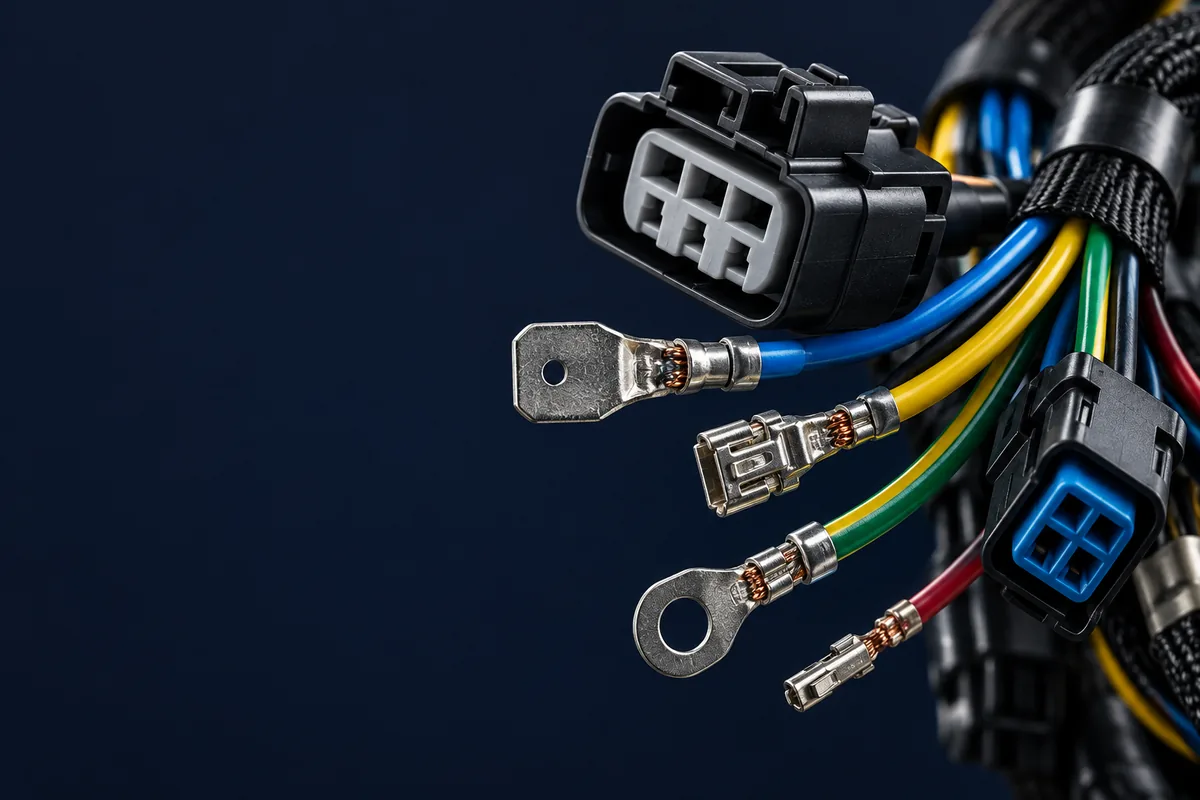
Industrial wire harness assembly with waterproof connectors and environmental sealing
of outdoor harness failures caused by moisture ingress
minimum rating for most outdoor wire harness applications
longer service life with proper environmental sealing
per-unit waterproofing cost depending on method and IP level
Table of Contents
- 1. Why Waterproofing Matters for Wire Harnesses
- 2. IP Ratings Explained: What the Numbers Actually Mean
- 3. Four Sealing Methods for Wire Harness Waterproofing
- 4. Sealing Materials: Properties and Trade-offs
- 5. Waterproofing Requirements by Industry
- 6. Waterproofing Testing Protocols
- 7. Five Waterproofing Failures and How to Prevent Them
- 8. Frequently Asked Questions
Water does not need to flood a wire harness to destroy it. A single droplet reaching a crimp terminal starts galvanic corrosion between dissimilar metals. Within months, contact resistance rises. Within a year, intermittent failures begin. Within two years, the connection fails completely. The failure is silent, progressive, and expensive to diagnose in the field.
Moisture ingress accounts for roughly 35 percent of wire harness field failures in outdoor and harsh-environment applications. The root cause is almost never the connector itself—modern sealed connectors from TE, Deutsch, and Amphenol perform well when properly mated. The failures concentrate at three weak points: the cable-to-connector junction, mid-span splices, and cable jacket penetrations where branches exit the main trunk.
Specifying waterproofing correctly requires understanding IP ratings, matching the sealing method to your production volume and service requirements, and selecting materials that survive your operating environment—not just water, but UV, chemicals, and thermal cycling. This guide gives you the data to make those decisions on your next wire harness RFQ.
"The most common waterproofing mistake we see is specifying a sealed connector but ignoring the cable entry point. An IP68 connector mated to an unsealed cable jacket is like installing a watertight door in a wall with holes. The weakest seal point determines your actual IP rating, not the component with the highest spec."
Hommer Zhao
Founder & General Manager
1. Why Waterproofing Matters for Wire Harnesses
Water damages electrical connections through three mechanisms. First, immediate short circuits when bulk water bridges between conductors at different potentials. Second, galvanic corrosion when moisture creates an electrolyte between dissimilar metals—typically tin-plated copper terminals mated with gold-plated contacts, or copper conductors in contact with aluminum housing. Third, electrochemical migration where ionic contamination in water causes metal dendrites to grow between closely spaced conductors, creating delayed short circuits.
The corrosion mechanism is particularly dangerous because it produces failures months or years after installation, making root cause analysis difficult. A wire harness failure analysis of corroded terminals often shows the original sealing was either underspecified or improperly installed.
Cost of Moisture-Related Failures
- Automotive warranty: $150–$800 per vehicle for harness corrosion claims
- Solar farm: $2,000–$15,000 per string failure including lost generation revenue
- Marine equipment: $5,000–$50,000 per incident for navigation or propulsion harness failure
- Industrial controls: $10,000–$100,000 per hour of unplanned downtime from moisture-induced control faults
Proper waterproofing adds $0.50 to $8.00 per cable assembly depending on the method and required IP rating. Compared to a single field failure, waterproofing delivers return on investment within the first warranty claim avoided.
2. IP Ratings Explained: What the Numbers Actually Mean
The Ingress Protection (IP) rating system, defined by IEC 60529, uses two digits. The first digit (0–6) rates solid particle protection. The second digit (0–9) rates liquid ingress protection. For wire harness applications, you will primarily work with dust protection levels 5 and 6, and water protection levels 4 through 8.
| IP Rating | Dust Protection | Water Protection | Typical Application |
|---|---|---|---|
| IP54 | Limited dust ingress | Splash-proof from any direction | Indoor industrial, HVAC controls |
| IP65 | Dust-tight | Low-pressure water jets | Outdoor enclosures, automotive underhood |
| IP66 | Dust-tight | High-pressure water jets | Pressure-washed equipment, food processing |
| IP67 | Dust-tight | Immersion up to 1m for 30 min | Automotive underbody, solar farms, outdoor robotics |
| IP68 | Dust-tight | Continuous immersion (depth per spec) | Marine, subsea, EV battery packs |
| IP69K | Dust-tight | High-pressure, high-temperature spray | Food and beverage washdown, agricultural |
Common IP Rating Misconception
IP68 does not automatically include IP66 (high-pressure jet) protection. The tests are independent. If your harness must survive both submersion and pressure washing, specify IP68 and IP66 testing, or request IP69K for the most comprehensive protection.
For North American projects, you may also encounter NEMA ratings. NEMA 4 is roughly equivalent to IP66, NEMA 4X adds corrosion resistance, and NEMA 6P corresponds approximately to IP68. Always verify the specific test conditions rather than relying on cross-reference tables, as NEMA and IP testing protocols differ in methodology.
3. Four Sealing Methods for Wire Harness Waterproofing
Each sealing method offers different trade-offs in protection level, cost, production volume suitability, and field serviceability. The right choice depends on your custom cable assembly requirements.
Overmolded Seals
Best for IP68Injection-molded thermoplastic or elastomer bonded directly around the cable-to-connector junction. Creates a permanent, monolithic seal with no gaps or interfaces. Multi-shot molding can combine rigid housing material with flexible sealing material in a single operation.
Strengths
- Highest reliability: permanent bond eliminates seal interfaces
- Achieves IP68 consistently across production runs
- Withstands 100,000+ thermal cycles without seal degradation
- Provides simultaneous strain relief and environmental sealing
Limitations
- Tooling cost: $2,000–$8,000 per mold
- Not field-serviceable: connector cannot be replaced
- Lead time: 3–6 weeks for initial tooling
- Economical only above 500–1,000 units
Potting Compounds
Best for Complex GeometryTwo-part epoxy, polyurethane, or silicone compound poured or injected into enclosures around wire terminations. Fills all voids and irregular shapes, providing both waterproofing and mechanical protection. Particularly effective for sealing junction boxes, splice enclosures, and PCB-to-harness interfaces.
Strengths
- Seals irregular geometries that molds cannot reach
- No tooling investment: suitable for any volume
- Provides vibration dampening and thermal management
- Chemical resistance (epoxy) or flexibility (silicone)
Limitations
- Irreversible: repairs require cutting out and re-potting
- Cure time: 4–24 hours depending on compound
- Weight: adds significant mass to the assembly
- Exothermic curing can damage heat-sensitive components
Adhesive-Lined Heat Shrink
Best for Low VolumeDual-wall heat shrink tubing with an inner layer of hot-melt adhesive. When heated, the outer wall shrinks to conform to the cable and connector profile while the adhesive melts and flows into gaps, creating a sealed barrier. Available in standard shrink ratios of 2:1, 3:1, and 4:1 to accommodate different connector-to-cable diameter transitions.
Strengths
- Zero tooling cost: off-the-shelf components
- Fast application: 30–90 seconds per seal point
- Achieves IP67 when properly applied with adhesive liner
- Field-repairable: cut off and reapply new tubing
Limitations
- Operator-dependent: inconsistent heating causes seal gaps
- Limited to IP67: pressure seal not reliable at greater depths
- Adhesive degrades above 125°C continuous exposure
- Not suitable for repeated flexing at seal point
Gasket and O-Ring Seals
Best for ServiceabilityCompression seals using elastomer gaskets or O-rings seated in machined grooves. The connector housing compresses the gasket against the panel or mating connector, creating a controlled seal. Cable glands use the same principle to seal the cable jacket where it enters an enclosure.
Strengths
- Fully field-serviceable: disconnect and reconnect without damage
- Reliable IP67/IP68 when torqued to specification
- Wide material options: silicone, EPDM, Viton, neoprene
- Replaceable seals extend harness service life
Limitations
- Requires proper torque: under-tightening leaks, over-tightening damages seal
- Gaskets degrade with UV and ozone exposure over time
- Seal performance depends on mating surface finish quality
- Installation training required to achieve rated IP level
"We test every waterproof harness at 1.5 times the rated pressure before shipping. The reason is simple: field conditions are never as clean as the test lab. Dirt on a gasket surface, a cable jacket with a nick from installation, connector pins not fully seated—all of these reduce your seal margin. Building in a 50 percent safety factor at the factory means the harness still meets spec when conditions are less than perfect in the field."
Hommer Zhao
Founder & General Manager
4. Sealing Materials: Properties and Trade-offs
The sealing material must survive not just water but the complete operating environment. UV radiation, chemical exposure, temperature extremes, and mechanical stress all degrade seals over time. Selecting the right material for your wire harness application prevents premature seal failure.
| Material | Temp Range | UV Resistance | Chemical Resistance | Cost | Best For |
|---|---|---|---|---|---|
| Silicone | −60°C to +200°C | Excellent | Moderate | $$$$ | industrial, medical, high-temp |
| EPDM | −50°C to +150°C | Excellent | Moderate | $$ | Outdoor, solar, agricultural |
| Viton (FKM) | −20°C to +200°C | Good | Excellent | $$$$$ | Fuel systems, chemical plants |
| Neoprene (CR) | −40°C to +120°C | Moderate | Good | $$ | Marine, oil-exposed environments |
| TPE | −40°C to +100°C | Moderate | Moderate | $ | Consumer, general industrial |
| Polyurethane | −40°C to +80°C | Poor | Good | $$ | Potting, abrasion-heavy environments |
Material Selection Rule of Thumb
For most outdoor industrial applications, EPDM provides the best balance of cost, UV resistance, and temperature range. Upgrade to silicone when temperatures exceed 150°C or medical/industrial traceability is required. Use Viton only when fuel, hydraulic fluid, or aggressive solvents are present.
5. Waterproofing Requirements by Industry
Different industries face different moisture exposure conditions. An automotive underbody harness sees road spray and salt but not sustained immersion. A marine harness faces continuous salt fog and potential submersion. Matching the waterproofing specification to actual operating conditions avoids both under-protection and over-spending.
Automotive
- Underhood: IP65–IP67, −40°C to +125°C
- Underbody: IP67, salt spray 1,000+ hours
- Interior: IP54, splash protection only
- EV battery: IP68 at 1m for 24 hours minimum
- Standards: SAE J1128, LV 124, VW 80000
Marine & Offshore
- Deck equipment: IP66–IP68, salt fog 3,000+ hours
- Below waterline: IP68 at rated depth, continuous
- Materials: Tinned copper, marine-grade jackets
- Connectors: Deutsch DT/DTP, Amphenol Marine
- Standards: IEC 60945, DNV GL, Lloyd's Register
Solar & Renewable Energy
- String harness: IP67, UV 20+ year life
- Inverter cable: IP65, high-temperature rated
- Connectors: MC4 (IP67 when mated), H4
- Jacket: XLPE or LSZH, UV-stabilized black
- Standards: UL 4703, EN 50618, TUV 2Pfg
Industrial & Food Processing
- Washdown zones: IP66–IP69K, chemical resistant
- Outdoor controls: IP65–IP67, UV resistant
- Connectors: M12, M8 circular sealed connectors
- Materials: Stainless steel glands, FKM seals
- Standards: IEC 60529, ECOLAB certified (food)
6. Waterproofing Testing Protocols
Proper wire harness quality testing for waterproofing goes beyond a simple dunk test. A comprehensive protocol validates seal integrity under the thermal, mechanical, and chemical stresses the harness will encounter in service.
Visual Inspection (Pre-test)
Inspect all seal points under magnification for adhesive voids, mold flash gaps, incomplete heat shrink recovery, and damaged O-rings. Reject any unit with visible seal defects before wet testing.
Thermal Cycling
Cycle the sealed harness from −40°C to +85°C (or max operating temp) for a minimum of 10 cycles. Thermal expansion and contraction stress seal interfaces, revealing bonding weaknesses before immersion testing.
Immersion Test (IEC 60529)
For IP67: immerse at 1 meter depth for 30 minutes. For IP68: immerse at manufacturer-specified depth for specified duration. Monitor for bubble formation during submersion. After removal, measure insulation resistance between all conductors and housing (must exceed 100 megohms).
Pressure Decay Test
Pressurize the sealed assembly to 1.5 times rated pressure and monitor for 60 seconds. Acceptable leak rate is less than 10 Pa pressure drop per second. This is the fastest production-line test for seal integrity verification.
Salt Spray Test (ASTM B117)
For automotive and marine applications, expose sealed harnesses to 5% NaCl salt fog at 35°C for 500–3,000 hours depending on the target environment. After exposure, verify contact resistance has not increased more than 5 milliohms on any terminal.
"Pressure decay testing catches 98 percent of seal defects in under two minutes on the production line. It is the single most cost-effective quality gate for waterproof harnesses. Every unit ships tested. The alternative—field failures in applications you cannot easily access for repair—costs orders of magnitude more."
Hommer Zhao
Founder & General Manager
7. Five Waterproofing Failures and How to Prevent Them
1. Breathing Effect (Thermal Pumping)
Temperature changes cause air inside a sealed enclosure to expand and contract. Cooling creates negative pressure that pulls moisture through microscopic seal imperfections. This is the most common cause of moisture ingress in sealed harness assemblies that pass initial IP testing but fail after 6–12 months in the field.
Prevention: Use breather valves (Gore-Tex vents) that allow pressure equalization while blocking liquid water, or specify hermetic seals that eliminate air exchange entirely.
2. Cable Jacket Wicking
Water travels between the cable jacket and individual conductor insulation through capillary action. Even a perfectly sealed connector can flood internally if the cable jacket is not sealed where it enters the connector backshell. Multi-conductor cables with unfilled interstices are particularly vulnerable.
Prevention: Specify filled cables (gel or powder-filled interstices) for wet environments. Apply adhesive-lined heat shrink or overmolding over the cable jacket entry point, not just the connector interface.
3. Seal Compression Set
Elastomer seals permanently deform under sustained compression, especially at elevated temperatures. After compression set exceeds 40–60 percent of the original cross-section, the gasket no longer provides adequate sealing force. High-temperature environments accelerate this degradation.
Prevention: Select seal materials with low compression set values for the operating temperature. Silicone maintains <15% compression set at 150°C; EPDM maintains <25% at 100°C. Design groove geometry to limit seal compression to 20–30% of cross-section.
4. UV Degradation of Seal Material
Ultraviolet radiation breaks polymer chains in exposed seal materials. Neoprene and polyurethane are particularly vulnerable, showing cracking and surface chalking within 2–5 years of outdoor UV exposure. Once the surface cracks, water finds a path through the compromised seal.
Prevention: Use EPDM or silicone for outdoor-exposed seals. Add UV-stabilized overjackets or protective boots over seal areas. For solar energy applications, specify 25-year UV-rated materials from the design phase.
5. Improper Cable Gland Installation
Cable glands are the most common field-installed waterproofing component, and the most commonly installed incorrectly. Using a gland sized for the wrong cable diameter, failing to tighten to specified torque, or omitting the sealing insert all result in IP rating loss. Even a correctly sized gland with 80 percent of specified torque can drop from IP68 to IP54.
Prevention: Specify exact cable gland part numbers on assembly drawings. Include torque values and mark witness lines after installation. Use split-type sealing inserts for multi-cable entries. Train installation crews on IP-critical torque requirements.
8. Frequently Asked Questions
What IP rating do I need for an outdoor wire harness?
Most outdoor wire harness applications require IP65 minimum, which protects against low-pressure water jets from any direction. For equipment exposed to heavy rain, pressure washing, or temporary submersion, specify IP67. Marine and underwater applications typically need IP68, rated for continuous submersion at a specified depth and duration agreed with the manufacturer.
What is the difference between IP67 and IP68 for cable assemblies?
IP67 means the cable assembly can survive temporary immersion in water up to 1 meter depth for 30 minutes. IP68 means it can withstand continuous immersion at a depth and duration specified by the manufacturer, typically 1.5 to 10 meters for extended periods. Both provide complete dust protection. The cost difference is typically 15 to 30 percent for IP68 over IP67 due to additional sealing requirements.
Can I waterproof an existing wire harness in the field?
Field waterproofing is possible for temporary repairs but never matches factory-sealed quality. Options include adhesive-lined heat shrink tubing over splice points, self-amalgamating silicone tape, or two-part potting compound applied in field-serviceable enclosures. For any safety-critical application, replace the harness with a factory-sealed unit tested to the required IP rating.
Which sealing method provides the best waterproofing for wire harnesses?
Overmolded seals provide the highest reliability because the seal is a permanent bond with no interfaces. They consistently achieve IP68 and withstand over 100,000 thermal cycles. However, they require tooling investment of $2,000–$8,000 per mold, making them cost-effective only above 500–1,000 units. For lower volumes, compression gaskets with sealed connectors offer IP67 performance without tooling costs.
How do I test wire harness waterproofing?
Testing follows IEC 60529 standards. For IP67, submerge the sealed harness at 1 meter depth for 30 minutes and verify no water intrusion using insulation resistance measurements. For production testing, pressure decay testing is fastest: pressurize to 1.5x rated pressure and monitor for 60 seconds. Additionally, thermal cycle before immersion testing to stress seal interfaces, as temperature changes create pressure differentials that reveal weak seals.
References & Standards
- IEC 60529: Degrees of Protection Provided by Enclosures (IP Code)
- NEMA 250: Enclosures for Electrical Equipment (1,000 Volts Maximum)
- ASTM B117: Standard Practice for Operating Salt Spray (Fog) Apparatus
- SAE J1128: Low Voltage Primary Cable for automotive wire harness applications
Need Waterproof Wire Harnesses?
We manufacture IP67 and IP68 rated wire harnesses with overmolded, potted, and gasket-sealed options. Share your environmental requirements and we will recommend the most cost-effective waterproofing solution for your application.