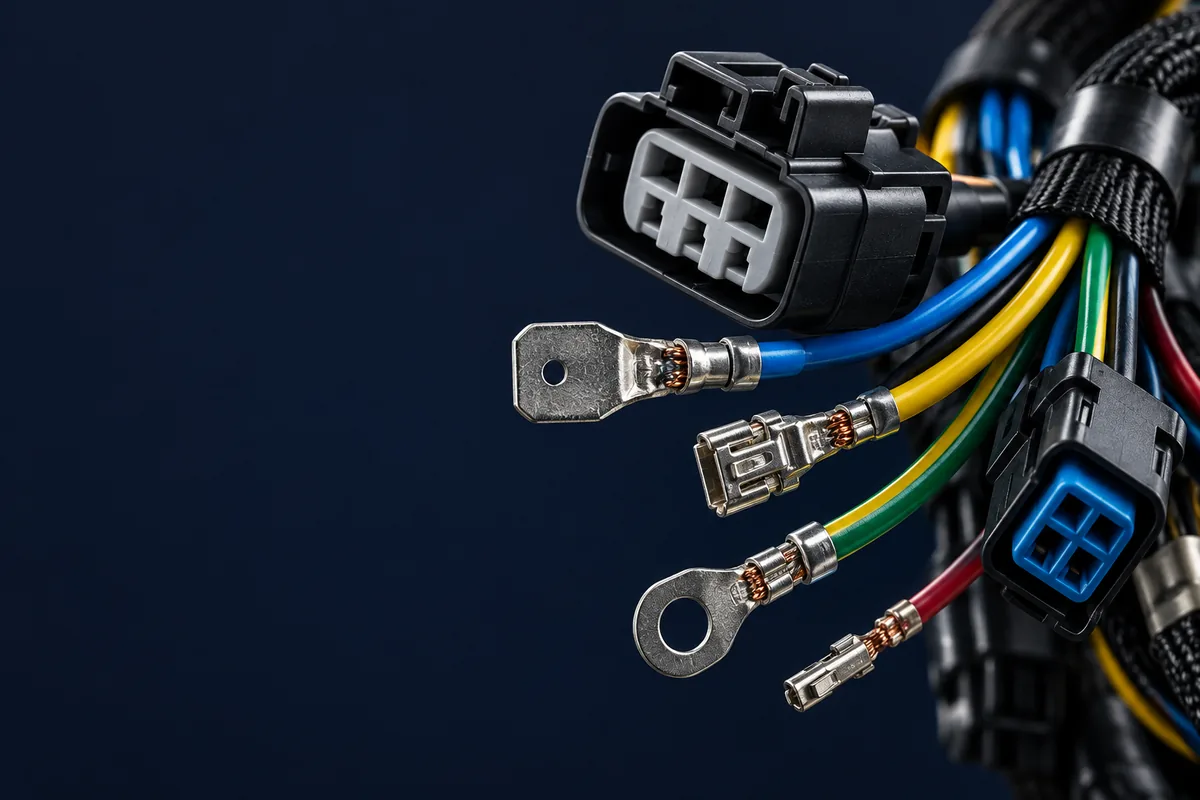
During a custom wiring harness project for the mining sector, the client expanded the RFQ from standard harness work into specialized braided cables, laser-etched markings, and injection-molded connectors. The challenge was exact configuration control: 3 Core (Yellow, Red, Blue), 18 AWG GXL, Black braid with 2 blue stripes, 50m or 100m rolls. That case matters for fiber optic connector selection because the same sourcing failure appears when an RFQ says only "fiber cable." Without connector type, polish, polarity, fiber count, test method, and packaging rules, two suppliers can quote assemblies that look similar but will not perform the same in the field.
A fiber optic connector is a precision mechanical interface that aligns one or more optical fibers so light can pass from cable to equipment, adapter, patch panel, or another cable. For OEM buyers, the practical question is not which connector is famous. The question is which connector family fits the mating hardware, density, handling risk, insertion-loss budget, return-loss target, and production test evidence required by the equipment.
TL;DR
- Use LC for dense duplex links, SC for larger handled ports, and MPO/MTP for high-fiber-count trunks.
- Specify UPC or APC polish; a green APC connector should not mate with a blue UPC connector.
- Require 100% insertion-loss testing and polarity verification for production optical cable assemblies.
- Reference IEC 61754 connector interfaces and TIA-568 cabling logic in the RFQ.
- For outdoor or industrial use, define boots, strain relief, dust caps, labels, and bend-radius protection.
This guide is written for engineering teams, sourcing managers, NPI buyers, and supplier quality teams comparing optical cable assembly quotes before pilot or repeat production. The factory role is a senior cable assembly engineer with manufacturing experience supporting custom wire harness, copper cable, and optical cable assembly programs. The objective is to help you choose a connector type, write a precise RFQ, and define evidence that prevents a low-price quote from becoming a rework order.
Connector Types at a Glance
Fiber optic connector type should be chosen by application package first, then by optical performance. A connector body can look familiar, but the finished assembly still depends on fiber mode, ferrule geometry, polish style, strain relief, cable OD, and test limits.
| Connector Type | Typical Fiber Count | Where It Fits | Buyer Risk | RFQ Detail to Lock |
|---|---|---|---|---|
| LC | 1 or 2 fibers per duplex pair | Dense switches, telecom panels, data devices, SFP modules | Wrong clip orientation, polish, or latch clearance | Simplex/duplex, UPC/APC, boot length, polarity, latch direction |
| SC | 1 or 2 fibers per duplex pair | Telecom equipment, FTTH panels, test fixtures, lower-density cabinets | Too large for dense equipment or wrong adapter color | UPC/APC, simplex/duplex housing, cable OD, adapter style |
| ST | 1 fiber | Legacy industrial, instrumentation, older telecom panels | Bayonet fit accepted while optical loss is not controlled | Multimode/singlemode, polish, boot, test wavelength |
| FC | 1 fiber | Vibration-sensitive instruments, lab gear, threaded interfaces | Slow service handling and wrong key alignment | Threaded mate, key width, UPC/APC, strain relief |
| MPO/MTP | 8, 12, 16, 24, or more fibers | High-density trunks, breakout cassettes, data center backbone links | Polarity, gender, and pinning mistakes that pass visual inspection | Method A/B/C, male/female, fiber count, key up/down, test report |
| Ruggedized LC/SC | 1 or 2 fibers per channel | Industrial cabinets, outdoor equipment, transportable systems | Connector survives handling but cable bend radius is violated | IP target, boot, jacket, pull load, bend radius, dust cap |
The interface families are often described through IEC connector standards. Public background on the International Electrotechnical Commission helps explain why buyers should name standards such as IEC 61754 for connector interfaces and IEC 61300 for fiber optic interconnecting device test methods rather than approving assemblies by appearance only. For structured cabling context, ANSI/TIA-568 is the public reference most buyers recognize. For cable and harness workmanship expectations around routing, strain relief, labeling, and final assembly condition, many OEMs still use IPC-driven inspection language alongside optical-specific tests.
When an RFQ says "LC fiber cable" without polarity, polish, fiber mode, and test wavelength, I treat it as incomplete. LC is the shell family, not the release specification.
LC vs SC vs MPO/MTP: The Practical Decision
LC connectors are compact and common where equipment density matters. A duplex LC assembly is often the default around SFP modules and dense patching. LC is a good choice when the buyer needs many ports in limited panel space, but the small latch can be damaged if the boot is too stiff, the panel is recessed, or operators pull on the cable instead of the housing.
SC connectors are larger and easier to handle with gloves or in lower-density cabinets. The push-pull body gives technicians a clear mating action. The tradeoff is space. A cabinet that supports 24 SC ports may support more LC ports in the same width, so panel density and service access should be checked before freezing the connector.
MPO and MTP-style assemblies solve a different problem: fiber count. A 12-fiber MPO trunk can replace several duplex links, but it brings polarity and gender control into the RFQ. Polarity is the end-to-end transmit/receive fiber relationship inside an optical link. If polarity is wrong, the assembly may be clean, labeled, and fully seated while the optical link still fails. For custom programs with mixed copper and optical interfaces, compare this discipline with our optical cable assembly service and our RJ45 Ethernet cable assembly page, where pair mapping and final testing play a similar release role.
Singlemode, Multimode, UPC, and APC
Singlemode fiber is an optical fiber with a small core designed for one dominant light path, usually selected for longer distance or higher bandwidth links. Multimode fiber is an optical fiber with a larger core that supports multiple light paths, often used for shorter equipment-room, industrial, or building links. Connector selection must match the fiber mode because ferrule alignment and test expectations differ.
Polish style is the end-face geometry of the ferrule. UPC connectors normally use a blue body in singlemode systems and are common where return-loss requirements are moderate. APC connectors normally use a green body and an angled polish that reduces back reflection. A green APC connector should not be mated to a blue UPC connector. It can damage end faces and create poor optical performance.
Insertion loss is the optical power lost when light passes through a connector pair or assembly. Return loss is the amount of light reflected back toward the source. A buyer should define both, because a cable can pass a simple continuity light check and still fail the network's loss budget. In production RFQs, state the required wavelengths, such as 850 nm and 1300 nm for many multimode checks or 1310 nm and 1550 nm for many singlemode checks.
For optical assemblies, I want the test sheet to show wavelength, connector end A, connector end B, polarity, and measured insertion loss. A pass/fail sticker without those fields does not tell the buyer enough.
Ruggedized and Industrial Optical Cable Assemblies
Industrial optical cable assemblies add mechanical risk to an optical interface. The connector may be LC, SC, or MPO, but the installed route can include panel edges, moving equipment, outdoor dust, service pulls, or tight cabinet doors. A ruggedized fiber cable assembly is an optical cable build with added jacket, armor, boot, strain relief, or enclosure features to protect the fiber path during installation and use.
Start with the route. If the cable passes through a cabinet wall, define panel cutout, grommet, clamp, or bulkhead details. If the cable runs near moving machine sections, define minimum bend radius and whether the route is static or repeated-flex. If the assembly is shipped as a kit, define dust caps, label positions, coil diameter, bagging, and whether the connector end faces must be cleaned before packing.
For harsh environments, the optical connector choice should sit beside the broader cable protection plan. Our strain relief cable assembly page covers exit support, while the coaxial bend radius guide shows the same routing principle for signal-sensitive cable. The materials are different, but the sourcing mistake is similar: buying by connector name while leaving the installed route undefined.
What to Send in a Fiber Optic Cable RFQ
A complete RFQ should make the supplier quote the same assembly you intend to buy. If the request is vague, the supplier may choose a cheaper boot, omit polarity mapping, test only at one wavelength, or pack the cable in a coil that violates bend radius before it reaches your line.
- Connector type at each end: LC, SC, ST, FC, MPO/MTP, or ruggedized variant.
- Fiber mode and count: singlemode OS2, multimode OM3/OM4/OM5, 2 fibers, 12 fibers, 24 fibers, or custom count.
- Polish and color rule: UPC, APC, body color, boot color, and adapter color where needed.
- Polarity and gender: especially for MPO/MTP, including Method A/B/C, pinned or unpinned, key orientation, and cassette relationship.
- Length and tolerance: finished length, measurement point, coil diameter, and label position.
- Mechanical protection: jacket type, armor, boot, strain relief, bend radius, pull load, and IP target if exposed.
- Test evidence: 100% insertion loss, return loss where required, visual end-face inspection, polarity report, and lot traceability.
For OEM projects that combine optical links with copper power or signal branches, keep the optical test report separate from the copper continuity report. The production traveler can share the same job number, but the release evidence should show which tests belong to which technology.
Factory Quality Gates Before Shipment
First article approval should prove the geometry before volume production starts. The supplier should confirm connector type, fiber mode, cable OD, jacket marking, length, label content, boot orientation, end-face condition, and polarity. For MPO/MTP, one first article photo is not enough; the report should also show gender, key orientation, fiber count, and polarity method.
During production, 100% optical testing is the practical baseline for custom assemblies. A lot report should include measured insertion loss for each channel, pass/fail limits, wavelength, equipment ID, test date, and operator or station traceability. For higher-reliability programs, add end-face inspection images and retained sample rules. IPC/WHMA-A-620 can support final workmanship review around labels, routing, strain relief, and visible damage, while IEC 61300-style optical testing language should govern the optical interface itself.
In a 24-fiber MPO harness, one wrong polarity decision creates 24 potential link problems. I would rather spend 10 minutes freezing Method A or Method B than spend two days debugging a clean-looking trunk after installation.
Buyer Decision Rules
Choose LC when density and common transceiver compatibility drive the design. Choose SC when handling space and field service access matter more than port density. Choose ST or FC mainly when the mating hardware already requires it. Choose MPO/MTP when fiber count and patching density justify the extra polarity, gender, and test controls.
Do not approve a connector type without the polish style. Do not approve MPO/MTP without polarity and gender. Do not approve ruggedized assemblies without bend-radius and strain-relief rules. Do not accept a quote that lists "tested" without naming the test wavelengths and measured loss limits. These four checks prevent most avoidable sourcing disputes.
If your equipment also includes copper harness branches, review the connector control approach in our wire harness connector selection guide and the sourcing structure in our multi-brand connector sourcing guide. Optical connectors are more sensitive to cleanliness and polarity, but the purchasing discipline is the same: freeze the interface before releasing production.
Frequently Asked Questions
What are the most common fiber optic connector types?
The most common types in custom cable assemblies are LC, SC, ST, FC, and MPO/MTP. LC and SC usually handle 1 or 2 fibers per duplex link, while MPO/MTP commonly handles 8, 12, 16, 24, or more fibers. The RFQ should name the connector type, fiber mode, polish, polarity, length tolerance, and 100% test requirement.
Is LC better than SC for fiber optic cable assemblies?
LC is better when panel density and SFP-style equipment ports matter. SC is better when larger handling surfaces and lower-density service access matter. Neither is automatically better optically; both should be controlled with IEC 61754 interface expectations, defined UPC or APC polish, and measured insertion loss at the required wavelength.
What is the difference between UPC and APC connectors?
UPC uses a flat ultra-polished end-face geometry, while APC uses an angled polish to reduce back reflection. Singlemode UPC connectors are commonly blue, and APC connectors are commonly green. Do not mate APC to UPC; the 8-degree angled end face can damage the opposite connector and create high loss.
What test report should I require for a fiber optic cable assembly?
Require 100% insertion-loss data for each channel, polarity verification, test wavelength, equipment ID, pass/fail limit, date, and lot traceability. For singlemode links, many buyers test at 1310 nm and 1550 nm; for multimode links, 850 nm and 1300 nm are common references. Add return loss when the system budget requires it.
When should I use MPO or MTP instead of LC duplex cables?
Use MPO/MTP when fiber count and patching density justify the added control burden. A 12-fiber or 24-fiber trunk can simplify routing, but it requires defined polarity Method A/B/C, male or female connector gender, key orientation, and channel-by-channel test evidence. If the team cannot control those details, LC duplex may be easier to release.
Can a custom cable supplier build hybrid copper and fiber assemblies?
Yes, but the RFQ should separate copper and optical acceptance rules. Copper branches need continuity, pinout, resistance, and IPC/WHMA-A-620 workmanship review. Optical branches need insertion loss, polarity, end-face cleanliness, and bend-radius protection. Keep both reports under the same job number but do not replace one test plan with the other.
Bottom Line
A fiber optic connector type chart is useful only when it leads to a controlled RFQ. LC, SC, ST, FC, and MPO/MTP each solve a packaging problem, but the finished assembly is released by polish, polarity, fiber mode, loss budget, routing protection, and test records. Send those details with your drawing, target quantity, and installation environment through our contact page, and our engineering team will review the connector choice, manufacturability risks, and test evidence before quoting.