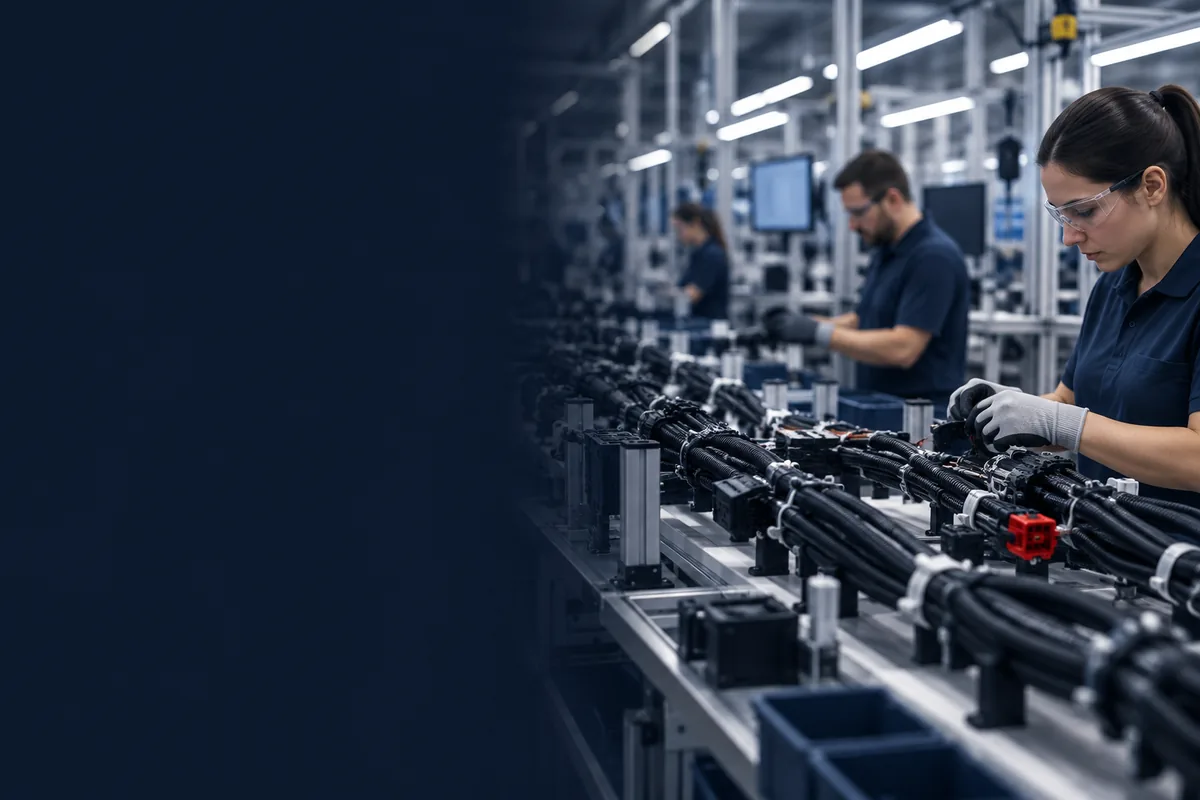
In 2025, a Croatian AI and robotics technology company needed custom cable assemblies for advanced automation systems, but the sourcing challenge was the mixed connector stack: 5 premium connector brands (JST, TE, MOLEX, ANDERSON, SUMITOMO) on one program. The buyer needed a contract manufacturer that could source, verify, and assemble those parts under ISO 9001:2015, IATF 16949:2016, and IPC/WHMA-A-620 controls, then qualify for 1 initial production order without turning every connector change into a line stop.
A robotics cable assembly is a cable or wire harness built for motion-control, sensing, power, vision, or end-effector circuits inside an automation system. A multi-brand connector package is a sourcing bill of material that combines connector families from several manufacturers instead of standardizing on one catalog. For engineers already preparing an RFQ, the core question is how to approve JST, TE, Molex, Anderson, and Sumitomo parts as one controlled assembly without creating hidden substitution risk.
TL;DR
- Lock the exact connector series, keying, contact plating, and crimp tooling before quote release.
- Use IPC-A-620 workmanship criteria with ISO 9001:2015 document control and IATF 16949:2016-style change gates.
- Require brand-level traceability for JST, TE, Molex, Anderson, and Sumitomo parts.
- Approve alternates by fit, crimp data, electrical rating, mating force, and availability.
- Treat connector sourcing as an engineering control item, not only a purchasing task.
Why Robotics Cables Use Multiple Connector Brands
Robotics platforms rarely use one connector family everywhere. A sensor branch may need a compact JST housing, a motor branch may use a TE or Molex sealed connector, a battery or actuator branch may need Anderson power contacts, and a vehicle or equipment interface may specify Sumitomo style terminals. The cable supplier has to combine those decisions into one harness drawing, one test plan, and one controlled production route.
Connector sourcing is the process of selecting, purchasing, verifying, and controlling connector housings, terminals, seals, locks, clips, and accessories for production. In robotics cable assembly, connector sourcing also includes mating compatibility, crimp applicator confirmation, contact plating review, and packaging traceability. If a supplier treats the connector as a line item only, the assembly can pass continuity while still failing mechanical retention, serviceability, or repeat-build control.
The standards baseline should be explicit in the RFQ. IPC-A-620 provides acceptance logic for cable and wire harness workmanship, including crimped terminals, insulation damage, soldered terminations when used, labeling, and final assembly condition. ISO 9001 supports controlled purchasing, documented inspection, nonconforming material handling, and corrective action. For automotive-adjacent robotics suppliers, IATF 16949 adds a stronger habit around change approval, traceability, and launch discipline.
When a robotics cable uses 5 premium connector brands (JST, TE, MOLEX, ANDERSON, SUMITOMO), the risk is not the brand count by itself. The risk is five separate crimp systems, five availability profiles, and five ways a substitution can break fit or pull force.
— Hommer Zhao
Background for the Engineer Buyer
This guide is written for engineering teams, sourcing managers, and supplier quality engineers who already have a robotics cable drawing or prototype set and need to move toward pilot or repeat production. At this buying stage, the problem is not "which connector brand is best." The problem is how to make several approved connector brands behave like one controlled assembly program.
The factory role is to review connector sourcing and production evidence across robotic, industrial, automotive, and medical harness programs. The objective is to help the buyer decide which connector details must be frozen, which alternates can be approved, and which evidence should be requested before production release.
The key result is a supplier package that includes exact connector identities, approved alternates, crimp evidence, test limits, inspection photos, and change-control rules. In the Croatian robotics case, that structure allowed the supplier to qualify as the manufacturing partner and establish the baseline for ongoing robotics manufacturing support after the initial order.
Connector Data to Freeze Before RFQ
Start with the connector identity. For every branch, the drawing or RFQ should state manufacturer, series, housing part number, terminal part number, seal or wedge part number, contact plating, wire size range, cavity count, keying, color when relevant, and mating connector reference. If the buyer does not know the exact mate, the supplier should flag that gap before quoting.
Next, freeze the wire-to-terminal relationship. The same housing may accept several terminals, and the same terminal may cover a wire range that looks acceptable on paper but performs poorly with a specific insulation OD or stranding. The crimp setup should identify conductor crimp height, insulation support, pull-force target, applicator or hand-tool reference, and inspection frequency.
For compact signal connectors, compare the connector choice with the routing and service environment. The JST cable assembly page covers small-pitch signal needs, while Molex cable assembly examples show how housing locks, terminal choice, and wire gauge affect repeat production. For robotics programs with moving axes, align connector choice with the robotics wire harness environment before approving the first article.
| Connector Control Item | What the RFQ Should State | Factory Verification | Release Evidence |
|---|---|---|---|
| Brand and series | JST, TE, Molex, Anderson, Sumitomo family and part number | BOM match against approved supplier list | Purchase record and incoming inspection photo |
| Terminal match | Terminal part number, wire gauge range, plating, seal compatibility | Crimp setup and terminal cross-check | Crimp height, pull-force data, terminal reel label |
| Mating interface | Mating part, keying, latch direction, cavity map | Fit check with customer-supplied or supplier-held mate | Mating photo and pinout continuity report |
| Availability risk | Approved alternates, no-substitute items, MOQ and lead time | Distributor check before quote release | AVL note and buyer-approved deviation path |
| Workmanship standard | IPC/WHMA-A-620 class target and inspection points | First-piece and in-process inspection | Photos, inspection sheet, retained sample |
| Change control | ISO 9001:2015 document control and IATF 16949:2016-style approval gate | Engineering change review before substitution | Revision log and signed approval |
Brand-Specific Risks in One Cable Assembly
JST-style signal connectors are often chosen for compact sensors, low-current interfaces, and tight packaging. The common factory risk is terminal handling: small contacts can be damaged by poor applicator setup, incorrect strip length, or insulation OD mismatch. The first article should include close-up photos of the conductor brush, insulation support, and locked terminal position.
TE and Molex families often cover sealed, industrial, and automotive-style interfaces. The risk shifts toward seal seating, secondary lock engagement, terminal retention, and tooling evidence. If the assembly routes near moving robot joints, the supplier should also check whether the connector exit angle and strain relief let the cable bend without loading the terminal.
Anderson-style power connectors bring current rating, contact wipe, housing color or keying, and cable gauge into the sourcing decision. A power branch should not be judged by continuity alone. Ask for conductor size confirmation, contact insertion condition, pull checks where applicable, and polarity verification. For higher-current programs, compare the current path with Anderson power connector cable assembly design notes and voltage-drop expectations.
Sumitomo-style automotive connectors can be a fit for vehicle-grade interfaces, equipment links, or automation modules that borrow from automotive supply chains. The challenge is keeping original terminals, seals, and locks aligned with the housing. A near-fit terminal or seal may assemble on the bench but create field risk after vibration, washdown, or repeated service.
For the Croatian robotics program, our first sourcing review was a connector map, not a price table. We had to know which branches could accept approved alternates and which ones needed original brand parts before the 1 initial production order moved forward.
— Hommer Zhao
Approved Alternates Without Losing Control
Approved alternates can protect schedule, but they must be engineering alternates, not purchasing guesses. A useful alternate record states the original part, proposed replacement, reason for change, dimensional comparison, electrical rating, material or plating difference, tooling impact, sample result, and buyer approval status.
The supplier should separate three categories. First, no-substitute items where the robot design, mating part, or certification evidence requires the exact connector. Second, pre-approved alternates that have already passed fit, crimp, and electrical checks. Third, emergency alternates that require a sample build and written approval before shipment. That structure prevents a shortage from becoming an undocumented product change.
For cable suppliers, the hardest alternates are not always the expensive connectors. Low-cost accessories such as seals, wedges, clips, backshells, and cavity plugs can stop production if they are missing or incompatible. A complete RFQ should list these parts as controlled items, not leave them as "included by supplier."
Factory Process Control for Mixed Connectors
A mixed-connector robotics cable should move through production with branch-level controls. The routing board, cut list, crimp cards, connector loading sheet, and electrical test program should use the same circuit names and cavity numbers. When these documents disagree, operators rely on memory, and memory is not a production control method.
Incoming inspection should verify connector labels, reel data, visible damage, terminal plating, seal color, and quantity against the BOM. First-piece inspection should confirm cut length, strip length, crimp height, pull force, terminal insertion, cavity loading, label placement, and continuity. During production, the supplier should set a sampling interval for crimp and visual checks instead of waiting until final test.
Testing should match the robot function. Basic branches may need continuity and pinout checks. Power branches may need resistance limits, polarity checks, and insulation resistance. Shielded signal branches may need shield continuity and drain-wire verification. Moving branches may need bend routing review and strain-relief inspection. Our wire harness testing service page shows how these checks can be tied to a shipment record.
A multi-brand connector assembly needs one traceability story. If the JST terminal lot, TE seal, Molex housing, Anderson contact, and Sumitomo lock cannot be tied back to the build record, the buyer owns the investigation after a field failure.
— Hommer Zhao
Supplier Scorecard for Robotics Connector Sourcing
Use a scorecard before sending the purchase order. The supplier should be able to show approved distributor channels, incoming inspection records, crimp tooling capability, first-article reporting, test fixture control, and change approval discipline. A supplier that can assemble one sample but cannot explain the repeat-build evidence is not ready for a robotics production program.
Ask for the supplier's escalation rule when a connector lead time changes after PO release. The answer should name who checks alternates, who reviews engineering fit, who sends the deviation request, and which production documents are updated after approval. If that path is unclear, a connector shortage can quietly change the cable before the buyer sees the shipment.
For new designs, combine the connector package with a broader wire harness connector selection review. For sourcing risk, compare the plan with the connector shortage RFQ guide. If the assembly will be used in robotic cells with moving axes or cable carriers, include routing expectations from the drag chain cable guide.
Buyer Checklist Before Production Release
- Every connector housing, terminal, seal, lock, clip, and accessory has a part number or approved equivalent rule.
- The BOM identifies no-substitute items separately from approved alternates.
- Crimp height, pull-force target, strip length, and inspection frequency are defined for each terminal family.
- IPC/WHMA-A-620 criteria are referenced for termination workmanship and final assembly condition.
- ISO 9001:2015 purchasing and document control records are available for the build.
- IATF 16949:2016-style change gates are applied when connector substitutions affect fit, form, function, or process.
- Final test covers pinout, continuity, polarity, resistance, shield continuity, or insulation resistance as the assembly requires.
- First-article evidence includes photos of connector loading, terminal seating, labels, and mating checks.
Frequently Asked Questions
How do I source robotics cable assemblies with JST, TE, Molex, Anderson, and Sumitomo connectors?
Build a connector-controlled BOM first. List each housing, terminal, seal, lock, and accessory by part number, then require IPC/WHMA-A-620 workmanship evidence, ISO 9001:2015 purchasing records, and brand-level traceability for all 5 premium connector brands.
Can a cable assembly supplier substitute equivalent connectors?
Only if the alternate is approved by engineering. The review should compare mating fit, keying, current rating, contact plating, crimp tooling, pull-force data, and test results. For an IATF 16949:2016-style process, the substitution needs written buyer approval before shipment.
What documents should I request before approving a multi-brand connector cable?
Request the final BOM, connector datasheets or distributor evidence, crimp setup records, pull-force results, first-article photos, continuity or pinout test report, and revision log. For IPC/WHMA-A-620 programs, include workmanship inspection photos for each terminal family.
Why do robotics cables often use multiple connector brands?
Different robot circuits have different constraints. A compact sensor branch may need JST, a sealed motor branch may need TE or Molex, a power branch may need Anderson, and an equipment interface may need Sumitomo. The sourcing plan must control all 5 brand paths as one assembly.
What is the biggest sourcing risk in mixed-connector robotics cable assemblies?
The biggest risk is undocumented change. A small seal, terminal, or housing substitution can pass a continuity test but fail retention, mating, or vibration behavior. Use ISO 9001:2015 document control and buyer-approved deviations for every fit, form, function, or process change.
How should first articles be checked before the production order?
Check every connector branch against the drawing: cavity map, terminal seating, crimp height, pull force, label position, pinout, polarity, and mating fit. For the Croatian robotics case, this release discipline supported 1 initial production order after the 5-brand connector package was verified.
Bottom Line for Robotics Cable Buyers
Multi-brand connector sourcing works when the supplier controls it as an engineering process. The buyer should see exact connector identities, alternate rules, crimp evidence, test records, traceability, and change approval before production starts. That is how a robotics cable assembly can combine JST, TE, Molex, Anderson, and Sumitomo parts without turning every future order into a sourcing reset.
If your robotics cable assembly includes mixed connector brands, send the drawing, connector BOM, mating requirements, annual volume, and launch schedule through our contact page. Our engineering team will review sourcing risk, crimp controls, approved alternates, and test evidence before quoting.