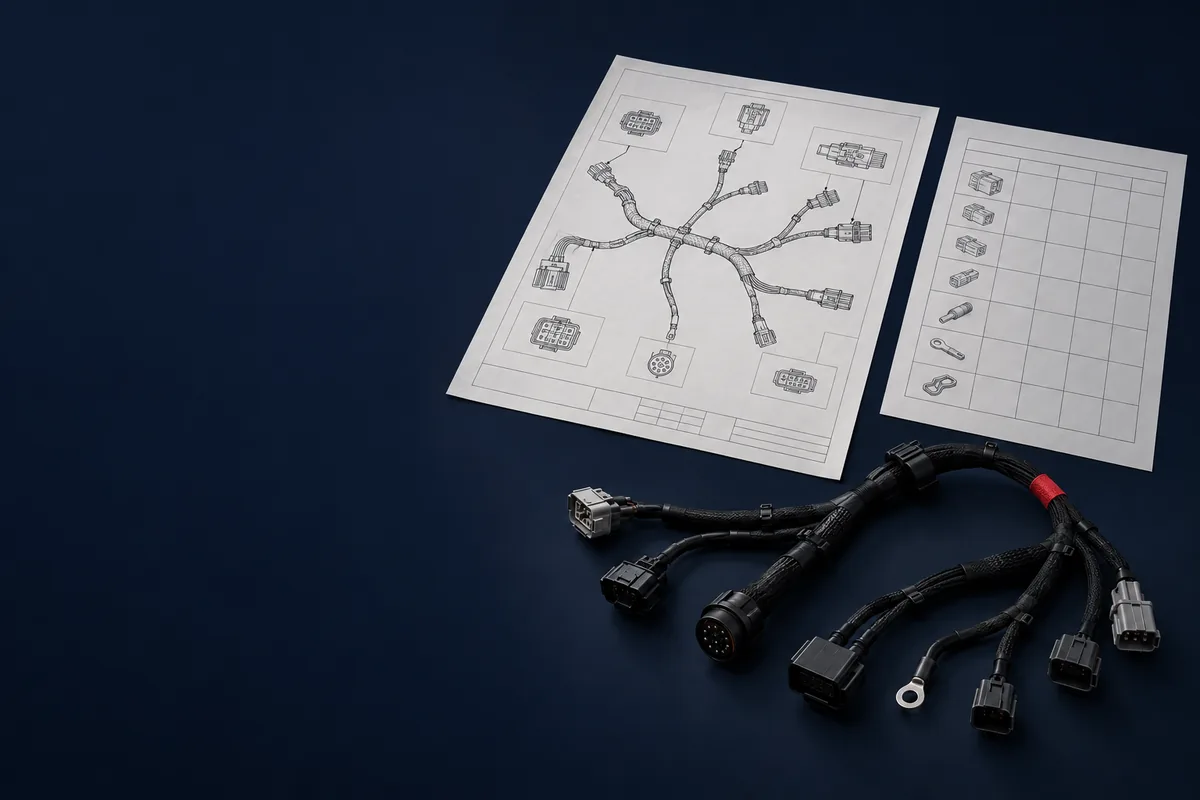
"How much does a custom wire harness cost?" is a common procurement question. The honest answer is: it depends. A simple low-circuit-count harness and a complex industrial harness with hundreds of circuits and customer-specified connectors have very different material, labor, tooling, and test requirements. Wire harnesses are quoted to the released package.
This guide explains the cost inputs to review before requesting a quote. We explain the 7 factors that drive cost, reveal hidden fees that inflate budgets, and share strategies for keeping a program cost-effective. Whether you are building a custom cable assembly for the first time or optimizing an existing program, this guide will sharpen your cost picture.
Three Datasheet Checks That Make Cost Comparisons Defensible
1. Compare wire cost at the required voltage drop. Belden 9918, 18 AWG lists 7.15 Ω/1,000 ft, while Belden 9916, 16 AWG lists 4.44 Ω/1,000 ft nominal conductor resistance. The example below assumes a 10 ft one-way run, an equal-length return and 5 A. Calculations use nominal resistance and exclude connectors; reference values, subject to the exact model datasheet and operating temperature. They are not universal ampacity limits or supplier quotations.
| Wire reference | Loop resistance | Voltage drop | Wire dissipation |
|---|---|---|---|
| 9918 / 18 AWG | 0.1430 Ω | 0.715 V | 3.575 W |
| 9916 / 16 AWG | 0.0888 Ω | 0.444 V | 2.220 W |
The calculation is R = datasheet Ω/1,000 ft × total feet / 1,000, followed by V = IR and P = I²R. A cheaper wire option only saves money if it still meets the circuit's allowed drop and thermal requirements.
2. Price the physical consequences of a gauge change. Those product pages list nominal outside diameters of 2.0 mm for 9918 and 2.3 mm for 9916. These model-specific reference dimensions affect terminal insulation support, seals and bundle routing. Ask the supplier to identify any changed terminal, seal or assembly operation alongside the wire-price difference.
3. Quote the required wire style and temperature together. Belden 3055 identifies UL AWM Style 1007 at 80°C and Style 1569 at 105°C, with a 300 V product rating. Reference values: confirm the exact ordered wire's markings and datasheet. Requiring the style, temperature and voltage in each quote line prevents a lower-rated substitute from appearing equivalent solely because the AWG and color match.
How a Harness Price Is Built Up
A harness unit price is the sum of materials, labor, test and packing, plus the supplier’s overhead and margin, plus one-time engineering and tooling spread over the order quantity. Written as a formula: unit price = (materials + labor + test + packing) × (1 + overhead and margin) + (NRE and tooling ÷ quantity). Landed cost adds freight, duties and handling on top. The next sections work through each term with assumed numbers, so you can reproduce the arithmetic with your own quotes.
| Volume tier | What tends to dominate | What to ask the supplier |
|---|---|---|
| Prototype (1–50) | One-time setup, engineering and tooling spread over few units | What is NRE and what is unit price; is tooling reusable for production |
| Low (50–500) | Setup and NRE still significant; material price breaks not yet reached | Quantity tiers on the same drawing; minimum order quantities for connectors |
| Mid (500–5,000) | Labor content and material price breaks | Which operations could be automated; connector price-break quantities |
| High (5,000+) | Material cost, yield and logistics | Forecast, scheduled releases, safety stock and landed cost |
Compare quotes only when they use the same connector brands, wire specifications, compliance requirements, test plan, quantities and delivery terms. Manufacturing location alone does not establish the landed cost.
7 Factors That Determine Wire Harness Cost
Understanding what drives cost gives you leverage in negotiations and design decisions. These seven factors help explain variation in wire harness pricing.
1. Materials
Materials can be a large share of the price, and in a manual build labor can be as large (see the worked example below). Copper wire, insulation type, gauge, rating, connector family, sealing requirement, and purchase volume all affect the supplier quote. Commodity terminals and sealed branded connectors can differ substantially in price and lead time.
Trade measures and copper prices can affect material quotations. High-temperature insulation may also add cost compared with standard PVC; compare approved constructions without over-specifying the application.
2. Design Complexity
Circuit count is the primary complexity driver. A simple harness generally needs fewer assembly operations than one with multiple branches, connector types, and shielded pairs. Every branch point, splice, and connector adds assembly time. Complex routing with tight bend radii requires custom fixtures. Shielded cables for EMI protection add both material and labor cost. Design with manufacturability in mind from the start—see our custom cable assembly page for guidance.
3. Labor & Assembly
Wire harness assembly often includes manual connector loading, routing, and inspection. Labor costs vary by region, process, and production volume. Automated cutting, stripping, and crimping may reduce labor content for suitable designs; compare the quoted process and landed cost.
4. Order Volume
Volume can affect material pricing, tooling and NRE amortization, setup time, and production planning. Ask suppliers to quote clear quantity tiers against the same drawing and BOM. If annual demand supports it, blanket purchase orders with scheduled releases may provide more predictable pricing and delivery planning.
5. Certifications & Compliance
Compliance requirements can add material, testing, traceability, and documentation costs. Confirm the applicable product approvals, quality-system requirements, and customer-specific acceptance rules; ISO 9001, ISO 13485, and IATF 16949 do not create a universal price premium or identical requirements for every harness.
6. Connector Specifications
Connector choice can swing costs dramatically. Standard Molex or JST families, sealed automotive connectors from Amphenol or TE Connectivity, and customer-specified circular connectors carry different distributor pricing, MOQs, and lead times. Wherever possible, standardize on fewer approved connector families to consolidate purchasing and reduce assembly complexity.
7. Lead Time Requirements
Expedited orders may incur surcharges for material procurement, overtime, or schedule changes. Confirm the available production slot and component lead times before agreeing to a rush date. Rolling forecasts and scheduled releases can reduce last-minute changes.
Cost Breakdown: A Worked Example With Assumed Numbers
The numbers below are assumptions chosen to show the arithmetic. They are not quotes, market prices or typical figures. Assume a 12-circuit harness built by hand, with two housings and 24 crimped terminals.
| Cost line | Assumption | Amount |
|---|---|---|
| Wire | 12 circuits × 0.8 m × $0.12 per m | $1.15 |
| Terminals | 24 × $0.03 | $0.72 |
| Housings | 2 × $0.40 | $0.80 |
| Sleeving, tape and labels | Allowance | $0.30 |
| Materials subtotal | $2.97 | |
| Assembly labor | 14 minutes at an assumed $18 per hour burdened rate | $4.20 |
| Electrical test | 1.5 minutes at the same rate | $0.45 |
| Packing | Allowance | $0.15 |
| Direct cost | Materials + labor + test + packing | $7.77 |
| Overhead and margin | Assumed 25% of direct cost | $1.94 |
| Unit price before NRE | $9.72 |
In this assumed manual build, labor ($4.20) is larger than materials ($2.97), which is why the common statement that materials are the largest cost does not hold for every harness. Which one dominates depends on the BOM and on how much of the work is manual.
The volume effect: spreading NRE and tooling
Now add an assumed one-time charge of $800 for the assembly board, test fixture and setup. The per-unit effect is $800 ÷ quantity:
| Order quantity | NRE per unit | Unit price including NRE |
|---|---|---|
| 100 | $8.00 | $17.72 |
| 1,000 | $0.80 | $10.52 |
| 10,000 | $0.08 | $9.80 |
At 100 units the one-time charge is almost half the price; at 10,000 it is under 1%. This is why a prototype quote and a production quote for the same harness look so different, and why you should ask for NRE and unit price as separate lines. Real volume pricing also changes the material lines through supplier price breaks.
Wire Harness Cost by Industry
Different industries have vastly different cost profiles due to certification requirements, material specifications, and quality expectations. Here is what to expect in each sector. For more on industry-specific requirements, visit our industries page .
Automotive & EV
Pricing: Per released BOM and volumeAutomotive customers may require IATF 16949 and PPAP evidence within the agreed supplier scope. Volume, high-voltage safety requirements, shielding, and specialized connectors all affect the quotation.
Medical Devices
Pricing: Per compliance and test scopeMedical customers may require ISO 13485-aligned supplier controls, traceability, and validated processes. Cleanroom assembly depends on the application. Documentation, inspection, and production volume affect pricing.
Industrial & Robotics
Pricing: Per environment and motion requirementsWide range depending on application severity. Robotics harnesses require high flex-life cables and strain relief. Industrial automation harnesses need oil and chemical resistance. Quote against the actual volume and validation plan.
Consumer Electronics
Pricing: Per design and volumeHigh production volumes can support lower unit costs. Simple designs with standard connectors. Cost optimization is paramount—buyers negotiate aggressively on fractions of a cent. Fully automated production is common for the simplest designs. Confirm product approvals for the intended market.
7 Strategies to Reduce Wire Harness Cost
These strategies can help buyers evaluate avoidable cost. Their relative impact depends on the design, sourcing constraints, and production volume.
Design for Manufacturability (DFM)
Simplify wire routing, reduce branch points, use standard bend radii, and design for assembly board compatibility. A DFM review before production release can identify avoidable assembly and tooling costs.
Standardize Connectors
Reduce the number of unique connector types across your product line. Fewer connector families means better bulk pricing, lower inventory costs, simplified assembly training, and fewer crimp tools required on the production floor.
Consolidate Suppliers
Awarding multiple harness programs to one manufacturer increases your total volume with that supplier, giving you leverage for better pricing, scheduling, and dedicated engineering support. Split sourcing often costs more in total.
Optimize Wire Lengths
Over-specified wire lengths waste material and add assembly time. Work with your manufacturer to optimize routing and eliminate unnecessary service loops. As an assumed example, trimming 6 inches (0.1524 m) from each of 30 wires removes 30 × 0.1524 = 4.57 m of wire per harness; at an assumed $0.12 per metre that is about $0.55 per harness, plus the handling time of the longer wires, before any volume multiplier.
Choose the Right Manufacturing Region
Total landed cost—not unit price—should drive your sourcing decision. Compare material availability, freight, origin rules, lead time, and intellectual-property requirements for each region. See our detailed sourcing comparison.
Increase Volume Commitments
Blanket purchase orders with scheduled releases give you volume pricing without taking delivery of all units at once. Annual volume commitments allow manufacturers to plan capacity and purchase materials in bulk, passing the savings through to you.
Engage Engineering Early
Involving your manufacturer during the design phase—not after it is locked—allows them to suggest connector alternatives, optimize wire routing for automated processes, and identify cost traps before they are built into the design. Evaluate proposed changes before the design is released.
How to Get an Accurate Quote
The quality of a quote depends on the quality of the package. Vague requests get padded quotes because the supplier has to price the unknowns. Send:
- Drawing and wiring diagram at a stated revision, with lengths and tolerances.
- BOM with manufacturer part numbers for wire, connectors, terminals and seals, and approved alternates.
- Quantity tiers: prototype, first order and annual volume, so the quote shows the volume effect.
- Test and acceptance requirements: continuity and any high-voltage or pull tests, and the workmanship standard, such as IPC/WHMA-A-620 class.
- Compliance and documents: markings, material declarations, first article and traceability requirements.
- Packing, labeling and delivery terms, including the destination.
An incomplete request needs clarification before pricing, and each question round adds days to the quote. For the full list and the RFQ process, see our Wire Harness RFQ Checklist, and for what incomplete packages do to the schedule, the lead time guide.
Comparing Regions: Use Landed Cost, Not Unit Price
Where a harness is built changes labor rates, material access, freight, lead time and the duties that apply at import. Compare regions with one formula: landed cost = unit price + freight + duty + brokerage and handling, where duty is the applicable rate times the customs value. The rate depends on the classification, origin, destination and the measures in force on the entry date, so confirm it with your customs broker.
As an assumed illustration using the 1,000-unit price from above ($10.52), assume freight of $0.35 per unit, brokerage and handling of $0.10, and a duty rate of 10% on a customs value of $10.52. Duty is $1.05, so the landed cost is $10.52 + $0.35 + $1.05 + $0.10 = $12.02. The 10% is a placeholder, not any country’s actual rate. Run the same formula for each region you are considering, using each quotation and your broker’s rate.
For the sourcing considerations by region, read our China vs Mexico vs USA sourcing comparison.
External resource: BCG: Copper Tariffs and Manufacturing Costs, an analysis of the copper tariff impact on manufacturing supply chains.
Frequently Asked Questions
How much does a simple wire harness cost?
Simple harness pricing depends on the wire and connector BOM, setup, test requirements, and order quantity. Ask for separate prototype and repeat-production quotations against the same specification so any volume savings are visible.
What is the minimum order quantity (MOQ) for custom wire harnesses?
Minimum order quantities vary with materials, tooling, setup, and supplier capacity. Confirm prototype and production minimums in the quotation, including any component purchase commitments.
How long does it take to get a custom wire harness made?
The schedule depends on material availability, design release, tooling, prototype approval, and testing. Request a dated plan identifying these dependencies and any surcharge for expediting.
Do I need to pay for tooling or NRE?
Tooling and NRE charges depend on fixture complexity, design review, process engineering, and test development. Some suppliers amortize these charges into unit pricing. Ask for a separate breakdown and confirm tooling ownership.
How do copper tariffs in 2026 affect wire harness pricing?
Tariff effects depend on classification, origin, import date, and applicable exclusions or trade agreements. Confirm the current landed cost with your broker and supplier rather than applying a headline copper tariff or generic percentage to every harness.
Can I reduce cost by supplying my own components?
Yes, but it is a trade-off. Customer-furnished materials (CFM) can reduce costs if you have better purchasing leverage on specific components. However, it transfers inventory risk and quality responsibility to you. If you supply a defective connector, rework responsibility depends on the agreed contract. Confirm any handling fee for customer-furnished materials. The approach may be useful when you have a global supply agreement with a connector manufacturer that gives you better pricing than the harness maker can get.