Cable Assembly

Drag Chain Cable Assembly for Moving Automation

Drag chain cable assembly manufacturing for OEM equipment where the cable moves every cycle: gantries, CNC equipment, robot cells, machine vision axes, conveyors, packaging systems, and warehouse automation. We review bend radius, carrier fill, cable jacket, conductor stranding, shielding, connector exits, clamp points, labels, and 100% electrical test requirements before quoting so a working bench cable does not become a field failure inside the carrier.

Drag chain cable assembly with continuous-flex industrial automation wiring
Connector mix handled5 brands
Quoted lead-time case4-week
NDA vetting case3-month
Electrical test plan100%

Application Context

Drag chain cable assembly at a glance

A drag chain cable assembly is a connectorized cable set built for repeated movement inside a cable carrier, where bend radius, carrier travel, jacket friction, conductor stranding, and connector exits decide service life. We review the motion profile before quoting because a cable that passes 100% continuity on the bench can still fail near a clamp, backshell, or branch exit after the machine starts cycling.

This page is narrower than our industrial robot harness and robotics wire harness pages. It focuses on cable-carrier assemblies for gantry, CNC, machine vision, conveyor, and automation systems. For general moving-axis harness programs, start with industrial robot harness. For a defined carrier path that needs cable construction, shield, connector-exit, and test-scope review, this drag-chain service is the more precise RFQ route.

A flexible cable is a cable category for moving applications, but supplier language varies. We treat flexible, high-flex, continuous-flex, robotic, and trailing-chain claims as starting points, then ask for the actual test conditions and installation geometry. Public supplier categories such as LAPP trailing-chain cable show why bend radius and cable construction matter, but final acceptance should be tied to your drawing and purchase contract.

TL;DR

  • Send the drawing, BOM, connector part numbers, carrier travel, bend radius, speed, acceleration, torsion, quantity, and test expectations.
  • Best fit: gantry axes, CNC equipment, robot cells, machine vision stages, conveyors, and warehouse automation cable carriers.
  • RFQ review covers continuous-flex cable choice, shield strategy, strain relief, branch exits, labels, carrier fill, and 100% electrical testing.
  • Out of scope: machine design, carrier sizing, field installation, drive programming, and unsupported flex-life guarantees without a defined motion profile.

Capabilities

Drag Chain Cable Assembly Capabilities

A drag chain cable assembly is a connectorized, tested cable set built for repeated linear motion inside a cable carrier, not a static harness routed through a cabinet.

Motion-profile review

A drag chain cable assembly is a moving interconnect that must survive a defined bend radius, travel length, speed, acceleration, carrier fill, and duty cycle. We ask for those values before sample build because cable life depends on the real machine motion, not only the wire gauge and connector family.

  • Bend radius, travel length, speed, and acceleration checked
  • Carrier fill, divider, and clamp-point questions captured
  • Torsion separated from straight carrier travel

Continuous-flex cable sourcing

Continuous-flex cable uses fine-strand conductors, flexible insulation, low-friction jacket compounds, and lay construction selected for repeated movement. We review PVC, PUR, TPE, shielded, unshielded, hybrid power, signal, and data options against the drawing and sourcing risk.

  • Fine-strand conductor and jacket review
  • PVC, PUR, TPE, and buyer-specified cable paths
  • Lead-time and approved-alternate notes in the RFQ

Connector exit and strain relief

Most moving-cable failures start near fixed clamps, connector backshells, molded exits, branch transitions, or hard tie points. We review boot, overmold, heat shrink, sleeve, gland, clamp, and service-loop choices so stress does not concentrate at the first rigid point outside the carrier.

  • Connector exit and backshell orientation review
  • Overmold, boot, sleeve, and heat-shrink options
  • Branch support and service-loop notes

Shielding and signal integrity

Encoder, servo feedback, camera, Ethernet, CAN, and sensor lines can fail functionally before a conductor opens if shield continuity or grounding is wrong. We define foil, braid, drain wire, 360-degree termination, and shield-continuity checks where the drawing requires noise control.

  • Shield-continuity check when specified
  • Foil, braid, drain wire, and shell-grounding review
  • Signal and power separation questions

Connector sourcing for moving systems

Robotics and automation programs often combine JST, TE, MOLEX, ANDERSON, SUMITOMO, M8, M12, Samtec, Deutsch, or buyer-specified interfaces in one build. We flag MOQ, lead time, tooling, mating fit, and approved alternates before the quote is treated as production-ready.

  • Multi-brand connector sourcing
  • MOQ and lead-time visibility
  • Mating connector and no-substitution rules captured

Documented release testing

Every drag chain cable assembly should ship with the electrical evidence needed for supplier-quality review. We can define continuity, pinout, polarity, shorts, hipot or insulation-resistance checks, shield continuity, label inspection, pull-force sampling, dimensional checks, CoC, and customer report fields.

  • 100% continuity, pinout, polarity, and shorts plan
  • Shield and insulation checks when required
  • CoC, FAI, and test-report options

Real Project Snapshot

Robotics cable assemblies with multi-brand connector sourcing

robotics · Europe

Scenario: A European AI and robotics technology company required custom cable assemblies integrating multiple premium connector brands for their advanced automation systems.

Challenge: The client needed a contract manufacturer capable of sourcing and assembling custom cables using a diverse mix of connector brands (JST, TE, MOLEX, ANDERSON, SUMITOMO) while ensuring compliance with rigorous quality standards for high-reliability robotic applications.

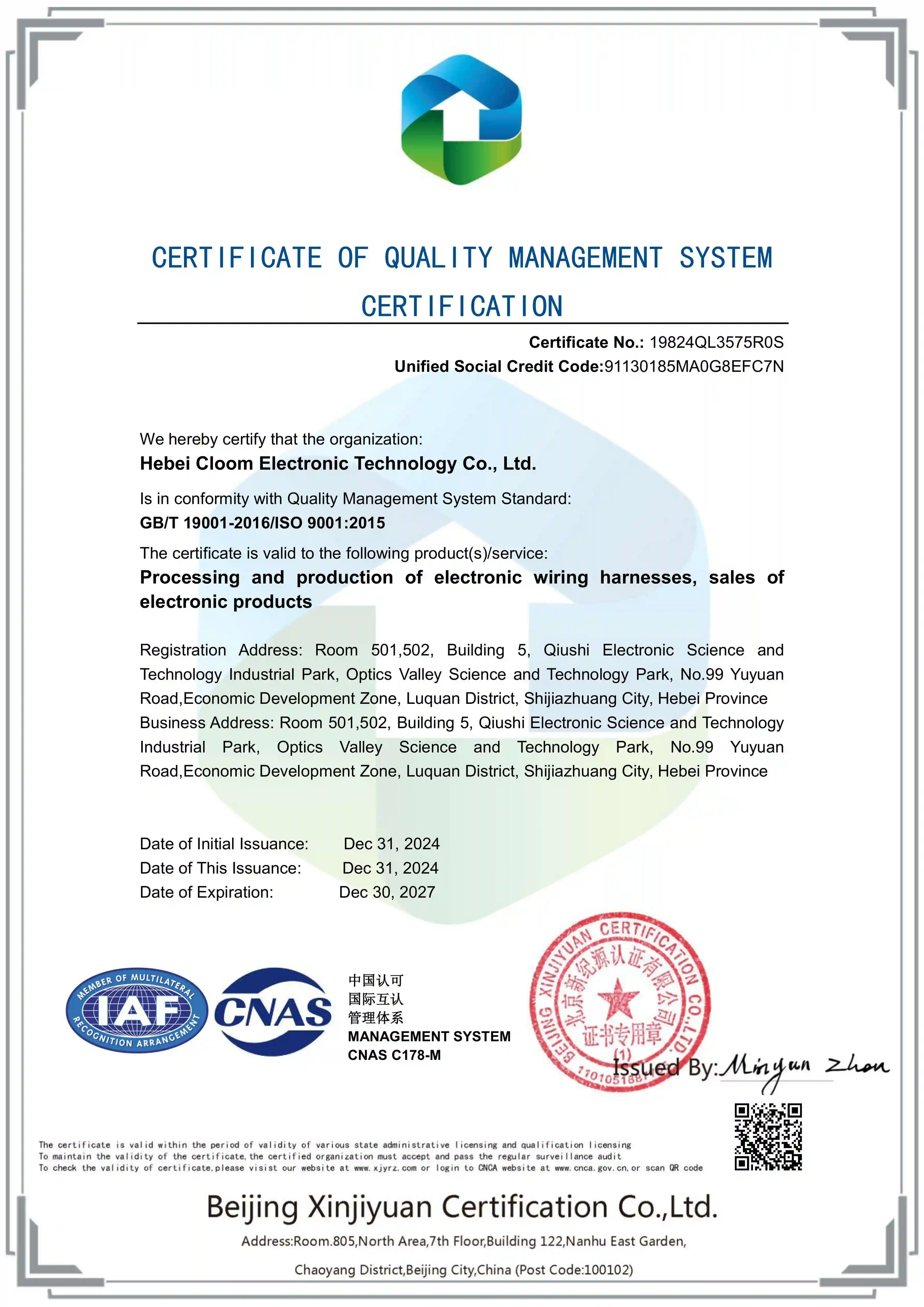
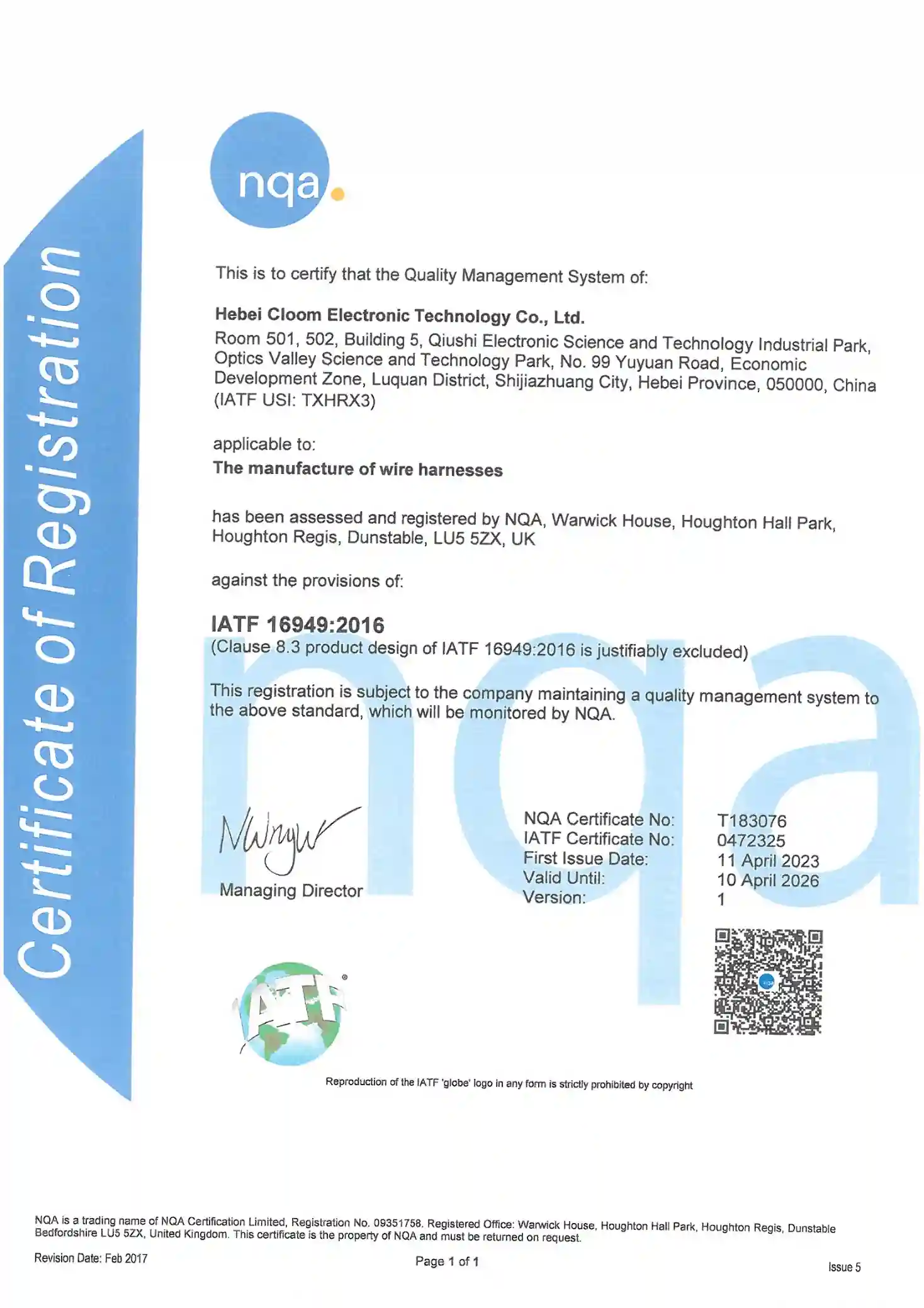
Solution: Consolidated multi-brand connector sourcing and custom assembly under ISO 9001:recently and IATF 16949:recently certified manufacturing processes, strictly adhering to IPC/WHMA-A-620 production standards to meet the client's high-reliability requirements.

Result: Successfully qualified as the manufacturing partner, securing an initial production order and establishing a baseline for ongoing high-tech robotics manufacturing support.

  • ISO 9001:recently
  • IATF 16949:recently
  • IPC/WHMA-A-620
  • 5 premium connector brands (JST, TE, MOLEX, ANDERSON, SUMITOMO)
  • 1 initial production order

Engineering Challenges

Review carrier-motion risk before production

01

Bench pass, carrier failure

Continuity, polarity, and pinout checks prove the electrical build, but they do not prove the cable will survive repeated travel. We separate electrical acceptance from mechanical-life assumptions so supplier-quality teams see both risks.

02

Hard transition points

Clamp edges, connector exits, tie points, branch breakouts, and backshells can concentrate bend stress. We review strain relief and service-loop geometry before approving samples for carrier installation.

03

Shield fatigue and intermittent faults

Encoder, servo, camera, Ethernet, and CAN cables can become intermittent when shield continuity or grounding changes under motion. We define shield checks when the application is noise-sensitive.

04

Unapproved cable substitutions

A substitute cable may match voltage and conductor count but change OD, jacket friction, shield geometry, or flex life. We capture approved alternates and no-substitution rules before production release.

Technical Capabilities

Drag chain cable capability table

Build-to-print drag-chain cable assemblies with documented cable, connector, motion, shield, strain-relief, sourcing, label, and test review for prototype, pilot, and recurring production releases.

Primary productConnectorized drag chain cable assembly for continuous-flex carrier motion, gantry axes, CNC equipment, robot cells, and automation machines
RFQ motion inputsBend radius, travel length, speed, acceleration, duty cycle, carrier size, fill ratio, clamp locations, and whether torsion is present
Connector optionsM8, M12, JST, TE, MOLEX, ANDERSON, SUMITOMO, Samtec, Deutsch, circular, terminal block, pigtail, and buyer-specified interfaces
Cable constructionFine-strand power, signal, encoder, servo, CAN, Ethernet, shielded, hybrid, PUR/TPE/PVC-style, or buyer-specified continuous-flex cable
Mechanical controlsConnector exit, service loop, branch support, clamp position, jacket abrasion, carrier divider, minimum bend radius, and strain-relief review
Quality referencesIPC-A-620 workmanship review, UL-758 wire review when applicable, ISO 9001 documentation, and IATF 16949-style change control when required
Inspection scopeContinuity, pinout, polarity, shorts, shield continuity, hipot or insulation resistance when specified, label position, pull-force sampling, CoC, and reports
Case-bank anchor5 premium connector brands (JST, TE, MOLEX, ANDERSON, SUMITOMO), 1 initial production order
Lead-time signal4-week lead time in an NDA-qualified industrial measurement assembly case; actual timing depends on connector stock, drawings, and test scope
Out of scopeMachine design, cable carrier sizing, drive programming, field installation, and flex-life guarantees without an agreed motion profile and validation method
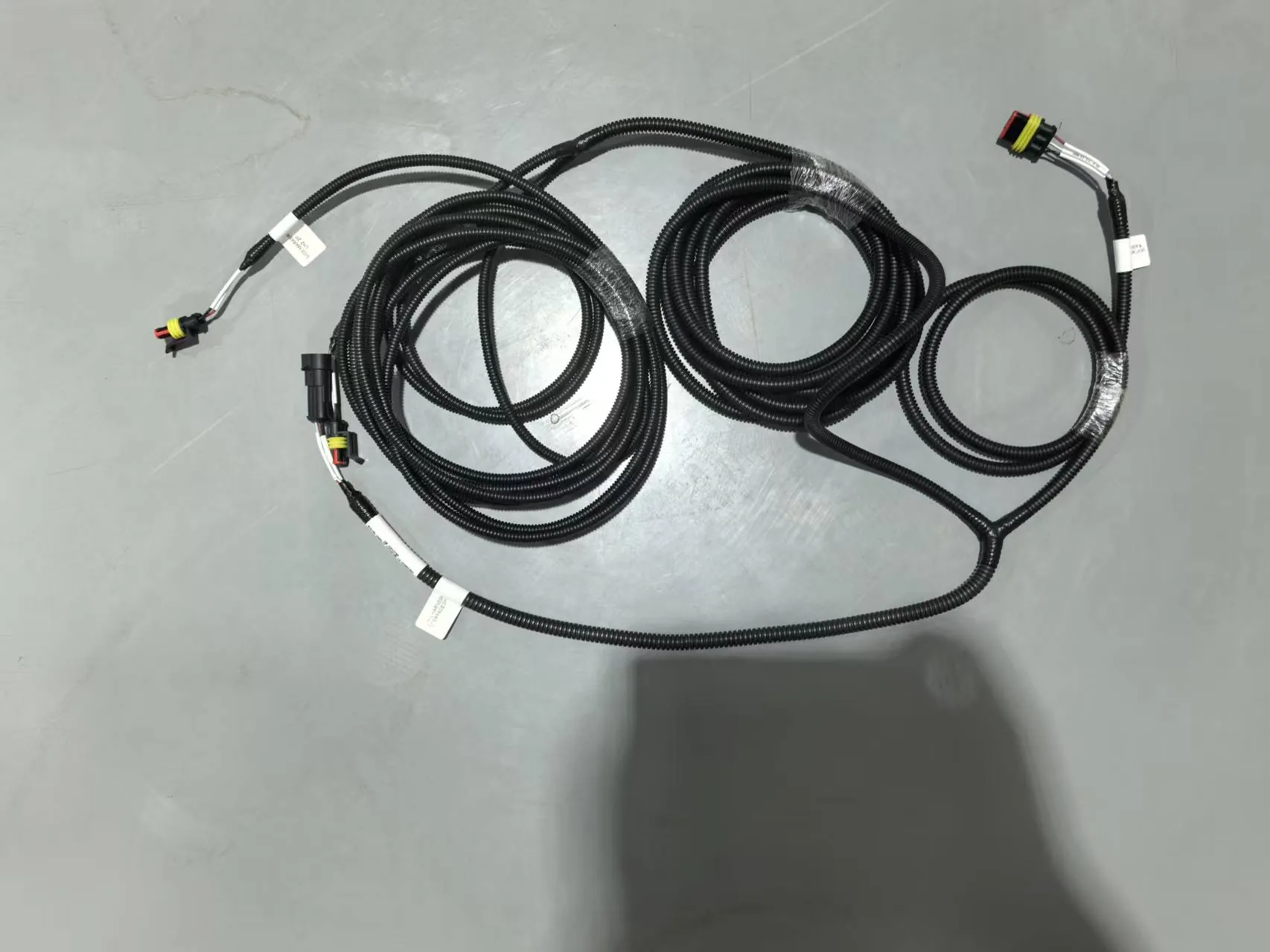
Drag chain cable assembly electrical testing and inspection records

Manufacturing Process

A controlled build, motion profile to shipment

01Drawing / Motion Review
02Cable & Connector Sourcing
03Cutting, Stripping & Marking
04Crimping / Shield Termination
05Exit & Strain-Relief Build
06100% Electrical Test
07Final Inspection
08Packaging & Export

Quality & Testing

Documentation for OEM review

Every drag chain cable lot can include 100% continuity, pinout, polarity and shorts testing, with shield-continuity, insulation-resistance, hipot, label, pull-force, dimensional, CoC, and FAI records where the drawing requires lot-level traceability.

100% ContinuityPinout VerificationPolarity CheckShorts TestShield ContinuityInsulation ResistancePull-Force SamplingLabel InspectionCoC / Test Report

Why WHP

How We Reduce Moving-Cable RFQ Risk

The strongest quote separates electrical continuity from mechanical life, because a drag chain cable can pass on the bench and still fail in the carrier.

Motion details are quoted early

We ask for bend radius, travel length, speed, acceleration, carrier size, clamp points, and torsion before locking the RFQ. Missing motion data is marked as an open issue, not hidden inside a generic cable price.

Connector sourcing is treated as part of reliability

A continuous-flex cable still fails if the connector exit, backshell, boot, or mating interface creates a hard stress point. We review connector lead time and mechanical exit design together.

Shield decisions are tied to the application

A VFD, encoder, camera, Ethernet, or CAN run may need different shield treatment than a low-speed sensor lead. We define the shield path, grounding expectation, and test evidence before production release.

Limitations are made explicit

If the final motion profile is unknown, we can build samples and recommend validation, but we will not turn a loose cable data-sheet claim into a guaranteed machine-life promise.

Standards and release context

Factory release checks map to cable workmanship, wire-material, documentation, and change-control references buyers use during supplier approval.

IPC-A-620Cable Workmanship
UL-758Wire Review
ISO 9001Documentation
IATF 16949Change Control
ISO 9001 Certificate
IATF 16949 build-to standard

FAQ

Drag chain cable RFQ questions buyers ask

What is a drag chain cable assembly?
A drag chain cable assembly is a connectorized cable set built for repeated movement inside a cable carrier under a defined bend radius and travel profile. The assembly usually combines continuous-flex cable, connectors, labels, strain relief, shield termination, and 100% electrical testing. For an RFQ, the important inputs are not only wire gauge and length; the buyer should also send carrier travel, speed, acceleration, clamp locations, duty cycle, environment, and whether torsion is present. Without those details, the quote can cover electrical build quality but cannot honestly prove service life inside the machine.
I need 50 drag chain cable assemblies for a prototype gantry, but the final carrier is not frozen. Can you quote it?
Yes, we can quote 50 prototype drag chain cable assemblies, but the quote will separate confirmed build scope from motion-risk assumptions. We can review the drawing, connectors, cable construction, preliminary bend radius, carrier envelope, and test requirements, then mark open issues before sample build. If the final carrier changes later, bend radius, clamp points, cable OD, shield design, and connector exits may need another review. That staged approach is better than pretending a prototype cable has a validated production flex-life guarantee before the gantry geometry is locked.
How do I choose between PUR, TPE, and PVC for continuous-flex cable?
Choose PUR, TPE, or PVC by matching the jacket to motion, abrasion, oil exposure, temperature, and budget, not by material name alone. PUR is often preferred for abrasion and oily machine environments, TPE can balance flexibility and cost, and PVC may fit lighter-duty movement where replacement access is easy. We ask for bend radius, duty cycle, coolant or oil exposure, and target lead time before recommending a construction. The same 24V sensor lead may need different jacket choices in a clean gantry, a CNC cabinet, and a washdown automation cell.
My automation cable carries encoder feedback and motor power. Should the shield be tested during production?
Yes, shield continuity should be defined when encoder feedback, servo signals, Ethernet, CAN, or other noise-sensitive lines run near motor power or switching electronics. A cable can pass basic continuity and still create intermittent faults if the shield path, drain wire, braid termination, or connector shell grounding is wrong. We can add shield-continuity checks, pinout verification, shorts testing, label inspection, and customer-defined report fields to the release plan. Where EMI risk is high, the buyer should freeze the grounding method and connector backshell before pilot approval.
What files and numbers should I send for a drag chain cable assembly quote?
Send the drawing, BOM, cable part number or target construction, connector part numbers, mating connector details, quantity, annual forecast, target lead time, and test requirements. Also send the motion numbers: bend radius, travel length, speed, acceleration, carrier size, fill ratio, clamp locations, and whether the cable twists. Environment matters too, so include oil, coolant, abrasion, washdown, UV, cold flex, or temperature limits. If the quote must follow IPC-A-620 workmanship, UL-758 wire review, ISO 9001 documentation, or IATF 16949-style change control, state that at RFQ stage.
How is a drag chain cable assembly different from a robotics wire harness?
A drag chain cable assembly is narrower than a robotics wire harness because it focuses on repeated linear carrier motion and the mechanical life of the moving cable path. A robotics wire harness may include static cabinet wiring, arm routing, EOAT tooling, sensor leads, power distribution, and torsional robot-axis cables. If the cable mainly travels back and forth inside a carrier, the drag-chain page is the right scope. If the program includes several robot subsystems, moving and static branches, and broader routing decisions, our industrial robot harness service is usually the better starting point.
Do you have real project experience with robotics or industrial automation cable assemblies?
Yes, our case bank includes a European AI and robotics technology company that required custom cable assemblies using JST, TE, MOLEX, ANDERSON, and SUMITOMO connector brands. The concrete_numbers record lists: ISO 9001:recently, IATF 16949:recently, IPC/WHMA-A-620, 5 premium connector brands (JST, TE, MOLEX, ANDERSON, SUMITOMO), 1 initial production order. Another industrial measurement OEM required NDA qualification before drawings could be shared; that case involved a 3-month vetting phase and a 4-week lead time after the formal inquiry was released.

OEM Program Entry

Request a Drag Chain Cable Assembly Quote

Send drawings, connector callouts, motion profile, carrier details, environment, quantity, and test requirements. We will review cable construction, connector exits, shielding, strain relief, sourcing risk, and release-test scope before quoting.

We will review

  • 01Design Feasibility
  • 02Component Availability
  • 03Cost Drivers
  • 04Validation Requirements

Related Capabilities

Related cable solutions

Custom cable assembly services that pair with drag-chain and continuous-flex cable programs.

Applications

Where Drag Chain Cable Assemblies Fit

Built for OEM teams buying connectorized moving-cable assemblies, not loose bulk cable alone.

Gantry and linear axes

Cable carrier assemblies for X/Y/Z axes, motion stages, scanning systems, camera rails, and factory automation where the cable bends repeatedly in one plane.

CNC and machine tools

Power, signal, encoder, sensor, and coolant-adjacent cable assemblies for machine tools where oil, abrasion, vibration, and service replacement affect cable life.

Industrial robot cells

Moving-axis cable assemblies for robot support equipment, EOAT tooling, servo feedback, sensors, and cabinet-to-arm transitions where bend and torsion must not be confused.

Machine vision systems

Camera, lighting, trigger, and measurement-system cables routed through moving stages where shielding, connector retention, and NDA-controlled drawings matter.

Warehouse automation

Moving cable assemblies for shuttles, conveyors, sorters, AMR charging stations, and equipment modules where replacement downtime can affect fulfillment operations.

Prototype-to-production builds

Sample, pilot, and recurring production cable assemblies where purchasing needs material availability, sample timing, test scope, and alternate-control notes before PO.

Before You Quote

Send this with your RFQ

5 premium connector brands (JST, TE, MOLEX, ANDERSON, SUMITOMO) · 3-month vetting phase · 4-week lead time

Send this with your RFQ

  • Drawing, BOM, cable construction target, connector part numbers, mating connector details, and no-substitution rules.
  • Bend radius, travel length, speed, acceleration, duty cycle, carrier size, clamp points, and whether torsion is present.
  • Environment: oil, coolant, abrasion, weld area, washdown, UV, cold flex, temperature, and chemical exposure.
  • Testing expectation: continuity, pinout, polarity, shorts, shield continuity, hipot, insulation resistance, pull-force, CoC, or motion validation.

What you get back

  • Costed RFQ with cable construction assumptions, connector availability, MOQ, sample timing, production timing, and sourcing-risk notes.
  • DFM feedback on bend radius, connector exits, branch support, carrier routing, shield termination, labels, and test fields.
  • Open questions for missing motion, environment, connector, material, test, or packaging inputs.
  • Recommended IPC-A-620, UL-758, ISO 9001, and IATF 16949-style release evidence when required.

References

References for continuous-flex cable decisions

Public references help define cable-carrier vocabulary, while acceptance criteria still come from the buyer drawing, purchase contract, and agreed test plan.

Reviewed by

Hommer Zhao

Technical Director, Wire Harness Production

  • Wire harness and cable assembly manufacturing review for OEM buyers
  • Factory-side RFQ review across China and Philippines production options
  • Focus areas: connector sourcing, crimp control, motion routing, testing, and release documentation