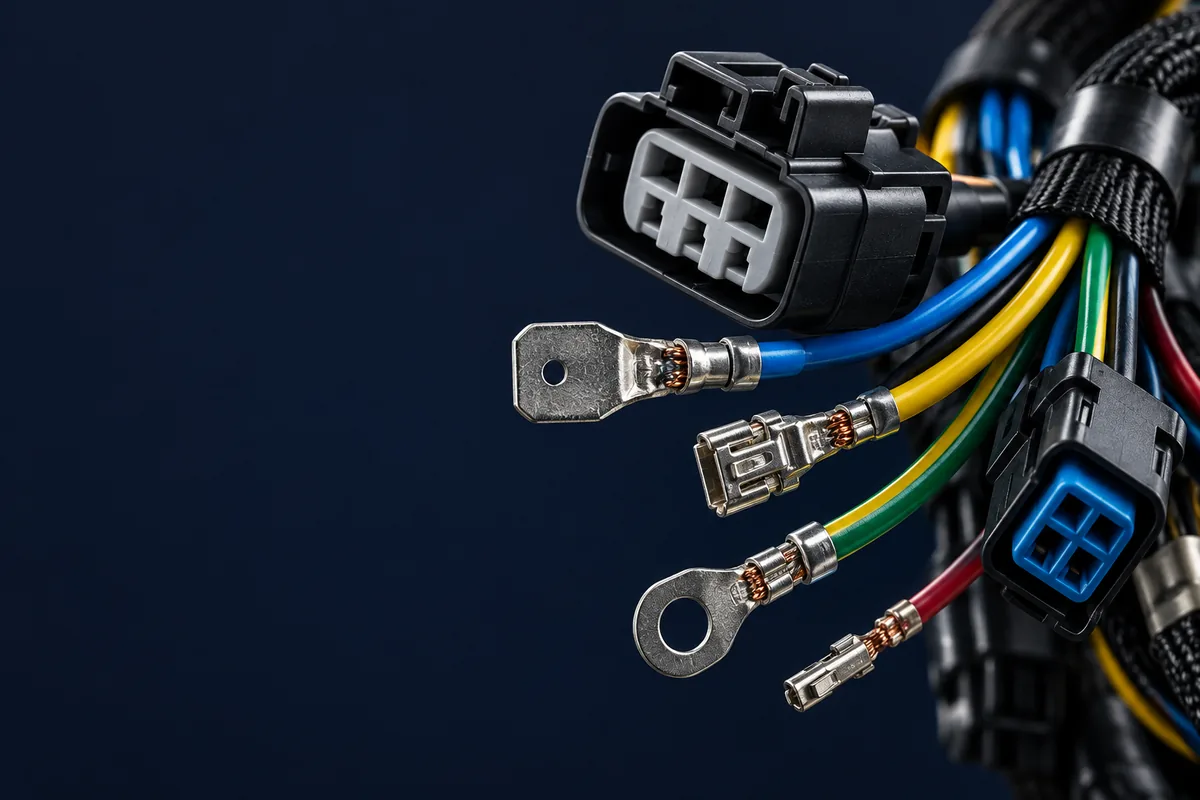
A comprehensive guide to wire harness materials—from conductors and insulation to connectors, terminals, and protective jacketing. Learn how to select the right materials for your application's requirements.
Introduction: Why Material Selection Matters
The materials used in a wire harness directly determine its performance, reliability, and lifespan. A harness that functions perfectly in a climate-controlled office may be unsuitable under the hood of a vehicle or in an industrial plant. Understanding material properties and matching them to your application's demands is fundamental to successful wire harness design.
This guide covers the 10 essential material categories in wire harness construction: from the copper conductors carrying current to the protective sleeving keeping everything together. For each category, we'll discuss material options, properties, and selection criteria to help you make informed decisions.
Key Factors in Material Selection:
- Operating temperature range
- Environmental exposure (moisture, chemicals)
- Electrical requirements (voltage, current)
- Mechanical stress (flex cycles, vibration)
- Fire safety and smoke requirements
- Regulatory compliance (UL, RoHS, etc.)
1. Conductor Materials
The conductor is the heart of any wire—it carries the electrical current from source to load. Material selection affects conductivity, flexibility, weight, and cost.
| Material | Conductivity | Weight | Cost | Best Applications |
|---|---|---|---|---|
| Bare Copper (ETP) | Grade- and construction-dependent | Check the material datasheet | $$ | General purpose, most applications |
| Tinned Copper | Grade- and construction-dependent | Check the material datasheet | $$$ | Corrosive environments, soldering |
| Silver-Plated Copper | Grade- and construction-dependent | Check the material datasheet | $$$$ | High-frequency RF, industrial |
| Nickel-Plated Copper | Grade- and construction-dependent | Check the material datasheet | $$$ | High temperature (verify the wire rating) |
| Aluminum | Grade- and construction-dependent | Check the material datasheet | $ | Weight-critical (industrial, EV) |
| Copper-Clad Aluminum | Grade- and construction-dependent | Check the material datasheet | $$ | Weight/cost compromise |
Copper Advantages
- Superior electrical conductivity
- Excellent flexibility and ductility
- Easy to crimp and solder
- Stable resistance over time
Aluminum Considerations
- Lower density than copper
- Lower material cost
- Requires special terminations
- Forms oxide layer (connection issues)
Practical guidance
Copper is the default choice for the large majority of harness applications. Aluminum requires a separate sizing and termination assessment, particularly in industrial and EV applications where every gram matters, where aluminum can make sense with the right terminal technology.
2. Insulation Materials
Insulation surrounds the conductor to prevent short circuits, protect against electrical shock, and shield the wire from environmental factors. The right insulation depends on temperature, chemical exposure, flexibility needs, and cost constraints.
| Material | Temp Range | Flexibility | Chemical Resist. | Cost |
|---|---|---|---|---|
| PVC | Check the specific wire rating | Good | Good | $ |
| XLPE | Check the specific wire rating | Moderate | Excellent | $$ |
| Silicone | Check the specific wire rating | Excellent | Moderate | $$$ |
| PTFE (Teflon) | Check the specific wire rating | Stiff | Outstanding | $$$$ |
| FEP | Check the specific wire rating | Good | Excellent | $$$ |
| ETFE (Tefzel) | Check the specific wire rating | Excellent | Excellent | $$$ |
| TPE | Check the specific wire rating | Excellent | Good | $$ |
| Kapton (Polyimide) | Check the specific wire rating | Stiff | Excellent | $$$$$ |
Insulation Material Deep Dive
PVC (Polyvinyl Chloride)
The industry workhorse for general-purpose applications. PVC offers good electrical properties, flame retardance, and resistance to oils and acids at relatively low cost. However, it becomes brittle at low temperatures and can release corrosive hydrogen chloride and smoke when burned.
Best for: Indoor applications, general electronics, appliances, building wire
XLPE (Cross-Linked Polyethylene)
A "step up" from PVC with superior temperature performance and mechanical properties. The cross-linking process creates a thermoset material that does not remelt like a thermoplastic, but can still degrade under excessive heat. XLPE is the standard for automotive wire (TXL/GXL types) and can be manufactured with LSZH properties.
Best for: Automotive, industrial, outdoor, underground cable
PTFE (Teflon)
Premium insulation for extreme environments. PTFE can suit elevated temperatures and many chemical exposures, subject to the specific wire rating, and has excellent electrical properties. The downsides are high cost, stiffness (poor for tight bend radii), and difficulty stripping without nicking conductors.
Best for: industrial, medical autoclaves, chemical processing, high-frequency RF
Silicone Rubber
Combines high temperature performance with excellent flexibility. Silicone maintains its properties across a wide temperature range and can be formulated to meet specified flame tests. However, it has lower mechanical strength and is more susceptible to cut-through damage.
Best for: High-flex applications, medical devices, lighting, heating elements
Temperature Ratings Are Not Absolute
Temperature ratings depend on the wire construction and qualification method. Select a margin using the supplier's aging data and the governing application requirements; do not assume a universal life or percentage-based temperature derating rule. Check short-term exposure limits separately.
3. AWM Wire & UL Style Numbers Explained
AWM (Appliance Wiring Material) is a UL component category, not a single wire type. When a drawing calls out a wire as "UL AWM Style 1015" or "AWM 1007," it is referencing a construction recognized under UL 758, the standard for appliance wiring material. Each AWM style defines permitted construction and rating conditions for wire used inside equipment — appliances, control panels, and, very commonly, wire harnesses. The styles discussed here concern component wiring for equipment; check the style's permitted use and the end-product requirements.
This is why AWM styles matter for a harness builder: specifying a style number is a compact way to lock the insulation material, voltage, and temperature class in one token, and it is what your manufacturer and UL auditor check against. The catch is that a style number is a family — the exact rating for a given gauge and color is on that manufacturer's UL recognition record in Product iQ, so confirm the specific card rather than assuming a generic value.
| UL AWM Style | Insulation | Voltage | Temp rating | Typical use |
|---|---|---|---|---|
| UL 1007 | PVC | 300 Vac | 80°C | General hook-up / internal wiring |
| UL 1015 | PVC | 600 Vac / 750 Vdc | 80, 90 or 105°C | Higher-voltage internal wiring |
| UL 1061 | SR-PVC (thin wall) | 300 Vac | 80°C | Space-constrained hook-up |
| UL 1571 | PVC (thin wall) | 30 Vac | 80°C | Small-gauge signal / low voltage |
| UL 1332 | FEP fluoropolymer | 300 Vac | 200°C | High-temperature internal wiring |
| UL 3239 | Construction-specific insulation | High voltage (see card) | Check specific construction | High-voltage, high-flex leads |
The linked UL style pages are historical references and are no longer updated. Confirm the current style, manufacturer recognition record in Product iQ, and permitted use before release; a style may allow multiple ratings or constructions.
How to specify AWM on a harness drawing
Call out the style number, the AWG, and the insulation color, then let the manufacturer confirm the matching UL recognition record. Note that an AWM style is a component recognition — it does not by itself make the finished harness or end product compliant; end-product safety approval is a separate assessment. For how the conductor size in that callout affects current capacity, see our AWG wire ampacity and size chart.
4. Connector Housing Materials
Connector housings protect terminals, provide mechanical interfaces, and often include sealing features. The housing material must withstand the application's temperature, chemicals, and mechanical stresses while maintaining dimensional stability.
| Material | Max Temp | Properties | Common Applications |
|---|---|---|---|
| Nylon (PA66) | Grade- and connector-specific | Good mechanical, absorbs moisture | Consumer electronics, appliances |
| PBT | Grade- and connector-specific | Low moisture absorption, dimensional stability | Automotive under-hood |
| PPA | Grade- and connector-specific | High strength, chemical resistant | EV battery, exhaust area |
| LCP | Grade- and connector-specific | Thin walls, very stable | SMT connectors, high-density |
| PEEK | Grade- and connector-specific | Premium performance, chemical resistant | industrial, oil & gas, medical |
For connector selection guidance, see our article on Wire Harness Design Guide.
5. Terminal & Contact Materials
Terminals and contacts form the electrical interface in connectors. They must provide reliable electrical contact, resist corrosion, and withstand mechanical forces during mating and environmental stress.
| Base Material | Properties | Plating Options | Applications |
|---|---|---|---|
| Brass (CuZn) | Good conductivity, easy forming | Tin, nickel, gold | Low-cost general purpose |
| Phosphor Bronze | High spring force, fatigue resistant | Tin, silver, gold | High-reliability connectors |
| Beryllium Copper | High spring strength and fatigue resistance; grade-dependent | Gold, silver | industrial, high-cycle |
Plating Materials
Tin Plating
- • Often a lower-cost finish
- • Good solderability
- • Mating life depends on contact design and finish
- • Can form whiskers
Gold Plating
- • Corrosion-resistant contact finish
- • Low contact resistance
- • Mating life depends on plating thickness and test conditions
- • Cost depends on finish specification
Silver Plating
- • High conductivity
- • High current capacity
- • Tarnishes over time
- • Moderate cost
6. Shielding Materials
Shielding protects sensitive signals from external interference (EMI/RFI) and prevents radiated emissions from the cable. Shielding effectiveness depends on material, coverage percentage, and construction type.
| Shield Type | Coverage | Flexibility | Best For |
|---|---|---|---|
| Braided Copper | Construction-dependent | Good | Low-frequency EMI, general purpose |
| Aluminum Foil | Overlap- and construction-dependent | Limited flex | High-frequency, static installations |
| Foil + Braid | Overlap- and construction-dependent | Moderate | Broadband EMI control, subject to design |
| Spiral Wrap | Construction-dependent | Excellent | High-flex, robotic cables |
| Conductive Tape | Overlap- and construction-dependent | Fair | Low-cost shielding |
For coaxial cable assemblies, shielding is integral to impedance control. For general wire harnesses, shielding is added to specific conductors or the entire bundle as needed.
7. Jacketing Materials
The outer jacket provides mechanical protection, abrasion resistance, and environmental sealing for multi-conductor cables. Jacketing material selection follows similar criteria to insulation but focuses more on mechanical and environmental protection.
Standard Jackets
- PVC: Low cost, good abrasion resistance, general indoor use
- PE: Excellent moisture resistance, outdoor/direct burial
- PUR: Superior abrasion and oil resistance, industrial
- TPE: Good flex life, wide temperature range
Specialty Jackets
- LSZH: Reduced smoke and halogen emissions under specified tests
- Silicone: High temperature, flexible, clean room
- PTFE: Extreme temperature, chemical resistant
- Metal Armor: Crush and rodent protection
LSZH (Low Smoke Zero Halogen) Requirements
LSZH jackets may be specified in the following settings; the applicable fire, smoke, and installation requirements must be checked for each project:
- Mass transit vehicles
- Commercial transit vehicle
- Ships and marine vessels
- Data centers
- Healthcare facilities
- High-rise buildings (check required fire classification)
8. Protective Sleeving
Protective sleeving bundles wires together and provides additional protection against abrasion, heat, and chemicals. The right sleeving depends on the harness routing environment.
| Type | Material | Properties | Applications |
|---|---|---|---|
| Braided Sleeve | PET, Nylon, Nomex | Expandable, abrasion resistant | Automotive, industrial |
| Corrugated Tubing | PA, PP, PE | Flexible, crush resistant | Automotive, appliances |
| Heat Shrink | Polyolefin, Viton, PTFE | Seals, strain relief | Connectors, splices |
| Spiral Wrap | PE, PA | Easy installation, serviceable | General bundling |
| Fiberglass Sleeve | Glass fiber, silicone coated | Extreme heat protection | Exhaust, engine harnesses |
9. Tapes & Adhesives
Tapes serve multiple functions in wire harnesses: bundling, insulation, abrasion protection, and noise reduction. Select tape based on temperature rating, adhesive type, and specific function needed.
Harness Tapes
- PVC Tape: General bundling and marking; check the product temperature rating
- Cloth/Fleece: Noise damping, abrasion protection
- Kapton: High temperature, electrical insulation
- Silicone: Self-fusing, waterproof repair
Adhesive Considerations
- Rubber: Good initial tack, general purpose
- Acrylic: Better temperature and UV resistance
- Silicone: Options for elevated-temperature bonding
- Hot Melt: Fast bonding, potting applications
10. Materials by Industry Application
Different industries have distinct material requirements based on their operating environments and regulatory demands. Here's a quick reference guide:
Automotive
High temperature under hood, vibration, fluids exposure
industrial
Extreme temperature range, weight critical, high reliability
Medical Devices
Biocompatibility, sterilization, patient safety
Industrial/Robotics
High flex cycles, oil/coolant exposure, EMI immunity
For industry-specific guidance, see our articles on Automotive vs Industrial Wire Harness and Medical Wire Harness Manufacturers.
Illustrative material-selection scenario
Hypothetical example of reviewing materials for a harsh-environment harness.
Application: Agricultural-machinery engine and cabin harnesses
Scenario: An agricultural harness design calls for engine and cabin wiring with documented environmental requirements.
Challenge: Agricultural tractor harnesses operate in harsh environments requiring high resistance to dust, water, vibration, and corrosion. The technical drawings required precise engineering evaluation to ensure the quote accurately reflected the necessary materials and manufacturing processes.
Review approach: Assess the cabin and engine harness drawings against material and manufacturing requirements before quoting.
Intended outcome: A quotation supported by documented material choices and a defined validation plan.
Control points: Wire insulation, sealing, vibration protection, and corrosion compatibility.
11. Frequently Asked Questions
What is the best wire insulation material for high temperature applications?
PTFE and silicone are options for elevated-temperature applications; XLPE may suit less demanding conditions. The allowable temperature depends on the specific wire construction and qualification. Select from the actual conductor temperature, flexibility needs, chemical exposure, and supplier rating.
What is AWM wire?
AWM stands for Appliance Wiring Material, a UL component category (UL 758) for insulated wire and cable used inside equipment such as appliances, control panels, and wire harnesses. Each AWM style defines permitted constructions and ratings; it does not replace the manufacturer's recognition record or the end-product approval requirements.
What is the difference between UL 1007 and UL 1015 wire?
UL's historical style pages list Style 1007 as PVC at 300 Vac / 80°C and Style 1015 as PVC at 600 Vac or 750 Vdc, with 80, 90, or 105°C options. Confirm the current style and the chosen manufacturer's recognition record before specifying a rating.
Should I use copper or aluminum wire for my wire harness?
Copper is the standard choice for most applications due to superior conductivity, flexibility, and ease of termination. Aluminum has lower density and may reduce conductor material cost, making it attractive for weight-sensitive applications like industrial and EVs, but requires special termination techniques and is less flexible.
What is LSZH cable and when should I use it?
LSZH cable is designed for reduced smoke and halogen emissions under defined tests. Whether it is required depends on the application, jurisdiction, and customer specification. LSZH alone does not establish a building-cable or plenum fire classification.
What connector housing material is best for high-temperature automotive applications?
PBT, PPA, and PEEK are candidate housing materials for elevated-temperature applications. Use the connector's actual operating-temperature rating and resin-grade data, including thermal aging and chemical exposure, rather than assigning a universal limit to a material family.
How do I choose between PVC and XLPE wire insulation?
PVC often suits general-purpose applications, while XLPE can offer different thermal and mechanical properties. Compare the specific wire ratings, flexibility, chemical exposure, and approved construction. For automotive TXL/GXL wire, verify the applicable SAE J1128 requirements and manufacturer datasheet.
Conclusion
Wire harness material selection is a balancing act between performance requirements, environmental conditions, regulatory compliance, and cost. There's rarely a single "best" material—the right choice depends on your specific application's demands.
Use this guide as a reference when specifying materials, but always validate selections with your manufacturer and conduct appropriate testing for your application. The tables and comparisons here provide starting points—actual performance can vary based on specific formulations, processing, and operating conditions.
Need Help Selecting Wire Harness Materials?
Our engineering team can help you select the optimal materials for your wire harness application, balancing performance, cost, and compliance requirements.
Related Articles
Wire Harness Design Guide: 10 Critical Steps
Comprehensive guide to designing reliable wire harnesses
Power Cable Assembly Guide
Types, voltage ratings, and industrial applications
Automotive vs Industrial Wire Harness
Key differences in requirements and materials
EV High-Voltage Wire Harness Guide
400V vs 800V systems and safety requirements
Hommer Zhao
Founder & General Manager
Hommer has wire harness manufacturing experience with materials across automotive, medical, robotics, and industrial applications. He helps engineering teams review customer-specified materials for manufacturability and sourcing risk.