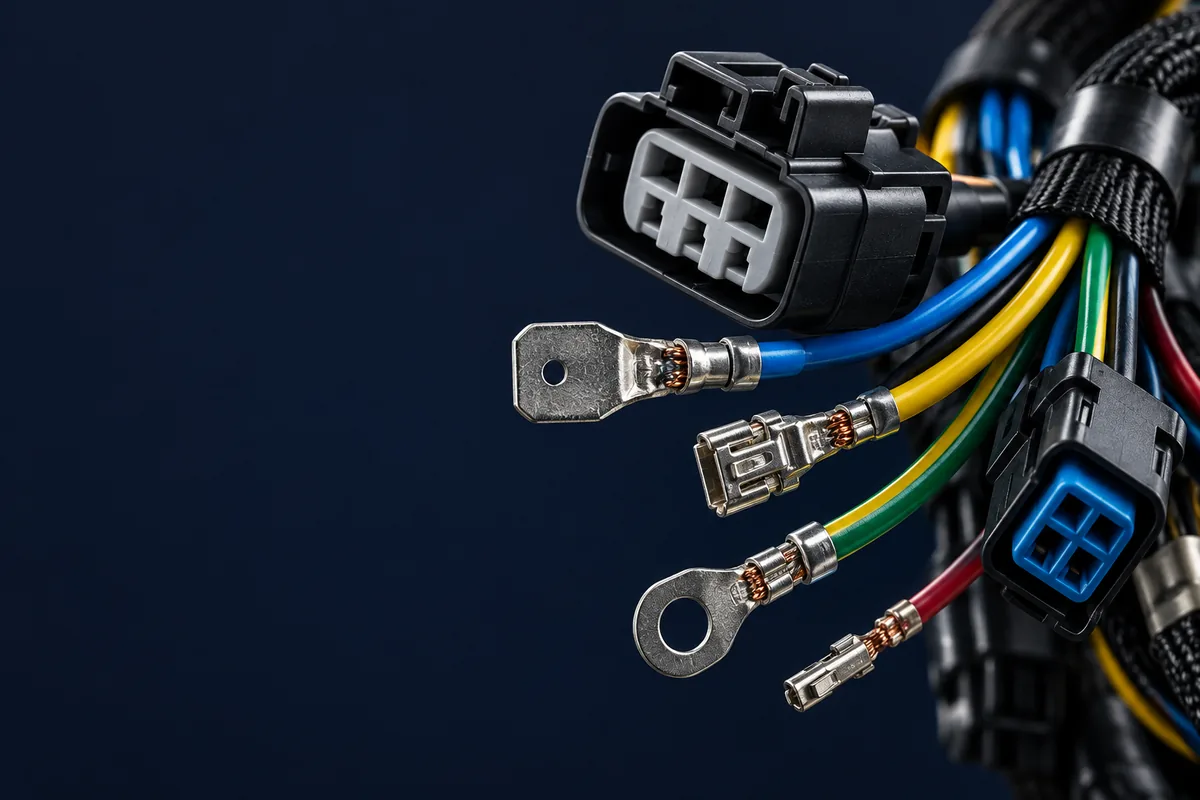
A Deutsch connector cable assembly is a sealed interconnect built around Deutsch-style housings, contacts, wedges, seals, and a controlled wire harness termination process. Buyers usually choose it for vehicles, construction equipment, agricultural machines, marine controls, and outdoor industrial equipment where vibration, water spray, dirt, and field service access all matter.
This guide is written for engineering teams, sourcing managers, NPI buyers, and supplier-quality teams that already have a harness drawing or are preparing the first RFQ. The buying stage is practical: you need to decide the connector family, contact size, wire range, seal package, tooling evidence, inspection standard, and supplier traceability before a pilot lot moves into repeat production.
Our team writes this from a senior factory-engineering role with more than 10 years supporting cable assembly and wire harness builds for automotive, industrial automation, EV, marine, and equipment programs. Use it alongside our wire harness connector selection guide, wire harness waterproofing guide, waterproof cable assembly service, automotive wire harness capability page, and wire harness testing service.
TL;DR
- Freeze housing, contact, seal, wedge, cavity plug, and mating half before quoting.
- Specify IPC-A-620 workmanship plus IP-code sealing targets where washdown or splash exposure exists.
- Crimp evidence should include tool setup, pull data, visual inspection, and 100 percent continuity test.
- For 500+ unit programs, require lot traceability and approved alternate rules before pilot release.
Where Deutsch Connectors Fit
A sealed connector is an electrical connector that uses housing geometry, wire seals, interface seals, and cavity plugs to reduce water and dust entry at the mating interface. Deutsch-style connector systems are common when the harness must be disconnected for service but cannot expose terminals to road spray, mud, pressure washing, salt fog, or vibration.
The buyer risk is rarely the word "Deutsch" itself. The risk is an incomplete connector definition. One project may need a DT-style 2-pin sensor branch with size 16 stamped contacts. Another may need a DTP-style power branch, a backshell, a boot, and larger contacts. A third may need a compact multi-cavity connector where unused cavities require plugs. If the RFQ says only "Deutsch connector," the supplier has to guess the current rating, wire seal range, tooling, mating side, and environmental target.
The objective is to turn that vague request into a controlled cable assembly package. A quote-ready package defines the exact connector set, the wire construction, the termination method, the sealing target, the inspection evidence, and the production ramp. That gives the supplier enough information to price material honestly and protect the first build from hidden alternates.
For sealed vehicle harnesses, I do not release a Deutsch connector job from engineering review until every unused cavity has a plug decision and every contact has a wire-range match. One missing plug can defeat an IP67 target faster than a bad crimp.
Factory Scenario: The 800-Harness Loader Batch
In a 2026-Q1 pilot order for 800 off-road loader harnesses, our team received a drawing that named a sealed 6-cavity Deutsch-style connector but left two cavities unused. The first sample passed continuity, but our incoming review found that the customer BOM did not call out cavity plugs for positions 5 and 6. We built 12 trial pieces and ran a low-pressure spray check after mating and unmating each connector 10 times. Four of the 12 samples showed visible moisture behind the secondary lock because the open cavities gave water a path around the rear seal.
The fix was concrete: add two cavity plugs per connector, revise the BOM, update the work instruction photo, and add a final visual check for plug depth before electrical test. We also changed the first-article record to list housing lot, contact lot, seal color, plug part number, crimp applicator, and pull-test values. The next 800-piece build had 0 continuity failures, 0 missing-plug findings, and lowest pull-force result of 68 N on the sampled 18 AWG signal contacts against a 55 N customer minimum.
Those numbers should not be copied blindly into every drawing. They show the sourcing lesson: sealed connector assemblies fail when small sealing accessories are treated as optional hardware instead of controlled parts. The same discipline applies to first article inspection and crimp pull testing.
Standards and Acceptance Criteria
IPC-A-620 is a workmanship standard used for cable and wire harness acceptance, including crimp quality, insulation support, conductor visibility, marking, routing, and inspection classes. Buyers often reference public IPC standards background when they need a neutral acceptance language for harness suppliers.
The IP Code is a rating system that classifies protection against solid objects and water ingress. For sealed connector cable assemblies, IP Code terms such as IP67 or IP69K must be tied to the finished assembly design, not only to a catalog connector claim. Wire OD, rear seal compression, unused cavity plugs, strain relief, backshell fit, and mating condition all affect the real assembly.
UL-758 is a safety-related appliance wiring material standard that buyers may cite when wire style, insulation rating, temperature, and traceability matter. For public background, use the UL safety organization reference rather than bot-blocking standards pages. Automotive buyers may also connect process evidence to IATF 16949 discipline for traceability, reaction plans, and change control.
A connector catalog IP rating is not a finished harness IP rating. I want the drawing to name the IP target, the wire OD range, the unused-cavity plug rule, and the post-build inspection method.
Connector Family Selection
A connector family is a set of mating housings, contacts, seals, wedges, and accessories designed to work together within defined electrical and environmental limits. For Deutsch-style cable assemblies, the family choice usually follows current, cavity count, package size, wire gauge, service environment, and installation space.
For sensor and signal branches, buyers often need compact sealed housings with smaller contacts and reliable terminal retention. For power branches, the connector must support larger wire gauges, higher current, stronger strain relief, and enough spacing for the voltage class. For mixed harnesses, do not force one connector family across every branch just to simplify the BOM. A single-family rule can create bulky routing or underspecified contacts.
Ask the supplier to mark every connector line as "complete kit" in the BOM. The kit should include housing, mating half if supplied, contacts, wire seals where separate, wedge lock, rear accessory, blanking plugs, backshell, boot, clip, label, and any special installation tool. This prevents a quote that prices only the visible plastic housing while omitting the parts that make the sealed assembly work.
Comparison Table: Deutsch Connector Assembly Decisions
| Decision Point | Good RFQ Detail | Factory Control | Common Failure Mode | Evidence to Request |
|---|---|---|---|---|
| Housing and mating half | Full part number, keying, cavity count, color, and mating side | BOM line review before purchasing | Correct plug with wrong receptacle or key | Approved BOM and connector photos |
| Contact size | Contact part number plus wire gauge and insulation OD | Applicator, die, and crimp-height setup | Loose crimp, damaged strands, or poor terminal retention | Pull-test values and crimp setup sheet |
| Rear sealing | Wire OD range, seal type, unused-cavity plug rule | Seal compression and plug-depth inspection | Water path through unused cavity or undersized wire seal | First-article inspection photos |
| Strain relief | Boot, backshell, clip location, bend radius, and pull-load target | Assembly board and final routing check | Side-load on connector, cracked seal, or conductor fatigue | Routing photo and retention check |
| Environmental rating | IP target, temperature range, vibration zone, chemical exposure | Material and test-plan review | Catalog rating assumed for finished harness | Test scope and inspection report |
| Traceability | Approved supplier channel and lot-record requirement | Incoming inspection and batch traveler | Unapproved alternate or mixed contact lots | COC, lot data, and change record |
Crimping and Tooling Controls
The crimp is the highest-risk manufacturing step in most sealed connector cable assemblies. A crimp contact may look seated while the conductor barrel is under-compressed, the insulation support is over-crushed, or a strand is folded outside the barrel. Once the terminal is inserted into the housing, those defects become harder to inspect without depinning.
For each Deutsch contact, ask for the terminal manufacturer part number, accepted wire gauge range, strip length, tooling reference, crimp-height target if available, and pull-force requirement. The supplier should verify first-piece crimp quality after any applicator setup, contact reel change, wire change, or operator change. For higher-risk assemblies, add periodic pull testing by quantity or shift.
Do not accept a supplier statement that says only "tested OK." A useful report lists sample count, wire gauge, terminal part number, measured pull force, failure mode, operator or station, and date. If a 22 AWG branch and a 12 AWG power lead use different contacts, each needs its own evidence line. Our wire harness crimping guide explains crimp height, bellmouth, conductor brush, and insulation support in more detail.
For a pilot lot above 500 harnesses, I want at least first-piece pull data by contact family and a documented reaction plan. IPC-A-620 visual acceptance alone does not replace measured crimp evidence.
Sealing, Routing, and Field-Service Details
A cavity plug is a sealing accessory that closes an unused connector position so the rear seal system can still work. It belongs in the BOM and on the inspection checklist. If the drawing shows six cavities and uses only four wires, the two unused cavities need an explicit rule. "Leave empty" is not a sealing strategy.
Routing also changes sealing performance. A tight bend immediately behind the connector can pull one side of the rear seal, tilt the wire, and create stress during vibration. For vehicle harnesses, define the clip distance from the connector, minimum bend radius, service loop allowance, and whether the connector is disconnected during maintenance. If the harness exits a panel or bracket, align the connector plan with the grommet and strain-relief plan.
For washdown, outdoor, marine, or heavy-equipment use, specify the exposure in concrete language: splash only, temporary immersion, pressure wash, salt spray, engine-bay heat, hydraulic fluid mist, or repeated service disconnect. Those conditions drive whether the assembly needs a boot, overmold, backshell, adhesive heat shrink, braid, conduit, or a different connector placement.
Sourcing and Change Control
Deutsch-style connector assemblies are sensitive to substitutions. A contact alternate may fit the cavity but require a different crimp tool. A housing alternate may mate physically but use a different wedge or seal package. A wire alternate may shift insulation OD outside the seal range even when the conductor gauge stays the same.
For production programs, request an approved-source list and a no-substitution rule for connector housings, contacts, wedges, seals, and cavity plugs. If alternates are allowed, require a side-by-side comparison covering mating fit, contact plating, wire range, seal range, current rating, temperature rating, tooling impact, IP target, and validation evidence.
This is where IATF 16949-style change discipline helps even outside formal automotive certification. The practical rule is simple: the supplier should not change a connector-system part, wire construction, seal accessory, crimp tool, or test method without buyer approval. The same rule should appear in the PO terms, drawing notes, or quality agreement.
RFQ Checklist for Deutsch Connector Cable Assemblies
- Send full connector part numbers for housing, mating half, contacts, wedges, seals, cavity plugs, boots, backshells, and clips.
- Define wire gauge, strand construction, insulation OD, jacket material, color code, length tolerance, and labeling method.
- State IPC-A-620 class, IP-code target, electrical test scope, pull-test requirement, and any UL-758 or IATF 16949 expectation.
- Include the operating environment: vibration zone, temperature range, fluids, UV exposure, washdown, salt spray, and maintenance disconnect cycles.
- Ask for material-ready date, first-article date, final ship date, and the longest-lead connector item.
- Require batch traceability for connector lots, wire lots, crimp station, inspection result, and final electrical test.
- Mark customer-approved alternates and no-substitution items before the supplier buys material.
FAQ
What information do I need for a Deutsch connector cable assembly quote?
Send the drawing, quantity, full connector kit part numbers, wire gauge, insulation OD, pinout, IP target, temperature range, and test requirements. For controlled programs, include IPC-A-620 class and whether UL-758 or IATF 16949-style traceability is required.
Can I specify only the Deutsch housing part number?
No. A quote-ready BOM should include housing, mating half, contacts, wedge locks, seals, cavity plugs, boots or backshells, and clips. Missing accessories can add 1-3 sourcing cycles and may invalidate an IP67 sealing target.
How should unused cavities be handled in sealed connectors?
Unused cavities should receive the approved cavity plug or blanking seal listed for that connector family. In our 800-harness loader batch, two missing plugs per connector caused visible moisture in 4 of 12 trial samples after repeated mating checks.
What tests should a supplier run before shipping Deutsch connector harnesses?
At minimum, request 100 percent continuity and pinout testing, visual inspection, connector seating checks, plug-depth inspection, and crimp pull data by contact family. For exposed assemblies, add insulation resistance, hi-pot, or sealing checks when the drawing specifies them.
Does an IP67 connector guarantee an IP67 cable assembly?
No. The finished assembly depends on wire OD, seal compression, cavity plugs, backshell fit, strain relief, bend radius, and mating condition. The IP Code target should be tied to the harness drawing and validation plan.
When should I approve a connector alternate?
Approve an alternate only after reviewing mating fit, contact size, crimp tooling, seal range, electrical rating, temperature rating, IP target, and traceability. Same cavity count is not enough for automotive, marine, EV, or heavy-equipment harnesses.
Next Step: Send a Controlled Connector Package
If your sealed harness depends on Deutsch-style connectors, send the drawing, BOM, quantity, connector kit, pinout, operating environment, IP target, test scope, and production ramp. We can review manufacturability, identify missing accessories, confirm crimp and sealing controls, and quote the cable assembly build. Start through our contact page, or compare related capabilities on our waterproof cable assembly and wire harness testing pages.