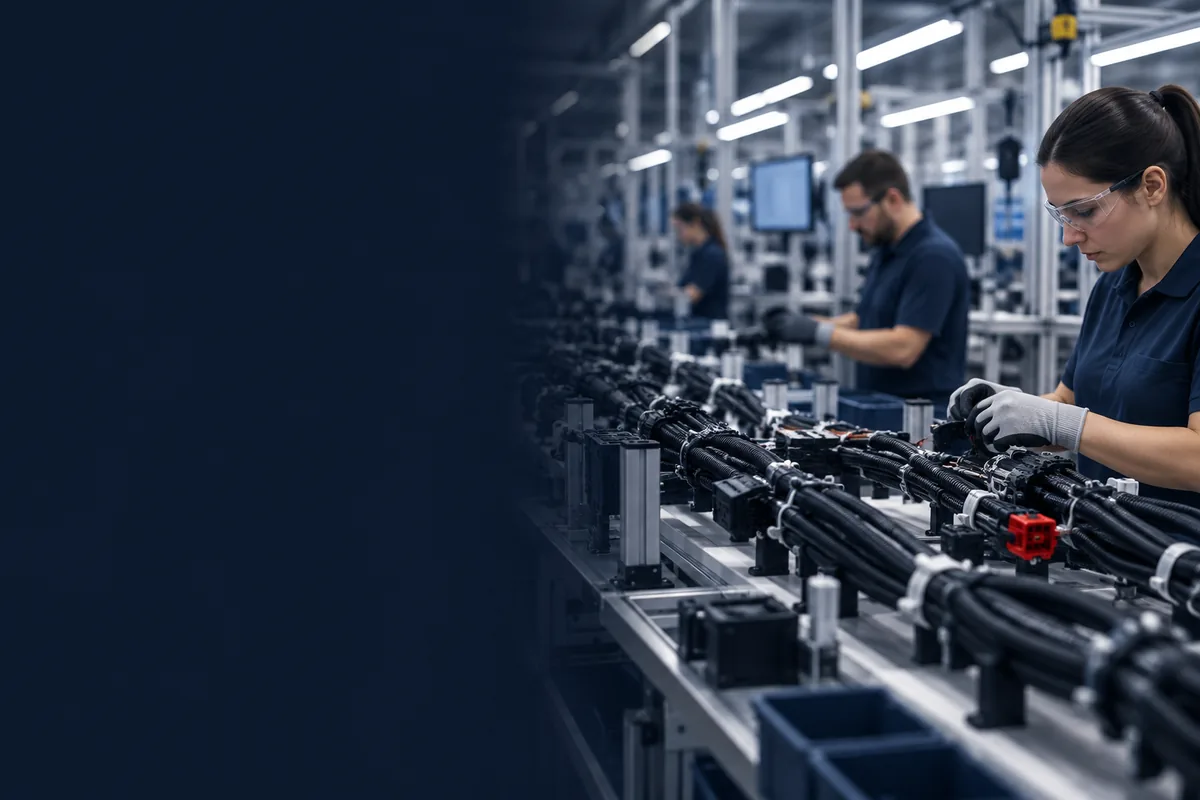
Building Solar Harnesses for Long-Term Reliability
Solar panels, inverters, and battery racks depend on wire harnesses suited to UV exposure, thermal cycling, and moisture. This guide covers material specifications, connector requirements, and supplier evaluation for the intended installation and service life.
Solar installations use wire harnesses to connect panels, inverters, batteries, and monitoring equipment. Procurement requirements depend on system architecture, operating conditions, and the destination market.
Solar harnesses can face UV radiation, temperature changes, moisture, ozone, and wind-induced vibration, often with limited maintenance access. Specify these conditions and the required design life explicitly.
Underspecified solar harnesses can cause lost production, overheating, and difficult field repairs. Qualification should address the actual installation conditions and the intended service life.
1. Why Solar Wire Harnesses Are Different
A wire harness inside a factory control cabinet may have more controlled exposure and easier maintenance access. A solar wire harness faces an entirely different reality.
Rooftop heat, winter cold, and repeated temperature changes stress insulation, crimps, and seals. Base the qualification plan on site conditions rather than assuming a universal thermal-cycle count.
UV exposure can degrade insulation that is not qualified for outdoor service. Select a documented sunlight-resistant construction and review aging evidence for the exact material; material family alone does not establish field life.
Environmental Stresses
- UV radiation: Assess site exposure and cable qualification
- Temperature range: Specify site and conductor conditions
- Humidity: Include condensation and immersion exposure
- Ozone, salt spray (coastal), and ammonia (agricultural)
Required Protection
- UV-stabilized XLPE or EPR insulation
- Tinned copper conductors where specified for corrosion resistance
- IP67/IP68 sealed connectors with locking mechanisms
- Flame performance qualified to the applicable cable standard
2. Types of Solar Wire Harnesses by Application
Solar wire harnesses are not one-size-fits-all. The requirements for a residential rooftop system are fundamentally different from a utility-scale solar farm or battery energy storage system. Understanding the application categories helps procurement teams specify the right harness for each use case.
| Application | Voltage | Wire Gauge | Connectors | Cost/Unit |
|---|---|---|---|---|
| String Harness (Panel-to-Panel) | Match system voltage | Size for current and installation | MC4 / H4 | Supplier quotation |
| Homerun Cable (String-to-Combiner) | Match system voltage | Size for current and installation | MC4 + Lug | Supplier quotation |
| Inverter Harness (DC Side) | Match system voltage | Size for current and installation | Amphenol / Custom | Supplier quotation |
| BESS Harness (Battery Pack) | Match system voltage | Size for current and installation | Anderson / Radsok | Supplier quotation |
| Monitoring/Signal Harness | Match system voltage | Size for current and installation | JST / Molex | Supplier quotation |
Important: Pre-fabricated string harnesses may reduce field assembly work. Compare installation effort and total cost against the project layout and approved connection method.
3. Material Specifications for Long-Term Reliability
Every component in a solar wire harness must be rated for outdoor use and validated against accelerated aging tests. The following specifications form the baseline for procurement.
Conductors: Tinned Copper, Stranded
Specify conductor material and flexible construction suited to the connection method and routing. Check the applicable IEC 60228 conductor class and size conductors for current, voltage drop, installation conditions, and terminal compatibility.
Insulation: UV-Stabilized XLPE
Use insulation with documented sunlight, temperature, and environmental suitability for the applicable PV cable standard. Confirm the exact compound and aging test evidence; generic PVC or XLPE names do not establish a service life.
Jacket: LSZH or UV-Rated TPE
The outer jacket must resist UV, ozone, chemicals, and abrasion. Low Smoke Zero Halogen (LSZH) compounds are preferred for rooftop installations near occupied spaces. For utility-scale ground mounts, UV-rated thermoplastic elastomer (TPE) may provide suitable flexibility when qualified for the site conditions. Specify cable flame testing separately from any UL 94 material classification.
Sealing: Match the Installation Exposure
Select the connector ingress rating for the actual exposure and mated configuration. Check IEC 60529 and the manufacturer test conditions for IP67 or IP68; IP68 immersion depth and duration are product-specific. Verify seals, cable diameters, and assembly instructions.
4. Connector Standards: MC4, H4, and Beyond
The MC4 connector (Multi-Contact 4 mm) is the de facto standard for solar panel interconnection. However, several connector families serve different roles in the solar power chain. Understanding which connector fits each application prevents costly mismatches.
| Connector | Current Rating | Voltage | IP Rating | Application |
|---|---|---|---|---|
| MC4 (Staubli) | Per exact part and conductor | Per exact part rating | Verify mated configuration | Panel strings |
| H4 (Amphenol) | Per exact part and conductor | Per exact part rating | Verify mated configuration | Panel strings, homeruns |
| QC4 (TE) | Per exact part and conductor | Per exact part rating | Verify mated configuration | Utility-scale homeruns |
| Anderson SB/PP | Per exact part and conductor | Per exact part rating | Verify mated configuration | BESS, inverter DC side |
Compatibility Warning: A claim of “MC4-compatible” does not establish an approved mating pair. Specify both mating part numbers and require manufacturer approval and applicable certification evidence before accepting cross-brand connections.
5. Certifications and Compliance Requirements
Solar wire harnesses sit at the intersection of electrical safety codes, building codes, and fire safety standards. The certification landscape varies by market, but the applicable requirements must be confirmed for each installation.
Wire & Cable Standards
- UL 4703 — Photovoltaic wire
- EN 50618 — Photovoltaic cable; confirm market applicability
- TUV PV cable approvals — Verify the applicable test basis and certificate scope
- UL 6703 — PV connectors; UL 4703 covers PV wire. UL Solutions
Manufacturing Standards
- IPC/WHMA-A-620 — Wire harness workmanship
- ISO 9001 — Quality management system
- UL 94 V-0 — Flame rating for materials
For North American projects, check the adopted NEC Article 690 requirements for the circuit, wiring method, conductor sizing, and overcurrent protection. Confirm listings and installation acceptance with the authority having jurisdiction.
For European projects, identify the applicable electrical safety and PV connector requirements and confirm any customer-required certification. Approval for one product or market does not establish worldwide acceptance.
6. How to Evaluate Solar Wire Harness Suppliers
Not every wire harness manufacturer has the capabilities for solar applications. The following evaluation framework identifies the critical differentiators.
Solar-Specific Capability Assessment
Experience with connector tooling and documented crimp validation
Dielectric test capability matching the applicable product standard and approved test plan
UV aging test capability or partnership with certified lab
IP67/IP68 sealing test equipment (submersion chamber)
Crimp pull-force testing against the terminal specification and applicable workmanship criteria
Traceability system linking each harness to material lot numbers
Ask potential suppliers for references from completed solar projects, including the project capacity (MW), harness type supplied, and whether they provided first-article test reports. Review evidence of relevant production planning, traceability, and field-quality controls rather than relying on claimed project capacity.
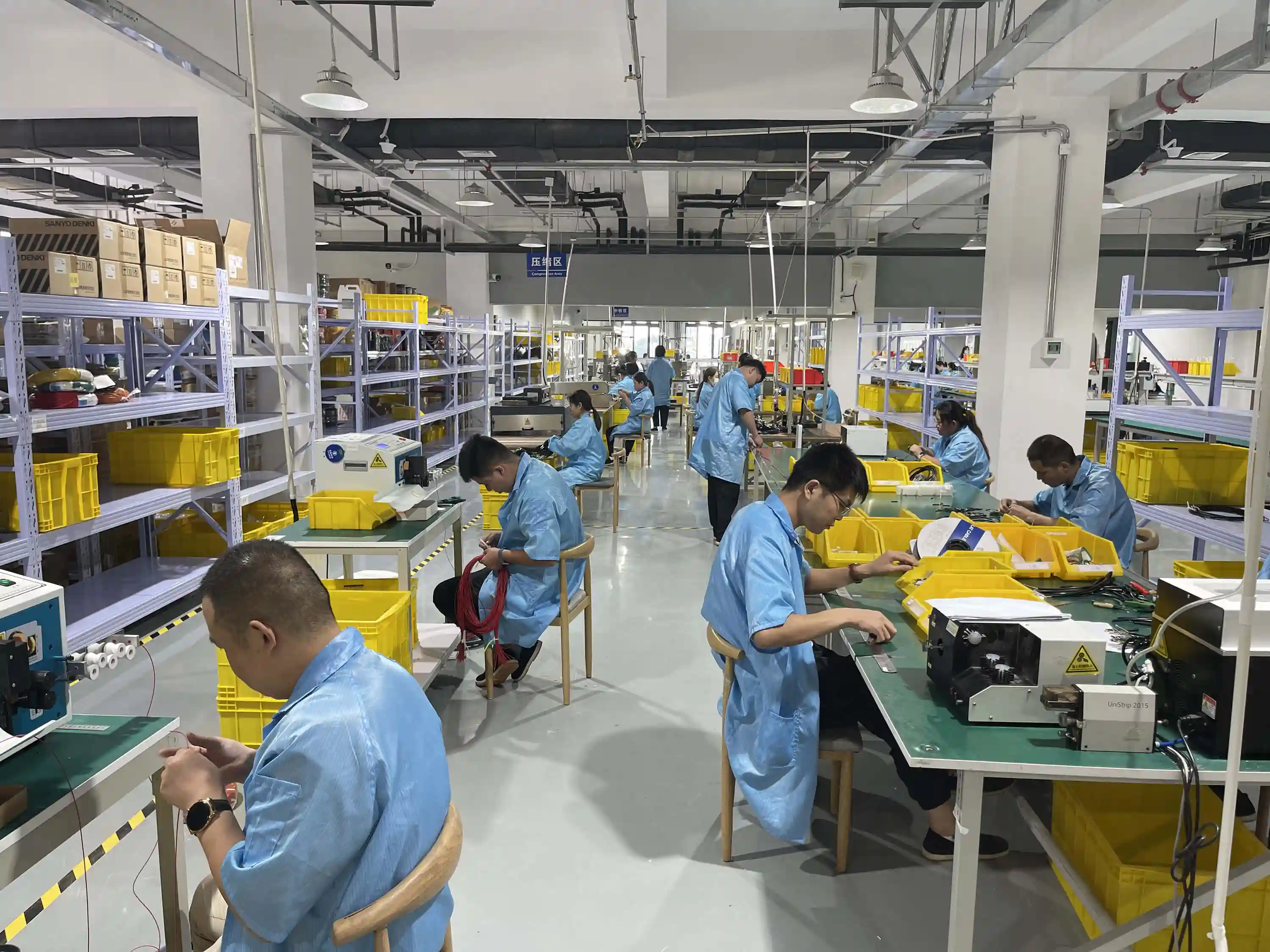
For large-scale procurement, consider a structured RFQ process that includes a factory audit. Evaluate the assembly area for ESD protection, clean conditions, proper lighting for crimp inspection, and dedicated solar wire inventory storage separate from non-PV materials.
7. Cost Analysis: What Drives Solar Harness Pricing
Understanding the cost structure helps procurement teams negotiate effectively and avoid underspecified harnesses from low-cost suppliers that cut corners on materials.
| Cost Driver | Quotation Basis | Key Variables |
|---|---|---|
| Connectors | Confirm in supplier cost breakdown | Brand (genuine vs compatible), current rating, IP rating |
| PV Wire/Cable | Confirm in supplier cost breakdown | Gauge, length, copper price, XLPE vs TPE jacket |
| Labor (Crimping + Assembly) | Confirm in supplier cost breakdown | Connector count, branch complexity, testing requirements |
| Testing & QC | Confirm in supplier cost breakdown | Continuity and dielectric tests per the approved plan; destructive pull testing on defined samples |
| Labeling & Packaging | Confirm in supplier cost breakdown | Traceability labels, UV-resistant tags, protective packaging |
Repeated harness designs may support automated cutting or crimping and more efficient purchasing. Ask the supplier to quote quantity tiers and identify the process assumptions behind any cost reduction.
Investigate unexpectedly low quotes by checking component part numbers, approvals, conductor construction, test scope, and exclusions. Price alone does not prove either compliance or a future failure.
8. Frequently Asked Questions
What certifications should a solar wire harness manufacturer have?
Check UL 4703 for PV wire and UL 6703 for PV connectors where applicable, plus the agreed workmanship and quality-system requirements. UL Solutions. For automotive-grade solar applications (like solar carports with EV charging), confirm any additional customer-specific requirements. Verify each certificate against the product, legal entity, site, and target market.
How long should a solar wire harness last in the field?
Set the required service life in the project specification. Review environmental ratings, compatible connectors, and aging evidence for the exact construction; accelerated testing does not automatically establish a universal field lifespan.
What is the typical lead time for custom solar wire harnesses?
Lead time depends on component availability, tooling, sample approval, production capacity, and testing. Obtain a dated supplier plan and agree an inventory buffer against installation milestones.
Can I use standard wire harnesses for outdoor solar installations?
Use only constructions documented as suitable for the PV circuit and installation environment. Check sunlight resistance, voltage and temperature ratings, sealing, and the applicable wiring code rather than assuming a standard indoor harness is suitable.
What is the cost range for solar wire harnesses?
Solar harness prices depend on cable length and gauge, connector part numbers, sealing, test scope, and order volume. Compare supplier quotations against the same released specification.
References & External Resources
Need Solar Wire Harnesses for Your Installation?
Send the system voltage, environment, connector part numbers, and test requirements for a solar harness quotation. Confirm the required product approvals and supporting documentation during review.