Technical Guide
Complete Manufacturing, Specification & Sourcing Guide
A robotics application may expose retractile cords to repeated motion, cleaning chemicals, and heat. Material selection and a validated coil-forming process should be reviewed against those conditions before release.
Flex-cycle target
Unit cost at production volume
Lead time for custom retractile cords
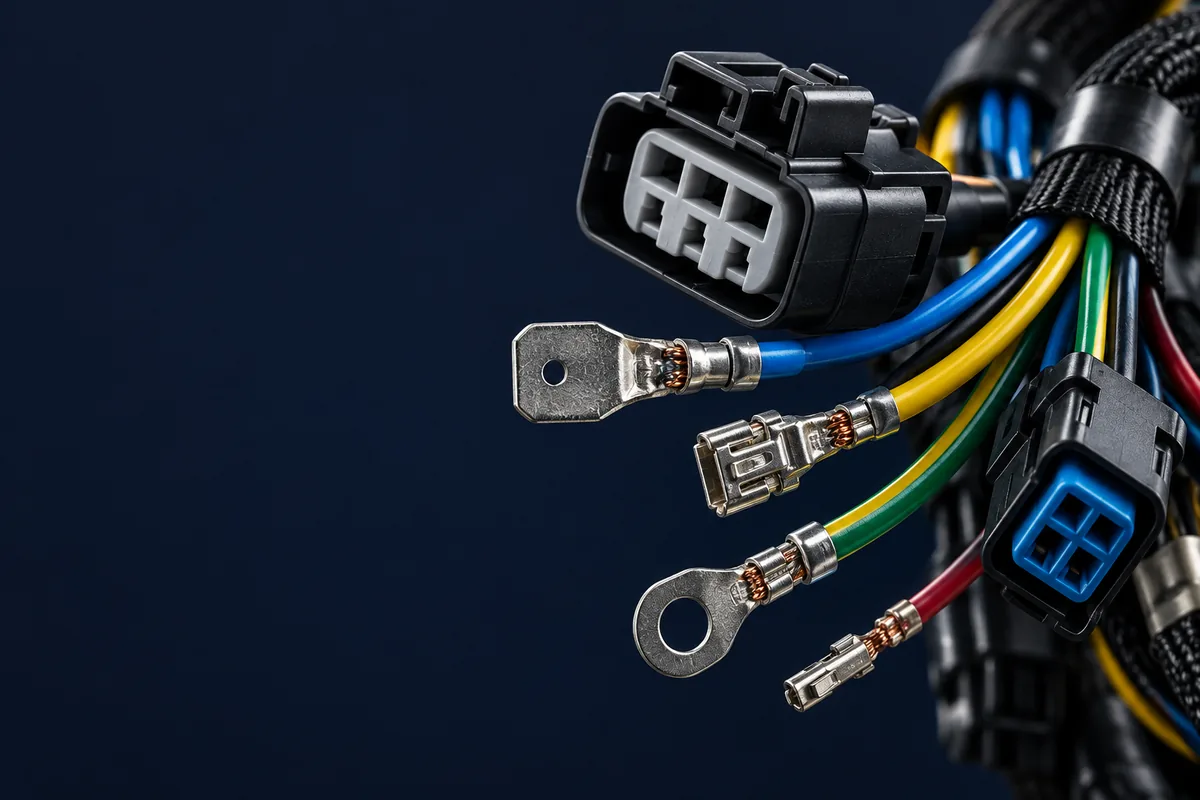
Retractile coil cord assembly showing helical coil structure and terminated connectors for industrial application
Custom retractile cord assembly with terminated connectors for industrial cable management
Every cable management decision involves a tradeoff between reach, compactness, and reliability. Retractile cords — the helically coiled cables that self-retract when released — provide reach from a compact coiled section without a separate reel. Validate working reach and retraction force for the selected geometry.
The global retractile cord market serves medical devices, industrial automation, industrial communications, point-of-sale terminals, and robotics. Incomplete procurement and engineering data can lead to unsuitable retractile cord specifications — choosing PVC when polyurethane was required, or accepting a 3:1 extension ratio when the application demanded 5:1. Possible consequences include memory loss, jacket cracking, and field replacements.
This guide covers the manufacturing process that creates coil memory, the material properties that determine service life, how to choose between retractile cords and mechanical alternatives, and a specification checklist for ordering custom retractile cords that meet the approved service requirements.
1. What Is a Retractile Cord?
A retractile cord is a cable permanently formed into a helical coil that self-retracts to its coiled length when tension is released. The coil memory is thermally set during manufacturing — the cable is wound around a mandrel and heat-set using a material-specific process, then cooled under controlled conditions. The resulting coil memory supports repeated extension and retraction; cycle life depends on the construction and motion profile.
The terms retractile cord, coil cord, curly cord, and spiral cable all describe the same product. Check the applicable NEC flexible-cord provisions and product marking for the intended use. "Coil cord" is the industry trade name. Old telephone handset cables are the most recognizable example, but modern retractile cords carry power, data, and signal connections with conductor counts selected for the application.
Extension ratio is the defining specification. A cord with a 4:1 ratio and a 2-foot coiled length extends to 8 feet. Available ratios are construction-specific and should be confirmed with the supplier. The ratio depends on mandrel diameter, wire gauge, jacket thickness, and curing parameters.
2. How Retractile Cords Are Manufactured
Retractile cord manufacturing is a five-stage process where the curing stage determines coil quality. Insufficient heat setting can impair coil memory. Validate winding, temperature, hold time, and cooling for the selected material and geometry.
Mandrel diameter controls the coil's outer diameter and retraction force. A smaller mandrel produces a tighter coil with higher retraction force but reduced extension ratio. Available mandrels and any custom tooling cost must be confirmed with the supplier for the released geometry.
The difference between thermoset and thermoplastic curing matters for service life. Thermoplastic materials (PVC, TPE) can be reformed with heat — useful for manufacturing but a liability in high-temperature environments where ambient heat can relax coil memory. Thermoset materials like cross-linked polyethylene (XLPE) and some specialty polyurethanes form permanent chemical bonds during curing and can improve thermal stability, but still require a defined operating-temperature limit and validation.
Table
| Stage | Process | Critical Parameters | Typical Duration |
|---|---|---|---|
| 1. Wire Prep | Cut, strip, and pre-tin conductors to length | Specified conductor size and drawing-defined strip tolerance | Per process validation |
| 2. Mandrel Winding | Wind cable helically around steel mandrel at controlled pitch | Mandrel OD, pitch angle, validated winding tension | Per process validation |
| 3. Oven Curing | Heat wound assembly to set coil memory | Material-specific validated temperature and hold time | Per process validation |
| 4. Cooling | Controlled cool-down while still on mandrel | Validated cooling rate and release temperature | Per process validation |
| 5. Termination | Strip coil ends, crimp/solder connectors, overmold if required | Pull test per applicable terminal and product specification | Per process validation |
3. Material Selection: PVC vs Polyurethane vs TPE
Jacket material strongly affects a retractile cord's service life, chemical resistance, and operating temperature range. PVC dominates budget applications. Polyurethane (PU) is an option for industrial and medical environments when the exact grade is qualified. TPE (thermoplastic elastomer) bridges the gap for applications requiring flexibility without PU cost.
For medical device applications, validate the exact jacket compound against the disinfectants, concentrations, contact times, and sterilization process in use. Generic PVC, polyurethane, or polyester-elastomer names do not establish chemical resistance, autoclave suitability, or relative cost.
Table
| Property | PVC | Polyurethane (PU) | TPE | Hytrel (verify current grade data) |
|---|---|---|---|---|
| Temperature Range | Per compound and cable datasheet | Per compound and cable datasheet | Per compound and cable datasheet | Per compound and cable datasheet |
| Flex Life (cycles) | Per validated motion test | Per validated motion test | Per validated motion test | Per validated motion test |
| Chemical Resistance | Fair (oils degrade) | Good (resists oils, solvents) | Good (resists UV, ozone) | Excellent (fuels, oils, acids) |
| Abrasion Resistance | Low | High | Medium | Very High |
| Memory Retention | Verify retraction after thermal exposure | Verify retraction after thermal exposure | Verify retraction after thermal exposure | Verify retraction after thermal exposure |
| Unit Cost (relative) | Supplier quotation | Supplier quotation | Supplier quotation | Supplier quotation |
| Typical Applications | POS terminals, telephone cords | Medical carts, robotics, industrial tools | Consumer electronics, light industrial | industrial, industrial, high-temp industrial |
4. Types, Extension Ratios & Specifications
Select the flexible-cord type for the insulation, environment, and intended use. SOOW, SEOOW, and STOW are construction designations; check the governing cord standard and listing rather than treating the designation alone as proof of retractile performance.
Extension ratio selection depends on the working envelope. Measure the maximum reach your operator needs, then divide by the available coiled storage space. A higher extension ratio provides more reach per foot of coiled cord, while retraction force depends on the complete design — which matters for hand-held devices where the cord pulls against the operator's grip. For robotics cable assemblies, compare available ratios using the required reach, routing, and measured retraction force.
Table
| Cord Type | Description | Voltage | Temp Rating | Best For |
|---|---|---|---|---|
| SOOW | Service, Oil-resistant jacket + Oil-resistant insulation, Weather | Typical 600V; verify exact cord listing | Per product marking | Industrial tools, portable equipment |
| SEOOW | Service, Elastomer, Oil-resistant outer + inner, Weather | Typical 600V; verify exact cord listing | Per product marking | Extra flexibility for robotic arms |
| STOW | Service, Thermoplastic, Oil-resistant, Weather | Typical 600V; verify exact cord listing | Per product marking | Light industrial, indoor/outdoor |
| SJT | Service Junior, Thermoplastic | Typical 300V; verify exact cord listing | Per product marking | POS terminals, consumer electronics |
| SVT | Vacuum-cleaner cord, Thermoplastic | Typical 300V; verify exact cord listing | Per product marking | Vacuum cleaners, light-duty appliances |
5. Retractile Cord vs Cable Reel vs Spring Balancer
Retractile cords are one of three cable-management approaches, alongside cable reels and spring balancers. Hardware cost, weight, reach, maintenance, and the drawing-defined motion profile should be compared using current supplier data rather than generic price assumptions.
Choose a cable reel when the required reach, conductor size, retraction force, or duty cycle cannot be met by a validated retractile design. There is no universal reach or AWG cutoff.
Table
| Criteria | Retractile Cord | Cable Reel | Spring Balancer |
|---|---|---|---|
| Max Reach | Drawing-defined | Drawing-defined | Fixed-position use |
| Wire Gauge Range | Supplier-specific | Supplier-specific | Supplier-specific |
| Weight | Per selected construction | Per selected construction | Per selected construction |
| Unit Cost | Supplier quote | Supplier quote | Supplier quote |
| Moving Parts | None | Reel hub, spring, slip rings | Spring mechanism, cable guide |
| Maintenance | Per supplier instructions | Per supplier instructions | Per supplier instructions |
| Cycle Life | Per manufacturer data | Per manufacturer data | Per manufacturer data |
| Best Application | Handheld tools, medical carts, POS | Heavy tools, vehicle repair bays | Overhead tool suspension |
6. Common Failure Modes and Prevention
Retractile cord failures can include memory loss, jacket damage, and conductor fatigue. Memory loss may result from over-extension, heat exposure, or an inadequately validated forming process; investigate the actual conditions rather than assigning a generic share of returns.
Jacket cracking can result from incompatible chemical exposure, UV aging, or operation outside the qualified temperature range. Select the exact compound based on environmental and cleaning tests rather than a universal hardness threshold.
Repeated flexing can fatigue conductor strands. Specify a conductor construction suited to the motion profile, using the applicable conductor standard and cable datasheet. Validate signal integrity, shielding, and extension behavior for the actual data interface.
7. Industry Applications
Medical devices are one application for retractile cords. Patient monitoring cables, infusion pump cords, surgical tool tethers, and medical cart power cords may use qualified retractile cords whose contribution to medical electrical equipment safety must be evaluated under the applicable IEC 60601-1 requirements. The key specification: chemical resistance to hospital disinfectants including isopropyl alcohol and quaternary ammonium compounds.
Industrial automation uses retractile cords for barcode scanner cords, handheld HMI cables, teach pendant cords, and power tool tethers. SOOW or SEOOW rating provides oil resistance required on factory floors. Robotics applications require shielding, jacket material, coil geometry, and routing to match the validated motion profile.
Harsh industrial applications may require specialized jackets, connectors, and environmental qualification. Define the actual temperature range, cleaning agents, outdoor exposure, and handling conditions for portable equipment.
8. Integrating Retractile Cords into Wire Harness Assemblies
Retractile cords are often a component within a larger wire harness assembly rather than a standalone product. The retractile section connects a fixed harness in a chassis to a moving subassembly — a display panel, a scanner holster, or a robotic end-effector. The integration points where the retractile section meets the fixed harness can be high-stress locations.
Overmolded strain relief at the coil-to-harness junction can limit concentrated bending. Validate its geometry and attachment using the installed motion profile; no universal cycle limit or life-extension multiplier applies.
For multi-conductor applications, maintain the same conductor count and gauge through the retractile section as the fixed harness. Splicing down to smaller gauge within the retractile section saves cost but creates a thermal bottleneck — the retractile section's tighter bundling and coiled geometry can restrict heat dissipation compared with a straight run, requiring an application-specific thermal review.
9. UL Certification and Compliance
Two UL standards govern retractile cord compliance. UL 62 (Flexible Cords and Cables) covers the base cable construction — conductor sizing, insulation thickness, jacket material, and voltage rating. UL 817 (Cord Sets and Power-Supply Cords) applies when the retractile cord ships with a molded plug or appliance connector attached.
The applicable UL 62 and UL 817 tests, markings, and acceptance limits depend on product construction and use. Check the governing standard and certification scope for flexing, dielectric withstand, plug retention, and strain relief rather than applying generic values.
For international markets, review the applicable flexible-cable standards, product approvals, and conformity-assessment obligations. IEC 60227 and IEC 60245 address relevant cable families but are not blanket equivalents for every retractile assembly. Medical equipment may add IEC 60601-1 requirements.
10. How to Specify Custom Retractile Cords
A complete retractile cord specification requires 12 parameters. Missing any one of them forces your manufacturer to assume — and assumptions drive rework. Use this checklist when submitting an RFQ for custom retractile cords.
Confirm prototype and production lead times, tooling charges, and minimum quantities with the supplier after the geometry, materials, terminations, and qualification plan are defined.
Ask for quantity-tier quotations and consider blanket orders with scheduled releases when demand is predictable. Savings depend on material purchasing, tooling utilization, and production planning.
Checklist
- Number of conductors (per application)
- Wire gauge per conductor (AWG or mm²)
- Conductor material (tinned copper, bare copper, silver-plated)
- Shielding requirement (braid, foil, spiral, none)
- Jacket material (PVC, PU, TPE, Hytrel, XLPE)
- Coiled length (compressed, no tension)
- Extended length (maximum working reach)
- Extension ratio (3:1, 4:1, 5:1, or specify working reach)
- Coil outer diameter (fits within routing channel?)
- Connector type on each end (molded plug, bare leads, specific connector P/N)
- Operating environment (temperature range, chemicals, UV exposure)
- Regulatory requirements (UL 62, UL 817, IEC 60601, or customer-specified standards)
11. Frequently Asked Questions
Frequently Asked Questions
What is a retractile cord and how does it differ from a standard cable?
A retractile cord is a cable permanently formed into a helical coil through mandrel winding and heat curing. Unlike standard cables, it self-retracts to a compact coiled length when released and extends when pulled, with working reach and retraction force defined by the selected construction, without a separate mechanical reel.
I need 500 custom retractile cords for medical carts — what should I specify and what's the typical lead time?
Specify conductor count and size from the load and signal requirements, a jacket qualified for the cleaning process, shielding where needed, and applicable cable or cord-set approvals. Confirm tooling, prototype, production, and testing milestones with the supplier and validate routing before release.
Why does my retractile cord stop retracting after a few months?
Investigate over-extension, thermal exposure, and the coil-forming process. Review the exact material rating and request retraction-force and flex-life data under a test profile that represents the installation.
Which is better for my application — a retractile cord, a cable reel, or a spring balancer?
Choose among retractile cords, cable reels, and spring balancers by comparing the released reach, gauge, motion profile, weight, maintenance, and installation constraints. Obtain current supplier quotations and validate the selected construction to the approved test plan.
What UL certifications apply to retractile cords?
UL 62 addresses flexible cord construction and UL 817 addresses applicable cord sets and power-supply cords. Confirm the exact scope and test requirements for the assembly. Medical equipment and destination markets may impose additional requirements.
Frequently Asked Questions
What is a retractile cord and how does it differ from a standard cable?
A retractile cord is a cable permanently formed into a helical coil through mandrel winding and heat curing. It self-retracts to a compact coiled length when released, with extension limits defined by the selected construction.
I need 500 custom retractile cords for medical carts — what should I specify?
Specify conductor count and AWG, a jacket qualified for the specified cleaning agents, shielding for data signals, and UL 62 or UL 817 listing. Confirm the schedule after material availability and validation requirements are established.
Why does my retractile cord stop retracting after a few months?
Memory loss from over-extension, heat exposure outside the qualified operating range, or insufficient curing during manufacturing. Request flex-life test data from your manufacturer.
Which is better — a retractile cord, cable reel, or spring balancer?
Compare reach, conductor size, retraction force, motion profile, and maintenance needs. Retractile cords offer compact reach; reels support managed payout; spring balancers support suspended tools. Validate the selected device for the duty cycle.
What UL certifications apply to retractile cords?
UL 62 covers base cable construction. UL 817 applies when the cord includes molded plugs. For medical use, add IEC 60601-1.
References
- UL (Underwriters Laboratories) — Safety Organization Overview
- IEC 60601 — Medical Electrical Equipment Safety Standard
- National Electrical Code (NEC) — Article 400 Flexible Cords and Cables
- US Patent 3318994 — Method of Making Retractile Cords
Cta
Title: Need Custom Retractile Cords?
Send the conductor configuration, jacket requirements, coiled and extended dimensions, connector details, and required approvals for a custom retractile cord review. Confirm schedule and documentation scope in the quotation.
Primarybutton: Get a Quote
Secondarybutton: See Capabilities