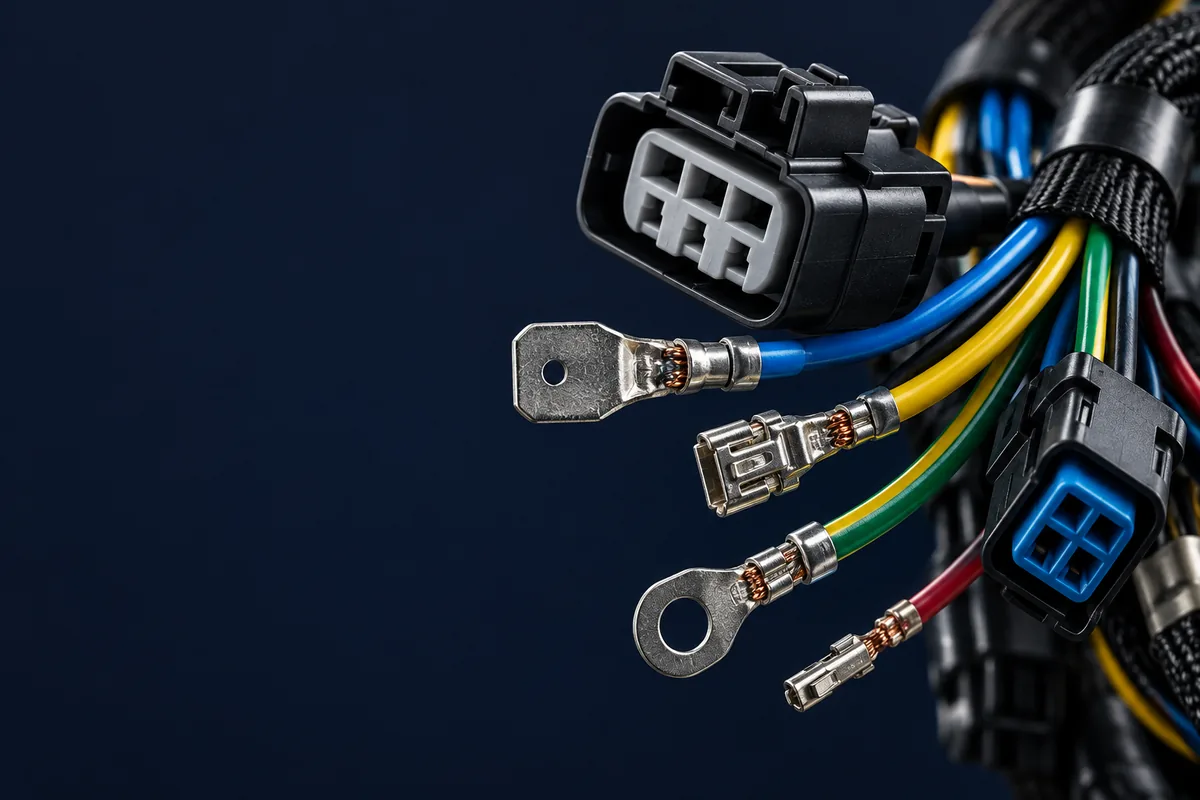
A crimp pull test answers a narrow but high-stakes question: will the terminal-to-conductor joint hold the required mechanical strength after cutting, stripping, crimping, handling, routing, and service load? For OEM engineers and sourcing teams moving from prototype to production, the test is not a substitute for good crimp geometry, but it is one of the fastest ways to catch weak tooling setup, wrong applicator height, conductor damage, terminal mismatch, and operator drift before those issues reach the field.
This guide is written for engineering teams, supplier quality engineers, NPI buyers, and production managers who already have a drawing or RFQ and need practical acceptance rules. The goal is to decide which crimps require pull testing, how many samples to test, which standard numbers to cite, what data belongs in the supplier report, and when a failure should stop shipment. Use it with our wire harness crimping guide, IPC-A-620 inspection guide, and wire harness testing service when preparing a production release package.
For workmanship language, many buyers cite IPC/WHMA-A-620 through public IPC standards background. For terminals and lugs in safety-controlled wiring, UL 486A-486B and UL 486C sit under the public UL safety organization framework. Automotive buyers often connect the same evidence to IATF 16949 process control and documented reaction plans. The standard number should appear on the drawing, control plan, or inspection instruction, not only in an email after a failure.
1. What a crimp pull test proves, and what it does not
A pull test proves that a crimped conductor can resist a defined tensile load under a defined test method. It is a destructive test. The sample is clamped, pulled until failure or until the specified force is reached, and the result is recorded. The data helps confirm conductor capture, barrel compression, strand retention, and process repeatability.
It does not prove full electrical performance by itself. A crimp can pass tensile force and still have high resistance if the barrel, plating, conductor, or compression window is wrong. It also does not prove seal integrity, terminal retention inside the connector cavity, or vibration durability. Those checks need separate evidence such as millivolt-drop testing, terminal retention force, visual cross-section, continuity, insulation resistance, or environmental cycling.
The buying-stage decision is simple: use pull testing as a gate for new terminals, new applicators, new wire sizes, first-article builds, periodic production audits, and any rework process that disturbs the conductor barrel. For mature repeat orders, the test can move into the control plan with a defined frequency and escalation rule.
2. Factory scenario: what changed after one weak crimp batch
In a Q1 2026 pilot run for 2,400 industrial sensor harnesses, our team tested open-barrel terminals on 22 AWG stranded copper leads after a customer reported intermittent readings during bench movement. The electrical test passed on all assemblies because the fault appeared only after handling. We pulled 60 samples across three applicator stations and found 11 results below the customer minimum of 35 N. The worst sample failed at 24 N, and eight weak samples came from one applicator after a terminal reel change.
The root cause was a 0.08 mm crimp height drift after the applicator ram was cleaned and reset. The wire strip length also varied from 3.0 mm to 3.8 mm, which left inconsistent strand capture in the conductor barrel. We stopped shipment, reworked the suspect lot, replaced the setup note with a measured crimp-height target, added a pull test at first piece and every 500 crimps, and required strip length verification every 2 hours. The next 5,000-piece build produced 0 pull-force failures across 120 destructive samples, with the lowest result at 42 N.
Those numbers are not a universal requirement for every 22 AWG crimp. They show why the RFQ must define the required force, sample frequency, and reaction plan. Without that definition, a supplier may treat pull testing as a one-time sample activity instead of a production control.
3. How buyers should set acceptance criteria
Start with the terminal manufacturer’s application specification. It usually defines wire range, insulation diameter, crimp height, crimp width, strip length, approved tooling, and mechanical pull-force values. If the customer drawing, IPC/WHMA-A-620 class, or UL 486 family requirement is stricter, the stricter rule should control. Do not let a quote use “standard pull test” language without a numeric value.
Acceptance criteria should include at least five items: minimum pull force, wire size and strand construction, terminal part number and revision, test method, and whether failure mode matters. For example, conductor break outside the crimp after exceeding the minimum force may be acceptable, while strands slipping from the barrel before the force threshold is not. Insulation support tabs should not be counted as conductor strength unless the referenced method allows that setup.
Buyers also need a rule for mixed harnesses. A control box harness may include 28 AWG signal leads, 18 AWG power leads, shield drains, ring terminals, ferrules, and sealed connector terminals. One pull-force value cannot cover all of them. Build a matrix by wire gauge, conductor material, terminal family, and crimp style.
Crimp pull test decision table
| Crimp Type | Typical Use | Primary Risk | Buyer Control Point | Recommended Evidence |
|---|---|---|---|---|
| Open-barrel terminal | Automotive and sensor connectors | Crimp height drift or strand brush error | Applicator setup, wire strip length, bellmouth | First-piece pull test plus crimp-height record |
| Closed-barrel ring terminal | Ground leads and power lugs | Wrong die nest or incomplete compression | Die mark, conductor fill, lug manufacturer spec | Pull test by gauge and die set, visual die-mark check |
| Ferrule | Control cabinets and screw terminals | Loose strands or wrong ferrule length | Ferrule size, exposed conductor length, square or trapezoid crimp | Pull test and insertion check in the mating terminal block |
| Splice crimp | Branch joints and repairs | Uneven conductor overlap or insulation trapped in barrel | Wire combination approval and splice barrel fill | Pull test on each wire side plus cross-section during validation |
| Shield drain crimp | EMI shield termination | Low strand count and fragile drain wire | Drain gauge, sleeve support, bend relief | Reduced-force acceptance tied to the drain wire specification |
| Sealed connector terminal | Waterproof cable assemblies | Pulling on seal support instead of conductor crimp | Seal position, insulation grip, conductor-barrel force | Pull test before insertion and separate terminal retention test |
4. Sample size and test frequency that work in production
Prototype builds need wider sampling because the process has not proven itself. For a new terminal family, test at least 5 samples per wire size and terminal combination during first article review, then add samples when tooling, wire supplier, terminal plating, conductor construction, or strip equipment changes. For a low-volume build of 50 harnesses, a destructive sample from spare cut leads may be more practical than scrapping finished assemblies.
Volume production needs a frequency that catches drift before a full shift is affected. A common control plan uses first-piece approval at shift start, after each reel change, after each applicator adjustment, and at a fixed interval such as every 500 or 1,000 crimps for critical circuits. High-current battery cables, safety grounds, and field-service terminals may justify tighter sampling. Low-risk internal jumpers may use a lower frequency after the process capability is proven.
The report should show actual force values, not just pass or fail. Actual values reveal trends. If a 70 N minimum requirement has results drifting from 105 N to 76 N across one shift, the process needs review even before a formal failure appears. Buyers should ask for raw values during first article approval and for periodic audit data during repeat production.
5. What to require in the supplier report
A useful report connects the pull result to the exact production condition. It should include project name, drawing revision, harness part number, terminal part number, wire part number, wire gauge, conductor material, insulation type, crimp tool or applicator ID, operator or station, date, sample quantity, minimum force, measured force, failure mode, and inspector sign-off. For IATF 16949 programs, connect that report to the control plan and reaction plan so a failed pull test automatically defines containment steps.
Photos help when the failure mode is unclear. A photo of the failed sample can show whether strands slipped from the barrel, conductor broke outside the crimp, insulation was trapped, or the terminal fractured. For new projects, request crimp-height records and at least one cross-section for critical terminals. Cross-sectioning is slower than pull testing, but it verifies compression geometry, strand distribution, and barrel closure.
Buyers should also define traceability depth. If the harness goes into medical equipment, EV charging, transit vehicle ground support, or industrial automation, the supplier should retain records by lot. For a simple indoor cable jumper, shipment-level records may be enough. The rule must match field risk and audit expectations.
6. Common mistakes that weaken pull-test value
The first mistake is testing only the easiest crimp. Suppliers may pick a large-gauge, forgiving terminal while skipping small signal terminals, shield drains, or splice crimps. The test plan must cover the weakest and highest-risk combinations.
The second mistake is pulling after the terminal is inserted into the connector housing. That can confuse conductor crimp strength with terminal retention or seal friction. Pull testing normally evaluates the crimped terminal before insertion. Terminal retention inside the plastic connector should be checked as a separate test with the connector manufacturer’s method.
The third mistake is accepting pass or fail without the actual force value. Pass/fail hides drift. Actual force values, paired with crimp height and strip-length checks, let a supplier correct the process before defects leave the factory.
The fourth mistake is ignoring the failure mode. If the conductor breaks after exceeding the specified force, the crimp may be stronger than the wire. If strands slide out below the threshold, the barrel compression, strip length, wire size, or terminal match needs containment. If the terminal barrel fractures, the issue may be material, plating, die damage, or over-crimping.
7. RFQ language buyers can use
Good RFQ language is short, numeric, and connected to evidence. A practical note may read: “Supplier shall perform destructive crimp pull testing for each terminal and wire-gauge combination per the approved terminal application specification and IPC/WHMA-A-620 workmanship class. Minimum force values, sample frequency, tool ID, actual force values, and failure mode shall be recorded. Testing is required at first article, shift start, terminal reel change, applicator adjustment, and every 500 crimps for critical circuits. Failed samples require lot containment and customer notification before shipment.”
That note still needs project-specific values. Add the workmanship class, terminal manufacturer documents, customer minimum pull values, drawing revision, and whether the harness uses copper, tinned copper, aluminum, high-flex stranding, or mixed-gauge splice crimps. For sealed harnesses, state whether the pull test occurs before terminal insertion and which separate retention or sealing tests are required.
Frequently Asked Questions
What is a crimp pull test for wire harnesses?
A crimp pull test is a destructive mechanical test that pulls a crimped terminal and wire until the joint reaches a specified force or fails. Buyers commonly connect the method to IPC/WHMA-A-620 workmanship and terminal manufacturer specifications, then record actual values in newtons or pounds-force.
How many crimp pull test samples should a supplier run?
For first article approval, test at least 5 samples per terminal and wire-gauge combination, then add samples for each tooling change, wire change, or terminal reel change. In production, many control plans require first-piece testing and periodic checks every 500 to 1,000 crimps for critical circuits.
Is a pull test enough to approve a crimp?
No. A pull test checks mechanical tensile strength, but it should be paired with visual inspection, crimp-height measurement, continuity or resistance testing, and terminal retention checks when the connector housing is part of the risk. Critical projects may also need cross-section evidence.
Should terminals be pull tested before or after connector insertion?
Crimp pull testing is usually done before connector insertion so the result reflects conductor-barrel strength. After insertion, a separate terminal retention test can verify that the contact stays locked in the connector cavity under the specified force.
Which standards should appear in a crimp pull test requirement?
Common references include IPC/WHMA-A-620 for cable and wire harness workmanship, UL 486A-486B or UL 486C for relevant terminals and splicing connectors, and IATF 16949 when automotive process control and reaction plans apply. The drawing should also cite the terminal manufacturer’s application specification.
What should happen when one crimp pull sample fails?
The supplier should stop the affected process, contain product made since the last passing check, verify tool setup and strip length, retest the affected terminal and wire size, and document disposition. For critical circuits, one failed sample should trigger customer notification before shipment.
Buyer checklist before release
- List every terminal and wire-gauge combination that needs destructive pull testing.
- Define numeric minimum force values from the terminal application specification, customer drawing, IPC/WHMA-A-620 class, or UL 486 family requirement.
- Set sample triggers: first article, shift start, reel change, applicator adjustment, and periodic production interval.
- Require actual force values, failure mode, crimp tool ID, wire lot, terminal lot, and inspector sign-off.
- Separate crimp pull testing from terminal retention, seal testing, continuity testing, and millivolt-drop checks.
- Define containment and stop-ship rules before the first production lot.
Need a supplier review for a new harness drawing, terminal family, or production transfer? Send your drawing, BOM, wire list, connector list, and target annual volume through our contact page. Our engineering team can review crimp pull-test requirements, prototype build controls, and production inspection evidence before the first lot is released.