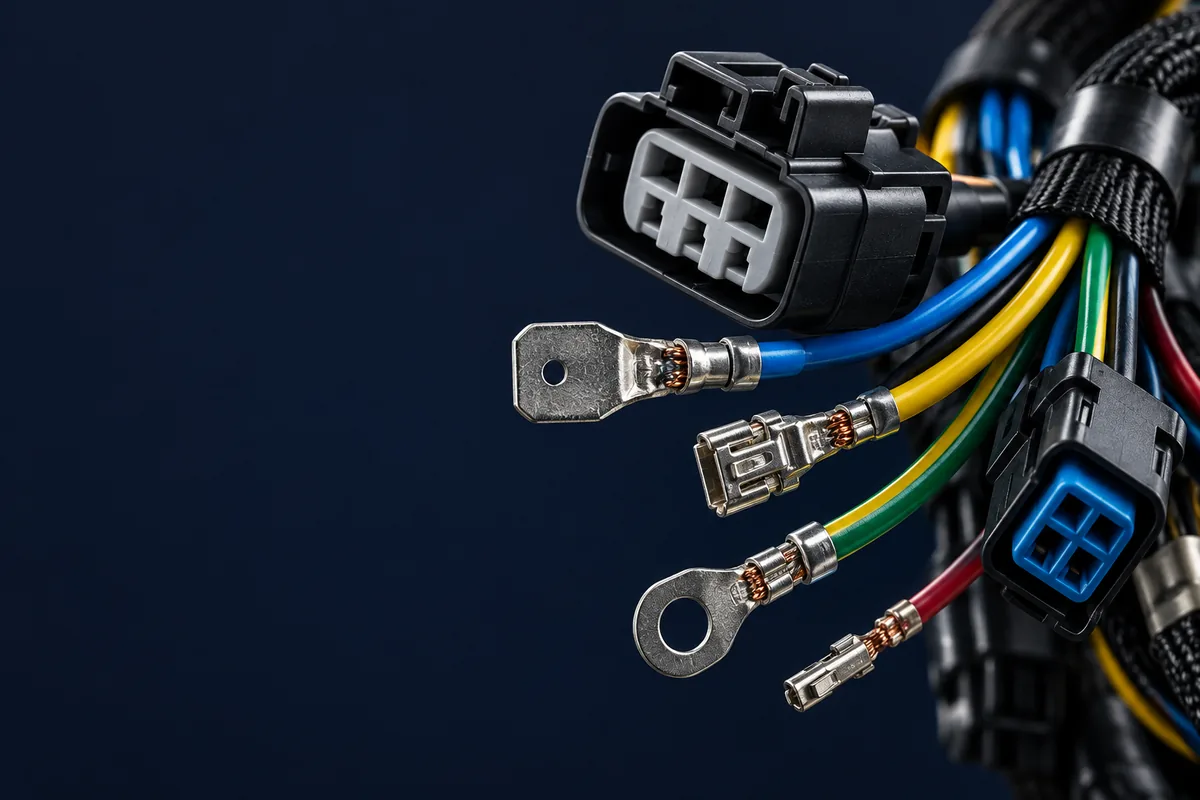
Braid vs Foil vs Combination Guide
Electromagnetic interference costs industries billions in product recalls, field failures, and redesign cycles every year. Selecting the right shielding material for your wire harness is the single most impactful design decision for EMC compliance. This guide compares every major shielding type—braided copper, aluminum foil, spiral wrap, and multi-layer combinations—with hard data on frequency performance, flex life, coverage, and cost.
global EMI shielding market by 2027
coverage range across shielding types
attenuation with combination shielding
of EMC failures traced to poor shielding
Table of Contents
- 1. Why EMI Shielding Matters in Wire Harness Design
- 2. Four Types of EMI Shielding Materials
- 3. Head-to-Head Performance Comparison
- 4. Shielding Selection by Industry
- 5. Shield Termination and Grounding Best Practices
- 6. Cost Analysis: What Shielding Adds to Your BOM
- 7. EMI Testing Standards and Compliance
- 8. Frequently Asked Questions
Every wire in a harness is an antenna. It radiates electromagnetic energy when carrying current, and it absorbs ambient interference from nearby sources—motors, switching power supplies, radio transmitters, and even other cables in the same bundle. In a controlled lab environment, this might cause minor signal degradation. In a moving vehicle, an operating room, or an critical equipment in a high-interference environment, it can cause systems to malfunction or shut down entirely.
EMI shielding wraps conductive material around signal-carrying conductors to create a Faraday cage effect. The shield reflects and absorbs electromagnetic energy, preventing internal signals from radiating outward (emissions) and blocking external interference from reaching the conductors inside (immunity). The effectiveness of this barrier depends entirely on the shield material, its coverage percentage, and how it is terminated at each end of the cable.
The wrong shielding choice wastes money. Under-shielding leads to EMC test failures and costly redesigns. Over-shielding inflates BOM cost and adds unnecessary weight and stiffness. This guide gives engineers and procurement teams the technical data to match shielding type to application requirements—the first time.
"EMC failures can originate in shielding material, coverage, or termination as well as in the circuit design. Datasheets alone may not capture program-specific factors such as flex fatigue, connector compatibility, routing, and assembly constraints. Review those interfaces against the released drawing and qualification plan before production."
Hommer Zhao
Founder & General Manager
1. Why EMI Shielding Matters in Wire Harness Design
Electromagnetic interference in wire harnesses manifests in three ways: radiated emissions (your harness radiating energy that disrupts nearby equipment), conducted emissions (noise traveling along conductors to connected devices), and susceptibility (external fields inducing unwanted signals in your harness). All three must be controlled for EMC compliance.
The consequences of inadequate shielding vary by industry but are universally expensive. In automotive applications, EMI causes infotainment glitches, sensor misreadings, and in worst cases, unintended acceleration or braking events that trigger NHTSA recalls. In medical devices, interference can corrupt patient monitoring data or disrupt therapeutic equipment. In industrial automation, EMI-induced signal errors cause servo drives to miss positions, robotic arms to overshoot targets, and PLCs to execute incorrect commands.
Real Cost of EMI Failures
- EMC test failure: $15,000–$50,000 per retest cycle (chamber time + engineer labor + shipping)
- Redesign cycle: 4–12 weeks of schedule delay plus $25,000–$100,000 in NRE
- Field recall: $500–$5,000+ per unit for automotive; $50,000+ for medical device class II recalls
The regulatory landscape makes shielding non-optional for most applications. FCC Part 15 (US), CE Marking with EN 55032/55035 (EU), and CISPR standards (international) all impose strict limits on radiated and conducted emissions. Automotive OEMs layer additional requirements through standards like CISPR 25 and manufacturer-specific EMC specifications (Ford ES-XW7T-1A278-AC, GM GMW3097, VW TL 81000). Failing these tests blocks market access entirely.
2. Four Types of EMI Shielding Materials
Each shielding type has distinct characteristics that make it suited to specific applications. Understanding these differences is the foundation for every shielding decision.
Braided Copper Shield
A woven mesh of bare or tinned copper wires interlocked in a diamond pattern around the conductor bundle. The most widely used shielding method in wire harnesses. Braid density (picks per inch) determines coverage percentage, typically ranging from 70% to 95%.
Strengths
- Excellent low-frequency shielding (DC to 15 MHz)
- High mechanical strength and abrasion resistance
- Long flex life (1M+ cycles with tinned copper)
- Easy to terminate with crimp ferrules and backshells
- Low DC resistance provides excellent ground path
Limitations
- Coverage gaps allow high-frequency leakage
- Adds significant diameter and weight
- Higher material cost than foil alternatives
- Slower manufacturing (braiding machine speed limited)
Foil Shield (Aluminum/Mylar)
A thin aluminum layer laminated to a polyester (Mylar) carrier film, wrapped around conductors with an accompanying drain wire for ground connection. Provides 100% optical coverage at minimal weight and cost.
Strengths
- 100% optical coverage (no gaps)
- Excellent high-frequency shielding (>15 MHz to GHz range)
- Lightweight, thin profile adds minimal diameter
- Lowest cost shielding option
Limitations
- Fragile; tears with repeated flexing
- Poor flex life (fails within 50–100 cycles)
- Requires drain wire for ground connection (higher impedance)
- Difficult to terminate at connectors without specialized backshells
Spiral (Serve) Shield
Individual wires wound in a single direction around the conductor bundle, like thread on a spool. Offers a compromise between braid and foil for applications requiring flexibility without the cost of full braiding.
Strengths
- Maximum flexibility (best for continuous motion applications)
- Good flex life for moderate-cycle applications
- Lower cost than braided shield
- Easier to strip and terminate than braid
Limitations
- Lower EMI shielding effectiveness than braid
- Typically 85–95% coverage (gaps between wraps)
- Poor performance at frequencies above 1 GHz
- Shield opens like a spring when cut—harder to manage in production
Combination Shield (Foil + Braid)
An inner foil layer for 100% high-frequency coverage, overlaid with a braided layer for low-frequency protection and mechanical strength. The gold standard for demanding EMC environments. Some designs add multiple foil-braid layers for extreme requirements.
Strengths
- Broadband protection: DC to multi-GHz frequency range
- 100% coverage plus low-impedance ground path
- Highest shielding effectiveness (60–100+ dB)
- Meets the strictest industrial EMC specs
Limitations
- Highest cost (50–80% more than unshielded)
- Maximum cable diameter and weight
- Reduced flexibility compared to single-layer options
- Complex termination requires skilled assembly technicians
3. Head-to-Head Performance Comparison
The following table compares the four shielding types across the eight criteria that matter most in wire harness procurement decisions.
| Criteria | Braided | Foil | Spiral | Combination |
|---|---|---|---|---|
| Coverage % | 70–95% | 100% | 85–95% | 100% |
| Best Frequency Range | DC–15 MHz | 15 MHz–GHz | DC–1 GHz | DC–multi-GHz |
| Shielding Effectiveness | 40–60 dB | 40–80 dB | 30–50 dB | 60–100+ dB |
| Flex Life (cycles) | 1M+ | 50–100 | 500K+ | 100K–500K |
| Mechanical Strength | High | Low | Medium | High |
| Weight Addition | High | Minimal | Medium | Highest |
| Termination Ease | Good | Fair | Good | Complex |
| Relative Cost | $$ | $ | $$ | $$$ |
Key Takeaway
No single shielding type wins on every metric. Braided excels at low-frequency protection and durability. Foil wins on coverage and high-frequency performance. Spiral offers the best flexibility. Combination provides the best overall EMC performance but at the highest cost. Your application requirements—not material preference—should drive the selection.
"The most common mistake we see in shielding specification is focusing exclusively on coverage percentage. A 95% braided shield with proper 360-degree termination will outperform a 100% foil shield with a pigtail ground connection every time. Shield effectiveness is only as good as the weakest point in the termination chain."
Hommer Zhao
Founder & General Manager
4. Shielding Selection by Industry
Different industries face different EMI environments and regulatory requirements. The examples below are general industry observations; final shielding construction and validation should follow the customer drawing and program-specific qualification plan.
Automotive
CISPR 25 Class 5 drives most shielding decisions. EV high-voltage harnesses (400V/800V systems) require combination foil+braid with 360° backshell termination. Low-voltage signal harnesses (CAN bus, LIN) typically use braided shield at 85%+ coverage.
Recommended: Combination (HV) / Braid (LV signals)
See automotive capabilitiesMedical Devices
IEC 60601-1-2 requires immunity to 3 V/m or 10 V/m fields depending on the intended environment. Patient-connected cables need combination shielding to prevent both emissions (disrupting other devices) and susceptibility (corrupting sensor readings).
Recommended: Combination (patient-connected) / Foil (data cables)
See medical capabilitiesIndustrial Automation
VFD-driven motors, servo systems, and welding equipment generate extreme EMI. Encoder and resolver cables need braided shield for low-frequency motor noise. EtherCAT and PROFINET cables need foil for high-speed data integrity.
Recommended: Braid (motor/power) / Foil+Braid (data/sensors)
See industrial capabilitiesindustrial & industrial
CISPR 25 and IEC 61000-4 define demanding EMC test methods across broad frequency ranges. Where a customer drawing calls for triple-layer shielding (foil + braid + foil), nickel-plated copper braid can balance mass and shielding performance.
Recommended: Multi-layer combination (foil/braid/foil)
See industrial capabilities5. Shield Termination and Grounding Best Practices
Shield termination is where most EMI shielding failures occur. A perfect shield with poor termination provides less protection than a mediocre shield with excellent termination. The goal is to maintain a continuous, low-impedance path from the shield to the system ground reference at both ends of the cable.
360° Backshell Termination (Best)
The shield makes full circumferential contact with a conductive backshell that connects directly to the connector shell. Provides the lowest impedance path and eliminates the "window antenna" effect. Required for CISPR 25 Class 5 and CISPR 25 and IEC 61000-4 compliance.
Shielding effectiveness: 95–100% of shield rating preserved
Crimp Band/Ferrule Termination (Good)
The shield is folded back over the cable jacket and secured with a metal crimp band. Simpler and cheaper than a backshell but maintains good 360° contact. Suitable for most industrial and consumer applications.
Shielding effectiveness: 80–90% of shield rating preserved
Pigtail Termination (Avoid If Possible)
A short wire twisted from the shield braid and connected to a ground pin. The pigtail acts as an antenna at higher frequencies, actually increasing emissions above 30 MHz. Only acceptable for low-frequency-only applications (below 1 MHz) where cost is the primary driver.
Shielding effectiveness: 30–50% of shield rating preserved above 10 MHz
Grounding Rule of Thumb
For EMI emission control: ground the shield at the source end only (single-point ground). For EMI immunity (susceptibility protection): ground at both ends (multi-point ground). For cables longer than 1/20th of the interference wavelength: always ground at both ends. When in doubt, consult your EMC test lab before finalizing the grounding scheme.
6. Cost Analysis: What Shielding Adds to Your BOM
Shielding cost is a function of material, manufacturing complexity, and termination method. Understanding the cost structure helps you optimize without over-specifying.
| Cost Component | Foil Only | Braid Only | Foil + Braid |
|---|---|---|---|
| Material cost premium | +15–25% | +30–50% | +50–80% |
| Assembly labor increase | +5–10% | +15–25% | +20–35% |
| Connector/backshell cost | +$0.50–$2 | +$1–$5 | +$3–$15 |
| Total harness cost impact | +20–35% | +40–65% | +65–100% |
Volume is the biggest cost lever. At quantities above 5,000 units, bulk material pricing reduces shield premiums by 10–20%. Copper braid costs fluctuate with commodity markets—lock in pricing during your contract negotiation if copper is trending upward. Aluminum foil pricing is more stable.
Compare the shielding premium against the cost of failure. A single EMC retest costs $15,000–$50,000. A production redesign costs $25,000–$100,000 and delays launch by 4–12 weeks. For most programs, the cost of over-specifying shielding by one tier is far less than the cost of one EMC test failure. Build shielding margin into your design, not your schedule.
"When clients ask us to reduce shielded harness costs, we look at three areas first: can we reduce braid density from 90% to 80% without affecting EMC margins? Can we switch from a machined backshell to a stamped one? Can we consolidate shield terminations to reduce assembly steps? These changes can cut 15–25% from the shielded harness cost without any performance trade-off."
Hommer Zhao
Founder & General Manager
7. EMI Testing Standards and Compliance
EMI shielding performance must be verified through standardized testing. The relevant standards depend on your target market and application.
IEC 62153-4 Series — Transfer Impedance Testing
The definitive test for cable shield quality. Measures the voltage developed on the shield inner surface per unit current on the outer surface per unit length (milliohms per meter). Lower transfer impedance = better shielding. Braided shields typically measure 5–50 mΩ/m; foil shields 1–10 mΩ/m at high frequency. This test is specified by most automotive OEMs as a cable qualification requirement.
CISPR 25 — Automotive Emissions
Measures radiated and conducted emissions from vehicle components in the 150 kHz to 2.5 GHz range. Class 5 (the strictest) requires the lowest emission levels and is the default for most major OEMs. Shielded harnesses with combination foil+braid and 360° termination are typically required to pass Class 5.
CISPR 25 and IEC 61000-4 — industrial EMC
The most comprehensive EMC standard, covering conducted emissions (CE101/CE102), conducted susceptibility (CS101/CS114/CS115/CS116), radiated emissions (RE101/RE102), and radiated susceptibility (RS101/RS103). industrial wire harnesses typically require multi-layer shielding and EMI-filtered connectors.
Request transfer impedance test data from your wire harness manufacturer as part of the qualification process. Any manufacturer producing shielded cable assemblies should have this data readily available for their standard shield constructions. For custom designs, require a transfer impedance measurement as part of the first article inspection.
8. Frequently Asked Questions
What is the difference between EMI shielding and EMC compliance?
EMI shielding is a physical design technique using conductive materials to block electromagnetic interference. EMC compliance is a regulatory requirement proving your finished product neither emits excessive interference nor is susceptible to it. Shielding is one tool for achieving EMC compliance, but proper grounding, filtering, and cable routing are equally important.
When should I use braided shielding vs foil shielding?
Use braided shielding for low-frequency protection (below 15 MHz), mechanical durability, high flex life, or easy termination. Use foil for high-frequency protection (above 15 MHz), 100% coverage, minimum weight, or lowest cost. For broadband protection in noisy environments, use both.
How much does EMI shielding add to wire harness cost?
Foil adds 20–35% to total harness cost. Braid adds 40–65%. Combination foil+braid adds 65–100%. At volumes above 5,000 units, bulk pricing reduces premiums by 10–20%. Compare these costs against EMC retest fees of $15,000–$50,000 per cycle.
What shielding effectiveness rating do I need?
Consumer electronics: 20–40 dB. Industrial/automotive: 40–60 dB. Medical/industrial: 60–100+ dB. A single braid gives 40–60 dB. Foil gives 40–80 dB at high frequencies. Combination shielding achieves 60–100+ dB across the full spectrum.
Can I add EMI shielding to an existing unshielded design?
Retrofitting is possible with external braided sleeving (70–85% coverage), conductive tape, or ferrite clamps. However, retrofits rarely match integrated shielding performance, especially at connector terminations. Design shielding in from the start whenever possible.
References & External Resources
Need Shielded Wire Harnesses Engineered for EMC Compliance?
Our engineering team manufactures build-to-print shielded cable assemblies with customer-specified braid, foil or combination shielding for automotive, medical and industrial applications. Send the released drawing, BOM and transfer-impedance test plan for review.