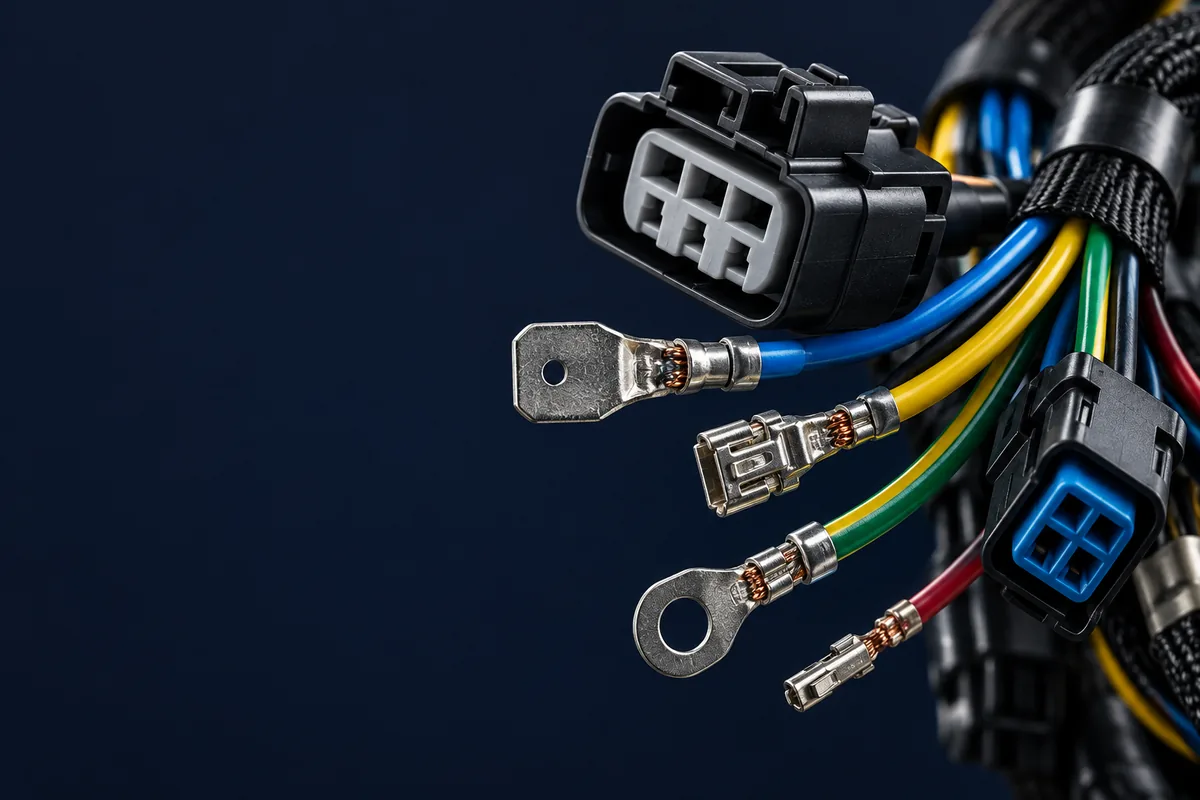
Real Project Snapshot — Drag Chain Cable Wire Harness Guide
Anonymized example from our case bank, shared so buyers can see how this scope is actually executed in production.
Industry: automotive | Region: Germany | Year: 2025-Q3 → 2025-Q4
Scenario: A German Tier-1 automotive supplier initiated contact seeking a global wire harness manufacturing partner, requiring rapid qualification across multiple regions.
Challenge: The customer needed quick validation of manufacturing capabilities, compliance (NDA, supplier code of conduct), and global coordination to issue multiple RFQs across North America, Europe, India, and South America within weeks.
Solution: Provided comprehensive company presentations, ISO/IATF certifications, and virtual reality factory tours of China and Philippines facilities. Swiftly executed NDAs and supplier codes of conduct, coordinating directly with the global lead buyer and regional buying teams.
Result: Successfully onboarded within two weeks, receiving at least 9 RFQs/RFIs across four global regions within the first four months of engagement.
Concrete numbers: 2 factory locations (China, Philippines), 9+ RFQs/RFIs received in 4 months, Onboarding completed in <14 days, ISO/IATF certifications provided
Technical Guide
Why Motion Changes the Cable Decision
How OEM Buyers Choose Continuous-Flex Cable for Robotics and Automation
A machine builder signs off a harness that works perfectly on the bench, then loses three weeks during pilot install because the cable jacket cracks inside the carrier, shield drain continuity becomes unstable after repeated motion, and the bend radius in the real machine is tighter than the drawing assumed. That failure pattern is common in robotics, gantry systems, automated handling equipment, and cable carrier applications. The first quote looked competitive, but the real cost arrived later through downtime, rework, sample loops, and expedited replacement builds.
This guide is written for OEM buyers, sourcing engineers, NPI teams, and automation designers who need a practical method for specifying drag chain cable inside a wire harness or cable assembly. It focuses on the decisions that actually move cost, lead time, and reliability: conductor class, jacket chemistry, shield construction, bend radius, torsion requirement, cycle-life evidence, and test scope. If you are buying assemblies for moving equipment, the cable is not just a line item. It is the mechanical life of the harness.
If your drawing is already ready for quotation, use our drag chain cable assembly service instead of this guide. That service page is scoped for connectorized cable-carrier builds, including bend-radius review, shield continuity, connector exits, strain relief, and release-test planning.
field-replacement cost versus catching the wrong flex cable during prototype or first article review
core inputs usually decide whether a drag-chain RFQ is quotable without clarification loops
continuity testing is the minimum expectation before shipping moving-cable assemblies
piece-price differences can be misleading if flex life, shielding, and installation radius are not defined together
Continuous-flex cable assemblies for robotics and industrial automation need different material and test logic than static wire harnesses.
Buyers already familiar with strain relief in wire harnesses and EMI shielding choices usually discover that motion combines those two problems. A moving harness is asked to survive repeated bending while still preserving electrical performance. That is why the most useful early design conversation is not “Which cable is cheapest?” but “What motion profile is the cable expected to survive, and how will we prove it before production release?”
1. Why Drag Chain Cable Is Different From Standard Wire Harness Cable
Standard wire harness cable is optimized for routing, installation, and normal service handling. Drag chain cable is optimized for controlled repetitive motion inside a cable carrier, sometimes combined with torsion, acceleration, oil exposure, weld spatter, washdown, or tight installation space. Those operating conditions change the material physics. Conductors must flex without work-hardening too quickly. Insulation must resist cold cracking and abrasion. The jacket must slide, not stick, in the carrier. Shield design must maintain coverage while bending. The assembly layout must prevent twist, crossover, and local stress concentration.
The hidden buying mistake is assuming that “flexible cable” and “continuous-flex cable” mean the same thing. They do not. A flexible cable may install nicely during assembly and survive occasional maintenance movement. A true drag-chain cable is designed for repeated cycles under a specified bend radius and travel profile. If the supplier is not asking about travel length, acceleration, speed, minimum radius, unsupported span, and whether torsion is present, the quote is missing the variables that actually decide service life.
For background on standards vocabulary, it helps to understand the role of the International Electrotechnical Commission in cable classification and the function of a cable carrier in automated machinery. Public references do not replace supplier validation, but they clarify why conductor class, jacket chemistry, and movement geometry matter so much more in dynamic service than in static wiring.
“In moving harness programs, we do not approve cable by data sheet adjectives like flexible or robotic grade alone. We want the motion profile, target bend radius, and at least one objective life claim tied to the actual construction. That discipline avoids expensive guesswork later.”
2. The Main Selection Factors Buyers Need to Lock Early
The first factor is conductor construction. Fine-stranded copper improves flex life, but the correct class still depends on the application. Buyers comparing static wire and dynamic wire should review strand class alongside ampacity and termination method. A cable that bends beautifully may still create problems if the chosen terminal, ferrule, or crimp process does not match the strand bundle. This is one reason dynamic harnesses often need a combined review of cable choice and termination strategy instead of separate purchasing decisions.
The second factor is insulation and jacket material. PVC may be acceptable for light-duty movement, but TPE, PUR, or other specialized compounds are often chosen where abrasion, oil, cold flex, or long cycle life matter. PUR jackets usually cost more, yet they often reduce total ownership cost because they resist cuts and surface wear better in compact carriers. The correct choice depends on chemicals, temperature window, carrier fill, and whether the harness also needs washdown resistance similar to programs in industrial automation or repeated motion in robotics cable assemblies.
The third factor is shielding. A moving VFD cable, encoder cable, or hybrid power-and-signal assembly can fail functionally before it fails mechanically if the shield design is wrong. Foil offers high optical coverage but may not be the best answer for demanding continuous motion by itself. Braids, served shields, or composite constructions may survive movement better depending on the cable design. The buyer should define whether EMI control is critical, whether the shield must terminate 360 degrees at a backshell, and whether the cable will run near motors, drives, or switching power electronics.
The fourth factor is bend radius and installation geometry. This is where many RFQs break down. The cable supplier may quote to the cable’s catalog minimum bend radius, while the machine designer intends to force the assembly through a tighter path around brackets, clamps, or bulkheads. If the installed geometry is tighter than the validated movement window, early failure should not be treated as a supplier surprise. It was a definition gap. When the application includes branch points, backshells, or molded exits, combine the cable review with the transition design. In some programs, an overmolded exit or better breakout support is as important as the cable itself.
The fifth factor is validation evidence. Buyers should ask what the cycle-life claim actually means. Was the cable tested in a real drag-chain setup or only in a simplified bend test? Was the shield continuity monitored during motion? Were temperature and chemical conditions included? Was torsion tested, or only reciprocating bend? A marketing statement without a test method is not engineering evidence.
3. Comparison Table: Common Continuous-Flex Cable Options
| Cable Construction | Best Fit | Main Advantage | Main Limitation | Buyer Note |
|---|---|---|---|---|
| Standard PVC flexible cable | Light-duty movement, low-cycle utility wiring | Low cost and broad availability | Weak abrasion and shorter continuous-flex life | Do not assume it is suitable for continuous-duty carrier motion |
| TPE continuous-flex cable | Industrial automation, moderate-to-high cycling | Good balance of flex life, cold flexibility, and cost | Not every TPE construction handles oil or weld splash equally | Ask for the tested bend radius and cycle conditions |
| PUR jacket drag-chain cable | High abrasion, oily, compact carrier environments | Strong surface durability and good mechanical life | Higher material price and sometimes longer lead time | Total cost can still be lower if replacement downtime matters |
| Shielded encoder / servo cable | Drives, feedback loops, motion control systems | Combines EMC control with dynamic cable design | Shield termination and grounding become more critical | Define connector backshell, braid termination, and routing early |
| Torsion-rated robotic cable | Robot wrists, articulated joints, twisting axes | Handles combined bend and twist better than carrier-only cable | May be over-specified and over-priced for straight carrier travel | Separate torsion requirement from simple drag-chain motion |
| Hybrid power-plus-signal cable | Space-constrained machine assemblies | Reduces routing count and installation labor | Harder to validate for heat, EMI, and motion together | Require a clear test plan before approving the simplification |
The table should not be used as a shortcut to skip sample validation. It is a sourcing framework. A lower-cost cable can still be the right answer when travel is short, duty cycle is light, and replacement access is easy. A premium construction is justified when machine downtime, field service cost, or warranty exposure is large. That is the real buying lens.
“A cable that costs 18% more but lasts 4 times longer in the carrier is usually the cheaper cable in production reality. Buyers get into trouble when they compare only meter price and ignore machine downtime, service labor, and the cost of repeating qualification.”
4. Failure Modes, Validation, and What to Test Before Release
The most common failure mode is conductor breakage near a fixed clamp or transition point, not in the middle of the free cable span. That means the assembly layout matters as much as the raw cable selection. A technically correct drag-chain cable can still fail early if the branch breakout is unsupported, if a zip tie creates a hard local pinch, or if the assembly exits the carrier with too little strain relief. That is why buyers should review fixture points, clamps, breakout protection, and connector exit geometry together with cable selection.
The second failure mode is jacket abrasion or sticking inside the carrier. Fill ratio, divider strategy, and whether unlike cables rub against each other all affect life. The third failure mode is electrical instability caused by shield damage, drain-wire fatigue, or intermittent conductor cracking before total open circuit appears. In motion applications, continuity and hipot are useful, but they are not the whole story. Some programs also need resistance trend checks, shield continuity review, or application-specific functional testing.
The fourth failure mode is approving the wrong test. A cable may pass a short lab flex test and still fail in the machine because the actual system adds torsion, side load, temperature swing, or chemicals. Buyers should align validation to the real operating profile: travel length, acceleration, carrier type, cable separation method, temperature, oil exposure, washdown, and the exact connectorized assembly rather than loose bulk cable only. If the program is high risk, require first-article evidence tied to the final assembly drawing, not just a generic cable family brochure.
Where workmanship matters, reference the same inspection discipline used elsewhere in harness production, including crimp acceptance logic and documentation similar to IPC/WHMA-A-620 inspection practice. Drag-chain assemblies are not exempt from normal harness quality rules simply because the cable itself is specialized.
“The worst dynamic-cable failures are the ones that look random: one intermittent encoder fault after 200 hours, then nothing for days, then a hard open during customer FAT. Those cases usually come from incomplete validation at the transition points, not from a dramatic cable defect you could see on day one.”
5. RFQ Checklist, Cost Drivers, and Approval Rules
A strong RFQ for drag-chain cable should remove ambiguity before pricing. Send the assembly drawing, cable part number if already defined, conductor count, power and signal loading, connector part numbers, target bend radius, carrier type if known, travel length, motion speed, acceleration profile, temperature window, chemical exposure, shield requirement, quantity split, target lead time, and compliance target such as UL, IPC/WHMA-A-620, or customer-specific validation. If you already have a failing field sample, send that too. A failed sample often explains more than a generic “need robotic cable” note.
The main cost drivers are not just cable price per meter. They include shielding complexity, custom hybrid construction, connector backshells, molded exits, test-fixture burden, imported connector lead times, and whether the supplier must build first articles before the final motion profile is frozen. Buyers should also state whether alternates are allowed. In moving applications, an unapproved alternate may change jacket friction, overall diameter, shield geometry, or flex life even when the electrical rating looks similar on paper.
The safest approval path is staged. First, lock the motion profile and installation space. Second, review one or two candidate constructions with the supplier. Third, build samples with the real connector exits and breakout support. Fourth, validate in either the real carrier or an agreed equivalent test. Finally, freeze the approved cable construction and any critical assembly instructions before releasing volume production. That process is slower than a catalogue purchase, but much faster than discovering the wrong cable after installation.
Checklist
Send This With the RFQ
- Harness drawing or cable assembly print with revision level
- BOM or target cable construction, conductor count, and connector part numbers
- Minimum bend radius, travel length, speed, acceleration, and whether torsion exists
- Environment: oil, coolant, weld area, washdown, UV, cold flex, or chemical exposure
- Required testing: continuity, hipot, shield continuity, cycle validation, or functional test
- Quantity split by prototype, pilot, and annual volume plus target lead time
- Compliance target and rules for approved alternates
Approve Before Production
- Sample build matches the final connector exit and branch geometry
- Installed bend radius is confirmed in the real machine layout
- Shield termination, backshell, and grounding method are frozen
- Validation scope matches the real motion profile, not a simplified assumption
- Any alternate cable or jacket compound is documented before release
Frequently Asked Questions
What is the difference between flexible cable and drag chain cable?
Flexible cable usually means the cable handles installation and occasional movement without damage. Drag chain cable is engineered for repeated motion inside a cable carrier under a defined bend radius and travel profile. For OEM buying, that difference changes conductor class, jacket compound, shield design, and validation requirements.
When do I need a torsion-rated cable instead of a drag-chain cable?
You need a torsion-rated cable when the assembly twists around its axis, such as on robot wrists or rotating joints. A carrier-only application with straight reciprocating motion may not need torsion construction. Mixing those two use cases is a common RFQ mistake and can add unnecessary cost or create early failure.
Is PUR always better than PVC for continuous-flex cable?
No. PUR is often better for abrasion and oily industrial environments, but it is not automatically the best answer for every machine. The correct choice depends on flex duty, temperature, chemicals, carrier geometry, and budget. Buyers should compare total service life and downtime risk, not only raw material price.
What should I ask a supplier to prove continuous-flex life?
Ask for the tested bend radius, cycle count, travel setup, temperature conditions, and whether the evidence applies to loose cable or the final connectorized assembly. If EMI matters, also ask how shield continuity was handled during motion testing. A marketing claim without a test condition is not enough for production approval.
Can I substitute a standard control cable if the machine only moves occasionally?
Sometimes yes, but only if the actual duty is light and the replacement risk is acceptable. Define the movement frequency, maintenance access, and consequence of field failure before making that tradeoff. A low-cost cable can become expensive quickly if replacement requires machine downtime or customer-site service.
What should I send for a drag-chain cable assembly quote?
Send the drawing, BOM, quantity, environment, target lead time, and compliance target, plus the movement profile: bend radius, travel length, speed, acceleration, and whether torsion is present. Also include connector part numbers, shielding needs, and any known test requirement so the quote reflects the real build rather than a generic cable assumption.
External Resources
Cta
Title: Need a Drag-Chain Cable Assembly Reviewed Before You Quote?
Send your drawing, BOM, quantity, environment, target lead time, compliance target, and the real motion profile: bend radius, travel length, speed, acceleration, and whether torsion is present. We will review cable construction, connector exits, shielding, breakout support, and test scope before quoting.
Primarybutton: Request a Drag-Chain Cable Quote
Secondarybutton: Contact Engineering
Badges
- Continuous-flex and torsion-risk review
- Connector exit and breakout support check
- Validation and test-scope recommendation
Rfqtitle: Send This With Your RFQ
Rfqitems
- Drawing, BOM, cable construction target, and connector part numbers
- Quantity split, environment, target lead time, and compliance target
- Carrier travel, bend radius, acceleration, speed, and torsion requirement
- Testing expectation: continuity, hipot, shield continuity, or motion validation
Deliverablestitle: What You Get Back
Deliverablesitems
- Recommended cable construction and risk notes
- DFM feedback on exits, shielding, and branch support
- Suggested validation scope for sample approval
- Quote with lead-time and alternate-control assumptions