Blog/Technical Guide

Aerospace Wire Harness Manufacturing: Standards, Materials & Qualification Guide

Everything you need to know about aerospace wire harness manufacturing—from AS9100 certification to MIL-SPEC materials to supplier qualification and emerging eVTOL trends.

Hommer Zhao
February 26, 2026
16 min read
$6.81B

Aerospace harness market 2025

5.51%

CAGR through 2030

340

Man-hours for complex harness

24+ hrs

Testing for 6,000+ connections

Aerospace wire harness comprehensive testing equipment in a certified facility

Comprehensive testing equipment used in aerospace wire harness production and qualification

Aerospace wire harnesses are among the most demanding products in electrical manufacturing. When a harness failure in a consumer appliance means a warranty claim, a failure in an aircraft can mean catastrophic loss. That reality shapes every decision—from the wire insulation you select to the way you document a single crimp termination.

This guide covers the complete landscape of aerospace wire harness manufacturing: the standards that govern every process, the materials qualified for flight, the step-by-step production workflow, and the qualification journey that separates aerospace-grade manufacturers from the rest. Whether you are an OEM engineer evaluating suppliers or a manufacturer considering entry into the aerospace wire harness market, this is the reference you need.

What Is an Aerospace Wire Harness?

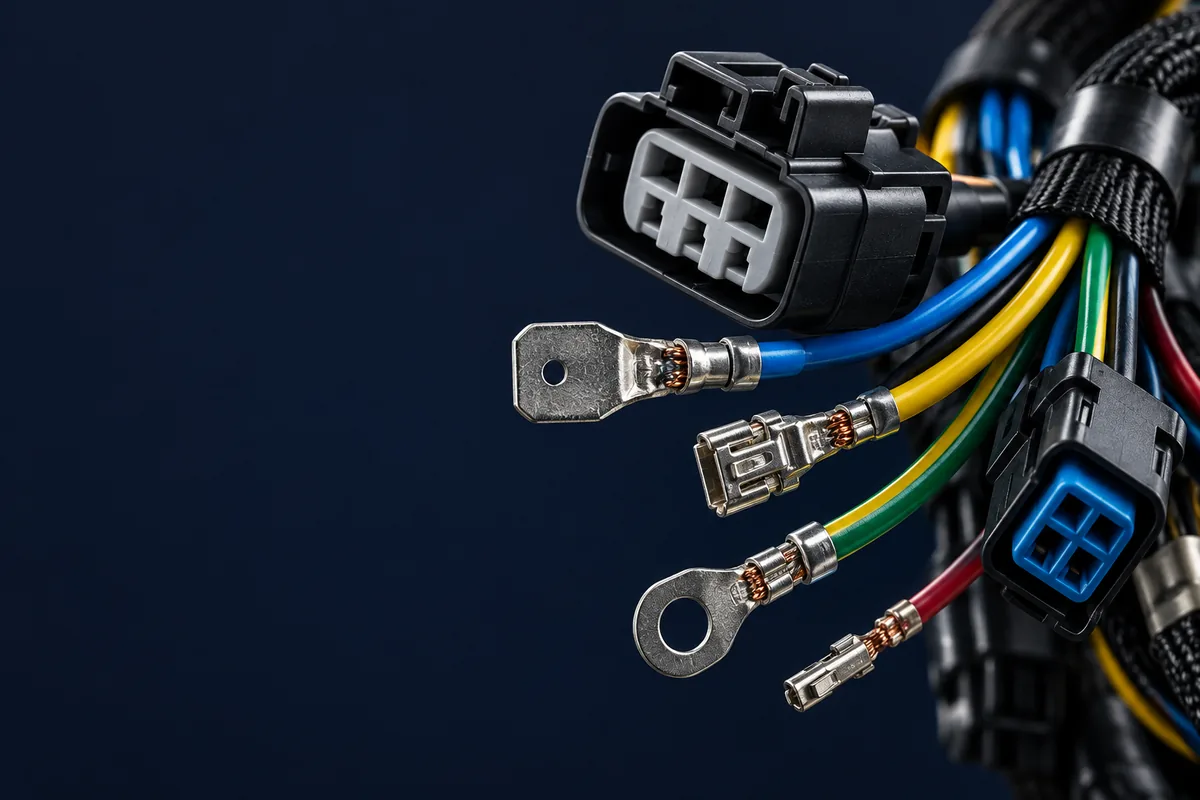
An aerospace wire harness is a bundled assembly of wires, cables, connectors, and protective components that routes electrical power and signals throughout an aircraft, satellite, or spacecraft. Unlike loose wiring, a harness is pre-assembled on a form board, tested as a unit, and installed as a single integrated component. A modern commercial aircraft contains hundreds of individual harnesses comprising thousands of components and miles of wire.

Three Core Functions

Power Transmission

Delivering electrical power from generators and batteries to avionics, actuators, lighting, and environmental systems across the entire airframe.

Signal Routing

Carrying data between sensors, flight computers, communication systems, navigation equipment, and cockpit displays at high speed and integrity.

System Regulation

Integrating circuit protection, grounding networks, and shielding to ensure electromagnetic compatibility and safe fault management.

Application Zones

Aerospace harnesses serve every zone of an aircraft: the cockpit instrument panel, avionics bay, engine quick engine change (QEC) harnesses exposed to extreme heat and vibration, wing and fuselage interconnect runs spanning dozens of meters, landing gear assemblies, and tail section control surfaces. Each zone presents unique environmental challenges—temperature extremes, fluid exposure, vibration profiles, and EMI environments—that dictate material and design choices.

Commercial Aviation vs Military/Defense

ParameterCommercial AviationMilitary / Defense
Primary standardAS9100 + FAA ACMIL-STD / MIL-DTL + AS9100
WorkmanshipIPC/WHMA-A-620 Class 2/3IPC/WHMA-A-620 Class 3 (mandatory)
Wire specAS22759 (ETFE/PTFE)M22759 (MIL-SPEC qualified)
ConnectorsVarious per OEMMIL-DTL-38999, MIL-DTL-83723
ITARRarelyFrequently required
EMI shieldingPer DO-160Per MIL-STD-461
TraceabilityFull lotFull lot + counterfeit avoidance
Temp range-55°C to +175°C-65°C to +260°C

Critical Standards & Certifications

Aerospace wire harness manufacturing is governed by an interlocking framework of standards that cover design, materials, workmanship, quality management, and export control. No single certification is sufficient—manufacturers must maintain compliance across all applicable standards simultaneously.

SAE AS50881

SAE AS50881 (formerly MIL-W-5088) is the foundation standard for aerospace wiring. It defines requirements for wire current capacity based on altitude and ambient temperature derating, marking and identification methods, routing and clamping specifications, and separation of redundant circuits. Every aerospace harness design begins with AS50881 compliance. It is the document that tells you what gauge wire to use for a given current at a given altitude, how to mark each wire for identification, and how to route harnesses to prevent chafing and heat damage.

IPC/WHMA-A-620

IPC/WHMA-A-620 is the industry-consensus standard for cable and wire harness workmanship acceptance. It defines three classes of product: Class 1 (general electronic), Class 2 (dedicated service electronic), and Class 3 (high-reliability electronic). Aerospace applications require Class 3, which mandates the tightest tolerances and zero acceptance of defects that Class 2 permits as "acceptable." The latest revision, A-620F (published 2025), includes over 700 color photographs illustrating accept/reject criteria for crimping, soldering, wire dressing, connector assembly, and harness protection. Certified IPC Trainers (CIT) and Certified IPC Specialists (CIS) provide the training and certification infrastructure that ensures every operator on the production floor understands these acceptance criteria.

AS9100

AS9100 is the aerospace quality management system standard, built on ISO 9001 with additional requirements specific to aviation, space, and defense. Key additions over ISO 9001 include configuration management, risk management throughout the product lifecycle, first article inspection requirements per AS9102, requirements for operational risk assessment, special process controls, and counterfeit part prevention. AS9100 certification is the baseline requirement—without it, most aerospace OEMs and Tier 1 integrators will not consider a supplier for evaluation.

NAVAIR 01-1A-505-1 & FAA Advisory Circulars

For military applications, NAVAIR 01-1A-505-1 is the definitive technical manual for aircraft wiring repair and installation. It provides detailed procedures for every aspect of harness work on military platforms. On the commercial side, FAA Advisory Circular AC 25.1701-1 establishes requirements for Enhanced Airworthiness Program for Airplane Systems (EWIS) certification, which treats the wiring system as a safety-critical aircraft system requiring dedicated maintenance and inspection programs throughout the aircraft's service life.

ITAR and Export Compliance

The International Traffic in Arms Regulations (ITAR) govern the export and import of defense-related articles and services on the US Munitions List (USML). Manufacturers producing harnesses for military aircraft, missiles, or defense electronics must register with the Directorate of Defense Trade Controls (DDTC). ITAR compliance means that controlled technical data cannot be shared with non-US persons, facilities must have physical and cyber security controls, and all employees with access to ITAR data must be US persons. Violations carry severe civil and criminal penalties.

"The biggest mistake I see from manufacturers entering the aerospace space is treating IPC/WHMA-A-620 Class 3 as just another checkbox. It is not—it is a fundamentally different manufacturing philosophy that demands zero tolerance for process variation. Every crimp, every solder joint, every wire route must be perfect and documented."

HZ

Hommer Zhao

Founder, WellPCB Wire Harness Production

Materials Selection

Material selection in aerospace is not a performance-versus-cost tradeoff—it is a performance-versus-safety mandate. Every material in a flight-certified harness must appear on a Qualified Products List (QPL) or be individually qualified through testing. There is no room for "equivalent" substitutions without full requalification.

Conductors & Wire Gauges

Copper remains the dominant conductor material for aerospace harnesses due to its superior conductivity, fatigue resistance, and well-established termination processes. Aluminum conductors are used in weight-critical applications where the 40% weight savings justifies the additional complexity of aluminum-to-copper transitions and specialized termination techniques. The M22759 series (MIL-SPEC) defines the most commonly used aerospace wire constructions. Wire gauges typically range from 16 AWG for power distribution down to 30 AWG for low-current signal applications, with the specific gauge determined by AS50881 derating tables based on current, altitude, and bundle configuration.

Insulation Materials

Insulation selection is critical for aerospace wire performance and safety. The primary insulation materials used in aerospace applications include:

ETFE (Tefzel)

Excellent chemical resistance, lightweight, good mechanical strength. Temperature range -65°C to +150°C. The workhorse insulation for most commercial aerospace wiring.

PTFE (Teflon)

Superior temperature resistance up to +260°C. Excellent chemical inertness. Used in engine zone and high-temperature environments where ETFE cannot survive.

FEP

Good balance of temperature resistance (-65°C to +200°C) and processability. Lower friction coefficient makes it suitable for tightly bundled harness runs.

Cross-Linked ETFE

Radiation cross-linking enhances temperature and abrasion resistance beyond standard ETFE. Increasingly used in next-generation aircraft programs.

Critical: No PVC in Aerospace

PVC is prohibited in aerospace applications due to toxic hydrogen chloride gas emission when burned. Additionally, Kapton (polyimide) insulation—once widely used—is being phased out of new designs due to arc-tracking risk, where damaged insulation can create a conductive carbon path leading to sustained arcing and fire. All insulation must survive 1,100°C flame exposure for 6 minutes per applicable fire test standards.

Connectors

The aerospace connector landscape encompasses over 3,200 MIL-SPEC part numbers across multiple families. MIL-DTL-38999 circular connectors dominate high-performance applications with their bayonet or threaded coupling, environmental sealing, and EMI shielding capabilities. MIL-DTL-83723 connectors serve similar roles with different form factors. MIL-DTL-5015 connectors remain in use for legacy platforms and ground-support equipment. Each connector family includes variants for different shell sizes, insert arrangements, contact types (pin and socket), and plating options (gold, silver, nickel).

Shielding & Protection

EMI shielding is essential for aerospace harnesses operating near radar, communication systems, and high-power electronics. Traditional braided copper shielding provides 60-80 dB attenuation but adds significant weight. Metalized Kevlar shielding represents a major advancement—75% lighter than copper braid while achieving 65 dB attenuation at 1 GHz. Additional protection includes heat-shrink tubing for environmental sealing, braided sleeving for abrasion resistance, and rigid or flexible conduit for routing through high-risk zones. For a deeper dive into material specifications, see our wiring harness materials guide.

Manufacturing Process: Step by Step

Aerospace wire harness manufacturing follows a rigorous seven-step process where each stage builds upon verified outputs from the previous stage. Unlike commercial harness production where speed drives efficiency, aerospace production prioritizes traceability, verification, and documentation at every step.

1

Engineering Review & Design

Production begins with a thorough engineering review of the customer's Aircraft Vendor Standard (AVS) documents, wiring diagrams, and harness drawings. Engineers interpret the design intent, verify component compatibility, create CAD models for form board layout, and identify any design-for-manufacturability concerns. This stage catches issues before a single wire is cut—preventing costly rework downstream.

2

Material Procurement & Incoming Inspection

All materials must be procured from approved sources with full Certificates of Conformance (C of C). Incoming inspection verifies part numbers, lot codes, and physical characteristics against purchase orders. Counterfeit avoidance procedures per AS6174 and AS6081 are mandatory—every component is verified against the manufacturer's documentation. Suspect or counterfeit parts are quarantined and reported through the Government-Industry Data Exchange Program (GIDEP).

3

Wire Preparation, Cutting & Marking

Wires are cut to length per the engineering drawing and marked with identification codes per AS50881 requirements. Marking must be permanent, legible, and resist environmental exposure throughout the aircraft's service life. Laser marking and hot-stamp methods have largely replaced ink-jet marking for aerospace applications due to superior durability. Each wire is tracked by part number, lot, and cut date.

4

Crimping, Soldering & Termination

Termination is the most quality-critical step in harness manufacturing. Crimp terminations must meet IPC/WHMA-A-620 Class 3 requirements for crimp height, bellmouth, conductor visibility, and insulation grip. Every crimp is verified with calibrated go/no-go gauges or crimp force monitors. Soldered connections follow IPC J-STD-001 Class 3 with pull-test verification. Ultrasonic welding is used for specific aluminum conductor applications. Each termination is documented with operator ID, tool serial number, and inspection results.

5

Harness Assembly on Form Board

Terminated wires are routed and assembled on a full-scale form board (assembly jig) that replicates the aircraft installation geometry. This is a predominantly manual process requiring highly skilled technicians. A complex aerospace harness with hundreds of breakouts and thousands of termination points can require 340 man-hours or more to assemble. Technicians apply lacing, cable ties, braided sleeving, heat-shrink boots, and connector backshells according to the engineering drawing. Every branch, breakout, and dimensional callout is verified during assembly.

6

Inspection & Testing

Testing is the final verification gate before delivery. Aerospace harness testing is comprehensive and time-intensive:

  • Continuity testing: 0.5A at 0.2 second dwell per point, verifying every circuit path end-to-end
  • Insulation resistance: 1,500 VDC applied between conductors, requiring greater than 100 megohms resistance
  • Hi-pot (dielectric withstand): Verifying insulation integrity under overvoltage conditions
  • Environmental testing: Per RTCA DO-160 (commercial) or MIL-STD-810 (military) for vibration, temperature, humidity, and altitude

For a complex harness with 6,000 or more connection points, the complete testing sequence can require 24 hours or more of continuous automated testing. For more information on testing methodologies, see our wire harness quality testing methods guide.

7

Documentation & Delivery

The documentation package delivered with each harness is extensive: complete electrical test reports with pass/fail data for every point, material certificates and lot traceability records, process records for special processes (crimping, soldering), First Article Inspection reports per AS9102 (for initial production), dimensional inspection reports, and Certificate of Conformance. In aerospace, the paperwork often weighs more than the harness itself—and it must be archived for the life of the aircraft program (typically 30+ years).

"In aerospace harness manufacturing, documentation is not paperwork—it is the product. If you cannot prove every wire was cut to spec, every crimp was verified, and every test was passed, then the harness does not exist in the eyes of the customer or the FAA."

HZ

Hommer Zhao

Founder, WellPCB Wire Harness Production

Qualification & Supplier Approval

Becoming a qualified aerospace wire harness supplier is a multi-year journey that represents a significant investment in systems, facilities, and personnel. Unlike commercial industries where a manufacturer can win business with competitive pricing and sample approval, aerospace qualification requires demonstrated capability across every dimension of quality, traceability, and process control.

The Qualification Journey

AS9100 Certification (12-18 months)

The foundation of aerospace qualification. Requires building or upgrading your quality management system to meet all AS9100 clauses, conducting internal audits, and passing a third-party registrar audit. Most manufacturers need 12-18 months from decision to certificate, including gap analysis, system development, implementation, and audit cycles.

IPC/WHMA-A-620 CIT/CIS Certification

Operators must be certified to IPC/WHMA-A-620 Class 3 standards. This requires training through a Certified IPC Trainer (CIT), hands-on practical examination, and recertification every two years. A facility typically needs multiple CIS-certified operators and at least one CIT for ongoing training capability.

Nadcap Accreditation

The National Aerospace and Defense Contractors Accreditation Program (Nadcap) provides special process accreditation for activities such as cable and harness assembly, soldering, and chemical processing. Nadcap audits are exceptionally thorough and focus on process control rather than product inspection. Initial accreditation typically takes 6-12 months and involves significant audit costs.

Customer Audits & Approval

Even with third-party certifications, major aerospace OEMs and Tier 1 suppliers conduct their own supplier audits. These can last 2-5 days and cover every aspect of your operation. Passing these audits is required before receiving production orders.

First Article Inspection per AS9102

First Article Inspection (FAI) is a formal process that verifies the production process is capable of producing parts that meet all engineering requirements. Per AS9102, FAI requires three forms: Form 1 (Part Number Accountability), Form 2 (Product Accountability for raw materials and special processes), and Form 3 (Characteristic Accountability for every dimension and feature on the drawing). Common FAI failure reasons include incomplete material traceability, missing special process certifications, dimensional discrepancies from drawing requirements, and inadequate test data documentation.

Facility & Personnel Requirements

Aerospace harness production requires ESD-controlled work areas, calibrated tooling with full traceability to national standards, climate-controlled material storage, and Foreign Object Debris (FOD) prevention programs. Personnel requirements include a minimum 2-month technician training program before independent production work, plus customer-specific certification requirements that can add additional weeks of training. Operators must demonstrate proficiency in crimping, soldering, wire preparation, and harness assembly before being authorized to work on production units.

Common Qualification Pitfalls

Document Control Gaps

Incomplete or outdated procedures are the number one audit finding. Every process must have a current, controlled work instruction.

Non-QPL Materials

Using materials not on the Qualified Products List will fail any audit. All materials must be QPL-listed or individually qualified.

Nadcap Cost & Timeline

Manufacturers often underestimate the cost and timeline for Nadcap. Budget 6-12 months and significant audit fees plus corrective action costs.

Missing Process FMEA

Process Failure Mode and Effects Analysis must be completed for every manufacturing step before production begins. Retroactive FMEAs rarely pass audit scrutiny.

Market Data at a Glance

The aerospace wire harness market is experiencing sustained growth driven by increasing aircraft production rates, defense modernization programs, and the emergence of new aviation platforms including eVTOL and unmanned systems.

MetricValue
Market size 2025$6.81 billion
Projected 2030$8.90 billion
CAGR5.51%
Largest marketNorth America
Boeing 787 weight savings30% vs older platforms
eVTOL demand China 203016,316 units
Drone market share 202926.7% of revenue
Complex harness test time24+ hours

Frequently Asked Questions

What is the difference between IPC/WHMA-A-620 Class 2 and Class 3?

Class 2 (Dedicated Service Electronic) permits certain minor defects as "acceptable" that Class 3 (High-Reliability Electronic) classifies as defects requiring rejection or rework. Class 3 demands zero tolerance for workmanship variations — every crimp height, solder joint, wire dress, and dimensional requirement must meet the tightest specifications. All aerospace and military applications require Class 3 compliance.

Which wire insulation is best for aerospace applications?

ETFE (Tefzel) and PTFE (Teflon) dominate aerospace wire insulation. ETFE is the standard choice for most applications (-65°C to +150°C), while PTFE is used for high-temperature zones up to +260°C. PVC is strictly prohibited due to toxic gas emission. Kapton (polyimide) is being phased out of new designs due to arc-tracking risk. Cross-linked ETFE is increasingly specified for next-generation programs.

How long does it take to become a qualified aerospace wire harness manufacturer?

Minimum 18-24 months from decision to first production order. This includes 12-18 months for AS9100 certification, concurrent IPC/WHMA-A-620 CIT/CIS certification, 6-12 months for Nadcap accreditation if required, and additional time for customer-specific audits and first article approval. Many manufacturers report 2-3 years before receiving their first significant production contract.

What are the most common causes of aerospace wire harness failures?

The four most common failure modes are chafing (wire insulation wearing through due to contact with structure or other harnesses), heat distress (insulation degradation from operating above rated temperature), moisture ingression (particularly in connectors without adequate environmental sealing), and crimp height errors (improper crimp resulting in high-resistance connections that generate heat under load).

Is ITAR required for all aerospace wire harnesses?

No. ITAR applies only to defense articles and services listed on the US Munitions List (USML). Commercial aviation harnesses for civil aircraft programs typically do not require ITAR compliance. However, any harness destined for military aircraft, missiles, defense electronics, or items with dual-use potential may fall under ITAR. When in doubt, consult with an export compliance attorney before accepting the contract.

How is EMI shielding tested on aerospace wire harnesses?

EMI shielding effectiveness is verified per RTCA DO-160 Section 20 (commercial) or MIL-STD-461 (military). Testing includes both radiated emissions and radiated susceptibility measurements across a wide frequency range. Transfer impedance testing per MIL-STD-1344 measures the shielding effectiveness of individual cables. A well-designed braided copper shield typically achieves 60-80 dB attenuation, while metalized Kevlar achieves approximately 65 dB at 1 GHz.

Need an AS9100-Certified Wire Harness Partner?

With over 20 years of manufacturing experience and dedicated aerospace engineering support, we deliver flight-ready harnesses that meet the most demanding qualification requirements.

External Resources