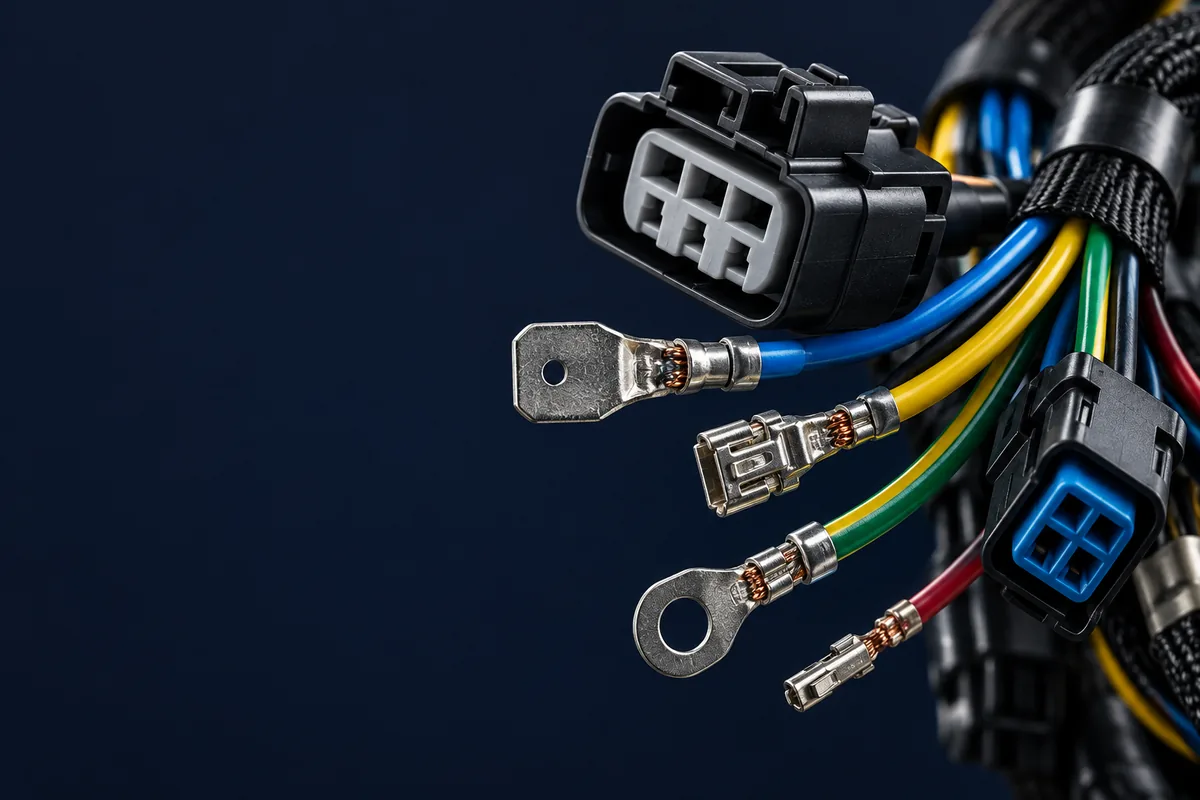
In 2022-Q4, a US smart-hardware distributor faced a severe quality rejection from a Tier-1 CM end-customer on custom cable assemblies. The rejection combined contact crimping issues, incorrect cable labeling, and dimensional non-conformities. We appointed a dedicated quality manager, added 100% production inspection plus extra outgoing quality control, remade samples, and the customer still placed a 500-piece order pre-approval, leading to a multi-year partnership (2022-2026).
A cable assembly quality recovery plan is a controlled containment and corrective-action process that turns a rejected shipment into verified replacement samples, buyer-visible evidence, and repeatable production controls. For engineers and sourcing managers already past first sample approval, the objective is not a polite apology. The objective is to isolate the defect family, protect the end customer, rebuild trust with records, and prevent the same crimp, label, or dimensional error from reaching the next lot.
TL;DR
- Separate containment, root cause, sample remake, and production release into different gates.
- Use IPC-A-620 for workmanship review and IATF 16949-style corrective-action discipline.
- Crimp, label, and dimensional defects need different evidence, not one generic inspection report.
- 100% inspection is temporary containment; the long-term fix must change process controls.
- Release the next lot only after OQC records match the revised drawing and control plan.
Why Rejected Cable Assemblies Need a Recovery Plan
A production rejection is different from a prototype comment. A prototype comment says the design still needs adjustment. A production rejection says the buyer expected repeatability and did not get it. Once the assembly is inside a Tier-1 CM review process, every weak answer from the supplier creates more risk for the distributor, OEM buyer, and end customer.
Containment is the first action that prevents suspect material from moving forward while the factory investigates the defect. In cable assembly work, containment usually means stopping shipment, identifying affected lots, separating work-in-process, checking warehouse stock, locking inspection status, and assigning one owner to communicate facts. Without containment, even a correct root-cause analysis arrives too late.
Outgoing quality control, or OQC, is the final inspection gate before finished cable assemblies leave the factory. OQC should verify electrical test records, visual condition, label correctness, dimensions, connector orientation, packaging, and customer-specific records. In a recovery project, OQC becomes more than a shipment checklist. It becomes the buyer's proof that the rebuilt lot was checked against the revised control plan.
Corrective action is a documented change that removes or controls the cause of a nonconformance. For cable assemblies, corrective action might mean changing crimp applicator setup approval, adding a label scan step, revising a fixture stop, requiring a first-piece dimensional photo, or changing how inspectors record cavity position. It should not be reduced to "operator retraining" unless the evidence proves training was the real cause.
When a rejected cable assembly has crimp, label, and dimensional findings together, I do not treat it as one defect. I split the problem by process step, then make each step prove its own recovery.
— Hommer Zhao
The standards baseline should be visible in the recovery file. IPC-A-620 gives buyers and suppliers a common acceptance language for cable and wire harness workmanship, including crimping, insulation damage, terminal seating, labeling, and final assembly condition. IATF 16949 provides a useful model for nonconforming-product control, corrective action, traceability, and production release discipline. ISO 9001 supports the same logic for documented processes and supplier quality systems outside automotive programs.
Triage the Rejection Before Touching Production
The first 24 hours should produce a factual defect map, not a final answer. Ask the buyer for photos, rejected sample IDs, inspection notes, drawing revision, lot number, shipment quantity, and whether any assemblies were already installed. Then compare those findings against the factory traveler, BOM, connector lot, terminal lot, wire lot, label file, test fixture record, and final inspection checklist.
Do not let the factory remake samples before this triage is complete. A fast remake may satisfy the buyer for a day, but it can also destroy evidence. Keep suspect samples, open several units from the same lot, and separate defects by process family: crimping, connector insertion, wire length, label content, label position, branch dimension, continuity, polarity, packaging damage, or documentation mismatch.
For the US smart-hardware case, the combined rejection looked chaotic at first because contact crimping issues, incorrect cable labeling, and dimensional non-conformities appeared in the same customer review. Once split by process step, the recovery path became practical: crimp process verification, label file and traveler verification, dimensional fixture review, then 100% inspection against the updated control plan.
Quality Recovery Decision Table
The table below shows how to decide what evidence belongs to each defect family. A recovery plan fails when every defect receives the same answer, such as "we will inspect more carefully." Each category needs its own control point and release record.
| Defect Family | Likely Risk | Immediate Containment | Corrective Control | Release Evidence |
|---|---|---|---|---|
| Contact crimping issue | Intermittent open circuit, heat rise, pull-out failure | Stop affected terminal lot and inspect all suspect crimps | Crimp height setup, pull-force sample, applicator check | Crimp records, photos, continuity, retention data |
| Incorrect cable label | Wrong installation, traceability loss, field replacement error | Quarantine labeled stock and compare traveler to label file | Approved label master, scan check, first-piece signoff | Label photos, traveler match, OQC checklist |
| Dimensional nonconformance | Harness cannot fit enclosure, strain point shifts, service loop fails | Measure retained samples and work-in-process against drawing | Fixture stop, cut length, branch board, measuring method | Dimensional report, fixture photo, sample approval |
| Connector cavity or orientation error | Polarity fault or customer-side assembly stop | 100% pinout check and connector visual verification | Cavity map, keyed fixture, insertion sequence check | Pinout report, cavity photos, inspector signoff |
| Missing test or document record | Buyer cannot approve shipment even if parts function | Hold shipment until record traceability is reconstructed | Traveler lock, test file naming, lot-number requirement | Complete packet tied to drawing revision and lot |
| Packaging or handling damage | Bent pins, kinked cable, damaged labels after inspection | Open carton audit and inspect packed samples | Cap, tray, bend radius, bagging, carton orientation | Packing photos and post-pack inspection result |
Crimp Recovery Must Prove the Joint
Crimping is a mechanical and electrical joining process that compresses conductor strands into a terminal barrel with controlled deformation. A good crimp is not judged by whether the wire stays in place during casual handling. It is judged by conductor capture, insulation support, crimp height, absence of strand damage, terminal compatibility, pull performance, and stable electrical behavior.
When a rejection includes contact crimping issues, do not rely on continuity alone. Continuity can pass even when a crimp is weak, over-compressed, under-compressed, or made with the wrong strip length. The recovery file should identify terminal part number, wire gauge, insulation diameter, applicator, crimp height target, accepted tolerance, pull-force sampling rule, and who released the setup for production.
For buyer-facing communication, show the difference between containment and corrective action. Containment may be 100% visual inspection of suspect crimps plus electrical testing of all rebuilt assemblies. Corrective action may be a new first-piece crimp-height signoff, a recorded applicator inspection at shift start, a locked terminal reel number, or a revised work instruction that prevents the same wire from being loaded into a near-match terminal.
A cable can pass continuity and still have a weak crimp. After a rejection, I want crimp-height evidence, pull evidence, and photos tied to the terminal lot, not a single green pass mark from the tester.
— Hommer Zhao
If the original failure came from a crimp concern, review the deeper controls in our wire harness crimping guide. If the buyer needs production-level evidence rather than sample comments, pair that with the inspection logic in our wire harness quality testing methods article and the service scope on our wire harness testing service page.
Label and Dimension Recovery Need Visual Proof
Incorrect labels are not cosmetic when the assembly enters a customer's line. A wrong circuit ID, rotated marker, missing lot code, or label placed under tape can cause installation delays, rework, field confusion, and traceability gaps. In a recovery plan, the label master should be revision-controlled the same way the drawing and BOM are controlled.
Use a first-piece label approval before restarting production. That approval should show label text, font size, sleeve color, print direction, marker setback from breakout, orientation to service side, and traveler or lot code. If the customer supplied artwork or a serial-number rule, include that file reference in the recovery record. The inspector should compare physical labels against the approved master, not against memory.
Dimensional nonconformance needs a different review. A cable assembly can pass test and still fail because the branch length, breakout location, overmold position, connector clocking, or total length does not fit the customer's enclosure. Check whether the operator used the correct board, whether wire cut length changed after stripping, whether taped branches shifted under tension, and whether the measurement method matches the drawing datum.
Visual proof matters because the buyer is often trying to defend the supplier internally. Photos of the fixture, marked dimensions, label orientation, connector face, and final packed assembly give the buyer something concrete to show the CM end-customer. A paragraph saying "we improved inspection" does not protect the next incoming inspection meeting.
For label-specific prevention, compare the recovery file against our wire harness labeling and marking guide. For dimensional and sample-release discipline, our wire harness first article inspection guide gives a practical approval gate before the next production run.
When to Use 100% Inspection
100% inspection is a containment method that checks every unit for defined risks before shipment. It is appropriate after a severe rejection, during sample rebuild, and for the first controlled production lot after corrective action. It is not a permanent substitute for stable process control because humans miss defects when inspection becomes repetitive and poorly defined.
In the 2022-Q4 recovery case, 100% production inspection was justified because the customer was already at risk of canceling the program. We also added extra OQC steps so the factory did not rely only on operator self-checks. The goal was to rebuild samples with evidence fast enough to protect the program, then convert lessons from the inspection findings into normal production controls.
Define the inspection scope with exact checkpoints. For a rejected cable assembly, that can include crimp visual review, terminal retention sampling, continuity, polarity, label content, label position, overall length, branch length, connector orientation, overmold or boot condition, packaging, and document completeness. If the drawing has critical dimensions, inspect those dimensions with a fixture or gauge rather than a loose ruler.
100% inspection buys time after a serious rejection. It does not solve the process by itself. The real recovery is when the next normal lot passes with fewer inspection findings because the fixture, label file, and crimp setup were corrected.
— Hommer Zhao
Buyer Communication and Release Gates
A recovery plan should give the buyer a timeline with gates. Gate 1 is containment: affected lots, shipment hold, sample IDs, and initial defect map. Gate 2 is root-cause confirmation: process step, evidence, and why the defect escaped. Gate 3 is sample remake: controlled build records and inspection proof. Gate 4 is production restart: revised control plan, OQC record, and buyer approval for release.
Keep the communication factual. State what is known, what is still under investigation, what material is held, which samples are being remade, when records will be delivered, and what changed before restart. Avoid promising that a defect will never happen again. A better promise is a control plan that makes the same defect visible earlier and harder to ship.
The buyer also needs a decision rule. Minor cosmetic label alignment might be accepted with documented correction if traceability, installation, and service readability are not affected. A marginal crimp, missing test evidence, wrong connector cavity, critical branch length error, or mismatched drawing revision should trigger rebuild or formal deviation approval before shipment.
Frequently Asked Questions
What should a supplier do first after a cable assembly rejection?
The supplier should stop shipment, identify affected lots, quarantine work-in-process, collect rejected sample IDs, and build a defect map within 24 hours. For cable assemblies, that map should separate crimping, labeling, dimensions, pinout, test evidence, and packaging so each issue receives the correct recovery evidence.
Is 100% inspection enough to recover rejected cable assemblies?
No. 100% inspection is useful containment after a severe rejection, but it must lead to process correction. The supplier should add crimp setup evidence, label master approval, fixture or dimensional checks, and OQC records. IATF 16949-style corrective action expects both containment and prevention.
Which standards help with cable assembly corrective action?
IPC-A-620 helps define workmanship expectations for crimps, insulation, terminals, labels, and final cable assembly condition. ISO 9001 supports documented process control and corrective action. IATF 16949 adds stronger discipline for nonconforming-product handling, traceability, production release, and buyer-approved changes.
How should crimping defects be verified after a rejection?
Crimp recovery should include terminal part number, wire gauge, strip length, crimp height target, applicator setup, pull-force sampling, visual photos, continuity, and terminal lot traceability. Continuity alone is not enough because a weak crimp can pass an electrical test before vibration or handling exposes it.
What evidence should accompany remade cable samples?
Remade samples should ship with a revised traveler, 100% electrical test record, OQC checklist, crimp evidence if relevant, label photos, dimensional report, connector orientation photos, material traceability, and packaging photos. Each record should reference drawing revision, lot number, inspection date, and inspector signoff.
When should a buyer reject instead of conditionally approve?
Reject or require formal deviation approval when the defect affects safety, fit, function, traceability, test evidence, connector cavity assignment, crimp reliability, or a critical dimension. Conditional approval is safer for minor cosmetic issues only when the assembly still meets drawing requirements and the correction is documented.
Next Step
A rejected cable assembly can be recovered when the supplier treats quality as evidence, not reassurance. Start with containment, split the defects by process family, rebuild samples with 100% inspection and OQC records, then release production only after the revised control plan proves crimp, label, and dimensional stability.
Need help recovering a rejected cable assembly program? Send the rejection notes, drawings, photos, and target restart date to our cable assembly team.