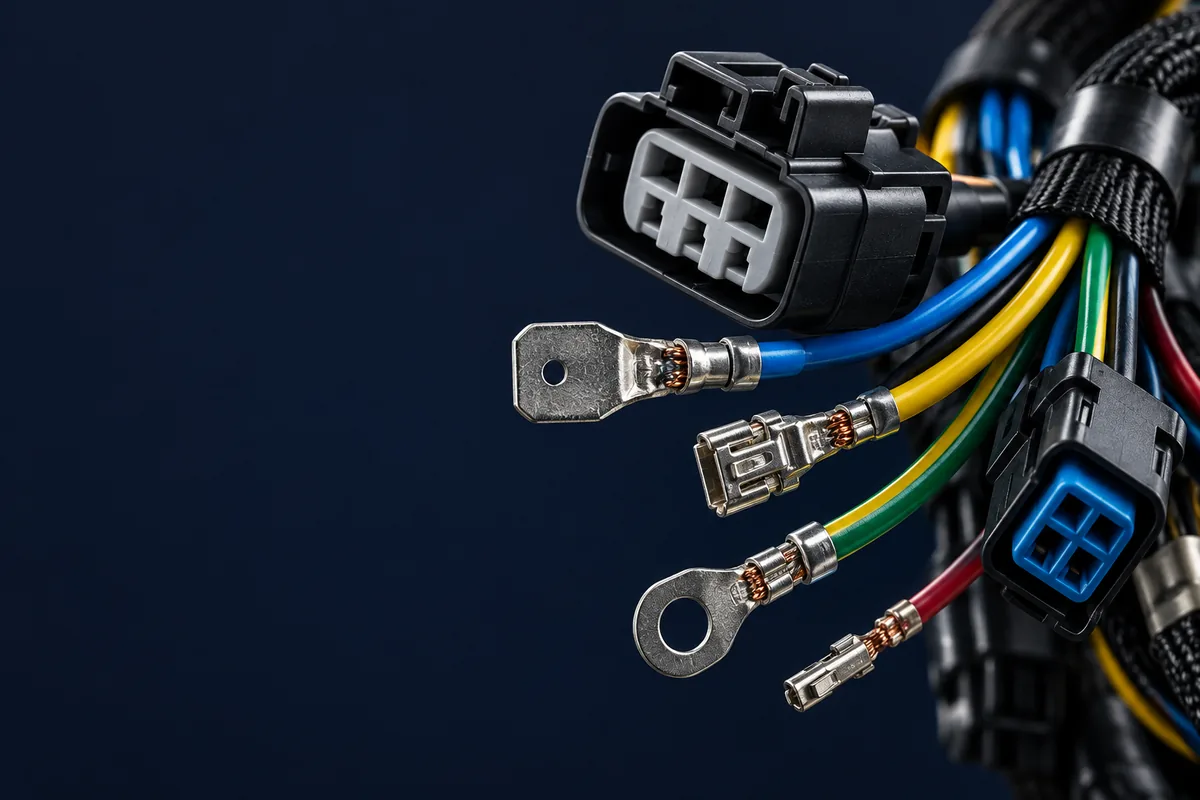
Wire harness labeling looks like a small detail until the first pilot build. A harness can pass continuity, fit the enclosure, and still slow production because operators cannot tell branch A from branch B after taping, the service technician cannot read the marker after heat exposure, or the receiving team cannot match the label to the released drawing revision. For OEM buyers, the labeling plan is not decoration. It is part of traceability, assembly speed, serviceability, and supplier quality control.
This guide is written for engineering teams, NPI teams, supplier quality engineers, and buyers who are preparing a harness RFQ or moving from prototype to production. The objective is practical: decide what needs to be marked, which label or marking method fits the environment, what data belongs on each marker, and what evidence the supplier should provide before volume release. It pairs well with our wire harness RFQ checklist, first article inspection guide, and prototype cable assembly service.
Standards should be named in the RFQ instead of implied later. For harness workmanship, buyers commonly reference IPC/WHMA-A-620 through public IPC standards background. For appliance wiring material and recognized hook-up wire, UL-758 is tied to the public UL safety organization framework. Quality-system traceability often sits inside ISO 9001 or automotive IATF 16949 controls.
1. Why harness labeling fails after a good sample
Most labeling failures start with an incomplete drawing note. The drawing says “mark wires per schematic” or “add part number label,” but it does not define position, text height, print contrast, material, wrap direction, durability test, or whether the marker must remain readable after taping and installation. The supplier then uses the cheapest method that passes sample review. That may work for five prototypes and fail at 500 pieces when operators rotate a branch, wrap over a marker, or substitute a sleeve material with weaker ink adhesion.
In a Q2 2025 build for 1,200 industrial control harnesses, our team found 37 label-related nonconformances during final audit even though every unit passed electrical test. The harnesses used two visually similar 18 AWG blue conductors in adjacent branches. The drawing showed circuit IDs, but the marker position tolerance was not defined. After tape wrapping, 24 markers were hidden under the branch transition, 9 were rotated away from the service side, and 4 had lot codes that did not match the traveler. The corrective action was not a new tester. We changed the drawing note to specify a 25 mm marker setback from the breakout, 2.5 mm minimum text height, white-on-black heat-shrink markers for those circuits, and a traveler scan before final bagging. The next 1,000-piece run had 2 label findings, both caught before shipment.
2. What should be marked on a wire harness?
Buyers should separate three marking purposes before choosing materials. Assembly markings help operators build or install the harness. Service markings help technicians diagnose and replace it later. Traceability markings help quality teams connect finished goods to drawings, BOM revisions, operator stations, wire lots, terminal lots, and test records. One label can carry more than one purpose, but mixing all data onto every wire usually creates clutter and cost.
For most OEM harnesses, the minimum marking plan includes finished harness part number, revision, date or lot code, manufacturer identity, critical branch or connector IDs, polarity where relevant, and any required voltage or safety warning. Individual wire markers are most useful when branches are dense, conductor colors repeat, connectors are field-serviceable, or installation depends on correct terminal landing. Printed wire legend from the cable manufacturer can help, but it does not replace assembly-level labels when branches are cut, sleeved, overmolded, or bundled.
For UL-758 appliance wiring material or customer-defined safety harnesses, keep the supplier declaration, wire style, temperature rating, voltage rating, and material traceability connected to the BOM. For IPC/WHMA-A-620 workmanship review, make sure labels do not create unacceptable damage, sharp edges, loose sleeves, unreadable marking, or interference with bend radius and strain relief.
3. Label and marking methods compared
The best marking method depends on environment, available space, service need, and process repeatability. A small indoor control lead may only need a printed flag label. A sealed automotive branch may need heat-shrink identification outside the seal compression zone. A high-flex robot cable may need jacket printing or a low-profile marker that does not stiffen the bend point. A medical cable may need clean, abrasion-resistant identification that does not trap residue.
Comparison table: common wire harness labeling options
| Method | Best Fit | Typical Control Point | Risk If Poorly Specified | Buyer Decision Rule |
|---|---|---|---|---|
| Printed heat-shrink marker | Branch IDs, service labels, durable circuit marks | Shrink ratio, text height, orientation, distance from breakout | Marker hides under tape or stiffens a flex zone | Use when readability and abrasion resistance matter more than lowest cost |
| Wraparound self-laminating label | Indoor panels, low-motion control wiring | Label length, adhesive compatibility, overlap, print contrast | Edge lift after handling, oil exposure, or tight bend | Use for dry indoor assemblies with enough straight wire length |
| Flag label | Dense harnesses where text must face the installer | Flag size, fold alignment, clearance envelope | Snagging, torn label, or blocked connector latch | Use only where service readability is more valuable than compact routing |
| Direct cable jacket printing | Long cable assemblies, repeated legends, OEM branding | Ink adhesion, spacing interval, line speed, cure condition | Print rubs off or becomes hidden after cutting | Use when the same data repeats along a cable length |
| Laser marking | High-durability jackets or sleeves approved for laser contrast | Material compatibility, contrast, depth, heat effect | Low contrast or jacket damage on unsuitable material | Use after testing the exact jacket or sleeve compound |
| Metal tag or stamped marker | Harsh industrial, marine, or high-temperature areas | Attachment method, edge condition, corrosion resistance | Sharp edges, vibration noise, galvanic corrosion | Use when polymer labels cannot survive the environment |
4. Drawing rules that prevent label disputes
A good drawing note tells the supplier exactly how to build and inspect the marker. The note should define marker content, location, orientation, material, print color, text height, barcode type if used, durability requirement, and whether the label must be readable after final bundling. If the harness includes multiple labels, create a small label table instead of spreading notes across the drawing.
For location, avoid vague instructions such as “near connector.” Use measurable references: 20 mm to 30 mm from the rear of connector housing, 25 mm from branch breakout, or centered on the straight section between clip and grommet. For orientation, define whether text must face the installer, service side, or connector latch side after routing. For heat-shrink markers, keep sleeves away from seal compression zones, tight bend points, and areas where diameter growth blocks a clip or gland.
Barcode and QR codes need extra discipline. A 2D code that scans on a loose sample may fail after shrink, curve, or abrasion. If scanning is required, define minimum code size, quiet zone, contrast, scanner distance, and whether the code must pass before or after final bundling. For lot traceability, link the code to a production traveler, not just a purchase order.
RFQ data buyers should send
- Harness drawing with label locations measured from connectors, breakouts, or clips
- Label content: part number, revision, circuit ID, lot, date code, voltage warning, or barcode
- Environment: temperature range, oil, water, UV, cleaning chemical, abrasion, and flex exposure
- Workmanship class, such as IPC/WHMA-A-620 Class 2 or Class 3
- Wire and cable requirements tied to UL-758, customer style, voltage, or temperature rating where applicable
- Inspection evidence: first-article photos, scan result, adhesion check, rub check, and lot record
5. Durability checks before production release
Label durability testing should match the field risk. A dry cabinet harness does not need the same test plan as a marine cable or under-hood automotive harness. The mistake is to skip all durability checks because the label looks clean at first article. Printed markers can fail through abrasion, solvent wipe, heat aging, shrink distortion, adhesive creep, UV exposure, or being hidden by later assembly steps.
For standard industrial harnesses, we usually ask for a simple first-article evidence package: photo before and after final bundling, confirmation of label material, print method, text height, position measurement, and a manual rub check after 10 cycles with a dry cloth or approved shop wipe. For higher-risk assemblies, add heat aging at the maximum storage or operating temperature, oil or cleaning-agent wipe, bend check at the installed radius, and scan verification if barcode traceability is required.
Do not let a label create a mechanical failure. A long heat-shrink sleeve can create a stiff point that shifts bending stress to the wire exit. A thick flag can snag during installation. A wrap label placed too close to a connector can prevent a boot, backshell, clamp, or gland from seating. Review labels with the same attention you give to strain relief, heat shrink tubing, and waterproof cable assembly.
6. Traceability: what the label should connect to
Traceability is useful only when the data connects to records that can answer a quality question. A date code alone may be enough for low-risk assemblies. For automotive, medical, industrial automation, and field-serviceable equipment, buyers often need part number, revision, production lot, test record, and material lot traceability. The label or barcode should point to that record without forcing the customer to decode a private supplier note.
For IATF 16949 style programs, label data should align with PPAP and control-plan logic. If a harness fails in the field, the team should be able to identify build date, operator or line where required, wire lot, terminal lot, connector lot, test file, and any approved deviation. For ISO 9001 programs, keep the system simpler but still controlled: revision, lot, and test status should not rely on memory or handwritten shortcuts.
The strongest approach is to separate customer-facing data from factory traceability data. The customer-facing label may show part number, revision, and serial or lot code. The supplier traveler holds the detailed internal trace: material lots, crimp applicator setup, test program version, inspector, and packaging record. That keeps the harness readable while preserving enough detail for containment.
7. Buyer approval checklist
Before approving production, run a labeling review during FAI. This is faster than discovering readability problems after the first shipment. Ask the supplier to build one sample through the full process: cutting, stripping, crimping, bundling, taping, sleeving, testing, packaging, and any final cleaning. Then review the label in its finished state, not as a loose marker on the bench.
- All label text matches drawing, BOM, and released revision
- Position is measured against a defined tolerance, such as plus or minus 5 mm
- Text height is readable at the intended service distance, typically 2.0 mm to 3.0 mm minimum for small harness labels
- Barcode or QR code scans after shrink, bundling, and packaging if required
- Label material is compatible with heat, fluid, UV, abrasion, and flex exposure
- Marker does not interfere with connector locks, seals, clips, bend radius, or strain relief
- Lot or serial code links to production traveler, material lots, and test record
- Photos are included in the FAI report for critical labels and service-facing markers
Frequently Asked Questions
What information should be printed on a wire harness label?
Most OEM harness labels should include part number, revision, lot or date code, and manufacturer identity. Critical branches may also need connector ID, circuit ID, polarity, voltage warning, or barcode. For controlled programs, tie the label to IPC/WHMA-A-620 workmanship review and a traveler record that can identify material lots.
Are heat-shrink markers better than wraparound labels?
Heat-shrink markers are usually better for abrasion resistance, branch identification, and service readability, but they add diameter and stiffness. Wraparound labels are often acceptable for dry indoor control wiring when there is enough straight length and low flex. For dynamic branches, check the installed bend radius and run at least a 10-cycle handling or rub check before approval.
How far from a connector should a harness marker be placed?
A common starting point is 20 mm to 30 mm from the rear of the connector housing or 25 mm from a breakout, but the final value depends on boot, seal, clip, and bend-radius space. Define a tolerance such as plus or minus 5 mm so the supplier can inspect it consistently.
Do wire harness labels need to meet UL-758?
UL-758 applies to appliance wiring material and related wire construction requirements, not every loose label. Buyers still reference UL data when the harness uses recognized wire styles, voltage ratings, or temperature ratings. The label plan should preserve that traceability and avoid covering required wire legends where they must remain visible.
Should every wire in a harness be individually marked?
No. Individual marking is useful when colors repeat, connectors are field-wired, branches are dense, or service diagnosis depends on fast identification. For simple harnesses with keyed connectors and unique colors, marking every wire can add cost and clutter. Mark the finished harness plus the circuits that carry real assembly, safety, or service risk.
What label evidence should buyers request during first article inspection?
Request finished-state photos, label material, print method, position measurements, text-height confirmation, scan result if barcodes are used, and a basic durability check matched to the environment. For higher-risk harnesses, add heat aging, fluid wipe, abrasion, or bend verification and keep the result with the FAI package.
Need a production-ready harness labeling plan?
Send your drawing, BOM, installation route, service requirements, operating environment, label data fields, and expected annual quantity through our contact page. We can review label locations, marker materials, traceability rules, and first-article evidence before the program moves into production.
- Send next: drawing, BOM, label data, environment, annual quantity, and any customer traceability rule
- You receive back: label method recommendation, drawing-note cleanup, FAI evidence list, and production quote
- Best fit for: OEM harnesses, industrial control cables, automotive subassemblies, medical device cables, and field-serviceable equipment