Technical Guide
Types, Methods & Selection Guide for Engineers
Tape selected only on purchase price can delaminate or lose protection when the routing temperature exceeds its rating. This guide covers tape types, wrapping methods, automotive qualification, and an application selection matrix.
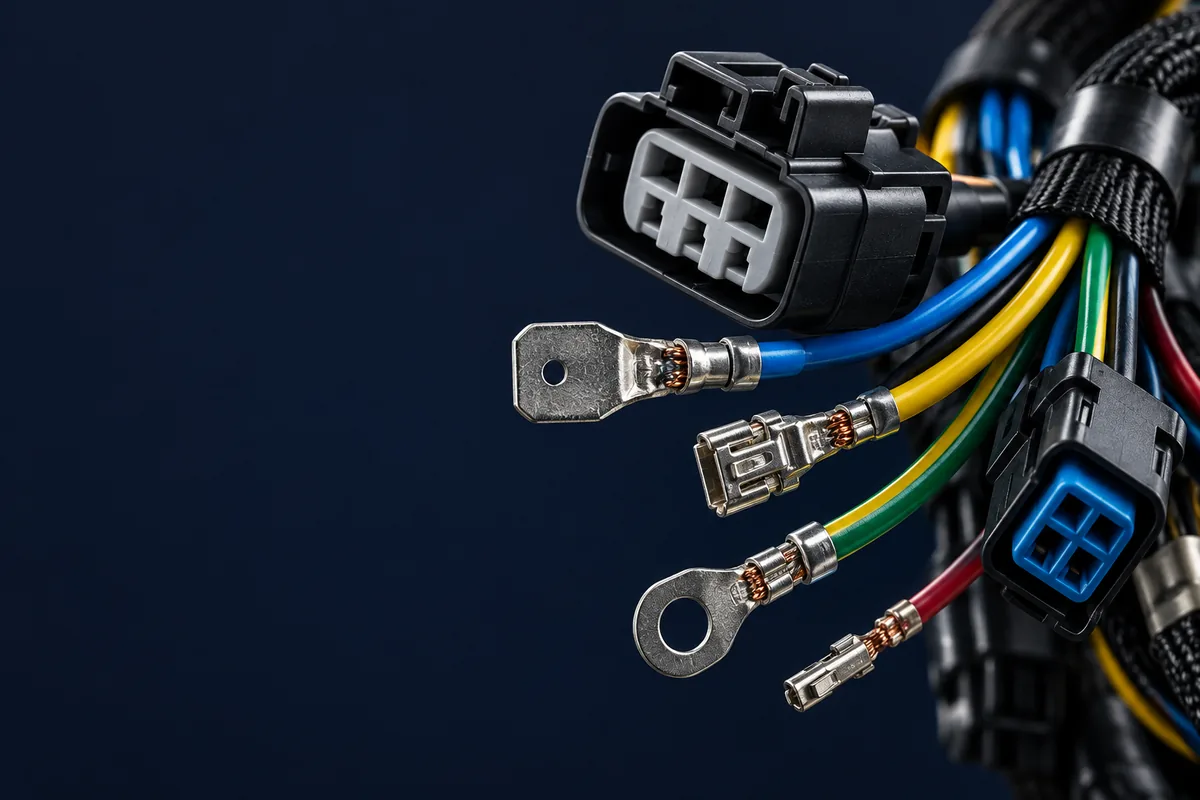
Automotive wire harness with multiple tape-wrapped sub-bundles showing cloth and PVC tape application in production
Automotive wire harness with tape-wrapped sub-bundles — tape selection directly affects long-term reliability in vibration and thermal environments
Tape is the least glamorous specification on a wire harness drawing — and an easily overlooked specification. Procurement teams see it as a commodity. Engineers copy it from a previous drawing without checking whether the application conditions match. The result is harnesses that fail for reasons that may not appear in initial electrical testing: abrasion on sheet metal edges, tape melt-off in high-temperature zones, rattle noise from inadequately damped bundles.
LV 312 is used in automotive tape qualification. Confirm the customer-required specification and the tape manufacturer's test conditions rather than assuming one designation applies across all OEM programs.
This guide covers key aspects of harness tape selection relevant to wire harness engineering teams and procurement teams: tape types, wrapping methods, the LV 312 temperature and abrasion classes, and an application-specific selection matrix.
1. Why Wire Harnesses Need Tape Wrapping
Tape wrapping serves four distinct functions in a wire harness: abrasion and mechanical protection, bundling and shape retention, noise damping, and limited environmental protection. Most engineers think primarily about abrasion protection, but understanding all four explains why different zones of the same harness often require different tape types.
A single harness section often needs to satisfy multiple functions simultaneously — abrasion protection and noise damping in a door sill route, for example. When a single tape type cannot satisfy all requirements, one possible approach is a two-layer system: a foam or fleece inner layer for damping, overwrapped with cloth tape for abrasion protection.
Protects insulation from contact with sheet metal edges, brackets, and grommets. Validate abrasion resistance for the actual routing and vibration environment.
Consolidates conductors into a bundle for routing and assembly. Control wrapping tension to maintain the required bundle geometry.
Foam and fleece tapes can reduce rattle against body panels. Assess damping in the intended installation.
Tape may provide splash resistance, but ordinary harness wrapping does not establish a waterproof seal. Use a qualified sealing system where ingress protection is required.
2. Types of Harness Tapes: Properties and Trade-offs
Six tape types cover the majority of wire harness applications. Each has a distinct backing material, adhesive system, and set of mechanical properties that make it suited to specific zones and environments.
PVC tape temperature capability depends on its backing and adhesive formulation. For engine-compartment use, select a product whose documented rating and aging performance match the routing conditions.
Table
| Tape Type | Max Temp (Continuous) | Abrasion Class (LV 312) | Noise Damping | Primary Use | Relative Cost |
|---|---|---|---|---|---|
| PVC tape | Per product datasheet | Per qualified product and test conditions | Low | General bundling, interior routing | Obtain current quotation |
| Woven cloth / fabric | Per product datasheet | Per qualified product and test conditions | Medium | Engine bay, high-abrasion zones | Obtain current quotation |
| Foam tape (PE/PU) | Per product datasheet | Per qualified product and test conditions | High | Door cavities, NVH-critical zones, inner layer | Obtain current quotation |
| Fleece / felt tape | Per product datasheet | Per qualified product and test conditions | Very High | Luxury vehicle NVH, instrument panel routing | Obtain current quotation |
| Paper / cellulose | Per product datasheet | Per qualified product and test conditions | Low | Lightweight body routing, temporary protection | Obtain current quotation |
| Glass fiber tape | Per product datasheet | Per qualified product and test conditions | Low | Exhaust-adjacent zones, extreme heat | Obtain current quotation |
3. Tape Wrapping Methods: Spiral, Half-Lap, and More
The wrapping pattern determines how much tape is used, how many effective protection layers are applied, and how the harness behaves under bending. Four methods illustrate common wrapping approaches.
Half-lap describes overlap by half the tape width. Wrap angle and coverage depend on tape width, bundle geometry, and applied tension; verify coverage while bending the finished harness.
Estimate tape consumption using the actual bundle geometry, overlap, and routing, then confirm it with a wrapping trial. Include the measured allowance for branches, starts, and production waste.
Table
| Method | Overlap | Effective Layers | Tape Consumption | Best For |
|---|---|---|---|---|
| Spiral / single-layer | Minimal or specified overlap | 1 | Trial-dependent | General bundling, flexible sections, cost-sensitive runs |
| Half-lap | Half the tape width | Nominally double coverage on a uniform section | Trial-dependent | Additional coverage where specified |
| Full-lap / cross-wrap | Per work instruction | Depends on overlap | Trial-dependent | Local protection where specified |
| Longitudinal / cigarette | N/A (lengthwise) | 1 | Trial-dependent | Branching points, short transition sections |
4. Key Tape Specifications and What They Mean
Tape data sheets report five key properties. Each maps to a real-world failure mode when the value is insufficient for the application.
Room-temperature adhesion alone does not establish service performance. Review aged adhesion and compatibility data under the temperature, fluid, and UV conditions required by the application.
Table
| Property | What It Measures | Typical Range | Failure If Insufficient |
|---|---|---|---|
| Temperature class | Max continuous service temp (adhesive + backing) | Per product datasheet | Tape softens, adhesive flows, tape unwraps |
| Abrasion resistance | Cycles to wire insulation breach under dynamic rubbing | Per specified LV 312 test and class | Wire insulation wears through at contact points |
| Adhesion force (peel) | Force to peel tape from wire insulation (N/cm) | Per product datasheet | Tape lifts, ends peel back, coverage gaps form |
| Elongation at break | How much tape stretches before tearing (%) | Per product datasheet | Tape tears at branching points or tight bends |
| Noise damping value | Vibration energy absorbed (dB reduction) | Per stated test method | Harness rattle against body panels, NVH failures |
5. Automotive Standard LV 312: Temperature and Abrasion Classes
LV 312 is a qualification reference for automotive harness tapes. Specify the applicable revision, temperature requirement, abrasion test conditions, and any OEM-specific approval requirements.
Abrasion class depends on the specified test setup, including mandrel size. For example, tesa lists Class D abrasion resistance and a maximum temperature resistance of 150°C for 51036 PV0; these are product-specific published values, not generic limits for cloth tape. (Source: tesa 51036 PV0)
Use the exact designation and test conditions on the approved drawing and product report. A matching class alone does not authorize substitution; confirm dimensions, adhesive compatibility, and customer approval.
6. Application Selection Matrix
The matrix below maps common wire harness routing zones to the recommended tape type, wrapping method, and LV 312 designation. This covers the major application categories encountered in automotive, industrial, and medical harness manufacturing.
Table
| Application Zone | Tape Type | Method | LV 312 | Key Requirement |
|---|---|---|---|---|
| Passenger cabin, interior | PVC or cloth | Half-lap | Per customer specification | Low temp, abrasion against plastic trim |
| Door cavity / sill | Foam + cloth overwrap | Half-lap each layer | Per customer specification | NVH damping + abrasion from sheet metal |
| Engine compartment | Woven cloth (polyester) | Half-lap | Per customer specification | Sustained routing temperature, fluid resistance, and abrasion |
| Exhaust / turbo adjacent | Glass fiber tape | Half-lap | Per customer specification | Exhaust-zone temperature and compatible adhesive |
| Underbody / wheel well | Cloth (water-resistant adhesive) | Full-lap | Per customer specification | Stone impact, water spray, road grime; qualify a separate seal if needed |
| Industrial control panel | PVC tape | Half-lap | Per customer specification | Bundling and abrasion at the specified ambient temperature |
| Medical device cable | Cloth with application-qualified adhesive | Half-lap | Per customer specification | Assess patient-contact and sterilization requirements |
| Marine (above waterline) | UV-resistant PVC or cloth | Full-lap | Per customer specification | UV aging resistance, salt spray, moisture |
7. Tape Width vs Bundle Diameter Rules
Tape width selection is more constrained than it appears. Using too-narrow tape on a large bundle creates an unworkably steep helix angle that slows production and results in inconsistent overlap. Using too-wide tape on a small bundle creates excessive buildup at branching points.
Select tape width and overlap using the bundle geometry and bending requirements. Confirm wrap consistency and protection in a representative assembly trial.
Define overlap onto each branch and the main bundle in the work instruction. Verify that the branch covering remains secure through installation and the required motion.
Table
| Bundle Diameter | Tape Width Selection | Wrap Count | Notes |
|---|---|---|---|
| <8 mm | Select by wrapping trial | Confirm for chosen overlap | Small sub-harnesses, individual branch legs |
| 8–20 mm | Select by wrapping trial | Confirm for chosen overlap | Sub-bundles; confirm dimensions for the program |
| 20–40 mm | Select by wrapping trial | Confirm for chosen overlap | Main harness runs, trunk-to-body connections |
| >40 mm | Select by wrapping trial | Confirm for chosen overlap | Large trunk cables, HV battery pack harnesses |
8. Frequently Asked Questions
Frequently Asked Questions
What is the difference between spiral wrap and half-lap tape wrapping for wire harnesses?
Spiral wrapping uses limited overlap, while half-lap overlaps half the tape width to provide nominally double coverage on a uniform section. Actual consumption and protection depend on geometry, tension, and bending; validate the selected method.
What tape standard does the automotive industry use for wire harness qualification?
LV 312 is used for automotive harness tape qualification. Confirm the customer-required revision and product test report, including temperature and abrasion conditions; do not assume a universal temperature-class mapping or automatic interchangeability.
My wire harness passes through an engine compartment that reaches 125°C. Which tape type should I use?
Choose a tape whose documented temperature resistance, adhesive compatibility, and aging results cover the stated engine-compartment conditions. Qualified polyester or other heat-resistant constructions may be suitable; backing type alone does not establish the rating.
How do I calculate how much tape I need for a given harness section?
Use tape width, bundle circumference, required overlap, and routing geometry to estimate consumption, then measure a representative wrap. Include measured allowances for branches, start and finish wraps, and production waste. Multiply tape length by the current quoted unit price.
Can I use foam tape alone for noise damping in an automotive harness, or does it need to be combined with another tape?
Foam may provide damping but still need an abrasion-resistant outer layer. Qualify the combined construction against the application requirements rather than assuming that foam alone always fails or that an overwrap automatically passes.
What is the minimum tape width recommended for a 30mm diameter harness bundle?
There is no universal minimum tape width for the stated bundle diameter. Select width and overlap through an assembly trial, checking bend coverage, branch transitions, and wrapping consistency against the drawing.
Which tape type is best for wire harnesses in marine and offshore environments?
Choose marine tape and sealing materials using documented salt-water, UV, temperature, and adhesion performance. Self-amalgamating products may support a qualified sealing design, but tape type alone does not establish waterproofing or ABYC compliance.
Frequently Asked Questions
What is the difference between spiral wrap and half-lap tape wrapping for wire harnesses?
Spiral wrapping uses limited overlap, while half-lap overlaps half the tape width to provide nominally double coverage on a uniform section. Actual consumption and protection depend on geometry, tension, and bending; validate the selected method.
What tape standard does the automotive industry use for wire harness qualification?
LV 312 is used for automotive harness tape qualification. Confirm the customer-required revision and product test report, including temperature and abrasion conditions; do not assume a universal temperature-class mapping or automatic interchangeability.
My wire harness passes through an engine compartment that reaches 125°C. Which tape should I use?
Choose a tape whose documented temperature resistance, adhesive compatibility, and aging results cover the stated engine-compartment conditions. Qualified polyester or other heat-resistant constructions may be suitable; backing type alone does not establish the rating.
Cta
Title: Need Help Specifying the Right Tape for Your Wire Harness?
Share the routing temperatures, abrasion environment, and customer tape requirements so the proposed material and wrapping method can be reviewed against the application.
Primarybutton: Request a Free Quote
Secondarybutton: View Our Capabilities