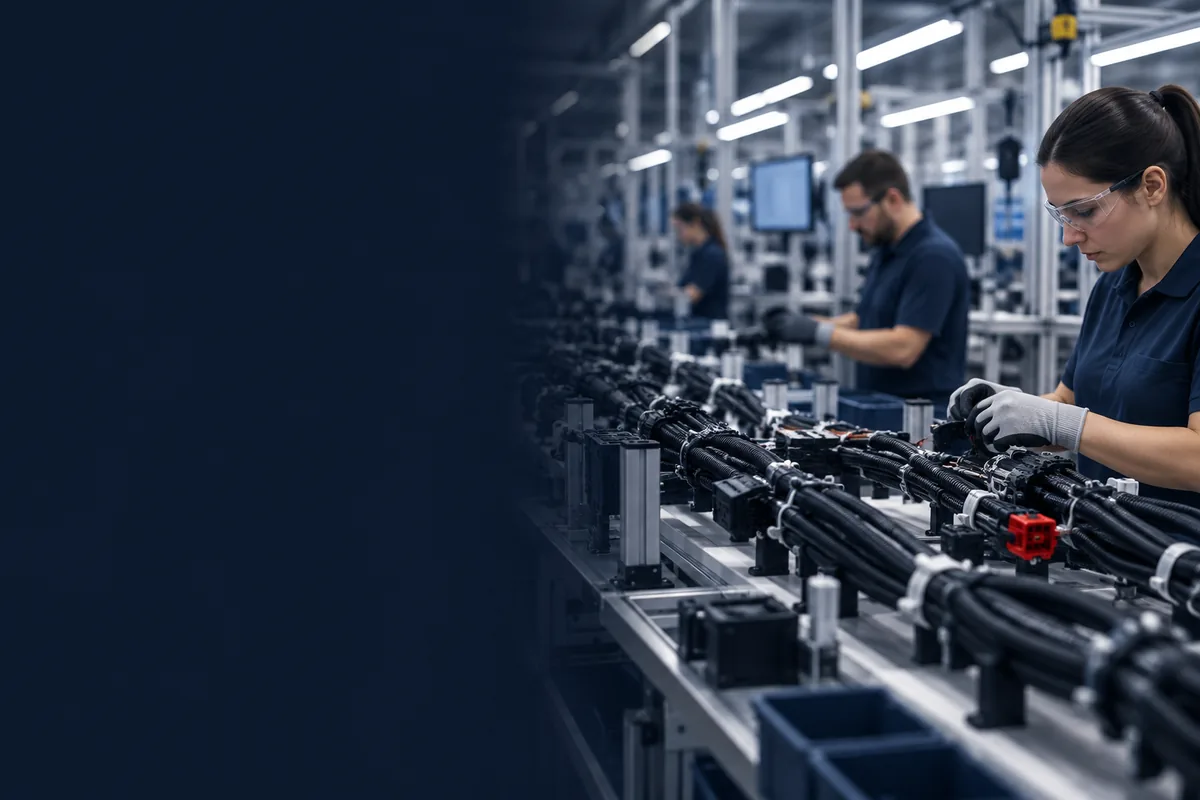
A US EV automotive OEM came to us in 2025-Q4 with a problem that procurement teams know too well: the harness design was not optional, the connector brand was not optional, and the launch clock was already running. The case-bank numbers were exact: "50 units", "15-day lead time", and "Amphenol connectors". The job was not only to assemble 50 prototype harnesses. We had to secure authorized Amphenol connector procurement, release the build schedule, and ship the initial NPI package inside 15 days after PO issuance.
That is where connector sourcing becomes a launch-control problem. A buyer can have a correct drawing, a clean BOM, and a capable harness factory, then still miss the prototype gate because one sealed connector family is constrained, substituted without approval, or delivered without traceability. For an EV harness, the commercial loss is not the connector price. It is the engineering week lost while the vehicle team waits for samples that should already be on the bench.
This guide is written for OEM buyers, NPI engineers, sourcing managers, and supplier-quality teams specifying Amphenol connectors in prototype or pilot wire harness programs. It explains how to protect authorized sourcing, quote timing, alternates, IPC-A-620 workmanship, IATF 16949-style change control, and the handoff from 50-unit prototype builds to repeat production. It also connects with our Amphenol cable assembly service, wire harness connector selection guide, wire harness prototyping guide, component sourcing guide, and prototype cable assembly service.
Why Amphenol Sourcing Can Break an NPI Build
Amphenol connector sourcing becomes risky when the connector is treated as a catalog line instead of a controlled launch item. The Amphenol Sine A Series includes sealed heavy-duty plastic and metal connectors for heavy equipment, agricultural, automotive, industrial, alternative energy, and other demanding interconnect architectures. That breadth is useful, but it also means a buyer must lock the exact series, cavity count, seal package, keying, contacts, backshells, plugs, and mating half before the supplier can quote a realistic lead time.
The NPI trap is simple. Engineering approves an Amphenol part number, procurement asks for a rush quote, and the supplier discovers that one contact, wedge lock, or seal accessory sits on a different lead-time path than the housing. If the program needs 50 assemblies inside 15 days, that accessory is now the schedule driver. The right question is not "Can you buy Amphenol?" The right question is "Can you procure the complete approved connector set through traceable channels before the harness line needs it?"
For urgent NPI harnesses, I treat the connector kit as one controlled assembly: housing, terminals, seals, locks, plugs, mating part, and sourcing evidence. If one item is missing, the harness is not quote-ready.
The 15-Day NPI Control Model
A 15-day prototype lead time is possible only when procurement, engineering, and production move in parallel with clear gates. In the EV case, we did not wait for every commercial detail to settle before checking connector availability. We separated the work into four lanes: authorized Amphenol sourcing, drawing and BOM review, fixture and work-instruction preparation, and final test planning. Each lane had an owner before the PO entered production release.
The practical model is "source, freeze, build, prove." Source means verifying the complete connector set and authorized channel. Freeze means locking the drawing revision, BOM revision, pinout, color code, and approved deviation list. Build means releasing cutting, stripping, crimping, insertion, labeling, and assembly board setup against that frozen package. Prove means returning test evidence with the samples, not after the buyer asks for it.
This matters most for EV, robotics, industrial automation, and heavy-equipment harnesses where connector interfaces drive the physical installation. If the first 50 samples use an unapproved alternate or an undocumented lot, the buyer may validate the wrong hardware. That can reset the prototype loop even when continuity testing passes.
What Buyers Should Freeze Before the PO
The buyer should freeze the connector definition before asking for an expedited NPI date. For an Amphenol-based harness, the RFQ should include the connector family, full manufacturer part numbers, contacts, seals, cavity plugs, terminal plating, wire gauge range, pinout, mating interface, backshell or strain relief parts, and any no-substitution rule. If the harness touches an EV platform, also state voltage, current, temperature, IP target, vibration exposure, and whether the program requires automotive documentation.
Put the drawing revision and BOM revision in the RFQ subject or filename, not only inside the attachment. A supplier processing multiple urgent files can otherwise quote revision B, build revision C, and test against a pinout copied from revision A. That is a real manufacturing failure mode, not an admin detail. Our wire harness RFQ checklist covers the broader quote package; for Amphenol sourcing, the connector kit deserves its own approval line.
For controlled programs, use IPC-A-620 as the workmanship reference for cable and wire harness acceptance. For automotive supply chains, IATF 16949:2016 expectations make revision control, traceability, customer-specific requirements, and defect prevention part of the sourcing conversation. If appliance wiring material rules apply, cite UL-758 and the relevant wire style rather than using generic "UL wire" language.
Comparison Table: Amphenol Sourcing Paths for NPI
| Sourcing Path | Typical Speed | Traceability Strength | Main Risk | Best Use |
|---|---|---|---|---|
| Authorized distributor stock | 1-7 days if complete kit is available | High: invoice, lot, and manufacturer chain are clearer | One accessory may be unavailable even if housing is in stock | Urgent 10-100 unit NPI builds |
| Factory allocation or direct channel | 2-12+ weeks depending on series and demand | Very high when program allocation is confirmed | Too slow for emergency prototypes unless planned early | Pilot and production ramp |
| Multi-region authorized search | 3-10 days with strong procurement follow-up | High if every source is documented | Freight, tariff, and small-lot pricing can rise quickly | Launch recovery when local stock is short |
| Approved alternate connector set | 1-4 weeks after engineering review | Medium to high if validation records are complete | Fit, crimp, seal, or mating change may require revalidation | Cost-down or shortage mitigation after buyer approval |
| Broker or gray-market purchase | Fast on paper | Weak unless independently verified | Counterfeit, wrong revision, missing compliance, no support | Avoid for EV, automotive, medical, or safety-related harnesses |
The table shows why speed alone is not the decision criterion. For a 15-day EV prototype run, a broker quote that arrives in 24 hours can be worse than no quote if the parts cannot be traced or validated. The best sourcing path is the fastest one that still preserves part-number accuracy, authorized-channel evidence, and the right to scale into repeat production.
Cost and Lead-Time Drivers Buyers Should Expect
Connector cost moves fast when the RFQ shifts from normal procurement to launch recovery. On a 50-unit NPI build, the buyer may pay premiums in five places: small-lot distributor pricing, split shipments, expedited freight, extra incoming inspection, and engineering time to review alternates. Those costs are easier to accept when they prevent a prototype slip; they are painful when they come from missing RFQ data.
For planning, separate the harness lead time from the connector lead time. A harness line may cut, strip, crimp, label, and electrically test simple prototype assemblies within days, but it cannot finish a sealed Amphenol interface until the correct terminals, seals, and locks arrive. If the connector kit has one 8-week item, the program needs either early procurement, approved alternates, a partial build plan, or a written decision to wait.
Ask the supplier to quote three dates, not one: material-ready date, first-article build date, and ship date. That exposes the real bottleneck. It also lets procurement decide whether to pay expedited freight for the connector kit, split the 50 units into 10 validation samples plus 40 follow-on units, or release the full lot after connector authorization is confirmed.
A 15-day promise is only meaningful if it names the material-ready date. If Amphenol contacts arrive on day 12, the factory has 3 days left for crimp setup, assembly, 100 percent electrical test, inspection, and packing.
Quality Evidence to Request With the Samples
The buyer should receive evidence with the samples because NPI is a decision point, not only a delivery event. For Amphenol connector harnesses, request the approved BOM, drawing revision, connector procurement record, incoming inspection result, crimp setup record, pull-test data where required, continuity test result, pinout verification, visual inspection checklist, and certificate of conformance. If the program is automotive, ask whether the supplier can connect the sample evidence to PPAP-style records later.
IPC-A-620 helps define workmanship acceptance for crimping, soldered terminations where used, insulation support, marking, cable ties, routing, and visible defects. IATF 16949 discipline matters because the same supplier behavior that protects the first 50 units should protect the next 200, 1,200, or 5,000 units. The point is not to turn every prototype into a full PPAP submission. The point is to make sure the first article does not become a disconnected craft build that cannot be repeated.
Our crimp pull test guide, first article inspection guide, and wire harness testing service show the evidence package in more detail. For this topic, the key is linkage: the Amphenol part number in the BOM should match the procured item, the crimp record, the sample label, and the final test report.
Buyer Checklist for Authorized Amphenol Procurement
Use this checklist before releasing an expedited NPI PO. It is intentionally practical: each item either protects the 15-day schedule, protects traceability, or prevents an avoidable engineering loop.
- Send the full Amphenol manufacturer part number for every housing, terminal, seal, lock, plug, backshell, and mating half.
- Mark no-substitution items in the BOM and state who can approve alternates.
- Include drawing revision, BOM revision, pinout revision, and target sample quantity in the RFQ header.
- Ask for a material-ready date separate from the final ship date.
- Require authorized-channel evidence for EV, automotive, medical, industrial, and other controlled programs.
- Define IPC-A-620 workmanship class, electrical test scope, pull-test requirements, and any IATF 16949 or PPAP expectation.
- State target lead time, target production ramp, annual volume, and whether the prototype supplier must also support volume production.
- Ask the supplier to identify the single longest-lead connector item before accepting the promised schedule.
When to Approve an Alternate
Approve an alternate only when the alternate protects the program without changing the validated interface silently. A connector alternate may affect cavity geometry, terminal crimp window, seal compression, latch force, IP rating, mating compatibility, current rating, voltage clearance, temperature range, and harness routing. If the buyer approves an alternate by email without those checks, the prototype may answer the wrong design question.
A controlled alternate package should include side-by-side part numbers, datasheets, dimensional comparison, electrical rating, environmental rating, crimp tool or applicator implications, sample-build notes, and test evidence. For EV harnesses, do not treat "same pin count" as equivalent. Pin count says little about sealing, retention, plating, thermal behavior, or mating reliability under vibration.
The best time to approve alternates is before the emergency. For repeat programs, create an approved vendor list with primary Amphenol parts, pre-approved alternates where allowed, and "no alternate without customer approval" parts. That gives procurement room to move without letting the production floor decide engineering risk.
The phrase 'equivalent connector' is dangerous until we define equivalent to what: mating fit, crimp geometry, seal performance, rating, supply chain traceability, or customer approval status.
From 50 Units to Repeat Production
The EV case did not stop at the first shipment. The on-time 50-unit prototype batch helped secure a follow-on multi-PO repeat program for the same vehicle platform. That is the real business value of controlled sourcing: the buyer validates a supplier process that can grow beyond the urgent first lot.
Before scaling, review what changed during the prototype rush. Did the supplier use standard Amphenol parts or emergency regional stock? Were any parts split across distributor lots? Were any manual build steps added to protect the 15-day timeline? Did the inspection plan capture those changes? If the answer is unclear, freeze the production baseline before issuing the next PO.
For repeat production, ask for a supply plan covering forecast quantity, MOQ, safety stock, reorder point, approved alternates, tariff exposure, and obsolete-stock liability after engineering changes. A prototype supplier who can explain that plan is more valuable than a supplier who only says "we can rush it again." Rush should be the exception. Control should be the operating model.
References
- Amphenol Sine A Series Connectors
- IPC and IPC/WHMA-A-620 reference
- AIAG IATF 16949:2016 overview
- UL safety organization reference for UL-758 context
FAQ
How fast can Amphenol connector sourcing support an NPI harness build?
For a complete connector kit available through authorized stock, sourcing can support a 10-15 day prototype window. In our 2025-Q4 EV case, the buyer needed 50 units inside a 15-day lead time, so the material-ready date had to be managed separately from assembly and test time.
What should I send for an Amphenol-based wire harness quote?
Send the drawing, BOM, quantity, Amphenol part numbers, mating connectors, wire gauge, pinout, environment, target lead time, compliance target, and test scope. For controlled programs, include IPC-A-620 workmanship class and whether IATF 16949-style traceability or PPAP evidence will be needed later.
Can a supplier substitute another connector for Amphenol during a shortage?
Only with written engineering approval. A substitute should be reviewed for at least 8 items: mating fit, cavity geometry, terminal crimp, seal behavior, current rating, voltage rating, temperature range, and traceability. Same pin count is not enough.
Why avoid broker-sourced connectors for EV prototype harnesses?
Broker stock may look fast, but EV programs need part-number accuracy, lot traceability, compliance evidence, and repeat supply. If a 50-unit prototype validates untraceable parts, the team may need another sample loop before pilot or PPAP planning.
What test evidence should come with the first 50 harness samples?
Ask for the released drawing revision, approved BOM, connector procurement record, crimp setup record, pull-test result where required, 100 percent continuity test result, pinout verification, visual inspection checklist, and certificate of conformance.
How do I reduce Amphenol connector lead-time risk before production ramp?
Freeze the approved connector kit, identify the longest-lead item, approve alternates before shortages, define safety stock, and quote the next production stage separately. For a ramp from 50 samples to 1,200+ annual units, procurement planning should start before prototype approval is complete.
Next Step: Send a Quote-Ready Connector Package
If your NPI harness depends on Amphenol connectors, send us the drawing, BOM, quantity, Amphenol part numbers, mating interface, operating environment, target lead time, compliance target, and required test evidence. We will return a manufacturability review, connector sourcing risk check, material-ready date, prototype lead-time plan, and quote for the harness build. For a service-level RFQ path, use the Amphenol cable assembly page; for urgent EV, robotics, industrial automation, or heavy-equipment programs, you can also start through our contact page or review the automotive wire harness capability page before sending the package.