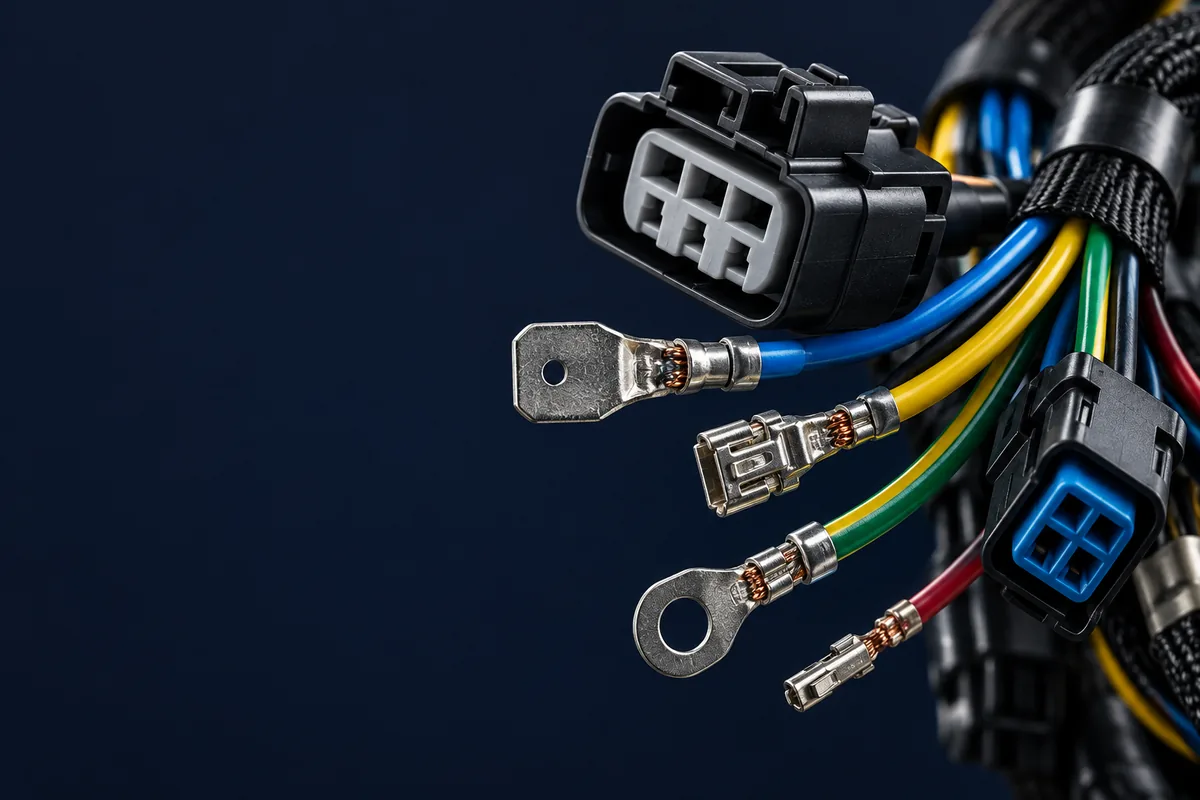
In 2025-Q4, a North American high-tech industrial client asked us to build a high-temperature probe cable with stricter tolerance control than its standard variant. The sourcing problem was not only material selection: the order covered 1440 spools, each at 30 meters per spool, with tighter tolerances and a required 4-5 week lead time.
A high-temperature probe cable assembly is a custom cable built to carry sensor, measurement, heater, or signal circuits near elevated-temperature equipment while holding length, jacket, conductor, shield, and termination requirements through production. For an engineer already comparing suppliers or preparing a production RFQ, the practical question is how to lock tolerance evidence before the first large spool batch ships.
TL;DR
- Define temperature, bend radius, length tolerance, and termination pull checks before quoting.
- Use UL-758 wire evidence and IPC-A-620 workmanship criteria as release references.
- For spool orders, inspect first-piece, in-process, and final samples from every production lot.
- Freeze packaging diameter and label rules when cables ship as 30-meter spools.
- Do not approve mass production until test limits match real equipment conditions.
Where High-Temperature Probe Cables Fail
A probe cable is a cable assembly that connects a sensor, probe head, heating element, or measuring instrument to a controller or test fixture. In test and measurement equipment, failure often starts outside the copper conductor: insulation shrinks, shields open, labels become unreadable, strain relief creeps, or the terminated end loses repeatable resistance after heat exposure.
A tight-tolerance cable is a cable assembly where length, outside diameter, conductor resistance, shield coverage, jacket thickness, or termination geometry must stay inside a defined process window. The word "tight" should never be left as a purchasing adjective. It belongs in the drawing as a measurable limit, such as total length, stripped length, conductor OD, jacket OD, crimp height, pull force, or resistance per meter.
A spool inspection plan is a receiving and production control method that samples cable at defined points before winding, after winding, and before packing. For 30-meter spools, the supplier should not only check one loose cable on the bench. Winding tension, flange diameter, tie position, and label placement can change cable memory and damage soft jackets during ocean or air freight.
For the 1440-spool probe cable order, we treated the 30-meter length as a production-control item, not a packing detail. A cable that passes electrical test but arrives kinked or mislabeled still creates receiving trouble for the OEM.
— Hommer Zhao
The standards backbone should be visible in the RFQ. UL-758 wire style evidence helps confirm insulation system, rated temperature, and construction data for appliance wiring material. IPC-A-620 gives workmanship acceptance logic for cable and wire harness assemblies, including crimping, soldered terminations when used, insulation damage, and final assembly condition. For supplier process control, ISO 9001 supports document control, inspection records, and corrective-action discipline.
Specification Details to Freeze Before RFQ
The RFQ should describe the real operating environment. "High temperature" can mean 105°C jacket rating near a cabinet, 150°C silicone insulation near a heater, or short exposure during equipment cleaning. The supplier cannot choose conductor, insulation, shield, and jacket correctly unless the drawing states continuous temperature, peak temperature, exposure time, movement, chemical contact, and connector location.
Start with the minimum data set. Define conductor material and size, number of cores, shield type, jacket material, length tolerance, stripped length, termination method, label text, spool length, and packaging format. If the cable connects to a measurement instrument, add resistance or impedance limits where relevant. If the cable moves during service, include bend radius and flex-cycle expectations rather than assuming a static cable can survive dynamic use.
For a related design package, compare your RFQ against our cable assembly design guide. If the cable is part of a heated machine module with higher voltage or current, review high-voltage cable assembly requirements before approving jacket or clearance substitutions.
| RFQ Item | What to Specify | Factory Control Method | Release Evidence |
|---|---|---|---|
| Temperature rating | Continuous and peak temperature, insulation family, exposure time | Wire style review against supplier material file | UL-758 style data or equivalent material datasheet |
| Length tolerance | Total length, cut length, stripped length, spool length | First-piece measurement and in-process sampling | Dimensional report with actual readings |
| Electrical limit | Continuity, resistance per meter, insulation resistance, hipot if required | Calibrated test fixture and lot-based records | Test report tied to production lot |
| Shield or braid | Coverage target, drain wire, termination point, exposed length | Visual and dimensional checks before jacket or termination closeout | Inspection photos and sample retention |
| Spool packaging | 30-meter spool, bend radius, tie method, label position | Finished-spool inspection and drop/handling review when needed | Packing photo, label sample, carton count |
| Termination strength | Crimp, solder cup, boot, molded strain relief, or probe-end clamp | Pull check, visual acceptance, and operator setup approval | IPC-A-620 workmanship record and pull data |
Material Selection for Heat, Movement, and Measurement Stability
Insulation choice drives much of the risk. PVC may be acceptable for moderate-temperature cabinet wiring, but silicone, FEP, PTFE, XLPE, or other specialty compounds may be needed near heated tooling, ovens, probes, or process chambers. The selection should consider rated temperature, abrasion, flexibility, jacket memory, flame behavior, chemical contact, and whether the cable must be stripped cleanly during termination.
Conductor choice also matters. Fine-stranded copper improves flexibility, but it can complicate stripping and termination if the process window is loose. Tinned copper helps with oxidation resistance and termination consistency in many assemblies. For measurement cables, resistance stability and conductor uniformity can matter more than the lowest material price.
Shielding should be specified by function. A foil shield can help coverage and diameter control, while braid can improve mechanical robustness and flex life. Some probe cables need both. The drawing should state whether the shield is floating, grounded at one end, grounded at both ends, connected through a drain wire, or trimmed back with insulation clearance.
When a buyer says the cable must survive heat, I ask for the temperature profile before quoting. A 105°C cabinet cable, a 150°C probe lead, and a cable routed past a moving heated jaw need different materials and different inspection records.
— Hommer Zhao
Process Control for 1440 Spools Without Drift
The hardest part of a high-volume spool order is repeatability. On a 1440-spool run, a small setup drift can multiply quickly. Cutting length, strip length, shield trim, label distance, and spool winding tension should be checked at first-piece approval, after setup changes, and at defined intervals during production. The inspection plan should name the sampling frequency instead of relying on a final visual check.
For the 2025-Q4 probe cable program, the production plan aligned the cable process around the tightened tolerance requirements and a multi-PO repeat program. That meant the supplier had to treat each repeat purchase order as a continuation of the same controlled process, not a fresh interpretation of the drawing. The 4-5 week lead time only made sense because material, measurement method, and packaging evidence were locked before the volume run.
Use a golden sample when the cable has subjective features such as jacket feel, winding appearance, label placement, or molded boot finish. Use a measured first article when the risk is dimensional or electrical. A golden sample without numbers cannot settle a length dispute. A dimensional report without photos cannot settle a packaging dispute.
Testing should match the assembly. Continuity alone is not enough when the cable has high-temperature insulation, shield requirements, or precision measurement behavior. Depending on the design, the inspection plan may include continuity, resistance, insulation resistance, hipot, shield continuity, pull force, dimensional checks, visual workmanship, and spool packaging inspection. Our wire harness testing service page shows how production evidence can be organized before shipment.
Supplier Questions That Separate Real Control From Guesswork
Ask the supplier how it will measure the part, not only whether it can make the part. The answer should include gauge type, fixture method, sampling frequency, operator setup approval, material traceability, and nonconforming-product handling. If the supplier cannot explain how a 30-meter spool is measured without stretching or kinking it, the tolerance discussion is unfinished.
Ask for the change-control path. High-temperature cable programs often face material availability pressure, especially when specialty insulation or imported connectors are involved. The supplier should not switch wire style, jacket material, shield construction, or termination tooling without a buyer-approved deviation. For safety-related assemblies, the approval path should reference the original UL-758 evidence and the workmanship criteria used for production release.
A 4-5 week lead time is realistic only when the tolerance window, material evidence, and spool packing method are already frozen. If those three items move after PO release, schedule confidence drops before cutting starts.
— Hommer Zhao
Buyer Release Checklist
Use this checklist before approving production:
- Operating temperature profile states continuous temperature, peak temperature, and exposure time.
- Drawing defines total length, stripped length, tolerance, and 30-meter spool packaging if applicable.
- Wire style or material datasheet supports the rated temperature and insulation construction.
- Inspection plan names continuity, resistance, insulation resistance, pull, visual, or spool checks as needed.
- Supplier confirms IPC-A-620 workmanship criteria for terminations, insulation condition, and final assembly.
- First article includes measured values, photos, material evidence, and packaging sample images.
- Repeat orders use the same controlled drawing revision, test limits, and packaging instructions.
For OEMs still comparing contract manufacturers, the best RFQ package is specific enough that two suppliers quote the same thing. If one quote is much lower, ask which requirement was removed: material rating, tolerance sampling, shield termination, electrical test, packaging, or change-control evidence.
Frequently Asked Questions
What temperature rating should a probe cable assembly use?
Choose the rating from the actual exposure profile, not the machine name. A 105°C cabinet cable, 150°C probe lead, and cable near a moving heated fixture require different insulation systems. Ask the supplier for UL-758 style evidence or equivalent material data before approving production.
How tight should the length tolerance be on a 30-meter probe cable spool?
The tolerance should match the equipment need and the factory measurement method. For a 30-meter spool, define total length, measurement tension, and acceptable end-prep tolerance. Tight limits without a measurement method create receiving disputes even when the cable functions electrically.
Is IPC-A-620 relevant to high-temperature probe cable assemblies?
Yes. IPC-A-620 is relevant when the assembly includes crimped, soldered, shielded, labeled, or strain-relieved cable terminations. It does not replace the cable material rating, but it gives workmanship acceptance logic for insulation damage, termination quality, and final assembly condition.
What tests should be required before shipping high-temperature cable assemblies?
Common checks include continuity, resistance, insulation resistance, hipot when required, shield continuity, dimensional inspection, pull testing, and visual workmanship. For spool shipments, add packaging inspection. A 1440-spool order needs lot records, not only one prototype test report.
Can a supplier substitute a different high-temperature wire style?
Only with buyer approval. A substitute should be checked against rated temperature, conductor size, insulation OD, bend radius, termination compatibility, and UL-758 evidence. If crimp height, strip quality, or spool behavior changes, request updated first-article samples before volume release.
How long does a custom high-temperature probe cable order take?
Lead time depends on material availability, tooling, testing, and volume. In the 2025-Q4 probe cable case, the controlled production run delivered 1440 spools at 30 meters per spool inside a 4-5 week lead time after specifications and process controls were aligned.
Bottom Line for OEM Buyers
A high-temperature probe cable assembly should be sourced as a controlled measurement product, not as a generic cable. Lock the material evidence, tolerance method, electrical tests, and spool packaging before PO release. That is how a supplier can protect repeatability across 1440 spools without stretching a 4-5 week delivery promise.
If you need a production-ready probe cable, send your drawing, temperature profile, length tolerance, and annual volume to our engineering team through the contact page. We will review material risk, test scope, and manufacturability before quoting.