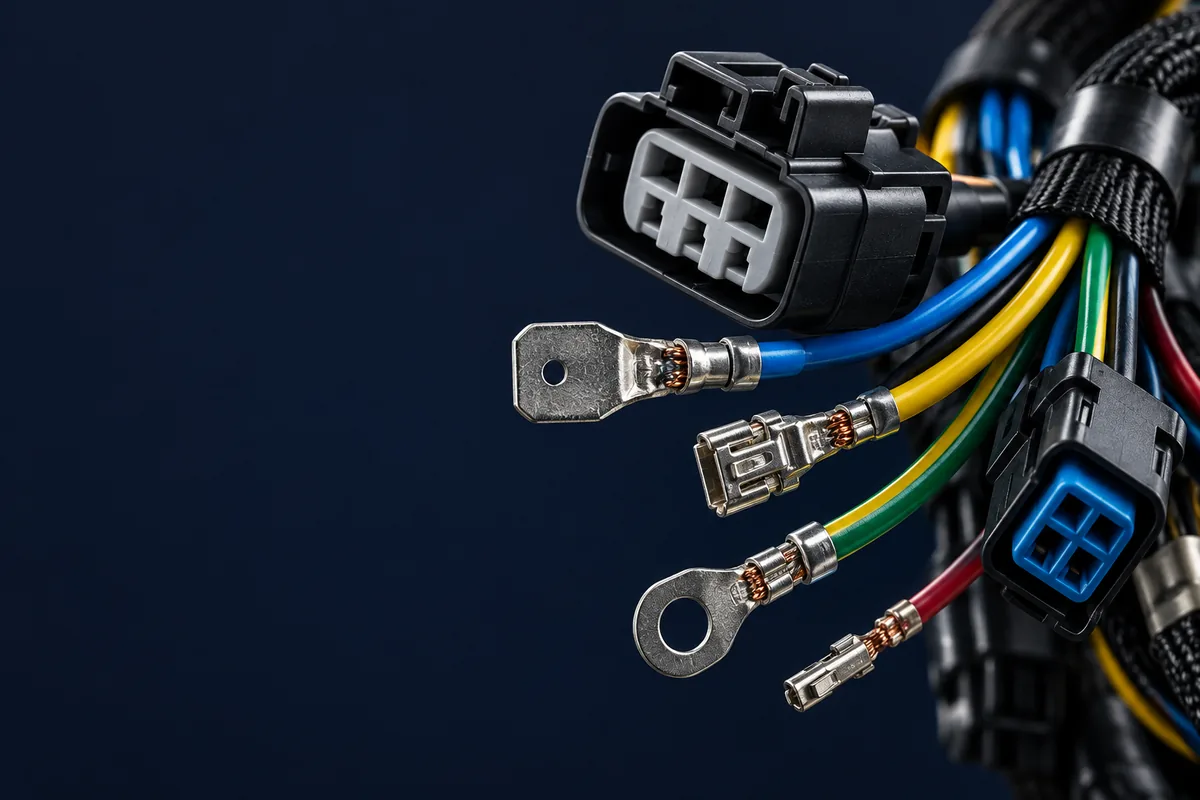
Real Project Snapshot — Automotive Wire Harness Clips Guide
Anonymized example from our case bank, shared so buyers can see how this scope is actually executed in production.
Industry: automotive | Region: Germany | Year: 2025-Q3 → 2025-Q4
Scenario: A German Tier-1 automotive supplier initiated contact seeking a global wire harness manufacturing partner, requiring rapid qualification across multiple regions.
Challenge: The customer needed quick validation of manufacturing capabilities, compliance (NDA, supplier code of conduct), and global coordination to issue multiple RFQs across North America, Europe, India, and South America within weeks.
Solution: Provided comprehensive company presentations, ISO/IATF certifications, and virtual reality factory tours of China and Philippines facilities. Swiftly executed NDAs and supplier codes of conduct, coordinating directly with the global lead buyer and regional buying teams.
Result: Successfully onboarded within two weeks, receiving at least 9 RFQs/RFIs across four global regions within the first four months of engagement.
Concrete numbers: 2 factory locations (China, Philippines), 9+ RFQs/RFIs received in 4 months, Onboarding completed in <14 days, ISO/IATF certifications provided
An automotive wire harness clip is a mounting component that fixes a harness bundle to a body panel, bracket, hole, weld stud, edge flange, or plastic carrier so the wiring stays away from heat, abrasion, pinch points, and moving parts. Buyers often focus on connectors and crimp data first, then discover during vehicle fit-up that a clip position is 18 mm off, a fir-tree stem does not fit the panel hole, or a bundle rubs after the first road-test loop.
This guide is written for engineering teams, sourcing managers, NPI buyers, and supplier-quality teams that already have a harness drawing, 3D route, or first RFQ package. The buying stage is practical: you need to define clip type, mounting hole, bundle diameter, spacing, pull retention, drawing datum, assembly sequence, and inspection evidence before pilot parts leave the harness board.
Our team writes this from a senior factory-engineering role with more than 10 years supporting wire harness and cable assembly programs for automotive, EV, industrial automation, robotics, medical, and marine builds. Use it with our automotive wire harness clips capability page, automotive wire harness page, wire harness strain relief guide, wire harness grommet guide, and first article inspection guide.
TL;DR
- Specify clip type, hole size, panel thickness, bundle OD, datum, and pull target before quoting.
- Use IPC-A-620 workmanship plus IATF 16949-style change control for automotive harness routing evidence.
- Check clip spacing against bend radius, service access, heat sources, and moving clearances.
- For pilot lots, request fit photos, pull checks, and 100 percent clip-count inspection.
What Automotive Harness Clips Control
A push mount clip is a plastic or metal retainer that locks into a panel hole and carries a tie, saddle, tape flag, or molded clip body around the harness bundle. An edge clip is a retainer that grips a sheet-metal or plastic flange without a round hole. A routing datum is a controlled reference point on the drawing or fixture that tells the supplier where the harness branch must sit after assembly.
Those definitions matter because clip mistakes are usually interface mistakes. The harness supplier may build the electrical circuit correctly, pass 100 percent continuity, and still ship a part that does not fit the vehicle because the clip stem, panel hole, or bracket sequence was assumed. A drawing note that says "add clip" is not enough for an automotive harness that must install in under 90 seconds on a vehicle line.
The objective is to turn clip hardware from loose accessory detail into a controlled mounting system. A quote-ready package defines the exact retainer, hole or edge geometry, harness OD range, position tolerance, pull retention, service loop, neighboring parts, and inspection method. That lets the supplier price labor honestly and build the first article against the same physical constraints the vehicle team will see.
When a harness fails fit-up, the root cause is often not the wire or connector. It is a clip datum that never made it from the 3D route into the harness drawing.
Factory Scenario: The 1,200-Harness Clip Position Escape
In a 2026-Q1 automotive accessory harness build of 1,200 pieces, our team received a released drawing with four push-mount clips but no panel-hole detail. The drawing showed nominal clip locations from connector A, yet the vehicle bracket used a 6.5 mm hole through 1.2 mm sheet metal and required the first clip to sit 42 mm from a grommet shoulder. Our first 20-piece pilot passed continuity, but a fit check on the customer bracket found that clip 2 landed 14 mm too close to a bend, which pushed the bundle against a stamped edge during installation.
We measured the bundle OD at the clip saddle on 30 samples: the mean was 11.8 mm, with a maximum of 12.6 mm after tape overlap. The original clip was rated for a 10-12 mm bundle, so the tape overlap made retention inconsistent. Three of 20 pilot harnesses released from the bracket below a 45 N pull check. The corrective action was to change to a 12-14 mm saddle clip, move clip 2 by 16 mm, add the 6.5 mm hole and 1.2 mm panel thickness to the drawing, and add a fixture pin for the grommet shoulder datum.
The next 1,200-piece lot shipped with 0 clip-count defects, 0 retention failures in sampled pull checks, and a recorded minimum retention value of 62 N. The lesson is not that every harness needs a 62 N clip target. The lesson is that clip retention, bundle diameter, and bracket fit must be measured together before the first production lot, not inferred after a vehicle build problem.
Standards and Acceptance Criteria
IPC-A-620 is a cable and wire harness workmanship standard used to define acceptance for routing, securing, tie placement, strain relief, terminals, splices, labels, and inspection classes. Buyers can reference public IPC standards background when they need neutral language for workmanship and visual acceptance.
IATF 16949 is an automotive quality management standard that supports process control, traceability, reaction plans, change approval, and defect prevention in automotive supply chains. For harness clips, IATF 16949 thinking matters because clip alternates, tool changes, drawing revisions, and fixture changes can alter vehicle fit even when the electrical test result stays the same.
The IP Code is a classification system for protection against dust and water. If a clip is near a grommet, sealed connector, splash zone, or washdown area, IP Code targets should be reviewed with the mounting plan because clip load can distort seals or pull a harness branch out of its intended bend radius. Automotive teams may also cite SAE J1128 for low-voltage primary cable expectations and ISO 16750 for vehicle environmental validation, but the public RFQ should state the exact customer requirement rather than linking to bot-blocking standards pages.
A clip alternate is not a plastic price change. It can change insertion force, retention, noise behavior, bundle strain, and the operator path on the vehicle line.
Comparison Table: Clip Types and Buyer Controls
| Clip Type | Mounting Interface | Best Use | RFQ Data Needed | Common Failure Mode |
|---|---|---|---|---|
| Fir-tree push mount | Round panel hole, often 5-8 mm | Body harness, engine-bay brackets, under-seat routes | Hole diameter, panel thickness, pull target, stem length | Loose fit from wrong hole size or thin panel |
| Arrowhead push mount | Round or rectangular hole with snap retention | Fast line installation where tactile lock is needed | Hole geometry, insertion force, retention force, access side | Tab damage during insertion or poor retention after rework |
| Edge clip | Sheet-metal or plastic flange | Door, seat, fascia, and bracket edges without holes | Edge thickness, coating, clip orientation, removal rule | Clip walk-off from vibration or coating thickness mismatch |
| Stud mount clip | Weld stud or threaded post | Power distribution, chassis routes, higher bundle load | Stud diameter, nut or snap style, torque if used, bundle mass | Rotation under harness weight or missing secondary lock |
| Adhesive-backed saddle | Clean flat surface, no hole | Low-load interior prototypes and temporary routing | Surface material, temperature, dwell time, load limit | Adhesive release after heat, dust, or cleaning solvent exposure |
| Molded branch clip | Integrated clip body over branch or connector lead | High-repeat programs needing fixed geometry | Tooling, overmold material, clip datum, service load | High tooling cost or fixed position before route is mature |
Clip Spacing, Bend Radius, and Clearance
Clip spacing is the distance between controlled mounting points along the harness route. The right spacing depends on bundle mass, branch stiffness, bend radius, vibration zone, temperature exposure, operator reach, and neighboring hardware. A 300 mm unsupported span may work on an interior signal branch, while a heavy battery cable or engine-bay harness may need shorter spacing and stronger retainers.
Do not set clip spacing only from a flat drawing. The supplier should check the route against a harness board, 3D model, bracket sample, or installation fixture. Watch the first 50 mm after a connector, grommet, overmold, or splice because that zone often carries hidden stress. If the first clip is too close, it side-loads the connector or seal. If it is too far, the branch moves during vibration and rubs the nearest bracket.
For heat and moving parts, define clearance numerically. Examples: keep the harness 25 mm from a stationary warm bracket, 50 mm from a high-temperature exhaust shield unless a thermal sleeve is specified, or 10 mm minimum from a seat track after full travel. Those values must come from the vehicle team's environment, but the RFQ should force the conversation before tooling, not after the first vehicle trial.
Drawing and Fixture Data Buyers Should Send
The drawing should identify each clip with a unique callout: C1, C2, C3, and so on. Each callout should tie to a BOM part number, mounting interface, position tolerance, orientation, and inspection requirement. If the harness is built on an assembly board, the board should have physical pins or nests that represent critical clip datums. Tape flags alone are too weak for repeat positioning when a bracket interface must land within a narrow window.
Send panel-hole data with the harness RFQ. Include hole diameter, slot dimensions, panel thickness, surface coating, burr direction if known, access side, and whether the clip must survive removal and reinsertion. For edge clips, include flange thickness, coating thickness, edge radius, and installation direction. For stud clips, include stud diameter, usable height, thread or smooth stem detail, and whether the harness is installed before or after nearby components.
If the vehicle team owns the bracket model, share a simplified 3D view or controlled screenshot with datums. A supplier can build from 2D length data, but clips are physical interfaces. Without bracket context, the supplier cannot see whether a branch must rotate, whether a clip needs a left-hand or right-hand orientation, or whether an operator can press the clip straight into the hole.
For mounted automotive harnesses, I ask for clip datums with the same seriousness as connector pinouts. The electrical test proves circuits; the clip datum proves the part can be installed.
Pull Retention and Inspection Evidence
Clip retention testing measures the force needed to release the clip from its mounting interface or the harness from the clip saddle. It is not a substitute for vehicle-level validation, but it catches wrong stem size, wrong saddle range, brittle plastic, and poor assembly before the lot ships. For pilot lots, request a recorded pull check by clip family and mounting interface, especially when the supplier buys clips from a new source.
Inspection should also cover clip count, orientation, tape wrap near the clip, bundle OD at the saddle, distance from datum, and damage after insertion. A harness can have the correct clip quantity but still fail if one clip is rotated 180 degrees or buried under tape so the operator cannot seat it. For clip-on ties, the tie tail should be trimmed cleanly and should not leave a sharp edge facing adjacent wiring.
For automotive programs, link clip checks to lot traceability. The final record should show drawing revision, BOM revision, clip lot, harness build lot, fixture revision, inspector, and any deviation approval. If a clip alternate is approved for a shortage, keep the alternate record with the shipment documents so incoming inspection does not treat the correct deviation as a mixed-material defect.
Sourcing and Alternate Control
Harness clips are often small-cost parts, which makes them vulnerable to casual substitution. That is risky. A cheaper clip may use a different stem geometry, resin grade, UV behavior, operating temperature, tie width, saddle radius, or insertion force. It may fit a sample bracket once but fail after repeated service removal, cold impact, or vibration.
Set a no-substitution rule for clips that define vehicle fit, hold high-mass branches, protect sealed interfaces, or sit near heat and moving parts. If alternates are allowed, require side-by-side review of dimensions, material, temperature range, mounting interface, retention data, installation force, service removal, and supplier traceability. Same catalog description is not enough.
For mature production, ask the supplier to identify the longest-lead or highest-risk clips before release. Some automotive retainers are easy to buy in small lots but hard to secure during a ramp. If annual volume is above 5,000 harnesses, safety stock and approved alternates should be planned before the line depends on weekly deliveries.
RFQ Checklist for Harness Clips
- List each clip callout, BOM part number, drawing datum, position tolerance, and orientation.
- Send panel-hole, edge, stud, bracket, or carrier details with dimensions and material thickness.
- Define bundle OD at each clip after tape, sleeve, conduit, label, or branch overlap.
- State clip spacing, minimum bend radius, service loop, and clearance from heat or moving parts.
- Require IPC-A-620 workmanship class, clip-count inspection, and 100 percent visual orientation check.
- Ask for first-article photos showing each clip seated on the bracket or fixture datum.
- Request pull retention data by clip family when the clip controls vehicle fit or branch load.
- Define alternate approval rules, lot traceability, and reaction plan for clip shortages.
References
- IPC standards background for IPC-A-620 context
- IATF 16949 automotive quality management background
- IP Code reference for dust and water ingress terms
FAQ
What information do I need to quote automotive wire harness clips?
Send clip part numbers, quantity, mounting interface, hole or edge dimensions, panel thickness, bundle OD, clip spacing, position tolerance, and inspection requirements. For automotive programs, include IPC-A-620 workmanship class and IATF 16949-style traceability expectations.
How close should the first clip be to a connector or grommet?
There is no universal distance, but the first clip should avoid side-loading the connector or seal. Many harness teams start with 50-100 mm as a review range, then adjust based on bundle stiffness, bend radius, vibration, and service access.
Should clip retention be tested on every production lot?
For clips that control vehicle fit, heavy branches, sealed interfaces, or safety-related routing, sample retention checks are worth specifying. In the 1,200-piece scenario above, a 45 N pull check caught a saddle-size problem before production release.
Can a supplier change to an equivalent harness clip?
Only with buyer approval. Review stem geometry, saddle range, resin, temperature rating, insertion force, retention force, and bracket fit. A clip with the same hole size can still change bundle position by 5-15 mm.
How do clips affect waterproof connectors or grommets?
A clip placed too close to a seal can pull the branch off-axis and reduce sealing compression. If an IP67 or IP69K target exists, check clip position, bend radius, wire OD, and service movement together rather than treating sealing as a connector-only issue.
What evidence should come with the first article?
Ask for clip callout photos, fixture or bracket fit photos, clip-count inspection, orientation check, bundle OD measurements at critical saddles, pull data where required, and the drawing/BOM/fixture revision used for the build.
Next Step: Send the Mounting Interface With the Harness RFQ
If your automotive harness depends on clips, push mounts, edge retainers, stud mounts, brackets, grommets, or fixed routing datums, send the drawing, BOM, quantity, clip callouts, panel-hole details, bundle OD, operating environment, and required evidence. We can review manufacturability, identify missing mounting data, confirm clip sourcing risk, and quote the harness build. Start through our contact page, or review our automotive wire harness clips and wire harness testing pages before sending the package.