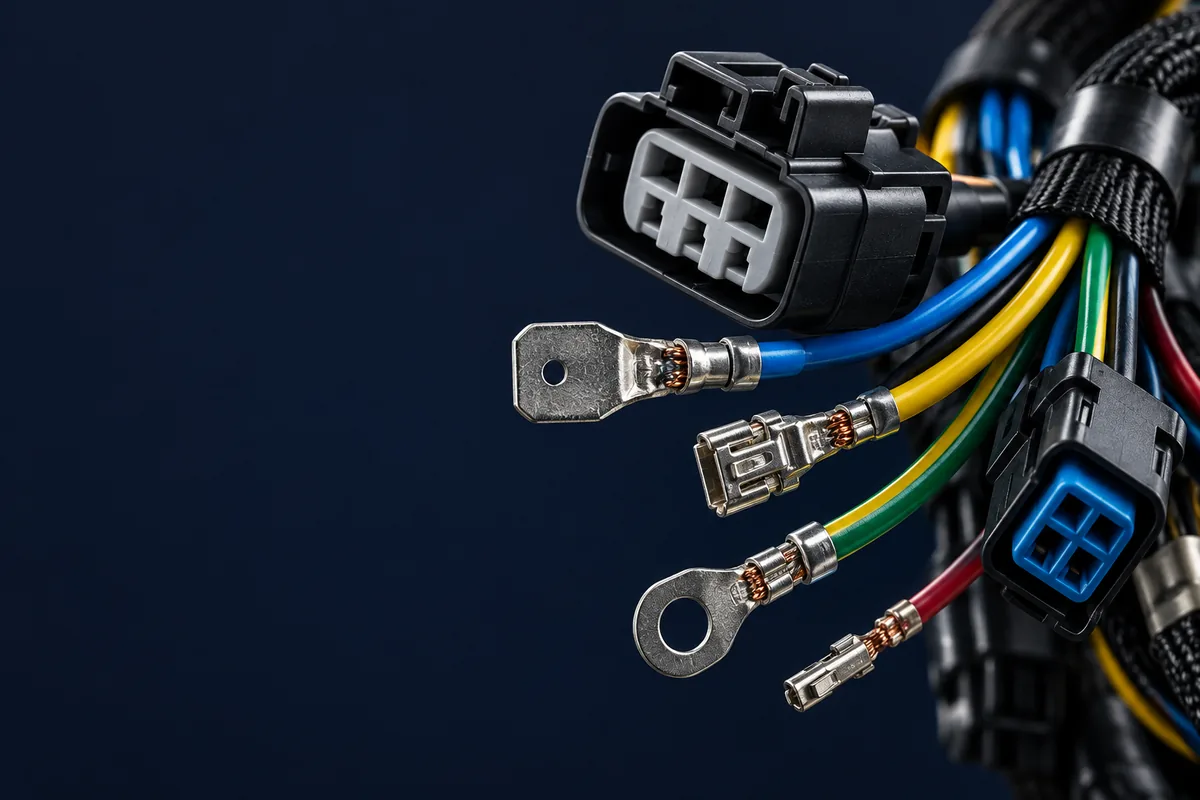
Direct answer: Chinese wire colors depend on the equipment and the governing standard. For IEC-style identification, blue identifies neutral and green/yellow identifies the protective conductor; phase and DC assignments must be checked against the released wiring diagram. Confirm conductor function before translating a Chinese harness into another market's color scheme. Schneider Electric conductor-identification guidance.
How the Two Color Systems Differ
Navigating wire color standards across global markets? This comprehensive guide compares Chinese GB standards with IEC, NEC, and JIS codes to help engineers and manufacturers ensure compliance and safety in international wire harness production.
1. Introduction: Why Wire Color Codes Matter in Global Manufacturing
In the interconnected world of modern manufacturing, a wire harness produced in China may be installed in a European vehicle, American industrial equipment, or Japanese consumer electronics. Each market has its own wire color code standards, and misunderstanding these differences can lead to safety hazards, regulatory non-compliance, and costly product recalls.
Wire color coding serves a fundamental purpose: rapid visual identification of conductor function during installation, maintenance, and troubleshooting. When an electrician opens a junction box, they need to instantly recognize which wire is live, neutral, and ground without requiring a multimeter for every connection.
Safety Statistics
According to industry safety reports, standardized electrical color coding can reduce wiring-related incidents by up to 23%. Incorrect wire identification is a leading cause of electrical accidents during installation and maintenance.
For manufacturers producing custom cable assemblies for global markets, understanding these differences is not optional—it's essential for compliance and safety. This guide provides the comprehensive reference you need.
Three Specification Checks Before Approving a Color Map
1. Record the Chinese standard edition. The official SAMR record lists GB/T 4026-2025, covering equipment terminals, conductor terminations and conductor identification, with an implementation date of February 1, 2026. Add the applicable edition to the drawing alongside the circuit ID, terminal number, base color and tracer color. This makes a color instruction traceable when a supplier works from an older drawing. Source: SAMR: GB/T 4026-2025.
2. Specify the international revision separately. IEC published IEC 60445:2021/AMD1:2026 on January 28, 2026. Its subject is terminal and conductor identification. For an IEC-governed order, record whether the base edition or the amended edition applies; do not assume a Chinese adoption automatically includes every later IEC amendment. Have engineering resolve any difference before releasing the color-to-pin schedule. Source: IEC 60445 Amendment 1 product record.
3. Check electrical ratings independently of jacket color. Prysmian specifies UL AWM Style 1007 at 80°C and 300 V for its hook-up wire offering. A blue jacket therefore identifies a circuit only within the applicable color scheme; it does not establish the wire's voltage, temperature or installation suitability. Reference values: use the specific wire model's datasheet and approval marking. Put the wire style and conductor size in the same BOM row as its color. Source: Prysmian UL 1007 hook-up wire.
2. Chinese Wire Color Standards (GB/T 6995 & GB 50303)
China's electrical wire color code system is governed by national standards issued by the Standardization Administration of China (SAC). The two primary standards are:
- GB/T 6995: Markings for electric wires and cables, defining standard identification colors
- GB 50303: Code for acceptance of construction quality of electrical installation in building, specifying wiring practices
Modern Chinese Color Code (IEC-Aligned)
Since harmonizing with international standards, modern Chinese electrical installations follow color codes that align with IEC conventions. This transition has made Chinese products more compatible with global markets.
| Conductor Function | Modern GB (IEC-aligned) | Legacy Chinese |
|---|---|---|
| Line/Phase L1 | Brown | Black |
| Line/Phase L2 | Black | Red |
| Line/Phase L3 | Grey | Yellow |
| Neutral (N) | Blue | White |
| Protective Earth (PE) | Green/Yellow | Green |
Legacy Color Codes in China
While modern installations follow IEC-aligned standards, you may still encounter legacy color codes in older buildings, rural areas, or when maintaining existing systems. Understanding both systems is crucial for maintenance and renovation projects.
Key Legacy Difference: In older Chinese systems, Black was commonly used for live/phase conductors and White for neutral—the opposite of the modern IEC-aligned system where Blue indicates neutral.
3. IEC International Standards (IEC 60445/60446)
The International Electrotechnical Commission (IEC) develops global standards for electrical equipment. The primary standard for wire color identification was IEC 60446, which was merged into IEC 60445 in 2010 to create a comprehensive conductor identification standard.
Countries and Regions Following IEC Standards
The IEC wire color code is widely adopted across the European Union, United Kingdom, China, Hong Kong, Singapore, Australia, New Zealand and many other international markets.
| Conductor | IEC Color | Notes |
|---|---|---|
| Line 1 (L1) | Brown | Primary phase conductor |
| Line 2 (L2) | Black | Second phase (3-phase systems) |
| Line 3 (L3) | Grey | Third phase (3-phase systems) |
| Neutral (N) | Light Blue | IEC specifies “light blue” |
| Protective Earth (PE) | Green/Yellow | Bicolor stripes (mandatory) |
The Green/Yellow bicolor stripe pattern for protective earth is perhaps the most universally recognized safety color code in electrical systems worldwide. This pattern is specifically designed to be distinguishable from any single-color conductor.
For more details on certification requirements, see our guide on top 5 wire harness certifications .
4. US NEC Wire Color Codes
The United States follows the National Electrical Code (NEC), published by the National Fire Protection Association (NFPA 70). Unlike the IEC system, NEC wire colors differ significantly based on system voltage, creating two distinct color schemes.
120/208/240V Systems (Common Commercial)
| Conductor | NEC Color | Application |
|---|---|---|
| Line 1 (L1/Hot) | Black | Primary hot conductor |
| Line 2 (L2) | Red | Second phase or switch leg |
| Line 3 (L3) | Blue | Third phase (3-phase systems) |
| Neutral (N) | White or Gray | Grounded conductor |
| Ground (G) | Green or Bare | Equipment grounding |
277/480V Systems (Industrial)
| Conductor | NEC Color | Application |
|---|---|---|
| Line 1 (L1) | Brown | Phase A |
| Line 2 (L2) | Orange | Phase B |
| Line 3 (L3) | Yellow | Phase C |
| Neutral (N) | Grey | High-voltage neutral |
| Ground (G) | Green | Equipment grounding |
Critical Difference: Blue Wire Meaning
In US NEC systems, Blue is a hot/live conductor (L3 at 120/208V). In IEC systems, Blue is neutral. This is the most dangerous cross-standard confusion—never assume a blue wire is safe to touch!
For products destined for the US market, understanding these differences is critical. See our automotive vs industrial wire harness comparison for industry-specific requirements.
5. Japan JIS Wire Color Standards
Japan follows Japanese Industrial Standards (JIS), which are distinct from both IEC and NEC systems. Japan's electrical system operates at unique voltage levels (100V single-phase, 200V three-phase), and its color codes reflect these characteristics.
| Conductor | JIS Color | Notes |
|---|---|---|
| Line 1 (L1) | Black | Primary phase |
| Line 2 (L2) | Red | Second phase (3Φ systems) |
| Line 3 (L3) | White | Third phase (3Φ systems) |
| Neutral (N) | White | Same as L3 in some systems |
| Ground (G) | Green | Solid green (not striped) |
Japan is specifically mentioned in IEC standards as using different colors—White for neutral (instead of light blue) and solid Green for protective earth (instead of Green/Yellow stripes). This is a recognized regional variation.
For manufacturers exporting to Japan, our custom wire harness services can produce JIS-compliant products to exact specifications.
6. Complete Comparison Tables
Single-Phase AC Systems
| Function | China (GB/IEC) | Europe (IEC) | USA (NEC) | Japan (JIS) |
|---|---|---|---|---|
| Line/Hot | Brown | Brown | Black | Black |
| Neutral | Blue | Blue | White/Gray | White |
| Ground/PE | Green/Yellow | Green/Yellow | Green/Bare | Green |
Three-Phase AC Systems
| Function | China (GB/IEC) | Europe (IEC) | USA 120/208V | USA 277/480V | Japan (JIS) |
|---|---|---|---|---|---|
| L1 | Brown | Brown | Black | Brown | Black |
| L2 | Black | Black | Red | Orange | Red |
| L3 | Grey | Grey | Blue | Yellow | White |
| Neutral | Blue | Blue | White/Gray | Grey | White |
| Ground | Green/Yellow | Green/Yellow | Green | Green | Green |
For detailed material selection guidance, see our top 10 wiring harness materials guide .
7. DC Power Wire Color Codes
DC (Direct Current) systems are increasingly common in modern applications including solar power, battery systems, electric vehicles, and data centers. DC color codes differ significantly between regions.
| Conductor | US/NEC | IEC/Europe | Common Practice |
|---|---|---|---|
| Positive (+) | Red | Brown | Red widely recognized |
| Negative (-) | Black | Blue | Black common globally |
| Ground | Green or Bare | Green/Yellow | Green universal |
For EV high-voltage systems, additional color requirements apply. See our comprehensive EV high-voltage wire harness guide for details on orange cable requirements and HVIL safety systems.
8. Practical Guidance for Global Manufacturing
Manufacturing Best Practices
Design Phase
- • Confirm target market standards early
- • Specify color codes in BOM documents
- • Include color requirements in drawings
- • Validate supplier color stock availability
Production Phase
- • Segregate wire inventory by standard
- • Implement color verification checkpoints
- • Document color compliance in QC records
- • Train operators on standard differences
Common Pitfalls to Avoid
| Pitfall | Risk | Prevention |
|---|---|---|
| Assuming blue is neutral globally | Electrocution risk in US installations | Verify target standard explicitly |
| Using solid green for PE in IEC markets | Non-compliance, installation rejection | Use Green/Yellow striped wire |
| Mixing legacy and modern Chinese colors | Confusion, miswiring, accidents | Confirm project requirements first |
| Ignoring voltage-based US color changes | Wrong colors for system voltage | Specify voltage level in requirements |
Documentation Requirements
When submitting RFQs for wire harnesses destined for specific markets, always include:
- Target standard: IEC, NEC, JIS, or specific GB number
- System voltage: Critical for NEC color selection
- Application type: Industrial, commercial, residential
- Color specifications: Exact Pantone or RAL if critical
- Labeling requirements: Some standards require printed identification
For complete RFQ preparation, see our wire harness RFQ checklist .
9. Frequently Asked Questions
What is the Chinese wire color code standard?
China follows GB 50303 and GB/T 6995 standards for wire color coding. Modern Chinese installations align with IEC conventions: Brown for L1, Black for L2, Grey for L3, Blue for Neutral, and Green/Yellow for Protective Earth. However, legacy installations may use Black for Live and White for Neutral.
What color is the neutral wire in Chinese electrical systems?
In modern Chinese electrical systems following GB standards, the neutral wire is Blue (aligned with IEC). In older installations, you may encounter White being used as neutral, which followed the legacy Chinese color code system.
How does Chinese wire color code differ from US NEC standards?
Key differences include: Chinese (IEC-aligned) uses Blue for neutral while US NEC uses White/Gray; Chinese uses Brown/Black/Grey for three-phase lines while US uses Black/Red/Blue at 120/208V or Brown/Orange/Yellow at 277/480V. Both use Green/Yellow or Green for ground.
Can I use US-colored wires in products destined for China?
Products manufactured for the Chinese market should follow GB/IEC color codes for compliance and safety. While US-colored wires may function electrically, they won't meet Chinese regulatory requirements and could cause confusion during installation or maintenance.
What is the ground wire color in Chinese standards?
The protective earth/ground wire in Chinese GB standards is Green with Yellow stripes (Green/Yellow), which is aligned with the IEC international standard. This bicolor striped pattern is the universal safety color recognized globally.
Need Wire Harnesses for Global Markets?
Our engineering team understands international wire color standards inside and out. Whether you need IEC, NEC, JIS, or GB-compliant wire harnesses, we deliver products that meet your target market requirements.
Related Articles
Hommer Zhao
Wire Harness Manufacturing Expert
With experience in wire harness manufacturing for global markets, Hommer leads technical operations ensuring compliance with international standards including IEC, NEC, UL, and GB requirements. He specializes in helping companies navigate complex multi-market compliance requirements.