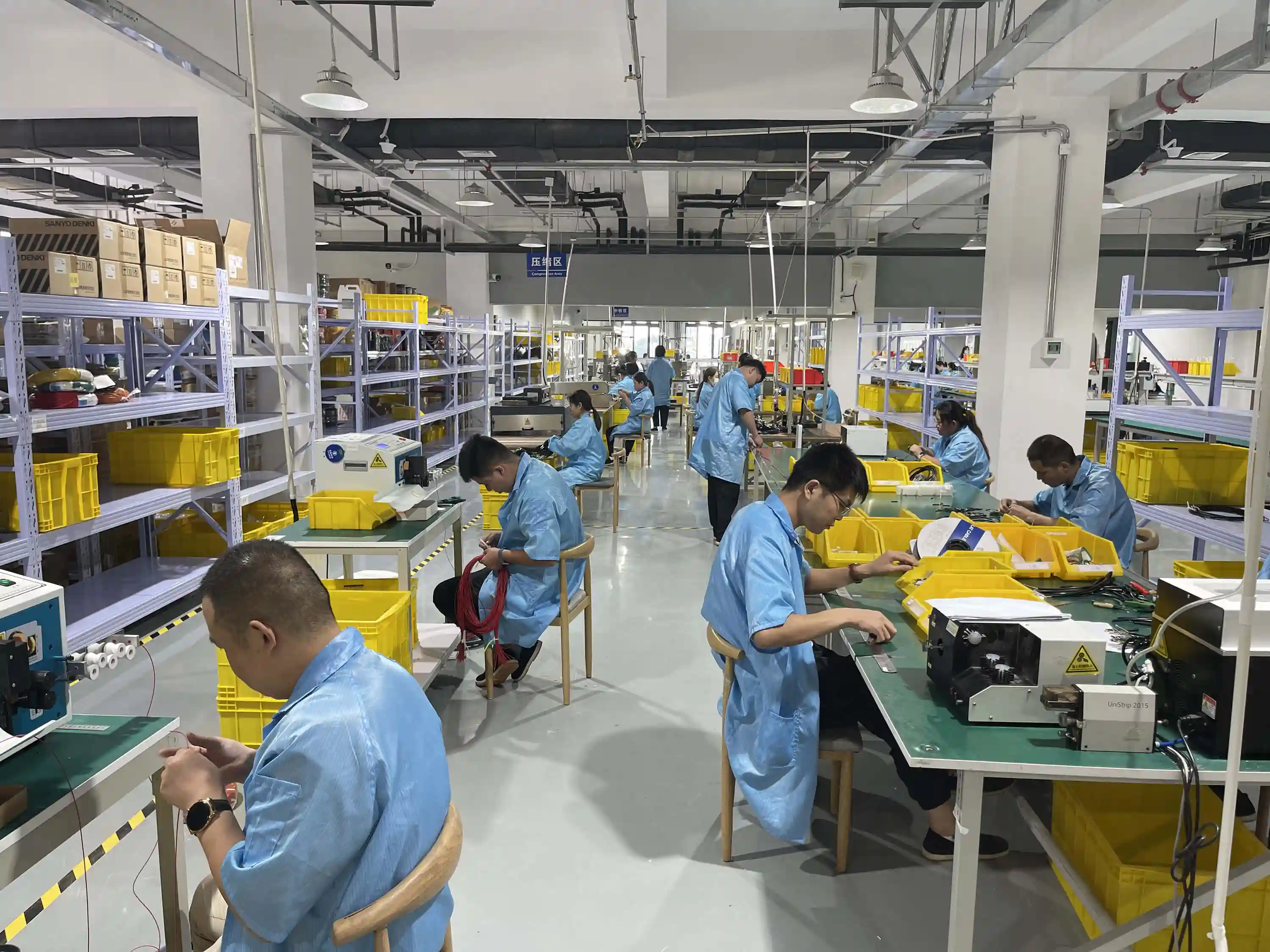
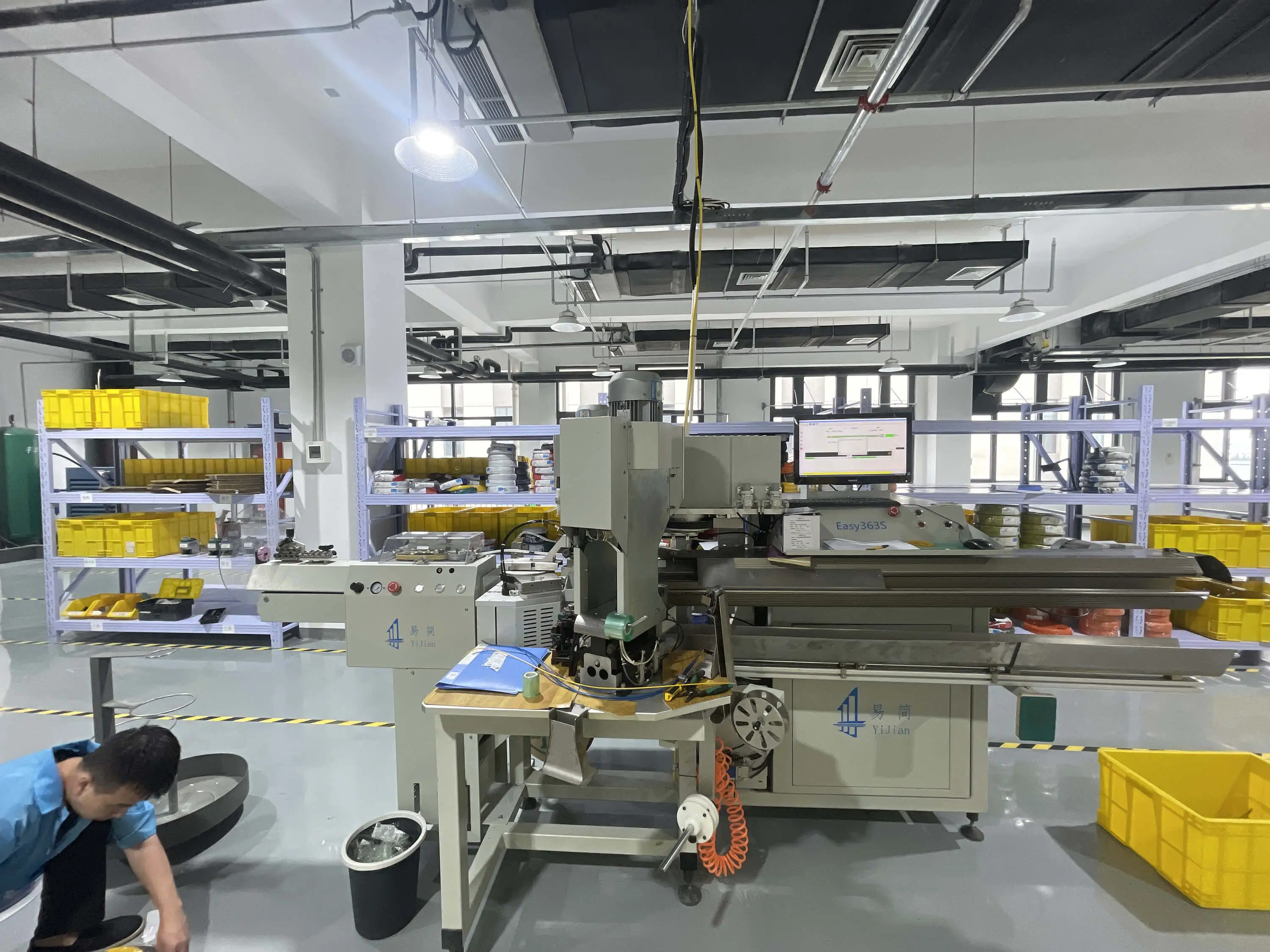
Factory Wiring Harness Manufacturing at Scale
Purpose-built factory production for wire harness programs that have graduated from prototyping. Automated terminal crimping, fixture-board routing, IPC/WHMA-A-620 workmanship alignment, and 100% electrical test on every unit β from 50-piece pilot lots to 100,000-unit production runs.

Factory Wiring Harness Capabilities
Production-grade processes for buyers who need repeatable quality across every lot, not just the first build
Automated Terminal Crimping
Wire ends are crimped using fully automatic terminal crimping machines set to validated force and crimp-height parameters. Every reel change triggers a crimp-force check before production resumes β preventing the batch-wide termination failures that result when manual settings drift mid-run.
Fixture-Board Assembly
Complex multi-branch harnesses are built on dedicated assembly fixture boards that lock wire routing, branch lengths, and connector orientation in place. Fixture boards eliminate the dimensional inconsistencies that accumulate when operators route freehand β a critical quality driver for harnesses that must fit a constrained space during integration.
100% Electrical Testing
Every harness leaves the line with a documented electrical test record. Continuity, shorts, opens, and polarity are verified against the harness schematic β not sampled, but tested unit by unit. For programs with customer-specific test requirements, we build dedicated test fixtures that match your electrical test plan.
IPC/WHMA-A-620 Workmanship
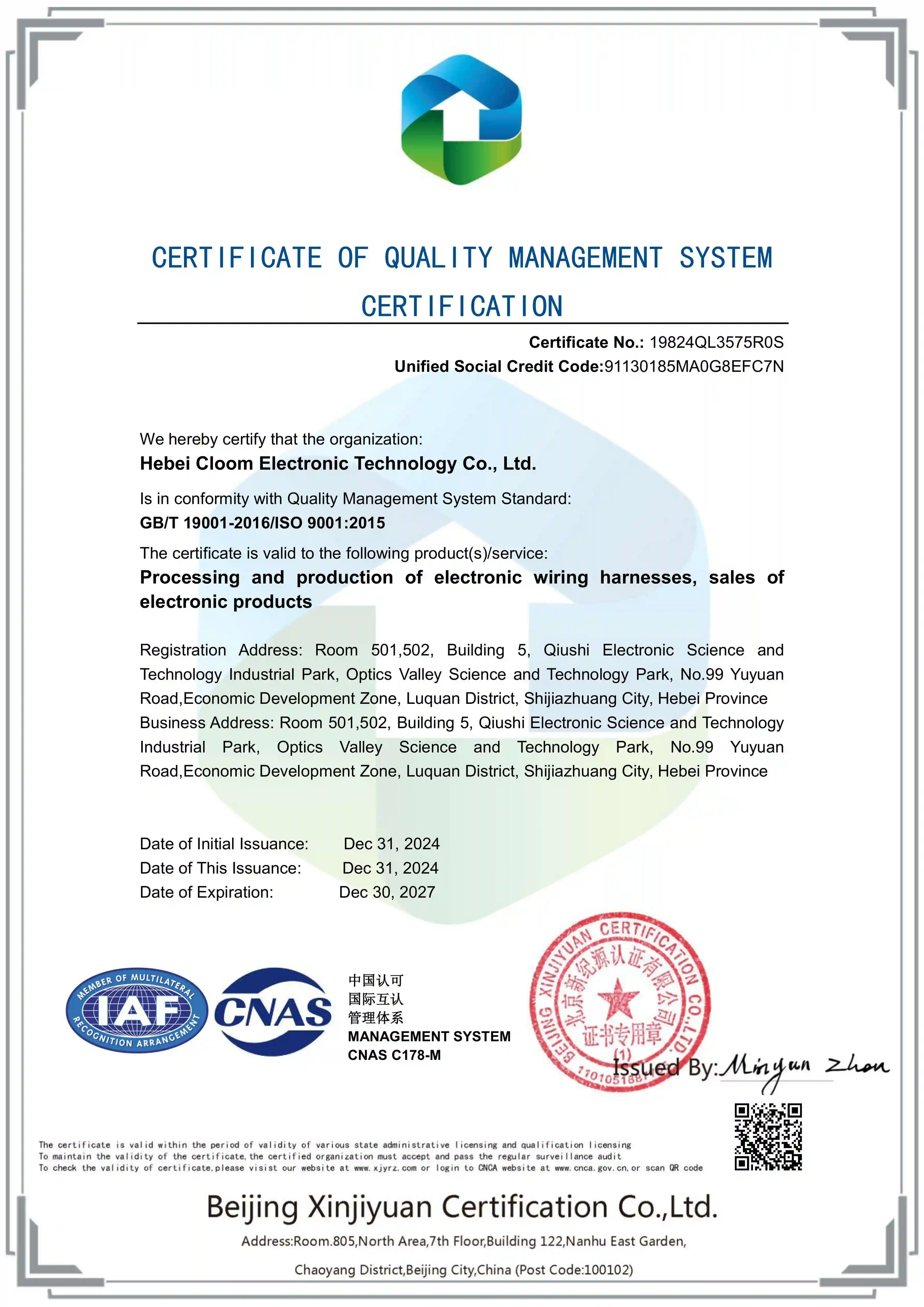
Production builds follow IPC/WHMA-A-620 workmanship requirements, the industry's principal quality standard for wire harness and cable assembly. Class 2 is standard; Class 3 is available for aerospace, defense, and medical programs where workmanship defects carry elevated field risk. Operators are trained and qualified to the standard β not just aware of it.
Multi-Branch Complex Harnesses
Factory production is organized for harnesses with multiple branches, Y-splits, stepped jackets, heat-shrink breakouts, and mixed wire gauges within a single assembly. Branch assemblies up to 240+ conductors are handled on the floor, with traveler-controlled routing sequences that keep the build reproducible across operators and shifts.
Scalable Volume Flexibility
The same factory process that builds a 50-unit pilot lot scales to 100,000+ units per month without requalification. Material buffers, machine capacity, and staffing are planned against your forecast so production ramp-ups do not create the lead-time surprises that disrupt your own production schedule.
Industries & Applications
Factory-built wire harnesses for volume OEM programs across demanding industries
Industrial Automation Equipment
Control cabinet harnesses, servo drive connections, sensor signal loops, and machine interconnects for automation builders running multi-unit production programs. Factory volume builds keep lead times off the critical path.
Automotive & EV Subsystems
Battery management harnesses, high-voltage inter-module cables, HVAC control assemblies, and interior subsystem harnesses for EV and specialty vehicle OEMs scaling from pilot to series production.
Medical Device Manufacturing
Patient monitoring leads, therapy device harnesses, and diagnostic equipment cable sets for medical OEMs that need IPC/WHMA-A-620 workmanship, lot traceability, and documented electrical test records.
Energy & Power Infrastructure
Control and signal harnesses for solar inverters, UPS systems, energy storage modules, and switchgear assemblies. High-volume builds with environmental resistance and 100% test documentation.
Robotics & Motion Systems
Robot arm internal harnesses, drag chain cable assemblies, and axis-to-controller wiring for robotics OEMs. Factory production ensures that every unit in your robot lineup ships with identical, tested cable routing.
Commercial & Agricultural Machinery
Engine control harnesses, hydraulic sensor loops, cab wiring, and implement connection assemblies for commercial vehicle and agricultural equipment manufacturers with multi-season production volumes.
Production Specifications
Factory Production Process
Drawing & BOM Review
We review your schematic, BOM, connector list, and branch layout. Any producibility issues β wire gauge conflicts, connector tooling gaps, missing callouts...
Crimp Tooling & Fixture Setup
Terminal crimp tooling is verified or procured for each connector and wire gauge combination. Assembly fixture boards are designed from your routing drawing...
Pilot Lot Build & First Article
Initial units are built under controlled travelers on the production fixture. Crimp heights are measured, pull-force checks are documented, and the full...
Process Lock
Approved crimp parameters, fixture board dimensions, wire routing sequence, electrical test setup, and packout instructions are locked in the production...
Volume Production & 100% Test
Production lots run with the approved setup. Every unit is electrically tested and receives a documented test record. Periodic crimp-force audits run...
Labeling, Packaging & Release
Finished harnesses are labeled per your requirements β part number, revision, date code, or barcode β then packaged and released against your delivery...
Why Production Buyers Choose Our Wire Harness Factory
Factory discipline that protects your production schedule, not just your first build
Crimp Failure Is the Leading Field Failure Mode β We Prevent It
Industry field data consistently identifies poor crimp quality as the top wire harness failure mode, responsible for intermittent electrical faults, field returns, and costly recalls. Our automated crimp machines maintain validated crimp-height and pull-force parameters across every wire gauge, with periodic pull-force verification during each production run. Manual crimping without validated parameters is where most harness failures originate β we removed it from volume production.
Fixture Boards Lock Dimension Repeatability
A wire harness built freehand will vary 10β30 mm in branch length across operators and shifts. When that harness must route through a constrained chassis or connect to a fixed bracket, dimensional drift becomes an integration problem at your assembly line. Our fixture boards hold branch lengths to Β±3 mm run to run, so the harness that fits at first article fits across every production lot.
100% Test Means No Electrical Escapes
Sampling-based electrical test lets wiring defects β pinout errors, undetected shorts, missed conductor insertions β escape into finished goods. For any volume harness program, the cost of a harness-caused field return exceeds the cost of 100% test many times over. Every harness we ship carries a documented electrical test record before it leaves the floor.
Volume Scalability Without Requalification
When your product ramps from pilot to series production, the harness supplier requalification is a delay you cannot afford. Our factory process is designed so that 50-unit pilot builds and 10,000-unit monthly runs use the same fixture, the same crimp setup, the same test fixture, and the same traveler. Scaling up adds machine time, not process change.
Material Planning That Protects Your Schedule
Connector and terminal lead times are a hidden risk in wire harness procurement. We plan material buffers against your forecast so that a connector backorder β common for Molex, TE, or Deutsch parts under supply pressure β does not stop your production. You share a rolling forecast; we manage the supply risk.
Documentation Ready for Regulated Industries
Medical, aerospace, defense, and automotive programs require more than a working harness β they require evidence of how it was built. We provide lot-tracked material records, operator qualification status, electrical test data, and workmanship inspection results. For regulated programs, documentation is not an add-on; it is part of the product.
"The single most common wire harness failure mode we see entering a factory is improper crimp height β terminals applied with the wrong tool setting or worn tooling that nobody verified. On a hand-built prototype, one bad crimp shows up at first test. In a 5,000-unit production run with manual crimping and no validated setup, the same bad crimp ships to the field. Automated machines with periodic pull-force checks exist specifically to prevent that. Every volume harness program should be built on validated crimp infrastructure, not manual skill."β Hommer Zhao, Wire Harness Engineering Lead
References: IPC/WHMA-A-620 Requirements and Acceptance for Cable and Wire Harness Assemblies
Factory Wiring Harness FAQ
Questions production buyers ask before moving a wire harness program into volume factory builds.
Related Services
Services commonly paired with factory wiring harness programs.
OEM Cable Assembly
For branded OEM programs that need revision-controlled production, private label packaging, and scheduled releases aligned to your product roadmap.
Learn MorePrototype Wire Harness
Before committing to factory tooling, validate your design with a fast-turn prototype build. We support NPI from first sample through first-article approval.
Learn MoreOvermolded Cable Assembly
Factory wire harnesses with injection-overmolded strain relief or environmental sealing where connectors exit exposed housings or panel penetrations.
Learn MoreReady to Move Your Wire Harness Program Into Production?
Send your drawings, BOM, connector list, and volume forecast. We will review the assembly for producibility, confirm crimp tooling availability, and return a factory production quote within 24 hours.