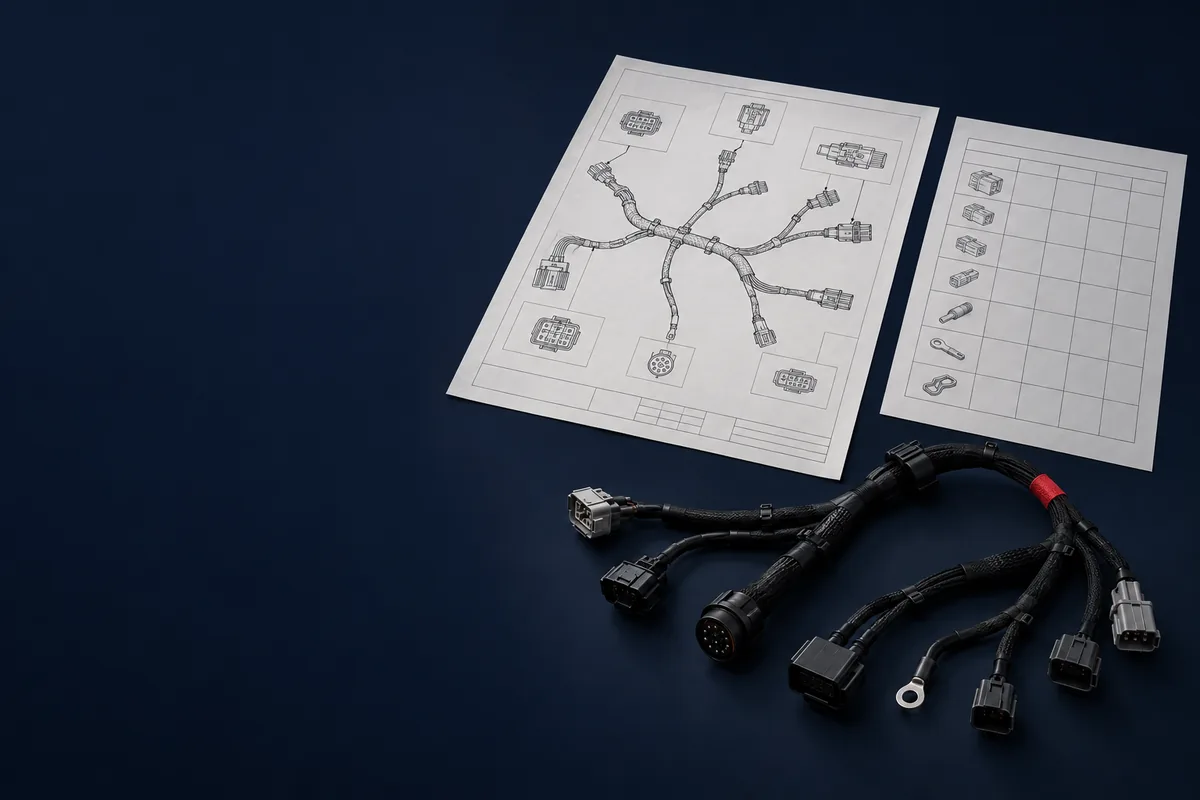
Procurement Guide
What a Misclassification Costs You
Tariff Classification for Wire Harness Imports & Exports
A procurement manager at a medical device company classified 2,000 shielded cable assemblies under HS 8544.49 instead of 8544.42 — missing the 'fitted with connectors' distinction. CBP held the shipment for three weeks and assessed $8,400 in penalty duties. A competitor with the correct classification cleared customs in 48 hours.
HS Chapter for insulated wire & cable assemblies
Current duty rate by origin and entry date
Classification rationale for each SKU
Wire harness assembly production line with cable assemblies being manufactured for international export
Cable assembly production line preparing wire harnesses for international shipment with customs documentation
Every cable assembly crossing an international border needs a Harmonized System (HS) code — a standardized numeric classification that determines duty rates, trade statistics, and regulatory requirements. Get it right, and your shipment clears customs in days. Get it wrong, and you face delays, penalty duties, and potential litigation.
Wire harnesses and cable assemblies fall primarily under HS Chapter 85, Heading 8544. The correct 6-digit subheading depends on three factors: whether the cable has connectors, the operating voltage, and the intended application. The U.S. HTS adds four more digits for a 10-digit classification that determines your exact duty rate.
This guide covers the classification logic for every common cable assembly type, current duty rates including Section 301 tariffs, the five most expensive misclassification mistakes, and how to lock in your classification with a binding ruling.
1. What Is an HS Code and Why Cable Assembly Classification Matters
The Harmonized System is a six-digit product classification maintained by the World Customs Organization (WCO). Over 200 countries use HS codes as the foundation for their customs tariffs. The first two digits identify the chapter, the next two narrow to the heading, and the final two specify the subheading.
For cable assemblies, the financial stakes are significant. A single-digit error in your HS code can swing duty rates from 0% to 25%. On a $200,000 annual import volume, that mistake costs $50,000 in unnecessary duties — or triggers the same amount in CBP penalties if you underpay.
The classification also determines whether your product qualifies for preferential treatment under free trade agreements like USMCA, EU FTAs, or RCEP. Procurement teams that master HS code classification gain a measurable cost advantage.
Quote
Text: Classification should be reviewed for each SKU against its construction, connector status, origin, and the rules in force on the entry date. Document the rationale and have the importer or customs professional confirm the applicable treatment.
Author: Hommer Zhao
Role: Founder & General Manager
2. Chapter 8544: The Home Base for Cable Assemblies
HS Heading 8544 covers 'Insulated wire, cable, and other insulated electric conductors, whether or not fitted with connectors; optical fiber cables.' This heading is the starting point for virtually all cable assemblies and wire harnesses.
The most common classification question: 8544.30 vs 8544.42. The dividing line is application, not construction. A wire harness built for a vehicle falls under 8544.30. The identical harness built for an industrial control panel falls under 8544.42. CBP looks at the declared end use, not the physical product.
For custom cable assemblies with mixed applications, classify based on the principal use. If 80% of a production run goes into automotive applications, the entire lot is classified under 8544.30 per GRI 3(b) of the Harmonized System.
Table
| HS Code | Description | Typical Products | U.S. MFN Duty |
|---|---|---|---|
| 8544.30 | Vehicle/transit vehicle/ship wiring sets | Automotive harnesses, transit vehicle wiring, marine harnesses | 5% |
| 8544.42 | Conductors ≤1,000 V, with connectors | Industrial cable assemblies, medical harnesses, consumer cables | 0–3.5% |
| 8544.49 | Conductors ≤1,000 V, without connectors | Bulk cable on spools, unterminated wire | 0–3.5% |
| 8544.60 | Conductors >1,000 V | High-voltage power cables, EV charging cables >1 kV | 3.5% |
| 8544.70 | Optical fiber cables | Fiber optic patch cables, fiber assemblies | 0% |
3. HS Code Decision Tree: Classifying Your Cable Assembly
Follow this five-step decision sequence to find the correct HS subheading for any cable assembly. Step 1: Does the product contain insulated electric conductors? If yes, proceed to Chapter 85 Heading 8544. Step 2: Does it contain active electronics that convert signals? If yes, reclassify under 8517.62 or 8471.80 — exit 8544 entirely.
Step 3: Is it designed for vehicles, transit vehicle, or ships? If yes, classify under 8544.30. Step 4: Is the operating voltage 1,000 V or less? If no, classify under 8544.60. Step 5: Is the cable fitted with connectors? If yes, classify under 8544.42. If no, classify under 8544.49.
The 'fitted with connectors' distinction catches the most importers. Per WCO Explanatory Notes, any termination — crimped terminals, soldered pins, molded plugs, or IDC headers — counts as a connector. A cable with one terminated end and one bare end still qualifies as 'fitted with connectors.'
Quote
Text: Section 301 tariffs turned cable assembly sourcing into a classification exercise. We have customers who moved connector crimping to Vietnam while keeping wire cutting in China — the substantial transformation shifted the country of origin and dropped effective duty from 28% to 2.6%. The HS code stayed the same; only the origin changed.
Author: Hommer Zhao
Role: Founder & General Manager
4. Duty Rates and Section 301 Tariffs
Base MFN duty rates for cable assemblies under Heading 8544 range from 0% to 5%. The complication is Section 301 tariffs, which add 7.5% to 25% on products originating from China. For HTS 8544.30.0000 (vehicle harnesses), the base 5% plus 25% Section 301 brings the effective rate to 30%. HTS 8544.42.2000 (copper conductors with connectors) carries 2.6% base plus 25% Section 301, totaling 27.6%.
The duty rate applies to the customs value — typically the transaction value plus freight, insurance, and any assists such as tooling, dies, or molds provided to the manufacturer. If you supplied $15,000 in crimp tooling, that amount must be prorated across imported units and added to the customs value.
Optical fiber cables under 8544.70 carry 0% base duty but still face Section 301 tariffs from China. Companies importing fiber assemblies from non-China sources pay zero duty.
Table
| HTS Code | Product Type | Base Duty | Section 301 | Effective Rate |
|---|---|---|---|---|
| 8544.30.0000 | Vehicle wiring harnesses | 5% | +25% | 30% |
| 8544.42.2000 | Copper conductors ≤1 kV with connectors | 2.6% | +25% | 27.6% |
| 8544.42.9090 | Other conductors ≤1 kV with connectors | 3.5% | +25% | 28.5% |
| 8544.49.9000 | Conductors ≤1 kV without connectors | 3.5% | +25% | 28.5% |
| 8544.70.0000 | Optical fiber cables | 0% | +25% | 25% |
5. Five Classification Mistakes That Trigger CBP Penalties
Mistake 1: Classifying terminated cables under 8544.49 instead of 8544.42 without confirming the current tariff text. Incorrect classification can cause duty adjustments, penalties, and clearance delays; the importer or customs professional should confirm treatment for each entry.
Mistake 2: Using 8544.30 for industrial harnesses installed in vehicles. HS 8544.30 requires the harness to be designed as vehicle wiring. An industrial sensor cable mounted inside a vehicle does not qualify. Risk: overpayment of 1.5–5% on every shipment.
Mistake 3: Classifying cables with active signal conversion under 8544. USB-C to DisplayPort adapters and protocol converters are data processing apparatus under 8517.62, not passive conductors. Risk: re-liquidation and back-duty for up to 5 years.
Mistake 4: Ignoring country-of-origin substantial transformation rules. Cutting wire in one country and crimping in another may or may not shift origin. CBP looks at where the essential character is established. Risk: double penalty exposure.
Mistake 5: Using supplier-provided HS codes without verification. Suppliers use their domestic export codes, which may differ from the importing country's classification. The importer of record bears legal responsibility.
Note: Potential treatment under 19 USC § 1592 depends on the facts and rules in force. Have the importer or a qualified customs professional confirm exposure rather than relying on a generic penalty estimate.
6. Country-of-Origin Rules and Free Trade Agreements
Country of origin determines which duty rate applies and whether Section 301 tariffs hit your shipment. CBP applies the substantial transformation test: the country where the product undergoes a fundamental change in character, name, or use. Wire cutting alone does not constitute substantial transformation. Connector termination combined with assembly and testing typically does.
The USMCA origin rule matters for companies that have shifted wire harness production to Mexico. If your Mexican facility sources Chinese wire but performs all cutting, stripping, crimping, and assembly in Mexico, the finished harness qualifies as Mexican-origin — eliminating both base duty and Section 301.
Keep documentation airtight. CBP can request verification at any time. Maintain bills of materials, production records, and IPC-620 inspection reports that prove where substantial transformation occurred.
Table
| Trade Agreement | Rule of Origin for 8544 | Duty Benefit |
|---|---|---|
| USMCA | Tariff shift from outside 8544 or 50% Regional Value Content | 0% duty |
| EU-Korea FTA | Change in tariff heading + max 50% non-originating materials | 0% duty |
| RCEP | 40% Regional Value Content | Reduced/0% duty |
Quote
Text: Documentation is your insurance policy. We maintain a complete chain-of-custody file for every wire harness SKU: wire mill certificates, connector purchase orders, production travelers, and test reports. When CBP requested a verification on a $380,000 shipment, we cleared it in four days because every document was indexed.
Author: Hommer Zhao
Role: Founder & General Manager
7. How to Get a Binding Ruling from CBP
A binding ruling is a written decision from CBP that locks in the tariff classification for your specific product. It protects you from penalty exposure and gives customs brokers a definitive classification. The ruling is legally binding on CBP for as long as facts remain unchanged.
File through the CBP eRulings portal (CROSS database). Include: complete product description, photographs, technical drawings, bill of materials listing conductor gauge and insulation type, connector specifications, intended end use, and your proposed classification. CBP typically responds within 30–90 days.
A binding ruling is product-specific. For high-variability product lines with hundreds of cable assembly variants, consider working with a licensed customs broker who can apply General Rules of Interpretation across your portfolio.
Checklist
- Product photographs from multiple angles
- Technical drawing with dimensions
- Bill of materials with wire gauge, insulation, connectors
- Conductor material specification
- Operating voltage and current rating
- Connector type and manufacturer part numbers
- Intended end use and industry application
- Country of manufacture and assembly steps
- Proposed HTS classification with reasoning
- Physical samples if requested by CBP laboratory
8. Frequently Asked Questions
Frequently Asked Questions
What is the HS code for a wire harness with connectors?
Most wire harnesses with connectors fall under HS 8544.30 (vehicle/transit vehicle/ship harnesses) or 8544.42 (other conductors ≤1,000 V with connectors). The correct subheading depends on end application: vehicle-specific harnesses use 8544.30, while industrial and consumer electronics harnesses use 8544.42.
I'm importing 5,000 automotive wire harnesses from China — what duty rate should I budget for?
For automotive wire harnesses from China under HTS 8544.30.0000, the base MFN duty is 5% plus 25% Section 301, totaling 30% of customs value. On a $50,000 shipment, budget $15,000 in combined duties. Check the USTR exclusion list periodically and explore USMCA origin rules if any assembly occurs in Mexico or Canada.
What happens if I use the wrong HS code for my cable assembly shipment?
Incorrect HS codes can trigger duty adjustments, penalties, clearance delays, and additional scrutiny. The importer should document the classification rationale and obtain advice or a binding ruling when the treatment is uncertain.
How do I determine the HS code for a cable assembly with active electronics?
Cable assemblies with active signal processing — USB-C to HDMI adapters, protocol converters — are reclassified out of 8544 to heading 8517.62 (data transmission apparatus) or 8471.80. The test: does the cable merely conduct electricity, or does it transform the signal?
Should I classify my shielded cable with connectors under 8544.42 or 8544.49?
If the cable has any termination — crimped terminals, molded plugs, board-level headers — it classifies under 8544.42 (fitted with connectors). HS 8544.49 is for unterminated cable only. A cable with one end terminated and one bare still goes to 8544.42.
Frequently Asked Questions
What is the HS code for a wire harness with connectors?
Most wire harnesses with connectors fall under HS 8544.30 (vehicle/transit vehicle/ship harnesses) or 8544.42 (other conductors ≤1,000 V with connectors). The correct subheading depends on end application.
I'm importing 5,000 automotive wire harnesses from China — what duty rate should I budget for?
For automotive wire harnesses from China under HTS 8544.30.0000, budget for 30% total duty (5% base + 25% Section 301). On a $50,000 shipment, expect $15,000 in combined duties.
What happens if I use the wrong HS code for my cable assembly shipment?
Incorrect HS codes can lead to duty adjustments, penalties, clearance delays, and additional scrutiny. The actual outcome depends on the facts and rules in force.
How do I determine the HS code for a cable assembly with active electronics?
Cable assemblies with active signal processing are reclassified out of 8544 to heading 8517.62 or 8471.80. The test is whether the cable conducts or transforms the signal.
Should I classify my shielded cable with connectors under 8544.42 or 8544.49?
If the cable has any termination, it classifies under 8544.42. HS 8544.49 is for unterminated cable only.
References
- U.S. International Trade Commission — Harmonized Tariff Schedule
- U.S. Customs and Border Protection — CROSS Rulings Database
- World Customs Organization — Harmonized System
- Section 301 Tariff Actions
- International Trade Administration — HS Codes Guide
Cta
Title: Need Cable Assemblies with Correct HS Documentation?
We provide complete customs documentation including HS classification, country-of-origin certificates, and commercial invoices with every wire harness shipment.
Primarybutton: Get a Quote
Secondarybutton: See Pricing Guide